
You are currently browsing the tag archive for the ‘Evidence Based Medicine’ tag.
Canada’s Bill C-4 was sold as a targeted ban on abusive “conversion therapy.” That goal of ending coercive, shame-based attempts to “pray the gay away”is legitimate, and the harms from such practices are well documented. (Library of Parliament)
But C-4 didn’t stop at prohibiting coercion. It built contested premises about “gender identity” into the Criminal Code—then wrapped ordinary clinical caution in legal risk. For children, that’s not a symbolic problem. It’s a downstream harm problem.
1) C-4 hard-codes a contested concept into criminal scope
The Criminal Code definition of “conversion therapy” includes any “practice, treatment or service designed to… change a person’s gender identity to cisgender,” or “repress… a person’s non-cisgender gender identity.” (Department of Justice Canada)
That’s not the same category as sexual orientation. Whatever one’s politics, “gender identity” is not measured like blood pressure. In real child psychotherapy, you do differential diagnosis: you test hypotheses, you treat comorbidities, you watch patterns over time, you revisit interpretations.
C-4 makes one interpretive direction toward “cisgender”a uniquely danger to be seen as the “design” of therapy. (Department of Justice Canada)
2) The preamble signals something stronger than “don’t abuse people”
The Act’s preamble denounces “myths and stereotypes,” including “the myth that… cisgender gender identity… [and] gender expression that conforms to the sex assigned… are to be preferred over other… gender identities.” (Parliament of Canada)
Supporters will say this is a dignity claim: no one should be pressured to “be cis.” Fine. But when Parliament declares a core premise a “myth,” it doesn’t just condemn abuse it pressures institutions to treat skepticism as suspect.
In therapy, that matters, because the clinician’s job is not to recite a moral slogan. It’s to find the causal engine of distress in a specific child.
3) “Exploration” is permitted—until it looks like exploration with a destination
C-4 includes a “for greater certainty” carve-out for “exploration or development of an integrated personal identity… such as… gender transition,” provided the service is not “based on an assumption that a particular… gender identity… is to be preferred over another.” (Department of Justice Canada)
Here’s the problem: in actual clinical practice, the line between exploration and influence is not a clean statutory boundary.
A careful therapist might say:
- “Let’s treat anxiety/OCD first and see what remains.”
- “Let’s explore trauma and dissociation before we interpret identity claims.”
- “Let’s reduce online reinforcement and stabilize sleep, mood, and social stress.”
- “Let’s slow down—puberty is a confounder, not an oracle.”
That’s not “conversion.” That’s normal clinical sequencing.
But under C-4’s language, a motivated complainant (or risk-averse administrator) can reframe caution as an attempt to “repress” a non-cis identity, or as therapy “designed” to steer toward “cisgender.” (Department of Justice Canada)
Even if a prosecution is unlikely, the chilling effect doesn’t require convictions. It only requires enough ambiguity that clinicians and clinics decide it’s not worth the exposure.
4) This isn’t “college policy.” It’s Criminal Code territory.
Bill C-4 received Royal Assent on December 8, 2021 and came into force in January 2022. (Parliament of Canada)
It created Criminal Code offences around causing someone to undergo conversion therapy, promoting/advertising it, and profiting from it. (Parliament of Canada)
So when therapists ask, “Can I safely do exploratory work with this child without being accused of ‘conversion’?” they are not being melodramatic. They are doing what professionals do when lawmakers write broad definitions: they assume the worst plausible reading—and they self-censor.
5) Why this hits children hardest
Adults can absorb bad ideology and still have time to course-correct. Kids often can’t.
Children need therapy that is:
- exploratory (many hypotheses, not one script),
- developmentally sober (puberty changes the picture),
- comorbidity-first (anxiety, depression, autism traits, trauma, dissociation),
- family-systems aware (parents are usually the safety net, not “the enemy”),
- outcome-humble (no foreclosed conclusions).
C-4 subtly tilts the playing field: it makes “don’t be seen as steering away from trans identity” the safest institutional posture regardless of whether that posture serves the child in front of you.
6) Why this question is sharper now
After the February 10, 2026 Tumbler Ridge shootings, public attention has turned—again—to institutional failure chains: mental health, gatekeeping, warning signs, and what “care” actually means when a young person is unstable. The BC RCMP’s Feb 13 update refers to autopsies for “eight victims and the suspect” (nine deceased total), and notes ongoing review of prior interactions with the suspect. (RCMP)
A tragedy doesn’t “prove” a policy critique. But it does remove the luxury of pretending that scripts are the same thing as safeguards.
A better standard (without reviving abusive conversion practices)
If Parliament’s aim is to ban coercion and fraud, it can do so cleanly without criminalizing clinical caution.
A fix would explicitly protect:
- Open-ended psychotherapy for gender distress, including differential diagnosis and comorbidity treatment.
- Neutral therapeutic goals (reducing distress, improving functioning, strengthening self-acceptance) without predetermining identity outcomes.
- The clinician’s ability to discuss biological sex reality, uncertainty, and developmental pathways without that being treated as “preference” or “myth.” (Parliament of Canada)
- Bright-line prohibitions aimed at the actual evils: coercion, aversive techniques, confinement, threats, and misrepresentation.
Canada can still denounce abuse and defend evidence-based exploration. Kids deserve therapists unbound by ideology—not just ideology unbound by evidence.

References
- Bill C-4 — First Reading (House of Commons) — Nov 29, 2021
https://www.parl.ca/DocumentViewer/en/44-1/bill/C-4/first-reading
Source: (Parliament of Canada) - Bill C-4 — Third Reading (House of Commons) — Dec 1, 2021
https://www.parl.ca/DocumentViewer/en/44-1/bill/C-4/third-reading
Source: (Parliament of Canada) - Bill C-4 — Royal Assent (Chapter 24) — Dec 8, 2021
https://www.parl.ca/DocumentViewer/en/44-1/bill/C-4/royal-assent
Source: (Parliament of Canada)
Core legal text (Criminal Code, consolidated)
- Criminal Code — s. 320.101 (definition + exploration carve-out)
https://laws-lois.justice.gc.ca/eng/acts/c-46/section-320.101.html - Statutes of Canada 2021, c. 24 (Annual Statutes full text — includes preamble)
https://laws-lois.justice.gc.ca/eng/AnnualStatutes/2021_24/FullText.html
Official legislative record / metadata (timeline, status)
- LEGISinfo — Bill C-4 (44-1) (dates, stages, summary trail)
https://www.parl.ca/legisinfo/en/bill/44-1/c-4
Source: (Parliament of Canada)
Neutral institutional summary
- Library of Parliament — Legislative Summary (PDF)
https://publications.gc.ca/collections/collection_2022/bdp-lop/ls/YM32-3-441-C4-eng.pdf
Source: (Government of Canada Publications)
Government explainer / enforcement framing
- Justice Canada — “Conversion therapy” page (in-force date, offences overview)
https://www.justice.gc.ca/eng/rp-pr/jr/ct-tc/p1.html
Context reference used in the essay (Tumbler Ridge)
- RCMP — Tumbler Ridge investigative update (Feb 13, 2026)
https://rcmp.ca/en/bc/tumbler-ridge/news/2026/02/4350292
As it is with most cult ideologies the majority of what they say is bullshit. The suicide myth is particularly pernicious as it is used to coerce parents into consenting to have their children surgically mutilated in a misguided attempt to solve their mental issues.
“There is no evidence of a large rise in suicides in young patients attending a gender identity clinic in London, an independent review has found.
Professor Louis Appleby was asked by Health Secretary Wes Streeting to examine the data following claims made by campaigners of a rise in suicide rates since puberty-blocking drugs were restricted at the Tavistock and Portman NHS Trust in 2020.
Prof Appleby’s review concludes “the data do not support the claim”, and he added the way the issue had been discussed on social media was “insensitive, distressing and dangerous”.
This is the truth that the people who advocate for this transgender social contagion do not want you to know.
“That was recommended in the Cass Review, published in April, which found “remarkably weak” evidence on the use of the treatment.
In response to their claims, the new health secretary launched an independent review led by Prof Appleby which analysed data from NHS England on suicides of patients at the Tavistock clinic, based on an audit at the trust.
Covering the period between 2018-19 and 2023-24, he found there were 12 suicides – five in the three years leading up to 2020-21 and seven in the three years afterwards.
“This is essentially no difference,” Prof Appleby says in his report, “taking account of expected fluctuations in small numbers, and would not reach statistical significance.”
He adds: “In the under 18s specifically, there were 3 suicides before and 3 after 2020-21.”
The patients who died were in different points in the care system, including post-discharge, suggesting no consistent link to any one aspect of care, Prof Appleby noted.”
Make note this is what evidence based medicine looks like.
“Dr Cass’ review found there was insufficient evidence to show puberty blockers were safe for under 18s which is why the NHS has already stopped their routine prescription for children with gender dysphoria.
“We are committed to ensuring children questioning their gender receive the best possible multidisciplinary care, led by expert clinical guidance. That is why we are reforming gender identity services.”
So, when will Canada return to actual medical practices instead of the gender activist quackery that it is currently following?
Children are being harmed because medical practitioners are either ideologically captured or too scared to speak out against the grotesque medical experimentation undertaken in the name of transgender ideology.
The transgender debate revolves around thought terminating clichés being flung at people rather than actual arguments based on facts and evidence. “No debate”, “TWAW”, and of course “you don’t want trans people to exist!” are all meant to emotionally manipulate and coerce people into agreement or at least silence on the the matters of gender affirming care specifically, and transgender health care in general. This is why (trans) activists almost always take this route because the facts (and medical evidence) DO NOT support their position and said evidence often indicates a risk of significant iatrogenic harm for children and adults.
When talking with the gender religious another dodge they will use is puberty blockers are just being used in a small number of cases. Replace ‘puberty blockers’ with lobotomies or thalidomide treatments to see how well this argument holds up…
This tragic medical scandal is what happens when we allow medical decisions to be made on the basis of feelings and activism, as opposed to evidence based medicine.
GAC is being halted in the UK and across Europe – Canada needs to get its head out of the sand and rejoin the medical community that follows evidence based medicine instead of the strictures of transgender activism. Children’s lives are being ruined because of this quackery and it needs to stop.
The article quoted below by Maria Maynes describes the content of the study. Read the full article here.
“A new study has suggested that damage done by puberty blockers is permanent, casting doubt on claims by trans campaigners that the hormone drugs simply “pause” puberty and provide time for children who question their gender.
The preprint study from the Mayo Clinic, a world-renowned leader in medical research, found mild to severe atrophy in the testes and sperm of male children on puberty blockers. The authors of the groundbreaking study have expressed doubt about the “reversibility” of such blockers, a claim made by campaigners who promote the use of the drugs for gender dysphoric children.
Scientists at the world-renowned clinic who carried out the study found that puberty blockers can lead to fertility problems, withering testicles, and even cancer among children who take them. Authors found that puberty blockers hurt the development of testicles and sperm production in ways that cannot be fully reversed, with problems including impacting users’ ability to have children in adulthood.”
[…]
“The recently published preprint came ahead of the long-anticipated Cass Review in Britain, released on Wednesday, with the independent review warning that healthcare professionals felt afraid to discuss their views on transgender services for children. The report also found that there was no evidence that puberty blockers or hormone drugs “buy time to think” or reduce the suicide risk in children suffering from gender dysphoria.
The publication of the review by paediatrician Dr Hilary Cass has confirmed the NHS in England’s shift away from the medicalised treatment of children struggling with their gender, to one focused on talk therapy and support.
The Mayo Clinic preprint, although not yet peer-reviewed or published, suggests that some of the effects of puberty blockers on testes and sperm may not be reversible, sparking concern from leading medics.
Prof Ashley Grossman, a University of Oxford endocrinologist, has pointed to the study as proof that there is ‘no good evidence’ showing puberty blockers help children.
The endocrinologist highlighted the study, saying that the drugs are too risky to be given to the “greatly increased” number of adolescents who identify as transgender.
“Routine puberty blocking treatment for this use has not yet been adequately studied, and many of these children may have other problems for which they need help,’ he added, hinting at a growing body of evidence showing gender confused youngsters often have other, underlying mental health issues,” he said, as he pointed to the early data released by the Mayo Clinic in the preprint last month.
The UK last month joined the Netherlands, Sweden, Finland and Norway in a growing list of European nations to have either placed restrictions on or banned medical interventions for gender dysphoric children.”
We need to act now to stop this reckless experimentation on our children.
TL:DR – The column on the left is activist dogma that has been pushed into the medical system. The column on the right is what proper evidence based care looks like.

Thank you to Our Duty Canada for composing this letter.
An Open Letter to the Alberta Medical Association (AMA)
Regarding the February 1st Statement from the AMA
Section of Pediatrics on gender-affirming treatments March 2024
On February 1, 2024 your association released a statement in response to
Alberta Premiere Danielle Smith’s proposed changes to the treatment of
trans-identified children and adolescents, those struggling with gender
ideation. We ask that you consider and respond to our questions and
concerns regarding your statement and explain how the official position
described therein is consistent with your profession’s fundamental
principle to first “do no harm.”
We are a group of concerned parents, most of whom have children
struggling with gender ideation and grappling with the largely unrestricted
social and medical options being presented to them in Canada. We believe
that no child has the necessary cognitive and psychosocial maturity to
provide informed consent to the use of off-label synthetic hormones and
surgical procedures, often referred to as “gender-affirming healthcare,”
that have irreversible and damaging effects on their health and fertility.
We also carefully follow the results of peer-reviewed research in this area,
which, to date, has NOT yielded strong evidence of the safety or efficacy
of gender-affirming medical treatments. Therefore, we work to increase
public awareness and pressure our social, medical and political
organizations to conduct themselves from an evidence-based perspective.
We have identified several areas of concern in your recent statement and
we address them herein. In summary, your statement contains
generalizations that are not supported by sound evidence; false statements
about the safety and efficacy of the off-label drugs you recommend for
children and adolescents; reference to your steadfast opposition to
safeguarding children and adolescents through proper regulatory
processes and networks; and finally, a strong disregard for age-appropriate
decision-making and consent to medical treatments and surgical
procedures that have irreversible and damaging effects, and which
increasing numbers of youth are living to regret.
Your statement first asserts that “transgender youth have higher rates of
mental health issues and suicidality because of the stigma attached to
their status. The mental health of these children and youth will be markedly
worse when denied care.” The fact is, however, that recent peer-reviewed
research, such as this 20-year Finnish study, does NOT show that gender
affirming healthcare improves the mental health outcomes of children and
adolescents. For example, and perhaps most importantly, this research
does NOT find decreased suicide rates in youth who have accessed
gender-affirming medical treatment.
Your statement further asserts that “the effects of puberty-blocking agents
are not irreversible; and once treatment stops, puberty goes forward.
Treatment allows the patient time to determine their options without
permanent effects.” This assertion is particularly disturbing for two
reasons: (1) it blatantly misleads readers about how puberty blockers are
actually used in trans-identified children and adolescents, and (2)
consequently, it evades the full truth about the actual impacts of these
off-label drugs. In regard to (1), your assertion is premised on cases where
puberty blockers are used for brief periods of time and then stopped so
that natural puberty can progress.
However, this is not how puberty
blockers are actually being used in the majority of trans-identified children
and adolescents. In reality, puberty blockers are most often followed by
cross-sex hormone treatment (up to 98% of the time) and these minors
never go through natural puberty. Further, the long-term effects of puberty
blockers when they are followed by cross-sex hormones are
well-documented and dire, as even the president of WPATH confirms in
this linked video and with this statement, “Every single child or adolescent
who was truly blocked at Tanner Stage 2 has never experienced orgasm, I
mean it’s really about zero.” The pituitary gland is actually rendered
indefinitely dormant with GnRH Analogues (Puberty Blockers), which is why
several countries, most recently England, have corrected their course and
banned their use for gender affirming healthcare. Medical associations owe
it to the public to provide COMPLETE and TRUTHFUL information, which
your statement does NOT do.
Your statement goes on to point out that “Bottom surgery in Canada is
already limited to patients over 18 years.” Once again, you assert a
half-truth that is misleading to readers when you state that “bottom surgery”
is limited, but you remain silent about bilateral mastectomies (“top
surgery”). The fact is that bilateral mastectomies ARE being performed
on patients UNDER 18 YEARS old in Canada. We know this first-hand
because it has happened to our own children, and we know that this
procedure is completely irreversible. Asserting half-truths and omitting
information is not conducive to maintaining the trust of the public.
In light of the recent release of the WPATH Files, we find the following part
of your statement to be an effort to escape the duty to be transparent that,
as a regulatory body for the entire province of Alberta, is crucial to the
AMA’s role and responsibility: “Requiring a private registry of physicians to
provide gender-affirming care has the feel of surveillance, to which we
object. It is an unnecessary bureaucratic process given the current
existence of effective referral processes and networks.” First, what you
refer to as “surveillance” is understood by the Albertans to whom you are
accountable as the transparency you are charged to uphold. Second, you
fail to explain that your referral process is based on the WPATH guidelines,
which have been largely discredited. The fact is that these guidelines, for
“gender-affirming healthcare,” are not evidence-based, but experimental.
A 2023 article in the prestigious British Medical Journal confirms this. As
parents, we are paying close attention to this, and we are asking that our
medical professionals do the same. Statements like the one you have just
made show us that you are NOT paying attention and that you are NOT
following the overwhelming and growing body of evidence.
When professional medical associations cease to be guided by
evidence-based research and principles, and cease to be open and honest
with the public, then the public– rightly and understandably– becomes
alarmed and will, in turn, support the intervention of governments and
ultimately the courts. While we do respect the doctor/patient relationship,
your lack of adherence to the evidence is a symptom of a problem to which
you, as a medical association, have contributed. Your statement is shining
evidence of this.
There is, however, one part of your statement with which we could not
agree more: “Children and youth have the right to the appropriate medical
care.” Children and adolescents DO have the right to safe, evidence-based,
non-experimental medical care that protects them from long-term harm
such as loss of sexual function and infertility. This right is enshrined in the
United Nations Convention on the Rights of the Child. Moreover, children,
adolescents and their families ALSO have the right to provide informed
consent to drugs and surgical procedures that are recommended to them.
This requires doctors and medical associations to be informed and
evidence-based, transparent and accountable. Your statement shows a
shocking disregard for these responsibilities, which the AMA SHOULD hold
sacred. Full stop.
We strongly recommend that your organization cease to follow the
guidelines put forth by the heavily discredited WPATH, stop promoting
medical negligence and harm while operating from a non-evidence-based
perspective, and change course now as progressive European countries
including Sweden, Finland, England, Norway and France have already
done.
We ask that you explain your comments from an evidence-based
perspective. If you cannot, we must assume that they, along with your
official position, are ideologically driven, in which case we call for complete
retraction or substantial correction to the AMA’s original statement. Should
you fail to respond, we will understand that as further dismissal of the
parents, children and adolescents, and citizens to whom you are
responsible, and we will proceed accordingly.
In Support of Children and Families,
Our Duty Canad
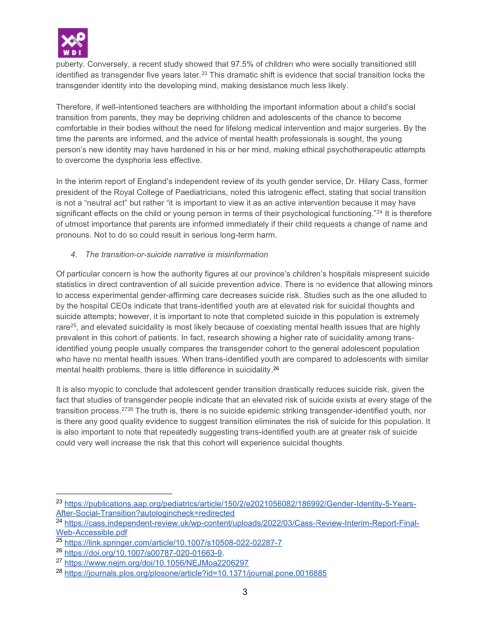
Letter to the PM and Premier Doug Ford on the danger of “gender affirming care”. Share widely. 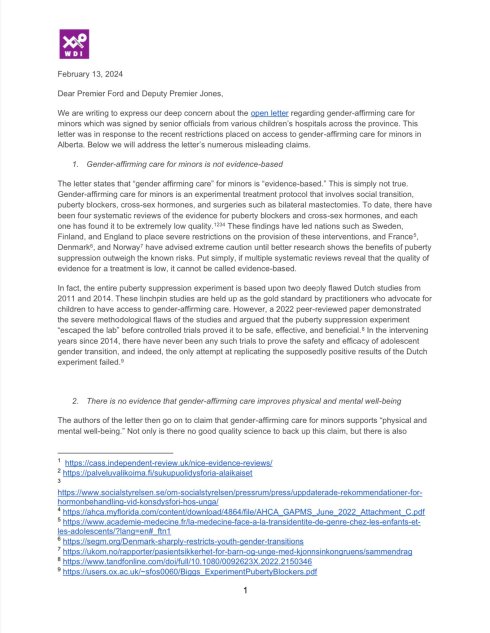


“Do you want a dead son or a live daughter?” A phrase used by countless gender clinicians to emotionally blackmail parents into allowing their troubled children to be placed on a conveyor belt to a lifetime of medicalized self-harm. It was always based on an odious lie.


“These findings underscore the fact that most youth presenting with GD have a high rate of co-occurring psychiatric diagnoses, which predate the onset of GD by months to years. The minority stress theory is an unlikely explanation, esp. for the diagnoses of autism, ADHD, etc.
“These latest findings further support the direction by the Finnish, English, and Swedish health authorities that psychotherapy (rather than medical gender transition) should be prioritized for most youth presenting with gender-related distress.”
Link to Study 1st Study – https://mentalhealth.bmj.com/content/27/1/e300940.full
Link to Second Study – https://pubmed.ncbi.nlm.nih.gov/33165650/











 bleatmop
 Mystro
 The Arbourist


 Dead Wild Roses
Your opinions…