
You are currently browsing the tag archive for the ‘Gender Ideology’ tag.

From the Canadian Government’s news realease –
“The legislation proposes four new Criminal Code offences that would prohibit:
- causing another person to undergo conversion therapy
- removing a minor from Canada to subject them to conversion therapy abroad
- profiting from providing conversion therapy
- advertising or promoting conversion therapy
The proposed legislation would also authorize courts to order the seizure of conversion therapy advertisements or to order their removal from computer systems or the Internet.
This bill expands on Bill C-6, adopted by the House of Commons in the previous Parliament. It does so by protecting all Canadians—regardless of their age—from the well-documented harms of conversion therapy practices.
Conversion therapy practices aim to change an individual’s sexual orientation to heterosexual, to change an individual’s gender identity to cisgender, or to change their gender expression to match the sex they were assigned at birth. They harm and further stigmatize sexual and gender-diverse persons and undermine their equality and dignity. They reflect myths and stereotypes about lesbian, gay, bisexual, transgender, queer and Two-Spirit (LGBTQ2) communities, particularly that their sexual orientation, gender identity or gender expression are wrong. These harmful practices also reinforce heteronormative and cis-normative ideas, as well as gender-conformity on LGBTQ2 individuals.
The practice can take various forms, including counselling and behavioural modification. Conversion therapy practices are discriminatory and have been proven to be harmful to the physical, mental and social well-being of the victim, even for adults who consented to it.
Criminal law reform is an important step in protecting the equality and dignity of LGBTQ2 persons, but more remains to be done. The Government of Canada is committed to working with provinces, territories, municipalities, survivors and stakeholders to ensure that Canada is a country where everyone—regardless of their gender expression, gender identity, or sexual orientation—can live equally and freely.”
The Federal Liberals are going full steam ahead with the gender ideology bullshit. It just passed the in the House of Commons unanimously – because our Conservative opposition has jello instead of a spine.
It looks like we’re trying to codify the ‘gendered soul’ into law in Canada. Of all the nebulous concepts that don’t need the state backing them up, it at the head of the list. This bill had better not be lumping the therapy that actually helps children be comfortable in their own body without surgery of hormones into an unlawful category. The notion that watchful waiting and other material reality confirming therapies are unlawful is just fucking crazy.
From The Canadian Gender report:
“Ken Zucker, Ph.D. C.Psych and Professor of Psychiatry at the University of Toronto presented a discussion of the differences in developmental trajectories for children with gender dysphoria at the 24th Congress of the World Association of Sexual Health, in October 2019, Mexico City. The following information is summarized and quoted from his presentation.
Dr Zucker based his analysis on a review of a number of follow up studies for persistence and desistance rates. He categorized therapeutic approaches designed to reduce gender dysphoria into 3 different types:
- Treatment 1: Assessment, “watchful waiting”
- Treatment 2: Assessment, active treatment of many kinds (recommendations to parents to implement in the naturalistic environment, behavior therapy, play therapy, psychodynamic psychotherapy, group therapy, etc., etc.)
- Treatment 3: Gender Social Transition
“The follow-up studies summarized so far, by and large, collected data on children who were assessed (and sometimes treated) prior to the emergence, around the mid-2000s, of pre-pubertal gender social transition as an alternative type of psychosocial treatment designed to reduce gender dysphoria: a treatment that parents may have instituted on their own, in consultation with a clinician, or on the advice of a clinician or some other type of professional (e.g., a teacher).”
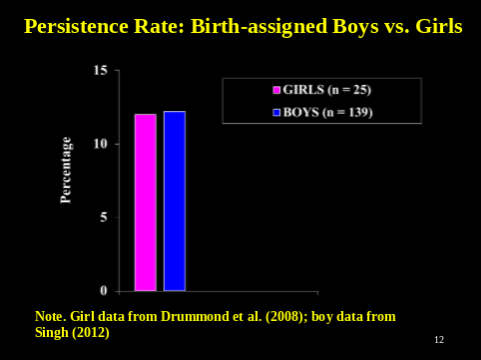
The very low persistence rates in the case of Treatments 1 and 2 show that gender identity becomes more congruent with birth-assigned sex in the majority of cases.
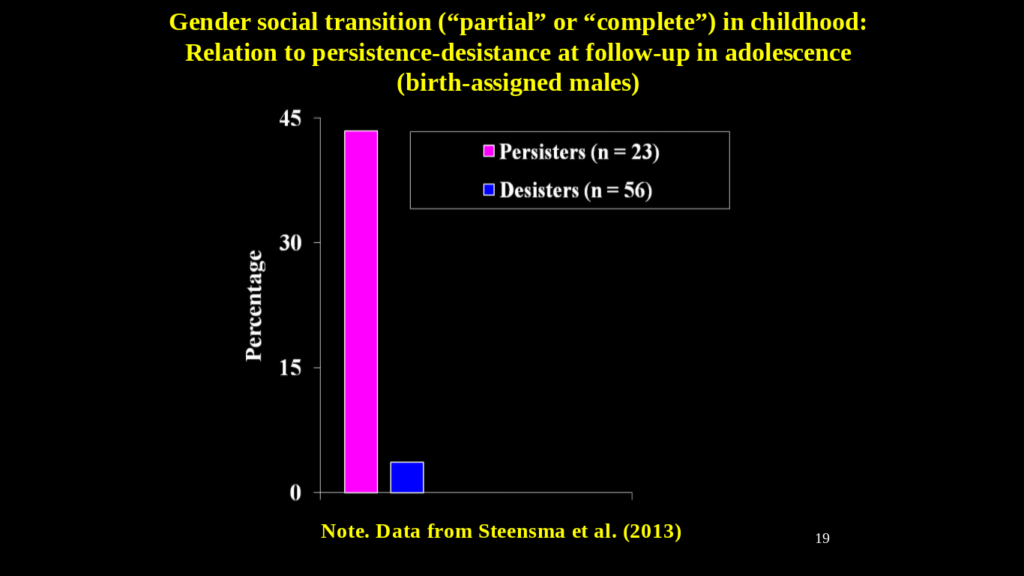
To compare the persistence and desistance rates of children who received a gender-affirming care approach characterized by social gender transitioning, Dr Zucker used data from Steensma et al. (2013) which reported a systematic follow-up study of children in which some children were classified as having had either a partial or a complete social transition prior to puberty.
The relationship between social gender transition and the follow-up persistence and desistance rates is striking. Among desisters, almost none of the natal boys had socially transitioned. Almost 45% of the persistors, however, had partially or completely socially transitioned, yet their gender dysphoria had not resolved.
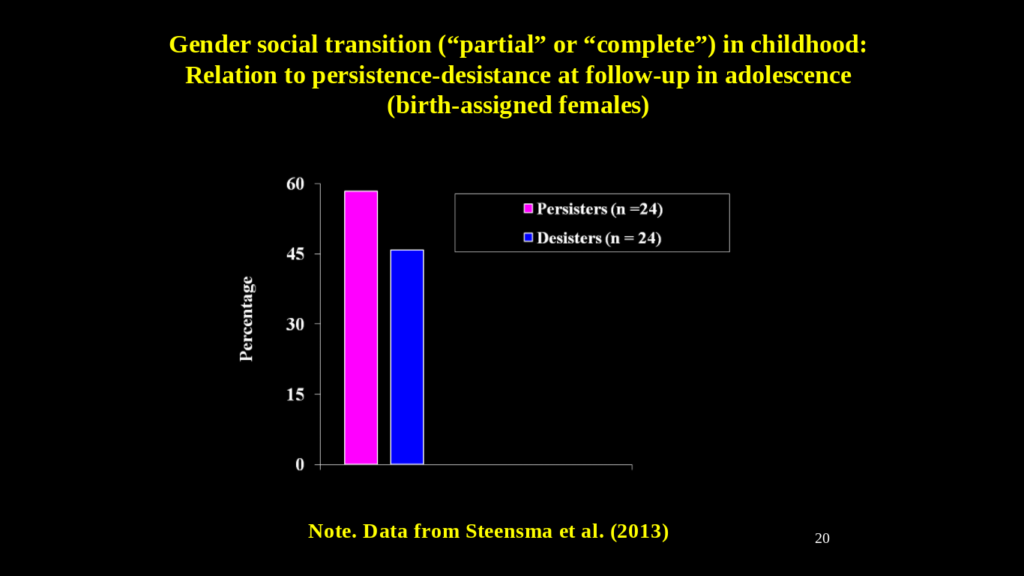
Social transition in relation to persistence and desistance was not as strong among the girls. Almost 60% of the persistors had socially transitioned. A significant number of desisters had socially transitioned as well, although Dr Zucker cautioned that the definition of social transition used by Steensma probably captured some girls where the social transition metric may have been very broad (e.g., change in hair-style or clothing style).
Dr Zucker predicts that as new samples of socially transitioned children become available, the rate of persistence will be much higher when compared to the older studies, where most of the children received either Treatment 1 or Treatment 2. Of the 3rd type of treatment, social gender transition, he commented that it offers a different approach that leads to desistance: the gender dysphoria dissipates because the child is now living in the “desired” gender; however, for desistance to remain stable, it will often, if not always, require biomedical treatment (life-long hormone therapy with or without gender-affirming surgery).
There are many possible pathways to desistance, which leads to the parental conundrum: which therapeutic approach does one take to reduce gender dysphoria? This is what the contemporary parent (and clinician) must decide.”
This is some authentically scary shit. Parents could be arrested for wanting effective means of treatment for their children. This isn’t good my fellow Canadians, and let us hope that the Senate can add some clarity to this proposed nightmare of a bill.
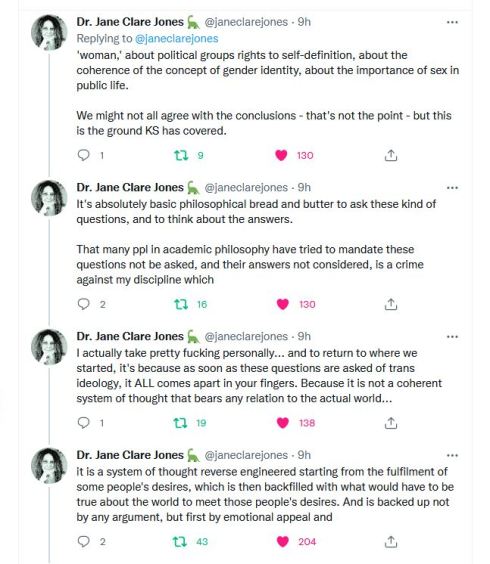
Pretty much this. Distilled down to what the mantra’s are all about. The control of women and the foregrounding of male desire.

Kathleen Lowrey is one the few and the brave women inside the University of Alberta that manage to retain an authentically feminist outlook. Furthermore, her criticisms of the new gender ideology are spot on and her insights are useful in understanding the ontology of transactivism in academic and real-world settings.
Sex, Ptolemaic Style
“The pervasiveness of this formula helps to explain the widespread enthusiasm for gender identity ideology in the academy. The relevant flippages are of at least three kinds. First is the reversal of the sex:gender relation as it is commonly understood. Ordinarily sex has primacy. It is the biological given upon which the cultural constructions of gender are elaborated. In gender identity ideology, the terms are reversed. Gender is essential, and sex is the unsteady social construct. Second is the relation of men to women. Conventionally, the social standing of men is understood to be privileged relative to that of women. This relationship is reversed in gender identity ideology. Trans identified men (“transwomen”) are figured as vulnerable relative to women and are even described as the most vulnerable of all women. Third, the quotidian apprehension is that children develop their gender identities as they grow up and engage with and adjust to cultural norms. Under gender identity ideology, it is asserted that children know from very young ages exactly their gender identities independent of cultural conditioning. As a corollary, adult men who express gender identities late in life that appear to be wholly fashioned out of sexist cultural norms about femininity have in fact been real women–the very realest of women–all along. The department colleague who was my most enthusiastic denouncer placed two signs on her office door after I put up gender critical feminist messaging on mine: “trans rights are human rights” and “transwomen are women.” She understood very well the messaging required of a “trans ally” and displayed it quite correctly.
Gender critical feminists like me notice, of course, that one infinitely more often sees and hears the slogan “transwomen are women” than its counterpart “transmen are men.” To understand why this is the case, you’d have to pay attention to patterns of power in the world rather than to Ptolemaic valence-flipping. One of the signs on my office door that most infuriated feminist academic women colleagues on social media described the parallels between men’s rights activism and trans rights activism. Many feminist academic women clearly saw it as their moral and intellectual duty to decry this assertion.”
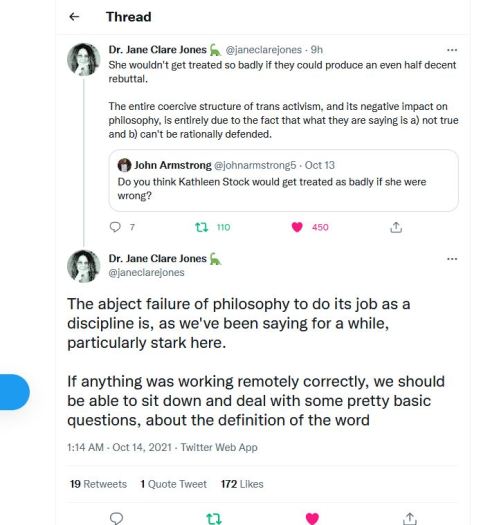


This rhetorical dodge frequently appears in arguments about the preservation of female only spaces in society. It is simply this, do you want this trans identified female in female only spaces? We are presented with a picture of a female that has masculine features and dressed stereotypically male.
Can you see the false equivocation? It goes like this, since we expect trans identified males to use the male washroom then also, we must expect trans identified females (like the dudette pictured above) to use the female washroom. The ‘gotcha’ continues, sometimes alluding to butch lesbians being questioned in female only spaces.
What this argument glosses over is that, back in reality, the class of females and the class of males in our society are socialized in very different ways and despite any gender pretenses have roughly the same capacities of the sex they were birthed into. So, women do not (in most cases) represent a threat to men in society this holds true regardless of how they ‘identify’. (The solution the gender religious do not want to hear is that every male space should be ‘gender inclusive’ while female spaces remain protected.)
The contrapositve is not true though. Men, regardless of how they identify, inhabit the class of people that do present a threat to women. Male and female standing and socialization in society is not equal, and trying to fudge this fact in an argument about female safety and spaces is patently dishonest. Therefore trans identified males – since they are male – are a threat to female safety and thus should not be in female only spaces.
If there is one feature that so many gender ideologues gloss over it is the current material conditions in society that we live in still work regardless of how one identifies. We still live in a society that has many patriarchal features that do not magically disappear if we start erasing females and their boundaries. On the contrary, corrupting female autonomy and boundaries increases the oppressive features of society for women.
There has been much controversy over lately at Science Based Medicine as they seem to have been institutionally captured by gender ideology and turning away from the foundations SBM was founded on. When gender woo-magic takes precedent of science based facts the lambasting by those who keep their scientific integrity intact is inevitable, hence this letter by Emeritus Editor Kimball Atwood to Steve Novella about his decent into gender-woo.
Thank you for Jessie Singal for posting the letter.
Harriet has told me that you stated that her article “dragged SBM into a raging controversy.” She feels, and I agree, that it was your retracting that article and replacing it by very bad articles written by advocates of “gender affirmation” that dragged SBM into a raging controversy. I’ve attempted to explain why previously, but here I’ll mention a couple of the most obvious reasons.
You claimed that Harriet’s article was below SBM’s minimal standard for “high quality scientific evidence and reasoning to inform medical issues.” Yet you replaced it with articles stating things such as the following:
- “Biology is a binary and differences of sex development (DSDs) are vanishingly rare”. False. DSDs are as common as 1 in 5,000 births, and increase to 1 in 200 or 1 in 300 if you include hypospadias and cryptorchidism. Biology is very, very well known to be a spectrum.
[Lovell attributes the sentence in quotes to Shrier; I’ve been unable to find it in her book]
Do you, Steve, think that sex is a spectrum? Yes, I know Lovell wrote “biology is a spectrum,” but that is an incoherent claim. Her implication is that sex is a spectrum. If that were true, it would upend all that we know about sex in mammals and many other life forms, including sexual dimorphism, reproduction, and selection. Do you think that Lovell’s statement constitutes “high quality scientific evidence and reasoning”? OMG, apparently you do. What’s happened to you?
Do you think that hypospadias and cryptorchism are DSDs? They are not, and to suggest that they are does not meet SBM’s minimal standard for reasoning about medical issues.
The citation is to a paper that discusses real DSDs, not cryptorchism or hypospadias, and makes no claims about a “spectrum.” It supports the very statement that Lovell claims to be false (even though Shrier seems never to have made that statement). Where was the editor here?
According to Eckert,
- Throughout her book, Shrier refers to her subjects as “biological girls,” a term that conflates sex with gender and mischaracterizes Shrier’s subjects. The reason is that a person’s sex refers to the identity assigned by doctors, parents, and medical professionals at birth, most often based on external anatomy (genitals).
Do you, Steve, think that Shrier’s subjects were not biological girls? Do you think that this characterization conflates sex with gender? Do you think that sex is an “identity assigned by doctors,” rather than a fact noted by everyone in the delivery room in almost every case? Do you think that “human” is also an identity assigned by doctors? How does such an absurd passage meet SBM’s minimal standard for scientific evidence and reasoning? Do you really think that “this is good scientific practice—not political correctness”? How can you be so naive?
Finally, I’ll remind you of a previous objection that you haven’t answered, which refutes the crux of Lovell’s claim about “gender affirmation” for biological girls “lead(ing) to improved psychological outcomes”:
“Lastly, as clearly noted in the American Academy of Pediatrics statement, complete with many citations of their own, we use affirmation, pubertal suppression, and hormone therapy in youth because it leads to improved psychological outcomes. The literature is abundant and clear on this topic.”
The “abundant” link is not to several studies or a review of several studies, as the adjective implies, but to a single study that is irrelevant to Shrier’s thesis because it looks at a group of pre-pubescent, transgender children (age 3-12) undergoing only social transition, not at adolescent girls. It’s also not a good study because it controls its cohort with a cohort of non-transgender children, rather than with the appropriate control group (transgender children not undergoing social transition).
The “clear” link is to a paper that does not reveal whether its subjects were gender dysphoric (GD) in childhood or not, but whose abstract states:
“Implications for impact: This study suggests that gender-affirming hormones are a helpful medical intervention for transgender youth. Gender-affirming hormones were found to be associated with decreases in suicidality and improvements in general well-being.”
That is all most SBM readers will read, if they even bother to click on the link. But in the discussion (behind a paywall; I got it on ResearchGate) we see this:
“Hypothesis 3 (i.e., those assigned female at birth will experience greater improvements in general well-being and larger decreases in suicidality) was not supported.” (My italics; parenthetical phrase in the original)
Need I mention (again) that this is the only outcome of the study that is relevant to Shrier’s book? Where was the editor here?
Speaking of editors, it appears that there have been none at SBM other than the original five. Of those, two ruled to retract Harriet’s review, two (Harriet and I) would have kept it, and one is dead. I knew Wally well enough to feel confident that he would have voted to keep the review, and that he would have been shocked, probably to the point of resigning, when you published the embarrassments by Lovell and Eckert and when you banned Andy Lewis from commenting.
No, it was not Harriet who dragged SBM into a raging controversy. It was you and David, because of some very poor choices, made worse by your doubling down after every reasonable objection by Jesse Singal, Andy Lewis, Michael Shermer, Jerry Coyne, Abigail Shrier, me, and several others.
Sincerely Yours,
Kimball











 bleatmop
 Mystro


 Dead Wild Roses
Your opinions…