
You are currently browsing the tag archive for the ‘Oppressor-Oppressed Dialectic’ tag.
When the Berlin Wall fell in 1989 and the Soviet Union dissolved two years later, the West succumbed to an understandable triumphalism. Soviet communism had collapsed beneath the weight of economic stagnation, political coercion and reforms that the system could neither contain nor survive. The centrally planned utopia had not merely underperformed; Soviet-style regimes had produced scarcity, repression and ruin across much of the world.
For a time, the revolutionary lie appeared to have been buried with it. Francis Fukuyama’s famous phrase, “the end of history,” was flattened into a civilizational victory lap: liberal democracy had won, communism had lost, and the ideological contest was over. What we mistook for intellectual extinction, however, was merely the collapse of one political form. The deeper moral machinery—the division of humanity into oppressors and oppressed, with guilt and legitimacy assigned accordingly—remained very much alive.
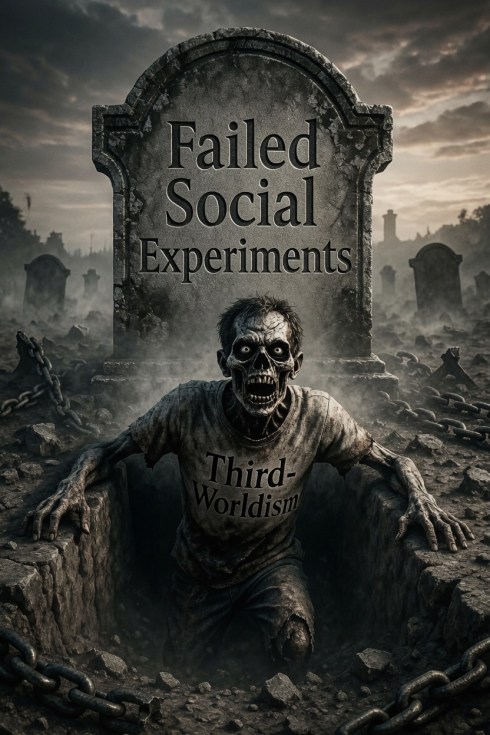
We celebrated the corpse before checking whether it was still moving.
This essay takes its starting point from Zineb Riboua’s “Naming the Threat: Third-Worldism.” Drawing upon the French historian François Furet’s The Passing of an Illusion, Riboua describes revolutionary politics as a mentalité: not merely a set of claims, but a way of inhabiting political reality that can survive even when those claims are repeatedly disproved. That insight helps explain why an ideology apparently buried in 1991 continues to return in new forms.
To understand what survived, however, we must distinguish the historical Third World from the ideology that appropriated its name.
The French demographer Alfred Sauvy coined the term Third World in his 1952 essay “Three Worlds, One Planet,” invoking the Third Estate of the French Revolution: ignored, exploited and scorned, yet demanding recognition. During the Cold War, the term came to describe countries belonging to neither the Western nor Soviet bloc. It was never a coherent civilization or political programme. The category contained democracies and dictatorships, capitalist and socialist economies, emerging powers and desperately poor states whose interests frequently conflicted.
Third-Worldism is something different. It transforms that complicated collection of countries into a symbolic moral category and interprets global politics through a recurring hierarchy: the Global North dominates, the Global South is dominated, Western power carries presumptive guilt, and resistance to that power acquires presumptive legitimacy.
Criticism of colonialism, Western intervention or unequal power is not inherently Third-Worldist. The label should not apply when critics revise their conclusions as outcomes change, acknowledge the agency and culpability of non-Western actors, distinguish unequal power from automatic guilt and apply the same moral standards to allies and enemies. It becomes ideological when the verdict is assigned in advance and no conduct or evidence can alter it.
The record of revolutionary socialism should nevertheless impose an extraordinary burden of proof. Stalin’s Soviet Union, Maoist China and Pol Pot’s Cambodia produced different forms and degrees of catastrophe; the Khmer Rouge alone killed nearly two million people while pursuing a classless agrarian utopia, according to the United States Holocaust Memorial Museum. None of this proves that contemporary arguments about extraction, debt or colonial inheritance are false. It demonstrates the danger of concentrating power in the name of an imagined future and explains why revolutionary promises must be judged against outcomes rather than intentions.
Yet the underlying idea survives because a mentalité determines what outcomes mean before they have been examined. If a revolutionary regime succeeds, success vindicates resistance. If it fails, sanctions, colonialism or interference explain the failure. If citizens flee or dissidents describe repression, the framework can absorb their testimony as the product of outside pressure, Western influence or false consciousness. Those external forces can cause real damage; the ideological move is to treat them as automatic and sufficient while refusing to examine domestic tyranny, corruption or ruinous policy. Once the verdict precedes the evidence, reality can only become further proof.
This is not an opponent assembled from scraps. Consider the recent writing of Marxist historian Vijay Prashad, executive director of the Tricontinental Institute for Social Research. A June 2026 newsletter identifies the central contradiction of our era as a declining imperialist system confronting peoples seeking sovereignty and justice. Its May newsletter, “Socialism Is Slow to Mature,” offers six reasons revolutionary states have struggled. Colonial impoverishment, sanctions and war are real entries in that account, but the conclusion is revealing: under those conditions, “inefficiencies emerge not from ideology or planning errors but from the permanent emergency conditions imposed by hostile powers.” Even elections become suspect because their short cycles can interrupt—or, in the newsletter’s language, sabotage—projects that require decades to mature.
The problem is not that Prashad considers sanctions, inherited poverty or foreign intervention. A truthful history must. It is that ideological and planning errors are explicitly removed from his explanation of inefficiency under hostile conditions, while democratic rejection is recast as an obstacle to transformation. Failure calls for more historical patience; opposition demonstrates the power of the hostile order; interruption prevents the promised future from arriving. The theory survives by placing its vindication beyond the reach of ordinary political time.
Credit where credit is due: revolutionary socialism has proved remarkably adaptable. When class revolution failed to sweep advanced capitalist societies, the conflict narrative widened. The proletariat and bourgeoisie were joined by colonized and colonizer; conflict over the ownership of production expanded into conflict over culture, language and knowledge. This was not merely new paint, nor were the problems imaginary. Colonial empires committed real crimes, and Western scholarship sometimes rationalized them. The continuity lies neither in conspiracy nor an unbroken intellectual lineage, but in a moral structure that remained useful after its economic doctrine became politically toxic.
The supporting intellectual infrastructure had been developing long before the Soviet collapse. Edward Said’s 1978 Orientalism argued that Western scholarship about the East was implicated in imperial domination—an important corrective to the conceit that experts are immune to prejudice or self-interest. The difficulty arose when that insight hardened within influential postcolonial currents into a presumption that Western knowledge was compromised by its origin and Western power suspect by definition. Soviet economics could be discarded while the deeper division between oppressor and oppressed remained.
What makes this structure so durable is its resistance to correction. Liberal institutions are not inherently self-correcting, nor do markets guarantee wise or just outcomes. Both can be captured, distorted or defended with excuses as circular as anything on the revolutionary left. Western governments have invoked civilization, development and the rules-based order to excuse allied dictatorships, failed interventions and policies that violated their professed principles. Third-Worldism has no monopoly on moral narratives that protect themselves from evidence.
The liberal advantage is narrower but still important: when elections remain competitive, speech remains free, evidence remains contestable and power remains divided, correction can occur without revolutionary rupture. Market prices communicate information, elections can remove governments, and competing institutions can expose mistakes. When those mechanisms are blocked, liberalism is failing according to its own standards.
The revolutionary mentalité treats corrective signals as evidence of corruption. Economic failure becomes sabotage, electoral defeat false consciousness, critical scholarship an instrument of Western power and internal dissent betrayal. Third-Worldism reproduces this defect globally: instead of asking which institutions produce freedom, prosperity and human flourishing, it first asks which actor possesses power. The categories decide the moral meaning of the evidence before the evidence can challenge the categories.
Third-Worldism never disappears completely because the impulses it organizes are older than any particular political system. Resentment, moral certainty and the dream of cleansing society through revolutionary rupture do not die when a regime collapses; they wait for a new vocabulary and a new division of humanity to inhabit.
This makes Third-Worldism especially corrosive to the Western synthesis of classical liberal institutions and Judeo-Christian moral inheritance. That tradition is imperfectly honoured, but it places moral agency in the individual, aspires to equality before the law, permits criticism and allows for repentance, reform and renewal. Third-Worldism substitutes collective guilt, inherited innocence and permanent historical indictment. It does not ask Western societies to correct their failures according to their professed principles. It teaches them that those principles are merely disguises for domination.
That Western inheritance is not innocent. Liberal societies tolerated slavery, constructed empires, denied women equal citizenship and repeatedly betrayed their universal claims. Postcolonial scholarship corrected narratives that had been self-serving or false, and a society incapable of hearing that criticism would deserve intellectual contempt. The distinction is whether criticism can lead to correction. Liberal principles supplied much of the moral language used against slavery, segregation and unequal citizenship. Where liberal self-criticism asks a society to live up to those principles, Third-Worldism treats the founding order as permanently contaminated and recasts the principles themselves as instruments of domination.
The zombie ideology survives because it offers each generation the same intoxicating promise in contemporary language: history has already identified the guilty, moral virtue belongs to those who oppose them, and destruction can be mistaken for justice so long as it is called liberation.
Works Cited
- Fukuyama, Francis. “The End of History?” The National Interest, no. 16, Summer 1989, pp. 3–18.
- Furet, François. The Passing of an Illusion: The Idea of Communism in the Twentieth Century. Translated by Deborah Furet, University of Chicago Press, 2000.
- Prashad, Vijay. “Socialism Is Slow to Mature: The Twenty-First Newsletter (2026).” Tricontinental: Institute for Social Research, 21 May 2026.
- Prashad, Vijay. “The World Needs a Living Left: The Twenty-Fourth Newsletter (2026).” Tricontinental: Institute for Social Research, 11 June 2026.
- Riboua, Zineb. “Naming the Threat: Third-Worldism.” Beyond the Ideological, 20 July 2026.
- Said, Edward W. Orientalism. Routledge & Kegan Paul, 1978.
- Sauvy, Alfred. “Trois mondes, une planète.” L’Observateur, 14 August 1952; reprinted in Vingtième Siècle. Revue d’histoire, no. 12, 1986, pp. 81–83.
- Tricontinental: Institute for Social Research. “The Team.” Accessed 25 July 2026.
- United States Holocaust Memorial Museum. “Cambodia 1975–1979.” Accessed 25 July 2026.











 bleatmop
 Mystro
 The Arbourist


 Dead Wild Roses
Your opinions…