
You are currently browsing the tag archive for the ‘PeopleWatching’ tag.
The smartphone is a remarkable invention. It provides maps, music, news, books, banking, photography and instant communication with nearly everyone we have ever met—including several people we had successfully avoided since high school.
Unfortunately, it has also annexed every unoccupied second of human life. Stand at a bus stop, enter an elevator or wait thirty seconds for a coffee and everyone begins studying their palms like Victorian mediums receiving messages from the dead.
Should you ever find yourself in public without an urgent notification to inspect, here are ten alternative activities.
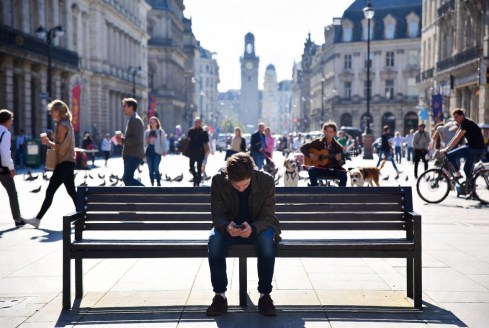
10. Look Where You Are Walking
This ancient practice predates Google Maps and requires no subscription.
Looking forward allows you to detect lampposts, curbs, open manholes and other pedestrians. More advanced practitioners may eventually learn to walk in a straight line without drifting unpredictably across the sidewalk like a Roomba trapped in a kitchen.
9. Read Something Made of Paper
A book, newspaper or magazine will do. Paper does not vibrate, demand an update or interrupt a paragraph to tell you that someone you barely remember has reacted to a photograph of someone else’s lunch.
As an added benefit, strangers may assume you possess an attention span.
8. Observe Your Surroundings
Public spaces contain architecture, trees, weather, animals and people wearing baffling combinations of clothing. All are available without creating an account.
You may discover that a building you pass every day has gargoyles, that pigeons conduct elaborate territorial disputes or that Edmonton possesses roughly six pleasant outdoor weeks per year.
7. Talk to the Person You Came With
This option is particularly suitable for restaurants, where couples can often be seen sitting opposite one another while communicating with entirely different people.
Possible subjects include the food, the day, future plans or the increasingly radical question, “How are you?”
If conversation fails, you may both return to your phones with the comforting knowledge that an attempt was made.
6. People-Watch
People-watching is not staring. The distinction is important and may eventually become legally relevant.
Simply observe the small theatre of public life: the parent negotiating with a toddler, the dog dragging its owner toward forbidden shrubbery, the teenager attempting to look indifferent while being intensely aware of everyone nearby.
Human beings are interesting when not reduced to profile pictures.
5. Perform a Tiny Act of Public Usefulness
Hold a door. Return an abandoned shopping cart. Give directions. Let someone merge. Pick up the glove that a child dropped while its parent was managing three bags and the gradual collapse of civilization.
No video is required. The act still counts if nobody posts it.
4. Make Brief Eye Contact
This manoeuvre should be performed carefully. The objective is not to peer into another person’s soul but to acknowledge that one human being has encountered another.
A nod or small smile is sufficient. Canadians may add “Morning,” “How’s it going?” or the nationally sanctioned observation, “Bit cold out.”
3. Allow Yourself to Be Bored
Boredom was once an ordinary interval between activities. Now it is treated as a medical emergency requiring immediate digital intervention.
Try waiting without consuming anything. Your mind may wander, remember something important or produce an original thought. It may also replay an embarrassing conversation from 1997. Results vary.
2. Help Someone Who Looks Lost
Airports, hospitals and transit stations regularly contain people studying signs with the expression of medieval cartographers confronting an unknown continent.
If you know the way, offer assistance. If you do not know the way, resist the temptation to gesture confidently toward a random corridor. This is the difference between helping and founding a religion.
1. Be Where You Are
Your body has already arrived. See whether your attention might join it.
Listen to the room. Notice the light. Watch the city move. Let a moment pass without photographing, rating, posting or forwarding it.
The world will continue producing notifications while you are away. It is very committed to the work.











 bleatmop
 Mystro


 Dead Wild Roses
Your opinions…