
You are currently browsing the tag archive for the ‘Woke Ideology’ tag.
Have you ever held your tongue during an otherwise friendly conversation because you could see exactly what would happen if you spoke your mind? Not because you lacked an answer, but because answering would transform the conversation into a trial of your character.
Scope note: Critical Theory is a diverse and disputed intellectual tradition. This essay offers a broad introduction to a recurring mechanism in contemporary woke politics; it does not claim that every critical theorist thinks alike or that every systemic criticism is false.
Why can saying that sex is a biological reality make you a transphobe? How can defending merit-based standards make you a racist? Why can asking that factual claims be judged by shared evidence turn you into a Western imperialist? Why can asking how 215 radar anomalies came to be reported as the remains of 215 children make you a colonialist or denialist? How can requesting concrete examples of systemic racism become proof that you are too privileged—or possess too much “false consciousness”—to recognize it?
Any of those questions may be reasonable, mistaken, or badly phrased. The tell is not whether the questioner is right. It is whether the question gets answered—or the questioner gets morally diagnosed.
“The argument ends before it begins. Instead of the claim being examined, you are.”
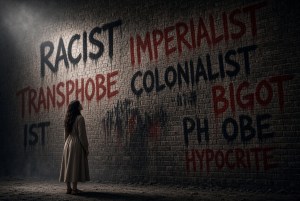
The argument ends before it begins. Instead of the claim being examined, you are.
You walk away wondering whether you really are the latest variety of “-phobe,” “-ist,” or some other socially shameful thing. Perhaps you were insensitive. Perhaps you missed something. Or perhaps you encountered a system of thought in which disagreement is not processed as information but reclassified as further evidence of your moral or ideological conditioning.
Well, dear reader, you have probably met Critical Theory without being formally introduced.
The Theory Beneath the Argument
Critical Theory emerged from the Western Marxist tradition associated with the Frankfurt School. Its foundational statement is usually traced to Max Horkheimer’s 1937 essay, Traditional and Critical Theory. We do not need the complete family tree here. The important distinction is between a theory that tries to describe and explain society and one that also intends to transform it.
The contemporary pattern did not travel unchanged from Horkheimer. It combined with later theories of power, identity, standpoint, and language before being simplified into activist practice. We are tracing that recurring logic, not claiming that every modern slogan came directly from Frankfurt in 1937.
Nor is self-sealing reasoning exclusive to the woke Left. Religious, nationalist, conspiratorial, and right-wing movements can do it as well. This essay examines the contemporary critical form because that is the form at issue here.
Critical Theory begins with a reasonable observation: societies do more than make laws. Families, schools, religions, media, professional bodies, and governments also transmit the values and categories through which people understand the world. The stronger claim is that these institutions reproduce existing power. What society calls normal, objective, reasonable, or meritorious may be the ruling order explaining itself in flattering language.
This is hegemony in plain English: power becomes secure when its assumptions feel like common sense. Social construction describes how language, customs, and institutions shape social categories. Critical consciousness is the claimed ability to recognize the power beneath those apparently natural arrangements.
These ideas are not useless. Institutions can possess blind spots. Rules written without discriminatory intent can produce unfair effects. Testimony from outsiders can expose facts that insiders overlook. A society genuinely interested in justice must be able to examine patterns extending beyond one malicious person or one explicit rule.
The trouble begins when power becomes the master explanation, and when the framework stops asking whether a particular institution is unjust and begins presuming that its apparent neutrality is how the injustice hides.
The Critical Theory Two-Step (Actually, Three Steps)
Imagine that an employer uses an examination to select applicants, and one demographic group passes at a lower rate. A serious inquiry asks whether the examination measures skills required for the job, whether applicants had equal preparation, whether discrimination affected the process, or whether another explanation better fits the evidence. The examination might be sound, biased, partly useful, or indefensible. We investigate because we do not yet know.
A critical analysis asks another legitimate question: who defined merit, and might the examination reward the experiences and expectations of the dominant group? That question can reveal something important. It becomes ideological when its answer is assumed in advance and protected from ordinary correction.
This is where the Critical Theory Two-Step begins.
Step one: disqualify the referee.
The standards normally used to settle the disagreement—objectivity, evidence, neutrality, consistent definitions, individual responsibility, and equal treatment—are redescribed as products of the dominant system. They cannot be trusted to judge that system because they help reproduce it.
Step two: put the questioner on trial.
Once common standards have been disqualified, attention shifts from the claim to the person questioning it. Why are you demanding evidence? Whose interests does your objection serve? What privilege shapes your perspective? What fragility, unconscious bias, or false consciousness prevents you from recognizing the deeper truth?
You cannot appeal to neutral standards because those standards are said to be compromised. You cannot challenge that conclusion because your challenge demonstrates how thoroughly the system has compromised you.
This is not merely an internet caricature. In a 2017 paper on feminist and critical-race philosophy classes, Alison Bailey cautions that resistance can be difficult to interpret, but calls one category “privilege-preserving epistemic pushback.” She describes it as “willful ignorance,” rather than scepticism or critical thinking, and recommends treating it as a “shadow text” alongside the assigned reading. The problem remains: the instructor using the framework decides which objection is genuine and which merely exposes the student’s privilege. Step two carries us directly into step three.
That is the deer-in-the-headlights moment. You entered expecting a discussion about whether something was true and discovered that the real proceeding concerned whether you were morally qualified to ask.
This pattern explains why neutrality becomes complicity, silence becomes violence, disagreement becomes harm, and equal treatment becomes a means of preserving inequality. These are not random contradictions. Once the system is presumed guilty, refusing the critical interpretation helps the guilty system continue.
Who Gets the Whistle?
Disqualifying neutral standards does not eliminate authority. It relocates authority.
The person with critical consciousness claims to see what ordinary consciousness cannot. Lived experience may supply the evidence, while academics and activists supply the framework explaining what that experience means. When members of the same group disagree, the dissenter can be diagnosed as having internalized the dominant ideology. The new hierarchy favours the critically conscious expert over the compromised expert, and approved lived experience over dissident lived experience.
Liberal inquiry accepts that the referee may be biased and allows everyone to challenge the calls. Ideological Critical Theory declares the rules corrupt, dismisses the referee, and then quietly hands the whistle to those who possess the correct consciousness.
The pattern now has three steps: disqualify the supposedly neutral standards, scrutinize the person who appeals to them, and transfer authority to those with critical consciousness. The referee has not disappeared. A new one has taken the whistle—and its calls are no longer open to challenge on equal terms.
The Negative Utopia
Where is this process supposed to lead?
Critical Theory can name its shiny future in moral terms: liberation, justice, equality, and freedom from domination. It is much less clear about the institutions that will produce those things. Horkheimer stated the difficulty himself. Its basic commitment was the “abolition of social injustice,” but he acknowledged that the transformed society could not be concretely known until it existed. If the concepts of the present society are part of the problem, they cannot be trusted to describe the solution.
The result is a future described by subtraction: what we have now, only without racism, sexism, hierarchy, exclusion, exploitation, oppressive norms, and unequal outcomes. Ask who will exercise authority, how competing rights will be reconciled, or what limits will bind the new institutions, and the answer often restates the wish: power will be shared, institutions equitable, and outcomes just.
This is the negative utopia. The criticism can be ruthless while the construction remains hazy. If the existing order reproduces domination, tearing it down can count as progress even when the replacement remains a hope that something better will emerge.
If reformers can name the replacement institutions, admit their trade-offs, limit their authority, and explain how their failures will be corrected, then they have answered this criticism. Their proposal must then be judged on its merits.
The existing liberal society is then compared not with another functioning society but with an imagined condition free of its imperfections. Every distance between liberal principles and liberal practice becomes another crack in the structure. Critical Theory pours itself into those cracks and freezes there, widening genuine failures into evidence that the whole arrangement is illegitimate. The new damage exposes further cracks, which invite another application of the theory.
Imagining a better society is not the problem. Liberal reform requires moral imagination. The danger begins when the imagined society is judged entirely by its intentions while the existing society is judged by every one of its failures.
This places the self-correcting mechanism in the wrong location. When the theory collides with reality, its premises rarely enter the dock. Failure is attributed to entrenched power, social conditioning, backlash, co-option, insufficient commitment, or incomplete transformation. Harmful reforms show that reform did not go far enough, resistance demonstrates false consciousness, and contrary evidence reveals who controls what counts as evidence.
The theory does not lose. Society merely proves how much more theory it requires.
That helps explain why dismantling an institution can count as progress without a workable replacement. If stability means stabilized injustice, disruption acquires moral value of its own. Revolution becomes a permanent process of identifying, delegitimizing, and breaking whatever reproduces the old society.
The Liberal Answer
Classical liberalism does not pretend that knowledge falls from the heavens untouched by human interests. Knowledge is produced by limited people inside fallible institutions. Power can distort research, experts can protect one another, and a comfortable consensus can be wrong.
The liberal answer is not an impossible view from nowhere. It is a society in which views from everywhere may collide.
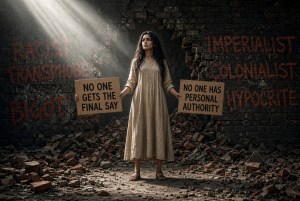
Liberal inquiry does not abolish authority; it makes authority contestable.
Jonathan Rauch condenses this system of “liberal science” into two rules: no one gets the final say, and no one has personal authority.
No one gets the final say because every public claim remains open to criticism and correction. Society needs provisional conclusions, but longevity, popularity, credentials, and institutional endorsement do not make them permanently incontestable.
No one has personal authority because identity, experience, and social position cannot settle a public claim. Experience may provide evidence others lack, and demonstrated expertise deserves serious weight. Neither lived experience nor professional status grants immunity from examination.
Free speech is therefore more than permission to say unpleasant things. It is part of liberal democracy’s error-correcting machinery. John Stuart Mill understood that a suppressed opinion might be true, partly true, or usefully wrong. Even a correct belief becomes little more than inherited prejudice when nobody is permitted to test it.
The liberal system does not guarantee that truth will win every argument. It prevents any faction from acquiring permanent authority to decide which arguments may occur.
This is the answer to the claim that knowledge is socially constructed and hegemonically reproduced. Yes, knowledge is socially produced. That does not mean it is socially determined. Reality constrains what can survive honest investigation, while open disagreement allows people with different interests and blind spots to expose one another’s errors.
We can socially decide that a red light means stop. We cannot socially decide that an unsafe bridge will remain standing. Culture creates some meanings; it does not create every fact those meanings describe.
Liberal institutions can certainly betray these principles. Universities can punish dissent, governments can conceal information, journalists can become conformist, and professional organizations can convert consensus into dogma. When that happens, the critical diagnosis earns some of its force.
The liberal remedy is more contestability: open the records, protect the dissenter, disclose the conflict, replicate the finding, permit the rival explanation, and let the argument continue. Liberal democracy can repair its cracks without declaring the entire structure fraudulent.
What to Notice Next Time
The next time a disputed claim turns into an examination of your moral character, watch for the two-step. Were the shared standards of evidence first declared compromised? Did scrutiny then move from the assertion to the identity, motives, or consciousness of the person asking about it? Who acquired the authority to interpret the dispute after the ordinary referee was dismissed?
Then ask the questions that every theory and every proposed remedy should have to survive. What evidence would prove the claim wrong? What competing explanation has been considered? What will replace the institution being dismantled? Who will exercise power afterward? How will that power be challenged and removed?
Critical Theory can identify real cracks in a liberal society. Its ideological power begins when those cracks can confirm the theory while almost nothing can disprove it.
Not every appeal to power, identity, or systemic effects completes this pattern. If an argument supplies evidence, answers objections without diagnosing the objector, specifies its remedy, and identifies what would count against it, then it remains contestable. It may be right or wrong, but it is not the closed system described here.
You are not obligated to accept that arrangement. The question itself is not evidence of guilt.

Liberal inquiry promises no final destination—only an open road on which every claim may be questioned.
Would You Like to Know More?
- The Woke Machine
How grievance becomes identity, identity becomes a special authority to know, and disagreement becomes further evidence of guilt. - The Woke Machine in the Wild
What happens when the machine escapes the seminar room: friend–enemy sorting, exception ethics, institutional conflict, and versions of the pattern on both Left and Right. - Woke for the Rest of Us
A pocket field guide for recognizing the script in real time, complete with diagnostic tests and conversational escape hatches. - When Disagreement Becomes Guilt
How a theory stops processing objections as information and begins treating them as evidence of the dissenter’s moral corruption. - The DSA’s Utopia Begins by Breaking the Society We Have
Why a movement without a credible institutional destination can still possess a revolutionary direction: dismantle the existing order first and discover what follows later. - “Hate” as a Governance Tool
How moral language can perform administrative work by reclassifying disputed arguments as harms that institutions may suppress rather than answer. - Beyond the Oppressor/Oppressed Lens
A deeper examination of the binary framework that sorts people by group power and struggles to accommodate agency, context, mixed motives, or individual responsibility. - Reading: Cynical Theories
An introduction to the postmodern knowledge principle: how suspicion of objectivity, language, and universal categories merged with an analysis centred upon power.
References
- Horkheimer, Max. Traditional and Critical Theory (1937), in Critical Theory: Selected Essays. Columbia Law School-hosted PDF: https://blogs.law.columbia.edu/critique1313/files/2019/09/Horkheimer-Traditional-and-Critical-Theory-2.pdf
- Institut für Sozialforschung. “The History of the IfS.” https://www.ifs.uni-frankfurt.de/history.html
- Stanford Encyclopedia of Philosophy. “Critical Theory (Frankfurt School).” https://plato.stanford.edu/entries/critical-theory/
- Mill, John Stuart. On Liberty (1859). https://eet.pixel-online.org/files/etranslation/original/Mill%2C%20On%20Liberty.pdf
- Rauch, Jonathan. Kindly Inquisitors: The New Attacks on Free Thought. University of Chicago Press, expanded edition, 2013.
- Rauch, Jonathan. “The Constitution of Knowledge.” National Affairs, 2021. https://nationalaffairs.com/publications/detail/the-constitution-of-knowledge
- Bailey, Alison. “Tracking Privilege-Preserving Epistemic Pushback in Feminist and Critical Race Philosophy Classes.” Hypatia 32, no. 4 (2017): 876–892. https://ir.library.illinoisstate.edu/fpphil/4/
- Crown-Indigenous Relations and Northern Affairs Canada. “Unmarked Burial Sites / Residential Schools Missing Children Community Support Fund,” June 5, 2026. https://www.rcaanc-cirnac.gc.ca/eng/1772556985244/1772557018851











 bleatmop
 Mystro


 Dead Wild Roses
Your opinions…