
“The failed attempt to criminalize “denialism” should not end the argument. It should begin a more honest one.”
Canada has just been given a useful lesson in how not to defend historical truth.
A Senate committee recently amended Bill C-9, the federal government’s anti-hate bill, to include a new offence for “residential school denialism.” The amendment passed committee by a vote of 7–1, then failed in the full Senate by a vote of 41–32. The broader anti-hate bill continued, but this particular amendment was defeated.
That defeat matters, but not because the residential school system was harmless, invented, or benign. It was not. More than 150,000 First Nations, Inuit, and Métis children attended residential schools, often far from their families and communities. The National Centre for Truth and Reconciliation describes the system as explicitly designed to separate Indigenous children from their families and cultures.
The historical record is ugly: forced removal, family rupture, cultural suppression, underfunded institutions, abuse, neglect, disease, and deaths are not fringe claims. No serious account of Canadian history should pretend otherwise.
But seriousness cuts both ways. The record is not made more honest by flattening it into a morality play. Some former students did gain literacy, language skills, vocational training, religious formation, discipline, shelter, or relationships with individual staff who treated them decently. Some may have experienced school as an escape from poverty, instability, disease, or family circumstances that were already difficult. Those facts do not redeem the system. They do not cancel forced removal, cultural suppression, abuse, neglect, or death. But they do belong in the record, because truth does not improve when inconvenient evidence is treated as betrayal.
That is why criminalizing “denialism” is such a dangerous move.
What exactly would the law punish? Denying that residential schools existed? Denying that abuse occurred? Denying that children died? Questioning a specific claim about a specific site? Asking whether a radar anomaly is a confirmed grave? Objecting to the phrase “mass grave” where no excavation has confirmed one? Disputing the legal or moral use of the word genocide? Challenging a death count?
These are not all the same act, morally or historically. A liberal society should be extremely careful before treating them as if they belong in the same criminal category.
This is where the Streisand effect begins. Tell citizens that a subject is so sacred it may need criminal protection from questioning, and many will not become more trusting. They will become more curious. Worse, they will start to wonder what parts of the official story cannot survive scrutiny without a law standing guard.
Some of that suspicion will be crude, resentful, or motivated by bad faith. There are people who would like to minimize the residential school system because they do not want Canada, churches, or public institutions to bear moral responsibility for what happened.
But not all skepticism is denial. Some of it is ordinary democratic distrust, especially when public history becomes entangled with settlements, land claims, curriculum mandates, activist organizations, government funding, institutional prestige, and careers built around a particular moral narrative. Once those incentives exist, citizens are entitled to ask for precision.
Canada does not need denial. It also does not need another official morality play. It needs a deeper reckoning with the residential school period than our public institutions often seem willing to allow. That means holding several truths in view at once: the system involved coercion, assimilation, family rupture, abuse, neglect, disease, and deaths; some students also received education, training, religious formation, shelter, or stability they may not otherwise have had; some claims are well established, some are plausible but unverified, and some have been rhetorically inflated beyond the evidence.
A serious country should be able to say all of that without reaching for the Criminal Code.
The better answer is evidence: open archives, careful forensic verification, precise death counts, and honest distinctions between confirmed graves, suspected burials, cemetery sites, radar anomalies, neglect, abuse, disease, and deliberate killing. The documented record is already ugly enough. It does not need exaggeration, and it does not need state protection from hard questions.
If the story is true, it does not need blasphemy law. If parts of the story have been overstated, then criminalization only delays the reckoning Canada eventually has to have.
The state cannot protect historical truth by owning permissible memory. It can only make the eventual reckoning harder.
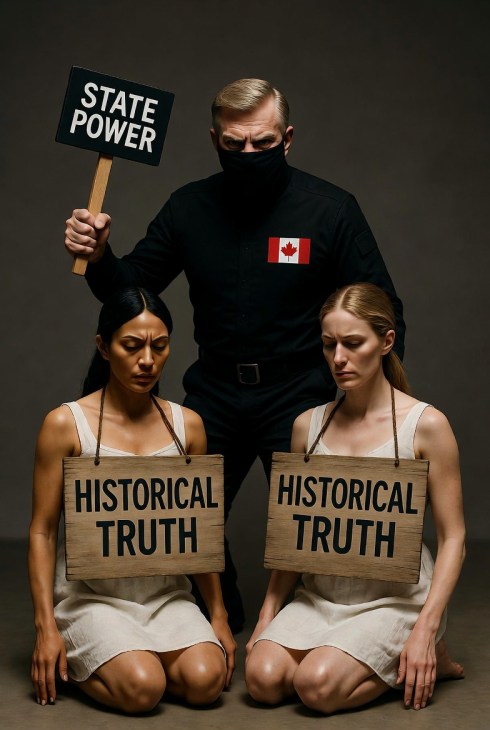
Historical truth does not become more trustworthy when the Criminal Code stands behind it.











 bleatmop
 Mystro
 The Arbourist


 Dead Wild Roses
9 comments
Comments feed for this article
June 13, 2026 at 5:52 am
tildeb
“The historical record is ugly: forced removal, family rupture, cultural suppression, underfunded institutions, abuse, neglect, disease, and deaths are not fringe claims. No serious account of Canadian history should pretend otherwise”…. unless one thinks or believes what’s true is not ‘serious’, that those who respect what’s true are ‘pretending’.
This example is why and how AI slop spreads. Just because the false narrative has been written so many times on the internet that LLMs use doesn’t make it true. Yet here we find the lies once again find a comfy home nestled inside another commentary that is not a lie: residential school ‘denialism’ isn’t just incoherent but an autocratic attempt to bludgeon believing the truth into a crime.
LikeLiked by 1 person
June 13, 2026 at 8:16 am
The Arbourist
Tildeb, I appreciate you engaging, but I think you’re reading more into that sentence than is there.
The historical record is ugly on multiple fronts: forced removal of children from families, prohibition of languages and cultures, chronic underfunding, documented physical and sexual abuse, neglect, rampant disease, and thousands of deaths, many with poor or missing records and unmarked graves. These are not fringe claims or “AI slop.” They come from the TRC’s archival work, survivor testimony, government documents, and the legal settlement itself. Pretending none of that happened would indeed be unserious history.
That said, I share your frustration with how parts of this story have been handled. Post-Kamloops, we saw repeated leaps from GPR “anomalies” to media and political certainty about “mass graves” and confirmed remains. Five years later, as of mid-2026, no human remains have been publicly confirmed through forensic excavation at the main Kamloops site. That evidentiary shortcut and narrative inflation are real. They damaged credibility and helped give dangerous momentum to attempts like the Bill C-9 “denialism” amendment, rightly rejected by the Senate.
My piece was trying to hold both realities at once: the residential school system was coercive and harmful in systemic, documented ways, and Canada still needs rigorous, open inquiry without criminal penalties for questioning specifics, numbers, or inflated claims. Turning historical debate into a speech crime is authoritarian, full stop.
If there is evidence I’m missing that the core elements I listed — forced separation, cultural suppression, abuse, neglect, disease, and excess deaths — are fabricated rather than documented policy outcomes, I’m genuinely interested. Otherwise, I think we need to separate legitimate pushback against overreach from blanket dismissal of the ugly baseline. That is the honest reckoning Canada actually needs.
LikeLiked by 1 person
June 13, 2026 at 11:18 am
tildeb
Right. And it’s wrong. For example, you and I were ‘forced’ to go to school in exactly the same way indigenous had to. And it was a fairly short period in the 60s. Hence, truant officers.
For the other 120+ years of IRS, every single student had to have their parent/guardian APPLY to attend and given permission by the local IRS administrator. That was Carney’s father’s job before becoming a superintendent. There was no ‘forcing’, no ‘taken away’; the only exceptions to this was regarding orphans (often from TB which was WAY worse on reserves than in schools) and those in very abusive home lives. In fact and in truth, many IRSs were both orphanages and child protective services wrapped into one.
Almost all had significant indigenous staff from the very tribes that attended and many tribes had their cultures PRESERVED by the work of those at residential schools including dictionaries from hundreds of languages that had no written form and its speech practiced with staff from those reserves. The idea that residential schools were trying to ‘kill’ the Indian or at least culturally eliminate their particular ethnicity is a blatant and demonstrable and historical farce… for anyone actually concerned with real and truthful history. AI slop doesn’t do that.
If you’re going to use the TRC as a source, perhaps you’re unaware that A) it selected fewer than 5% to tell their ‘story’ of abuse, and B) the more gruesome the tale, the greater the financial reward. And the evidentiary bar to reach? Say so. That’s it. Even when contrary evidence was overwhelming. Well, golly gee whiz, I wonder why so much truthful testimony was rejected?
Look, the litany of indigenous grievances AI produces is not extracting good information or what is true. It is extracting a popular lie. Garbage in, garbage out. It does not explain why the greatest call to institute and RE-institute local residential schools for the indigenous over a century came from tribal chiefs pressured by parents to provide public education for their kids. If abuse like you list here were anything more than rarest of events over 130 years, the facts don’t match reality… unless tens of thousands of indigenous parents were monsters and wanted their kids and grand kids to suffer the horrors we are to believe were ‘common treatment’. All of this false narrative has legs because of repetition and the intentional vilification of anyone – indigenous or not – who dares respect what’s true. An entire grievance industry worth over 100 billion dollars so far and counting is relying on people to believe the worst rather than know the truth. And look how successful this has been. AI slop isn’t going to alter the lying algorithm it regularly spews. And promoting it is not going to help, either.
LikeLiked by 1 person
June 13, 2026 at 12:13 pm
The Arbourist
Tildeb,
I want to slow this down because this is exactly where the problem lies.
I am not an expert on residential-school history, and I do not want to pretend I have personally audited every source, every school, every decade, or every claim made under the reconciliation banner. I share your concern about narrative inflation, especially after Kamloops, and I strongly oppose turning historical dispute into a speech crime.
But I am also not comfortable moving from “some claims have been overstated” to “the core residential-school harm record is AI slop.”
That is the distinction I am trying to hold.
At minimum, I think several narrower claims have enough documentary support to be treated seriously: residential schools existed inside a federal/church framework directed specifically at Indigenous children; attendance was legally compulsory in significant periods; many children were separated from family and community for schooling; assimilation was at least a major policy aim; disease and poor conditions are documented in some early government reporting; and records around deaths and burials are incomplete.
Those claims are narrower than “every school was the same,” “every child was dragged away,” “all parents opposed attendance,” “all testimony is equally reliable,” or “Kamloops proved mass graves.” I am not claiming those things.
Maybe the better way forward is to test confidence claim by claim. I have very low confidence in the public leap from GPR anomalies to confirmed bodies at Kamloops. I have low confidence in claims of deliberate mass murder without direct evidence. I have lower confidence around exact death totals where records are incomplete. But I have higher confidence that the system had coercive and assimilationist features that cannot simply be dismissed as a fabricated grievance narrative.
So rather than arguing over “the narrative” as one giant object, I’d rather ask: which specific claim are we testing, what evidence supports it, what evidence weakens it, and what would change our confidence?
On a 0–100 scale, how confident are you that residential schools were not meaningfully coercive or assimilationist in any systemic sense? And what primary-source evidence would lower that confidence?
I am genuinely open to revising downward where claims outrun evidence. But I do not think skepticism toward Kamloops or opposition to denialism laws requires rejecting the entire documented baseline.
LikeLike
June 13, 2026 at 3:38 pm
tildeb
So ask for evidence from those claiming highly biased negative cause and effect.
For example:
‘Murdered’ children. Evidence? Zero.
‘Missing’ children. Evidence? Zero.
Cultural assimilation. Evidence? Zero.
Genocidal intentions. Evidence? Zero.
At what point, Arb, do you create an equivalency between outrageous evidence-free claims with significant contrary evidence and those who doubt them for cause? Since when did the demand for negative evidence to extraordinary claims obtain ‘equivalent’ weight in some ‘respectful’ dialogue?
Prove to me the equivalent case that alien lizard people do not inhabit billionaires when I claim they do, demand and receive privilege in law to ‘counter’ that influence, demand and receive political and social support to vilify those who doubt my belief (maybe even jail time as a ‘denier’), lower the national flag for half a year to demonstrate remorse for inviting the lizard people, and compensation to account for their ongoing influence. Now provide me the means to examine the issue for balance and fairness and respectful dialogue. Come on… I’ll wait…
LikeLike
June 13, 2026 at 5:36 pm
The Arbourist
Tildeb,
I think we need to separate three different things that are getting collapsed here.
First, there are inflated or rhetorically loaded claims that I also reject as stated — for example, “confirmed mass graves at Kamloops” or sweeping claims of deliberate murder without direct evidence. I agree those require very high evidentiary standards, and I do not defend them as settled fact.
Second, there are documented institutional and policy features that do not have “zero evidence.” Attendance was legally compulsory in significant periods, especially after the 1920 Indian Act amendment. Assimilation was an explicit federal policy aim in key official statements, including Duncan Campbell Scott’s comments about eliminating “the Indian problem” through absorption. Serious disease problems and poor conditions were documented at the time by government medical officials, including Dr. Peter Bryce in his 1907 report.
These are narrower claims about law, policy, and contemporary government records. They are not the same category of claim as “murdered children at Kamloops.”
Third, there are interpretive and moral claims — genocide terminology, uniform intent across the entire system, degree of culpability — where reasonable people can disagree even when some underlying facts are accepted.
Your lizard people analogy only works if all of this belongs in the same category of evidence-free extraordinary claim. It does not. Some parts are documented policy and outcomes. Some parts are exaggerated. Some parts are interpretive. Treating the entire package as equivalent is the move I am resisting.
My position is not “believe every claim.” It is that we should evaluate claims with granularity: which specific assertion are we talking about, what primary evidence supports or weakens it, and what would change our confidence?
Are there specific claims or sources you would like to go over? I am open to walking through them one at a time rather than defending or rejecting “the narrative” as a single package.
I am not asking for symmetry between belief and disbelief. I am asking for intellectual consistency. Dismissing the narrower documented baseline — compulsory attendance in key periods, a coercive framework with assimilationist aims, and documented disease/condition problems — because some public claims have been inflated does not seem more careful to me. It repeats the same flattening error in the opposite direction.
LikeLike
June 13, 2026 at 8:58 pm
tildeb
There is So much to have to go over to put into context all the claims you list and why they are incorrect. Here is one. But again, this is the equivalent to thee and me being ‘forced’ to attend school. This mandatory attendance does not create ‘survivors’. It creates a literate society, of which the indigenous and their leadership across the country INSISTED on obtaining for their kids. In fact, it’s part of treaty rights!
The narrative you are promoting is casting literally all of this in as negative and overpowering way as possible (presuming the conclusion as a premise is true) to support the imposed ‘colonizing’ version that is not only false in reality but very often opposite to what is true. Your Duncan Scott quote, for example, is literally from Kevin Arnett (who ALSO claimed the Queen murdered and ate some dozen native children while visiting BC). Actual documentation does not support what you think it means. The context of that quote – rarely if ever presented fairly – has to do with the choice government faced at the time of either turning the indigenous (‘the Indian’) into a perpetual welfare caste or having them become an integral part of building and developing the new country. Such a choice had to be made.
The slant of the narrative of intentionally creating a victim class by colonizing forces is so wrong and so backwards that it does fall into Lizard People equivalency. It’s a fiction – as overwhelming evidence to the contrary clearly demonstrates – intended to create a false victim narrative.
Included is this notion, for example, is disease at IRSs, which was units of factors LESS than the rates found on reserves AND with medical intervention far greater than other equivalent public schools. This equivalency is never presented not because it isn;t true but because it doesn’t fit the assumed conclusion about evil intention. There are dozens and dozens of religious people – doctors, nurses, clergy – who championed significant beneficial changes to public health at these schools solely for the benefit of the children in attendance. That included diet. IRS graduates were, on average, significantly taller than those kids left on reserve. (Golly, I wonder why these other kids weren’t ‘taken’, why the average stay was only 4 years, why only 1/3 of all indigenous kids who qualified attended such schools. Don’t worry, Nobody cares about any of these inconvenient facts when there’s a false and evil narrative to assume is true.)
And there many cases of political battles to provide additional funding – even during recessions – to these populations through the IRS far above equivalent situations elsewhere. But the negative narrative is so prevalent and so often used to promote the grievance industry that finding what’s true requires work… work that most people are not going to do. They are going to believe media that aligns with the nation-destroying claims of the narrative and – as we see published on front pages – that lizard people really do exist, that mass graves really do exist, that terrible crimes were regularly committed against indigenous children for the depraved enjoyment of people who dedicated their lives to improving opportunities through education and training to a vulnerable population. Including many indigenous staff and teachers. Including Carney’s father. And for this extraordinary effort they are vilified by those who presume the negative narrative is true and who double down on believing it when compelling contrary evidence is presented. Five years on, and only the Globe and Mail has done a half-hearted apology for spreading the malicious lie that 215 children were buried at Kamloops. To date, not even ONE example exists anywhere in Canada. Zero. That’s not an opinion; that’s a fact.
Read real experts, people who have put their professional and academic lives on the line to stand beside what’s true rather than those who go along to get along and risk nothing constantly, reliably, and consistently vilifying these people by presuming as you do in the OP that the grievances you list are true as if a starting point for the inquiry rather than the false conclusion it is but presented as if a premise to a ‘respectful’ dialogue.
LikeLike
June 14, 2026 at 8:34 am
The Arbourist
Tildeb,
This is more useful because now we have specific claims to test.
On “forced”: I accept the distinction. If “forced” means every Indigenous child was physically seized from unwilling parents in every period, then that claim is too broad and I would not defend it. I also accept that many Indigenous parents and leaders wanted education for their children and that schooling was sometimes connected to treaty obligations.
But I do not think that makes residential-school attendance equivalent to ordinary public schooling. The relevant question is whether the system operated inside a distinct federal framework with compulsory-attendance provisions, enforcement powers, frequent placement away from home, and assimilationist policy aims. That is narrower than “all children dragged away,” but it is not nothing.
On disease and conditions: I accept that reserves often had terrible health outcomes too and that many staff were sincere. But Dr. Peter Bryce’s 1907 report remains serious contemporary government documentation of TB mortality, overcrowding, and poor conditions in some schools. If the counterclaim is that residential schools were generally safer or healthier, I would want to see the comparative data by period and region.
On Kamloops: We are largely aligned. The leap from GPR anomalies to public certainty about “mass graves” or “murdered children” was irresponsible. No human remains have been forensically confirmed and publicly reported at the main Kamloops site, as far as I know. That overreach damaged trust and fueled bad policy like denialism laws, which I oppose.
Where we still differ is the leap from “many public claims are inflated or wrongly framed” to “the entire baseline record is fiction.” Some claims are weak or interpretive. Others — compulsory-attendance provisions, assimilation policy, documented disease problems in government records — are grounded in law and contemporary official reporting.
I am not trying to irritate you or defend a maximalist activist narrative. I am trying to separate what is well documented from what is exaggerated or interpretive, and I remain open to narrowing my views where the evidence warrants.
I would appreciate the strongest primary sources you have on comparative disease rates, attendance patterns, average stay lengths, average height, or similar empirical points.
I am happy to go claim by claim. If you want to start with the Dorchester Review piece on “forced,” Bryce’s reports, or anything else, let’s do that.
LikeLike
June 14, 2026 at 9:08 am
The Arbourist
Tildeb,
I want to try a different tack here, because I think we may be talking past each other.
I am not asking you to accept the activist version of residential-school history. I reject parts of that version too, especially post-Kamloops claims that moved from GPR anomalies to public certainty about bodies, mass graves, or murder without forensic confirmation.
But you seem to be making a strong counter-claim of your own: that the core harm record is not merely overstated, but essentially fictional. That is also a positive claim, and it needs evidence.
So rather than arguing over “the narrative” as one giant object, I’d like to narrow this down.
I accept that some parents applied, some Indigenous leaders wanted schooling, some students had positive experiences, and some staff were sincere and beneficial. Those facts matter. But I do not think they automatically disprove systemic harms. They complicate the record, which is exactly why I am trying to separate specific claims rather than defend or reject the whole package at once.
Likewise, I accept your point that disease rates on reserves may often have been worse than disease rates in schools. That may be an important comparative point. But comparison is not the same as absolution. We would still need school-specific evidence on overcrowding, ventilation, diet, medical care, funding, and mortality by period and region.
So here are the questions I’d most like answered:
1. When you say there is “zero evidence” for cultural assimilation, do you mean literally zero evidence, or insufficient evidence for the strongest activist framing?
2. What would count, in your view, as evidence that the system had meaningful coercive or assimilationist features?
3. Do parental applications and positive testimony disprove systemic harms, or do they complicate them?
4. If TB rates were worse on reserves than in schools, does that prove residential schools were safe and well-run, or only that both reserve and school conditions require separate analysis?
5. What is your positive account of the residential-school system: basically benign, mixed but unfairly maligned, flawed but often beneficial, or something else?
6. What primary source would you point to as the strongest single support for that account?
LikeLike