
You are currently browsing The Arbourist’s articles.
The lesson of 1970s stagflation was not that governments can do nothing. It was that the people running policy understood less than they claimed, and that the tools they trusted were much cruder than advertised. The “Great Inflation” from roughly 1965 to 1982 forced economists and central banks to rethink how inflation, unemployment, and monetary policy actually interact. (Federal Reserve History)
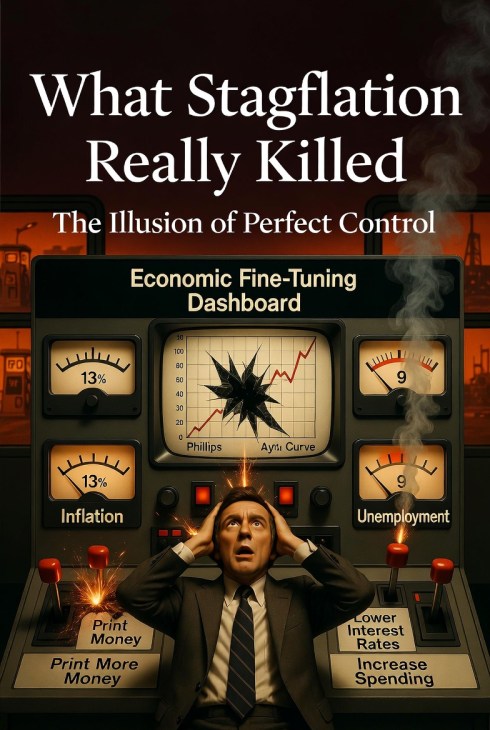
For a time, the postwar consensus rested on a flattering idea. Inflation and unemployment were treated as a manageable trade-off. The Phillips Curve was not just read as a pattern in the data. In practice, it became a governing intuition: if unemployment rose, policymakers could push demand higher and accept somewhat more inflation as the cost. That was the real temptation. A relationship observed under one set of conditions was quietly promoted into an instrument of control. The curve stopped being a caution and became a dashboard. That is where the error entered. As later critiques made clear, any apparent trade-off could break down once expectations adjusted. (Federal Reserve History)
Then the 1970s arrived and the trade-off stopped behaving.
Inflation rose sharply while unemployment also remained painfully high. BLS historical CPI data show annual U.S. inflation at 11.0 percent in 1974, 11.3 percent in 1979, and 13.5 percent in 1980. Federal Reserve History identifies this whole era as the defining macroeconomic crisis of the late twentieth century precisely because it combined persistent inflation with serious economic weakness and forced a rethink of earlier policy assumptions. The old promise had implied that these pressures could be balanced against each other. Instead they arrived together. (Bureau of Labor Statistics)
It is tempting to tell that story too neatly. Some people reduce stagflation to one cause, usually Nixon’s August 1971 suspension of dollar convertibility into gold. That was a major monetary break, and it helped bring the Bretton Woods system to an end. But it was not the whole story. Nixon’s package also included wage and price controls, and the wider period was shaped by multiple interacting forces, including oil shocks and broader inflation dynamics. The point of that complexity is not to rescue the old confidence. It is to bury it. An economy shaped by that many moving parts was never going to be managed with the precision implied by mid-century technocratic rhetoric. (Federal Reserve History)
This is where some critics of monetary manipulation look stronger in retrospect than they did at the time. Austrian economists such as Mises and Hayek had long warned that money and credit are not harmless policy tools. Cheap credit can distort investment. Monetary expansion can scramble price signals. Artificial booms can end in painful correction. There is no need to pretend they possessed a complete script for every feature of 1970s macroeconomics. They did not. But they were directionally right about something central: when policymakers treat money as an instrument of short-run management rather than a framework for stable coordination, they increase the odds of disorder. That warning aged better than the promise of fine-tuning. This is an interpretive judgment, but it is supported by how badly the simpler policy reading of the Phillips Curve fared during the Great Inflation. (Federal Reserve History)
Paul Volcker’s anti-inflation campaign in the early 1980s drove the point home in brutal form. The Federal Reserve’s October 1979 shift to tighter anti-inflation policy helped bring inflation down, but the price of restoring credibility was severe. Federal Reserve History notes that inflation fell sharply after its 1980 peak, while unemployment reached 10.8 percent in late 1982 during the deep 1981–82 recession. That was not the triumph of elegant expert control. It was the bill arriving. Once inflationary disorder hardens, the correction is rarely gentle. (Federal Reserve History)
So what did stagflation actually kill?
Not economics. Not all state action. Not even every Keynesian insight. What it killed was a style of elite confidence. It killed the belief that national economies can be fine-tuned with enough intelligence, enough models, and enough institutional nerve. It killed the conceit that the dashboard is the machine. The language has changed since then. The models are more sophisticated. The temptation is still with us. Every generation of managers wants to believe that this time the controls are better and the uncertainties smaller. The 1970s remain useful because they remind us that policy operates under limits, trade-offs turn ugly, and reality does not care how elegant the model looked on paper. (Federal Reserve History)
Glossary
Phillips Curve
A model associated with a short-run relationship between inflation and unemployment. In practice, many policymakers treated it as if lower unemployment could be purchased with somewhat higher inflation. The 1970s badly damaged confidence in that simple reading. (Federal Reserve History)
Stagflation
A period of high inflation combined with weak growth and high unemployment. The 1970s made the term famous because that combination was supposed to be difficult to sustain under older policy assumptions. (Federal Reserve History)
Fiat money
Money that is not redeemable for a commodity such as gold and instead depends on legal and institutional backing. Nixon’s 1971 decision ended dollar convertibility into gold for foreign governments and central banks. (Federal Reserve History)
Bretton Woods system
The postwar international monetary order in which other currencies were pegged to the U.S. dollar, and the dollar was convertible into gold under the system’s rules. It unraveled in the early 1970s. (Federal Reserve History)
Disinflation
A slowing in the rate of inflation. Prices may still be rising, but less quickly than before. Volcker’s early-1980s policy is a classic U.S. example. (Federal Reserve History)
References / URLs
Federal Reserve History, “The Great Inflation”
https://www.federalreservehistory.org/essays/great-inflation
Federal Reserve History, “Nixon Ends Convertibility of U.S. Dollars to Gold and Announces Wage/Price Controls”
https://www.federalreservehistory.org/essays/gold-convertibility-ends
Federal Reserve History, “Volcker’s Announcement of Anti-Inflation Measures”
https://www.federalreservehistory.org/essays/anti-inflation-measures
Federal Reserve History, “Recession of 1981–82”
https://www.federalreservehistory.org/essays/recession-of-1981-82
Federal Reserve History, “Creation of the Bretton Woods System”
https://www.federalreservehistory.org/essays/bretton-woods-created
U.S. Bureau of Labor Statistics, Historical CPI-U, 1913–2023
https://www.bls.gov/cpi/tables/supplemental-files/historical-cpi-u-202312.pdf
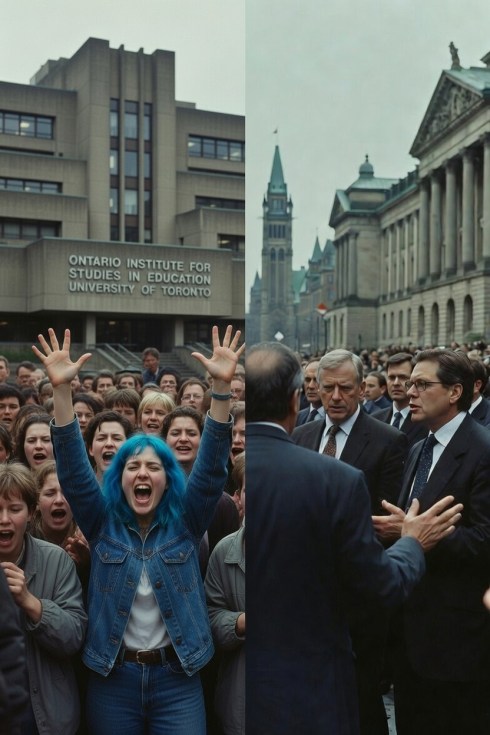
The Ontario Institute for Studies in Education at the University of Toronto is hosting its 13th annual decolonizing conference from March 12 to 14, 2026. The title tells you plenty: Colonial Ruptures: Unmasking Ongoing Coloniality and Fostering Counter Insurgency, Resistance and Liberatory Possibilities. The event materials describe a gathering of scholars, activists, educators, artists, Elders, and community leaders committed to critical reflection, collective action, and “decolonial futures.” They speak of resisting “global capital extractivism and supremacist thinking,” rejecting “colonial binaries,” and advancing liberatory possibilities. This is not an outside caricature. It is the institution describing itself.
That matters because OISE is not a fringe collective borrowing university space for a weekend. It is one of the country’s most influential faculties of education, and CIARS is one of its public-facing centres. A conference like this does not define every part of OISE, but it does reveal a real moral and intellectual current inside one of Canada’s most important teacher-forming institutions. When an institution like that adopts the language of rupture, insurgency, resistance, and decolonial struggle, critics are entitled to ask a basic question: is this education in the ordinary civic sense, or ideological formation dressed in educational language?
To be fair, proponents would say the purpose is not social fragmentation but repair. They would say decolonizing education means confronting historical blind spots, taking Indigenous and anti-racist perspectives seriously, and widening the moral vocabulary of the classroom. Fine. That case should be acknowledged. But public language still matters. When a flagship faculty of education foregrounds coloniality, rupture, counter-insurgency, and resistance, it signals something more than curricular broadening. It signals an adversarial posture, even when softened by the language of care, solidarity, and reimagined futures.
That is the real concern. The problem is not that Canada’s injustices are being taught. A serious country should teach its history honestly. The problem is that teacher formation may be drifting toward a framework in which critique stops being a tool of civic improvement and becomes the default grammar through which the society itself is read. In theory, decolonial approaches and core educational goals can coexist. In practice, the public-facing language here suggests a hierarchy of concerns in which ideological critique increasingly outranks institutional competence, shared citizenship, and academic pluralism.
“What the public sees is not repair but drift: a professional class fluent in rupture and resistance while the country struggles to do ordinary things well.”
People notice that shift because they are already living inside a country under strain. Canada has struggled with weak productivity for years. The OECD’s 2025 survey says the outlook was worsened by trade uncertainty and tariffs, projects a decline in GDP from the second quarter of 2025 because of falling exports to the United States, and devotes sustained attention to the problem of raising business-sector productivity. Housing is worse. CMHC said in 2025 that restoring affordability to 2019 levels would require roughly 430,000 to 480,000 new housing units per year until 2035, about double the recent pace. That is not ideological spin. It is the national housing agency saying the country is not building nearly enough homes.
So people look around and see weak productivity, punishing housing costs, trade pressure, strained public capacity, and thinning civic confidence. Then they watch elite educational institutions pour moral energy into conferences on colonial rupture and liberatory counter-insurgency. The disconnect is hard to miss. Citizens who want functional schools, affordable homes, competent government, and some residue of common national identity are told, again and again, that the deeper task is deconstruction. Not reform. Not competence. Deconstruction.
That is one reason disillusionment has grown. The problem is not honest history. It is not the inclusion of neglected perspectives. The problem is that “decolonizing” has become, in practice, a legitimating language for ideological sorting. It shifts attention away from what institutions are for and toward the moral drama of permanent critique. In education, that is a serious danger. A teacher should be equipped to help students read, write, reason, deliberate, and live with others in a shared society. If the training environment increasingly teaches that the shared society itself is morally suspect at the root, the civic consequences are unlikely to be good.
Canada does not need amnesia. It does not need self-flattery either. But it also does not need a professional class trained to interpret the country chiefly through the grammar of oppression, rupture, and resistance. A society held together by trust, inheritance, and common rules cannot sustain indefinite elite suspicion toward its own foundations. If public institutions want to recover legitimacy, they will have to rediscover a language of citizenship, competence, pluralism, and shared belonging. Until then, more Canadians will keep feeling that the country they were told to love is being taught to despise itself.
References
OISE / CIARS conference page
https://www.oise.utoronto.ca/ciars/ciars-2026-xiii-decolonizing-conference-1
OISE / SJE newsletter page on the conference
https://www.oise.utoronto.ca/sje/newsletter/march-2026/CIARS-newsletter-conference
OISE February 2026 conference notice
https://www.oise.utoronto.ca/home/sje/newsletter/february-2026/CIARS-conference
CIARS centre page
https://www.oise.utoronto.ca/ciars
CMHC housing supply report page
https://www.cmhc-schl.gc.ca/professionals/housing-markets-data-and-research/housing-research/research-reports/accelerate-supply/canadas-housing-supply-shortages-a-new-framework
CMHC housing supply gap explainer
https://www.cmhc-schl.gc.ca/observer/2025/updating-canada-housing-supply-shortages-new-housing-supply-gap-estimates
CMHC news release on housing supply gaps
https://www.cmhc-schl.gc.ca/media-newsroom/news-releases/2025/cmhc-releases-latest-housing-supply-gaps-report
OECD Economic Survey of Canada 2025
https://www.oecd.org/en/publications/2025/05/oecd-economic-surveys-canada-2025_ee18a269.html
OECD full report
https://www.oecd.org/en/publications/2025/05/oecd-economic-surveys-canada-2025_ee18a269/full-report.html
OECD chapter on raising business-sector productivity
https://www.oecd.org/en/publications/2025/05/oecd-economic-surveys-canada-2025_ee18a269/full-report/raising-business-sector-productivity_443bcd88.html
Glossary
Decolonizing
A broad academic and political term for efforts to challenge ideas, institutions, and practices seen as shaped by colonial power.
Coloniality
The claim that power structures formed under colonial rule can persist long after formal colonial administration ends.
Counter-insurgency
Traditionally, efforts to resist or suppress insurgent movements. In academic settings it is often used metaphorically, which is part of why it sounds so militant.
Colonial binaries
Simple oppositions said to come out of colonial thinking, such as colonizer/colonized or civilized/uncivilized.
Liberatory
A term used to describe ideas or practices aimed at freeing people from oppression or domination.
Extractivism
An economic model focused on intensive resource extraction, usually criticized for environmental damage or unequal power.
Academic pluralism
The principle that higher education should make room for genuine intellectual diversity rather than one dominant ideological framework.
Civic order
The shared rules, institutions, and habits that allow people with real differences to live together in one political community.
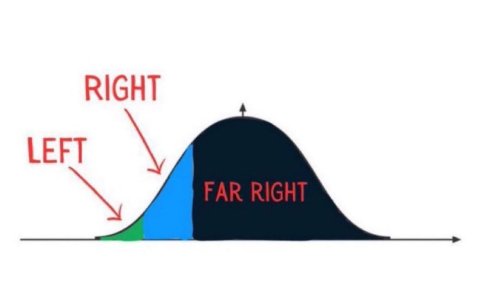
One of the most corrosive habits in current political discourse is the way plain factual claims get assigned a partisan label. Not arguments. Not policies. Facts. Or, more precisely, statements that point back to material reality, institutional limits, or ordinary human constraints. In theory, facts are supposed to discipline ideology. In practice, they are often treated as ideological aggression when they obstruct a preferred moral script.
That is what people are reaching for when they say facts are now treated as right-wing. The phrase is blunt, but it points to something real. In a growing number of disputes, especially around sex, gender, speech, and institutional policy, a person can say something materially true and be treated not as a participant in debate but as a moral suspect. The point is not answered on its merits. It is recoded as a signal of contamination. The speaker is no longer heard as describing reality. He is heard as choosing a tribe.
That shift matters because it changes the structure of argument. Once a factual claim is socially coded as “right-wing,” the burden quietly moves. The question is no longer whether the claim is true. The question becomes why you said it, what kind of person says such things, and who might feel endangered by hearing it. Motive replaces mechanism. Stigma replaces rebuttal. The claim is not refuted so much as quarantined.
You can see this clearly in disputes over sex and pronouns. For many people, saying that sex is real, binary in the ordinary human sense, and not altered by self-declaration is not an act of hostility. It is a claim about reality and a claim about language. “He” and “she” historically track male and female persons. Refusing to detach those words from sex is not, on its face, a partisan performance. It is an attempt to keep public language tethered to the material world rather than to inward identity claims.
“The disagreement is not mainly about politeness. It is about which reality gets public authority.”
That is exactly why the issue generates so much heat. The disagreement is not mainly about politeness. It is about which reality gets public authority. Does language track bodies, or does it track self-declared identity? Does a school treat sex as a stable feature of the world, or does it treat identity assertion as the governing fact? Those are not small etiquette disputes inflated by the internet. They are conflicts about ontology, law, and institutional power.
Canada now offers several live examples. Alberta’s Education Amendment Act requires parental notification when a student requests a gender identity-related preferred name or pronouns, and parental consent for students under 16 before staff may use them. The province says these changes are part of supporting families and setting clear school rules, with the remaining education amendments anticipated to take effect on September 1, 2025. Then, in late 2025, Alberta escalated further. Bill 9 invoked the notwithstanding clause to shield not only this school policy but other contested sex-and-gender measures from being struck down by the courts. That bundling matters. It shows this is no longer being treated as a narrow administrative disagreement, but as a foundational conflict over parental authority, child development, and the public meaning of sex.
Quebec presents the same fracture from the opposite direction, and it is ongoing now. Current reporting says a Montreal teacher is challenging the provincial policy that allows students 14 and older to change the name and pronouns used at school without parental consent. The teacher alleges she was required to use male pronouns at school while using female pronouns with the student’s parents. A preliminary hearing on anonymity and confidentiality was held on March 6, 2026, with the broader merits challenge still to come. Strip away the activist packaging and the conflict becomes plain: can institutional professionals be required to maintain two vocabularies of reality depending on the audience, and if they object, are they making an ethical argument or committing a moral offense?
The Barry Neufeld case in British Columbia shows the institutional end point of this logic. On February 18, 2026, the B.C. Human Rights Tribunal issued its decision and ordered substantial damages after finding that multiple publications were discriminatory, while some crossed the threshold into hate speech. That does not prove that every factual objection to gender ideology is punishable. It does show how readily dissent can be processed through systems that move from moral condemnation to formal classification. Once that line is crossed, everyone watching understands the lesson. The risk is no longer simply that you will be called wrong. The risk is that you will be treated as a public contaminant.
This is why the familiar “both sides are just choosing different facts” formula goes soft in exactly the wrong place. The conflict is not symmetrical. One side is generally making claims about bodies, language, legal authority, and institutional procedure. The other is often demanding that those things yield to identity-based recognition norms. Dignity is real and relevant. But dignity does not erase biological category, dissolve observable sex, or transmute factual disagreement into literal violence.
So when people say facts are treated as right-wing, the point is not that truth literally belongs to one side of the spectrum. The point is that in a culture saturated with moral performance, inconvenient facts are often recoded as partisan because it is easier to stigmatize them than to answer them. A factual claim that disrupts the script is no longer processed as description. It is processed as dissent. And dissent, under current conditions, is increasingly treated as a character defect.
Facts do not have a party. But when facts obstruct an ideological narrative, that narrative will often brand them right-wing and move straight to motive-policing. That is not a sign that the facts have changed. It is a sign that too much of public discourse has become allergic to reality when reality refuses to flatter the creed.
References
Government of Alberta. “Supporting Alberta students and families.”
https://www.alberta.ca/supporting-alberta-students-and-families
Government of Alberta. “Protecting youth, supporting parents, and safeguarding female sport.”
https://www.alberta.ca/protecting-youth-supporting-parents-and-safeguarding-female-sport
Global News. “Montreal teacher challenges policy for trans students to hide identity from parents.” March 6, 2026.
https://globalnews.ca/news/11719392/montreal-teacher-trans-students-challenge/
British Columbia Human Rights Tribunal. Chilliwack Teachers’ Association v. Neufeld (No. 10), 2026 BCHRT 49. February 18, 2026.
https://www.bctf.ca/docs/default-source/for-news-and-stories/49_chilliwack_teachers-_association_v_neufeld_no_10_2026_bchrt_49.pdf?sfvrsn=2d847803_1
Online discourse is exhausting for a simple reason: certain words are used not to describe reality, but to end the conversation. The label does the work. The argument never has to.
“Fascist” is one of those words.
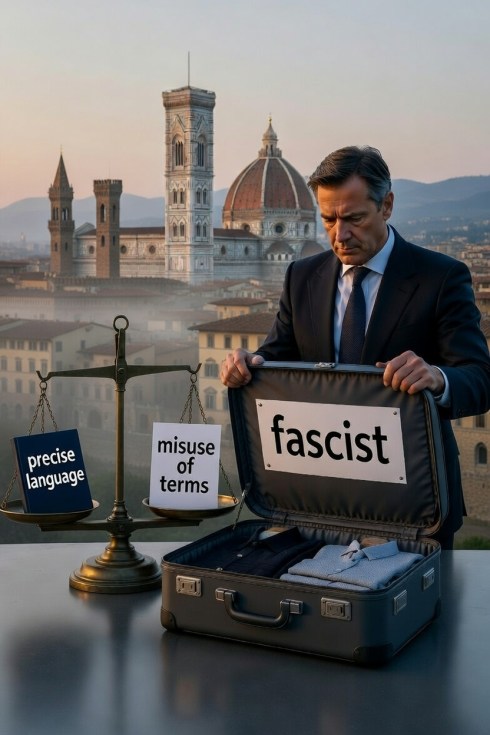
In current usage, it often functions as a moral airhorn: you’re beyond the pale; you’re dangerous; you’re not worth debating. It gets tossed at people over ordinary ideological disputes about sex and gender, about speech norms, about state power, about immigration, about education. Sometimes it’s malice. Sometimes it’s a sincere attempt to name something authoritarian using the most nuclear term available. Either way, the practical effect is the same: “fascist” becomes a conversation-stopper rather than a description.
That’s why definitions matter. Not because language never evolves (it does), but because political language has consequences. When a term carries a freight of historical evil, using it casually is not “rhetorical adaptation.” It’s moral inflation. Moral inflation does not stay rhetorical for long.
Fascism isn’t just “authoritarian”
Start with what fascism is not.
Fascism is not merely “oppressive, dictatorial control.” That’s too broad. Plenty of regimes are oppressive. Plenty of dictators are brutal. If “fascist” just means “authoritarian,” it becomes a synonym for “bad,” and then it means nothing at all.
Fascism is a historically specific modern political project. A workable definition, tight enough to guide usage and broad enough to cover the main cases, looks like this:
Fascism is an authoritarian mass movement aimed at national rebirth, organized around the leader principle, hostile to liberal constraints (pluralism, due process, free speech), willing to use intimidation or violence against opponents, and committed to subordinating institutions to a single national story.
Notice the “mass movement” piece. Fascism is not only what the state does; it’s what a mobilized public is trained to do for the regime. It does not merely punish dissent. It cultivates a moral atmosphere in which dissent feels like treason, contamination, sabotage.
Economically, fascist systems often preserve nominal private ownership while subordinating markets, labour, and industry to regime goals through state direction and corporatist control. That’s not the essence, but it’s part of the recognizable package: the economy exists for the national project, not the other way around.
History: what it looked like when it was real
Words should cash out in the world.
Historically, fascism is anchored in early 20th-century Europe, most centrally Mussolini’s Italy and Hitler’s Germany. They differed in important ways, but the family resemblance is clear: politics becomes a spiritual drama of national humiliation and promised restoration; the leader becomes the embodiment of the nation; opposition becomes illegitimate by definition; and coercion becomes normalized as “necessary” for unity and renewal.
The methods are recognizably modern: propaganda, spectacle, the disciplining of media and education, the weaponization of law, the tolerated use of street-level intimidation, and the steady narrowing of permissible speech and association. It’s not merely “the government is strong.” It’s the fusion of power with myth, enforced socially and legally.
A practical threshold: not one trait, a cluster
If you want to use “fascist” responsibly, you need a threshold. Not a single feature, a cluster.
The label starts to become warranted only when several of these are present together:
- Leader principle: politics organized around a singular figure or party claiming a unique right to rule.
- Myth of national rebirth: humiliation plus promised restoration demanding unity and purification.
- Anti-pluralism: opponents treated as enemies, not fellow citizens.
- Suppression of dissent: legal, institutional, or social narrowing of speech and association.
- Propaganda and spectacle: mass emotional mobilization replacing open contest.
- Normalization of intimidation: harassment, threats, “consequences,” or violence used as political tools.
- Institutional capture: courts, schools, media, and professions bent into ideological instruments.
This is also how you keep your head when the internet offers you cheap clarity. If someone is merely wrong, stubborn, rude, or convinced, that is not fascism. If someone wants stronger regulation, that is not fascism. If someone defends free speech, or argues about sex and gender, that is certainly not fascism by definition. Those are disputes inside ordinary politics, however heated.
A concrete misuse: the pattern in miniature
Here’s the move you see constantly:
A person says, “I think compelled speech policies in workplaces and schools are a mistake.”
The reply is not, “I disagree, because…”
The reply is, “Fascist.”
What did the label accomplish? It converted a claim about policy into an accusation about moral essence. It implied the speaker is not merely mistaken but dangerous; not merely wrong but disqualifying. Once you have categorized someone as a “fascist,” the next steps feel justified: deplatforming, professional punishment, social exile, denial of hearing.
Maybe the labeler was “just venting.” Maybe it was “good-faith hyperbole.” But hyperbole has downstream effects. It trains the audience to treat coercion as civic hygiene.
Symmetry: this is not a left-only sin
And yes: the right does its own version. “Marxist” becomes a synonym for “liberal.” “Communist” becomes “anyone who wants a program.” “Groomer” becomes a sloppy club for any disagreement about education. “Traitor” becomes shorthand for “opponent who won.” Same mechanism, different tribe: labels as argument-substitutes and permission structures.
If we’re going to complain about language used as a weapon, we don’t get to only notice it when it hits our side.
Why this matters beyond the internet
The problem isn’t just vibes on social media. Label inflation spills into institutions.
When terms like “fascist” become casual descriptors, workplaces and professional bodies begin treating contested political disagreement as a safety issue. Media narratives start pre-sorting dissent as extremism. Politicians learn to substitute moral denunciation for persuasion. The public learns to fear argument and love punishment.
The final irony is that this habit corrodes the liberal norms that make pluralistic society possible: the expectation of disagreement, the discipline of evidence, and the moral restraint of not treating opponents as vermin.
A better standard
Here’s the rule I’m adopting: I’ll reserve “fascist” for cases where I can point to the cluster. Leader principle, anti-pluralism, suppression, intimidation, institutional capture, mythic rebirth. Not merely the heat of the dispute.
When I mean “authoritarian,” I’ll say authoritarian. When I mean “illiberal,” I’ll say illiberal. When I mean “coercive,” I’ll say coercive.
Definitions aren’t pedantry. They are the line between argument and excommunication, a public safety measure for language. “Fascist” should be a diagnosis you can defend, not a mood you can perform. If we flatten every disagreement into fascism, we train ourselves to crave punishment instead of persuasion, and we teach institutions to treat dissent as contamination. That habit does not protect democracy. It rots the muscles that make democracy possible, and it turns politics into a brawl we will eventually call governance.
Iran, American Hegemony, and Western Resolve.
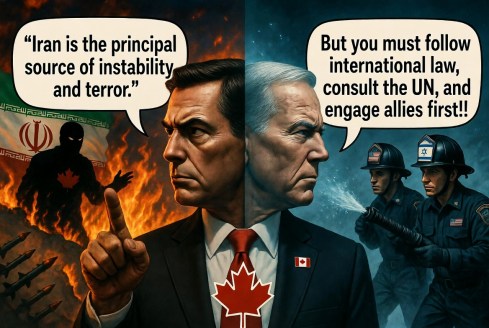
For years, Iran has functioned not as a normal state with normal ambitions, but as a regime that exports pressure through proxies, intimidation, missile programs, and calibrated disorder. Ottawa itself has repeatedly described Iran as “the principal source of instability and terror in the Middle East,” while stressing that Tehran must never be allowed to obtain or develop nuclear weapons. That matters because it cuts through the usual fog. This was not a strike against a harmless status quo. It was a strike against a regime that has spent years making the region more combustible, more violent, and more difficult to govern. (Canada PM)
That does not make war clean. It does not make every target choice wise. It does not make every legal question disappear. But it does clarify the strategic question. If a regime repeatedly funds, arms, and directs forces that destabilize the region, then eventually someone must decide whether deterrence is a word or a policy. The American and Israeli action in Iran is best understood in those terms. Not as a fantasy of moral purity, but as a decision to reimpose costs on a state that had grown used to exporting them. Ottawa’s own language makes that case harder to evade than many critics would like. (Canada PM)
This is the part many Western governments still struggle to say plainly. Order is not maintained by sentiment alone. It is not maintained by declarations, concern, and another exhausted appeal to “the international community.” Canada’s March 3 statement admitted the core reality: years of negotiations, sanctions, international monitoring, and multilateral pressure did not neutralize the Iranian threat. That is a brutal admission, and an important one. It means the soft-language consensus failed on its own stated terms. At some point, if the threat remains, either somebody acts or the speeches become a form of theatre performed over a steadily deteriorating map. (Canada PM)
“American hegemony, however much the word offends refined opinion, has often been the hard outer shell of a wider Western order.”
So yes, there is a case for saying the strikes were good in strategic terms. Iran was not a stabilizing power that got misunderstood by the usual Western moralists. It was a revolutionary regime that helped build and sustain a network of armed clients and auxiliaries across the region. Striking at that centre of gravity carries risks, but so did allowing it to operate under the assumption that the West had become too managerial, too conflict-averse, and too morally confused to act decisively. The risk of action is real. The risk of permanent indulgence was real too, and too often treated as invisible. (Canada PM)
That is why this moment matters beyond Iran. Not because one campaign settles the world. Not because every adversary will instantly become cautious. But because power still communicates. It communicates especially to regimes that have spent years studying the West and concluding that we prefer procedure to force, messaging to punishment, and managed humiliation to escalation. The lesson of Iran may not be that America will always act. It is simpler and more important than that: America still can act, and under some conditions still will. Even the White House’s preferred language of “peace through strength” matters less here as slogan than as signal. Adversaries do not have to admire the wording to understand the demonstration. (Canada PM)
That broader message is where China enters the discussion, but only carefully. It would be too strong, and probably false, to say Beijing has “backed down” because of Iran. Reuters reporting on Chinese military activity around Taiwan points to a narrower and more ambiguous picture: visible Chinese air activity around Taiwan has fallen sharply, but Taiwanese officials and analysts offered multiple possible explanations, including a possible Trump-Xi meeting atmosphere and internal turbulence inside China’s military. They explicitly warned against reading too much into a short lull. So the honest claim is not that China has folded. It is that Beijing is being reminded, in public, that the United States still possesses both the means and, at times, the appetite to use hard power. That is an inference. It is not yet a proved geopolitical shift. (Reuters)
The January Venezuela raid helps make that point, though only in a limited sense. Reuters reported that U.S. officials explicitly framed the operation as a warning to Beijing to keep its distance from the Americas. That does not prove deterrence has been restored, and it does not establish a new global pattern on its own. It does show that the message was sent. In Venezuela and now Iran, Washington has demonstrated that recent American power has not been purely rhetorical. Rivals may draw their own conclusions, but they are being given fresh evidence that the United States still possesses both the means and, at times, the appetite to use hard force. (Reuters)
And that matters because American hegemony, however much the word offends refined opinion, has served for decades as the hard outer shell of a wider Western order. It has not produced a perfect world. It has produced something rarer: a world in which hostile powers, rogue regimes, and ambitious revisionists often had to think twice. That “think twice” space is not everything, but it is a great deal. Lose it, and you do not get peace. You get more tests, more probes, more daring clients, more rulers gambling that the old sheriff now prefers seminars to force. The language may rankle. The reality remains. (Reuters)
“Ottawa could identify the arsonist, but still felt compelled to lecture the firefighters on process before the building stopped burning.”
And then there is Canada, performing once again its favourite late-imperial routine: saying the truest thing in the room and then rushing to blur it. On March 3, Carney said Iran is the principal source of instability and terror in the Middle East and condemned Iranian violence against civilians. On March 4, he also stressed that the United States and Israel acted without engaging the United Nations or consulting allies, including Canada, and reaffirmed that international law binds all belligerents. In other words, Ottawa could identify the arsonist, but still felt compelled to lecture the firefighters on process before the building stopped burning. (Canada PM)
That is the embarrassment. Not caution as such. Caution can be prudent. The embarrassment is the inability to rank moral and strategic realities in the right order. A serious government can say: Iran is the principal destabilizing force, diplomacy failed, the strikes carry grave risks, and the next task is preventing a wider regional catastrophe. That would at least sound like an adult hierarchy of judgment. What we got instead was a familiar Canadian blend of partial clarity and procedural recoil, as if sounding too decisive might itself be a diplomatic offence. (Canada PM)
The deeper issue is civilizational confidence. A West that cannot impose costs on regimes that menace its allies, fuel regional disorder, and exploit every sign of hesitation will not be admired for its restraint. It will be read as tired. The value of American hegemony, whatever its flaws, has never been that it creates a frictionless world. It is that it has often underwritten a world in which enemies of the West had reason to fear miscalculation. That fear is not barbarism. It is one of the costs of preserving order. Remove it, and you do not get a more humane international system. You get a more predatory one. (Canada PM)
So the case for the strikes is not that war is noble or that consequences will be tidy. It is that deterrence sometimes has to become visible again. Iran built power by betting that the West preferred delay to decision. In this case, that bet was answered with force. Even America’s enemies, and Canada’s evasive political class, may have been reminded of something they had started to forget: strength still speaks, and sometimes it is the only language a revolutionary regime believes. (Canada PM)
References
Prime Minister of Canada. “Statement by Prime Minister Carney on the evolving situation in the Middle East.” March 3, 2026.
Prime Minister of Canada. “Prime Minister Carney delivers remarks to media in Sydney, Australia.” March 4, 2026.
Reuters. “Chinese military flights around Taiwan fall, Trump-Xi meeting may be factor.” March 5, 2026.
Reuters. “With Venezuela raid, US tells China to keep away from the Americas.” January 11, 2026.

A lot of arguments don’t end because someone “lost.” They end because someone drops a category word: harmful, hateful, unsafe. The conversation gets reclassified as an emergency, and suddenly you are no longer debating a claim. You are defending your right to be in the room.
If you’ve felt this happening more often lately, you’re not imagining it. The move is simple: treat disagreement as injury, then treat your refusal to retract as more injury. It’s a neat little loop. You can’t disprove it, because your attempt to disprove it is counted as part of the harm.
So the goal here isn’t to “win” every exchange. The goal is to stay clear, stay calm, and avoid being dragged into fog.
Three rules help.
1) Ask what the harm is, mechanically
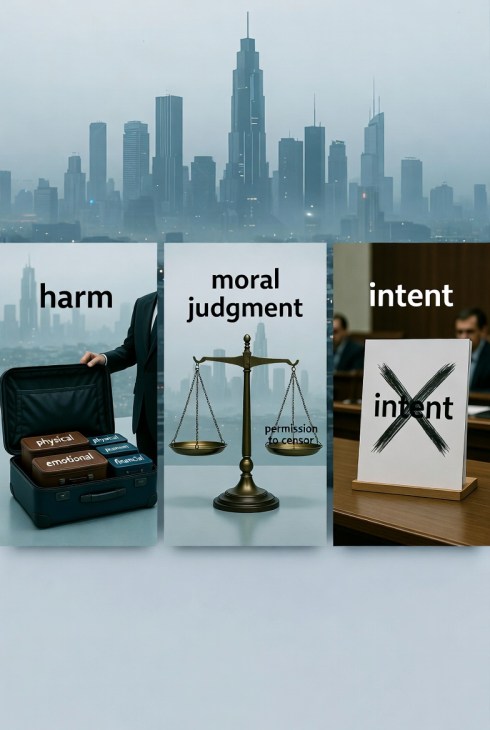
“Harm” is a suitcase word. People pack a dozen meanings into it, then wheel it around as if it’s one thing.
Don’t fight the suitcase. Open it.
Try:
-
“What kind of harm do you mean: emotional distress, social exclusion, incitement, discrimination, or something else?”
-
“What’s the actual path from my claim to the harm you’re naming?”
-
“Is the harm that you dislike the idea, or that you think it leads to a specific outcome?”
This isn’t a gotcha. It’s basic hygiene. If a person can’t tell you what they mean, you cannot respond intelligently. You’re shadowboxing.
A good rule of thumb: if they can’t name a mechanism, they aren’t making an argument. They’re placing a stop sign on the table and acting like the sign is evidence.
And notice the comfort “harm” provides. It allows someone to skip the hard part, the part where they explain why your claim is false, or why it leads to a concrete bad result. They can just announce: “That’s harmful,” and then expect you to retreat on cue.
Make them do the work. Not as punishment, but because without that work you are not in a debate. You are in a moral weather report.
2) Separate moral judgment from permission to censor
Even if a statement is rude, wrong, or ignorant, it does not automatically follow that it should be suppressed or punished.
That leap is the whole game.
You’ll notice how quickly some conversations smuggle in this assumption: if it’s harmful, it must be disallowed. But that premise is not neutral. It’s political. It’s also the premise that makes “harm” such a powerful word, because it offers a shortcut from “I condemn that” to “you don’t get to say that.”
Break the spell with a calm distinction:
-
“You’re free to think I’m wrong. That doesn’t mean you’re entitled to make me silent.”
Or softer:
-
“We can disagree strongly and still protect the right to say it.”
This forces a choice. Are they arguing that you are mistaken, or are they arguing that mistaken speech is illegitimate?
In a plural society, we tolerate a lot of speech precisely because we do not trust any faction, left or right, religious or secular, activist or corporate, to define “harm” without expanding it until it covers whatever irritates them this week.
Also: don’t let “consequences” do lazy work. Yes, speech can have consequences. So can silence. So can mandatory agreement. So can the habit of treating adults like fragile glassware.
You can live in a world where people criticize each other sharply. That’s normal. What you cannot do, without slowly breaking civic life, is turn moral condemnation into a veto.
Criticism is fair game. Coercion is not.
3) Don’t get trapped in intent court
When someone says “That’s hateful,” they often mean: “Your intent must be hateful.”
Now you’re in a trial about your inner motives, which is the safest place for them. It’s unfalsifiable. You can’t prove you don’t hate. They can’t prove you do. But they can keep you stuck there forever while the original claim remains untouched.
So: state your intent once, briefly, then return to the claim.
A template that works:
-
“My intent isn’t to attack anyone. The claim is X. If X is wrong, show me where.”
That’s it. One sentence of intent, then substance.
If they refuse and keep circling back to your hidden motives, set a boundary:
-
“If your position is that disagreement equals hate by definition, then there isn’t a debate to have.”
This is not escalation. It’s diagnosis. Because at that point the argument is no longer about facts, reasons, or tradeoffs. It’s about social control: the category word has been used to declare you out of bounds, and your only permitted move is submission.
The point of the exercise
The goal isn’t to dunk on people. It’s to keep the conversation from being hijacked by fog words and moral shortcuts.
So:
-
Define the harm (mechanism, not mood).
-
Separate judgment from censorship (criticism isn’t a veto).
-
Refuse the intent trap (claims, not soul-reading).
If they can engage those terms, you might actually have a discussion. If they can’t, you’ve learned something useful. You learned it without flailing, apologizing for existing, or agreeing to a vocabulary designed to make debate impossible.
And that, in 2026, is already a small victory.











 bleatmop
 Mystro


 Dead Wild Roses
Your opinions…