
You are currently browsing The Arbourist’s articles.
Singing this in Men’s choir. Great song, hits hard.
“Winter Winds” by Mumford & Sons, from their 2009 album *Sigh No More*, is a folk-rock song rich with emotional complexity and poetic imagery. To unpack its meaning, let’s dive into the lyrics and the themes they evoke, while keeping in mind the band’s signature style—blending introspective storytelling with raw, anthemic energy.
The song opens with a vivid scene: “As the winter winds litter London with lonely hearts.” This sets a tone of melancholy and isolation, suggesting a cold, harsh season—both literal and emotional. Winter often symbolizes hardship or introspection in literature and music, and here it’s paired with “lonely hearts,” hinting at a struggle with connection or love. The mention of London grounds it in a specific place, perhaps reflecting the band’s British roots or a personal experience.
The chorus—”But if your strife strikes at your sleep / Remember spring swaps snow for leaves”—offers a glimmer of hope. It acknowledges pain (“strife”) but counters it with renewal, a reminder that seasons change, and so can circumstances. This push-and-pull between despair and optimism is a recurring thread in Mumford & Sons’ work, often tied to their exploration of human vulnerability and resilience.
A key line, “Was it love or fear of the cold that led us through the night?” captures the song’s central tension. It questions the motivations behind a relationship or a pivotal moment—was it genuine affection or just a need for warmth, literal or metaphorical, in a tough time? This ambiguity invites listeners to reflect on their own experiences. The follow-up, “For every kiss your beauty trumped my doubt,” suggests that, at least temporarily, love (or beauty) won out over uncertainty.
The repeated refrain—”And my head told my heart / Let love grow / But my heart told my head / This time no”—is the emotional crux. It’s a dialogue between reason and feeling, a battle many can relate to. The head pushes for openness, but the heart, perhaps scarred or cautious, resists. This internal conflict mirrors the song’s broader themes of love’s fragility and the fear of being hurt again.
Later, “We’ll be washed and buried one day, my girl / And the time we were given will be left for the world,” introduces mortality. It’s a sobering reminder that life is fleeting, and what we do with our time—especially in love—matters. Yet, there’s a bittersweet acceptance here, a nod to legacy over despair.
Musically, the song’s driving banjo and swelling harmonies amplify this emotional tug-of-war, making it feel both personal and universal. Mumford & Sons often draw on folk traditions, and “Winter Winds” fits that mold—its lyrics feel timeless, like a story passed down, yet grounded in modern struggles.
So, what’s the meaning? At its core, “Winter Winds” is about wrestling with love in the face of doubt, fear, and the inevitability of change. It’s not a tidy resolution—spring may come, but the heart’s hesitation lingers. The song captures that messy, human space where hope and trepidation coexist, leaving listeners to ponder their own battles between head and heart. What do you think—does any particular line resonate with you?
The Tesla backlash of March 2025 and the Bud Light controversy of 2023 both ignited swift, ideologically charged consumer reactions amplified by social media. Bud Light’s woes began with a Dylan Mulvaney ad, sparking a conservative boycott that cratered sales by up to 26%, while Tesla’s stem from Elon Musk’s Trump ties, alienating liberals and moderates as its stock plummeted over 40%. Both cases show how fast brand loyalty can erode when politics collide with commerce.
Yet, the responses differ sharply in tone and tactics. Bud Light faced a peaceful, effective boycott—think Kid Rock’s viral gunplay—focused on wallets, not violence, with sales dipping hard but stabilizing later. Tesla’s backlash has veered into chaos, with arson and vandalism targeting cars and dealerships, reflecting a rawer fury possibly fueled by Musk’s outsized persona and Tesla’s physical presence as a punching bag. The right shunned Bud Light; the left now torches Tesla.
Bud Light retreated, tweaking its image to appease critics, while Musk doubles down, flaunting Teslas at the White House amid Trump’s support. The beer brand took a hit but survived as a commodity; Tesla’s premium status and Musk’s defiance make its crisis more existential, blending economic rejection with a destructive edge. These sagas reveal how political tribalism can punish brands—one with a cold shoulder, the other with Molotovs.

Anne Fausto-Sterling’s claim that 1.7% of live births are intersex, popularized in her 2000 book Sexing the Body and a paper by Blackless et al., sounds compelling—until you peek under the hood. She argues it shows sex isn’t binary, estimating 1 in 59 babies has some “nondimorphic sexual development.” But this number isn’t what it seems. It’s a classic case of “cooking definitions”—stretching the term “intersex” so wide it loses meaning, inflating the stats to fit a narrative. Let’s break down how she did it and why it’s misleading.
Fausto-Sterling’s team cast a net over every condition deviating from a textbook male (XY, penis, testes) or female (XX, vagina, ovaries). They counted late-onset congenital adrenal hyperplasia (LOCAH)—1.5% of births—as intersex, despite these babies being born clearly male or female with matching chromosomes. LOCAH might cause later issues like excess hair, but it’s not ambiguous; most never need sex reassignment. Tossing in 88% of her 1.7% from this alone smells like padding the books to hit a target.
Then there’s Klinefelter Syndrome (XXY, 0.1%) and Turner Syndrome (X0, 0.05%). Klinefelter folks are phenotypically male—penis, testes, often fertile until puberty—and Turner folks are female—vagina, uterus, just with ovarian quirks. Neither has ambiguous genitals or mismatched sex; they’re not “intersex” by clinical standards. Fausto-Sterling also includes vaginal agenesis (0.016%), where XX females lack a vagina but have normal ovaries—hardly unclassifiable. This isn’t intersex; it’s a grab-bag of differences of sex development (DSDs).
Leonard Sax shredded this in 2002 in Journal of Sex Research. He argued “intersex” should mean chromosomal sex (XX/XY) clashing with phenotype or truly ambiguous genitals—think ovotestes or severe CAH needing surgery. By that definition, intersex drops to 0.018%—1 in 5,500 births—matching what neonatologists see (1 in 1,500–2,000 for ambiguous cases). Sax’s critique shows Fausto-Sterling’s 1.7% isn’t wrong data; it’s a definitional sleight-of-hand, lumping in conditions no doctor flags as intersex at birth.
So, when someone touts 1.7% to argue sex is a spectrum, point to the cooking: Fausto-Sterling broadened “intersex” beyond reason, counting non-ambiguous cases to juice the number. It’s not fabricated—her prevalence rates trace to real studies—but it’s misleading, designed to push a point rather than reflect reality. The true intersex rate, where sex is unclear, is closer to 0.05% or less. Next time that stat drops, you’ve got the recipe to call out the fudge.

So much of the discussion around DEI is people arguing about two or more very different ideas of what DEI is. Let’s investigate that problem – like many of the situations we face as a society today much of the furor is being caused by have multiple definitions of the same idea.
Polysemy—the fact that words or concepts like DEI (Diversity, Equity, and Inclusion) can have multiple meanings—does indeed complicate discussions about it. Supporters might define DEI as a noble effort to ensure fairness and opportunity for all, as seen in your earlier examples (e.g., accommodations for disabled neighbors or pregnant friends). Critics, however, might interpret it differently, focusing on its implementation or unintended consequences. Below is a 5-point breakdown of why DEI, as commonly applied, might not be a good thing for society, while acknowledging this definitional divide and approaching the critique thoughtfully.
1. It Can Prioritize Group Identity Over Individual Merit
-
Critics’ View: DEI often emphasizes categories like race, gender, or disability status, which can shift focus away from a person’s skills or qualifications. For example, hiring quotas (real or perceived) might lead to someone being chosen to “check a box” rather than based on their ability.
-
Supporters’ Definition Clash: Supporters might say DEI is about removing barriers, not enforcing quotas—like ensuring the autistic barista gets a fair shot. But when DEI translates into policies that seem to favor group outcomes over individual effort, it risks alienating those who value meritocracy, creating resentment instead of unity.
2. It May Undermine Equal Treatment Under the Guise of Equity
-
Critics’ View: Equity, a core DEI pillar, seeks equal outcomes rather than equal opportunities. This can lead to unequal treatment—e.g., giving extra resources to one group while others receive less, even if their circumstances differ due to personal choices or chance. Critics argue this contradicts the principle of fairness it claims to uphold.
-
Supporters’ Definition Clash: Supporters might frame equity as leveling the playing field (e.g., accommodations for a pregnant friend via FMLA). Yet when DEI pushes beyond legal protections into preferential policies, it can feel like reverse discrimination to those outside the targeted groups, fueling social division.
3. It Risks Oversimplifying Complex Social Issues
-
Critics’ View: DEI often reduces multifaceted problems—like poverty, education gaps, or workplace struggles—to identity-based solutions. For instance, a veteran’s employment challenges might stem from PTSD or lack of training, not just their veteran status. DEI’s broad brush can miss these nuances, offering symbolic fixes rather than addressing root causes.
-
Supporters’ Definition Clash: Supporters might argue DEI raises awareness of systemic barriers (e.g., for the Down syndrome bagger). But critics contend that awareness alone, without tailored solutions, can become performative, leaving deeper issues unresolved while claiming progress.
4. It Can Foster Resentment and Polarization
-
Critics’ View: When DEI initiatives spotlight certain groups for special attention, others may feel excluded or unfairly judged. For example, a non-disabled worker might resent extra accommodations for a colleague who works fewer hours, even if those accommodations are fair. This breeds a “zero-sum” mindset where one group’s gain feels like another’s loss.
-
Supporters’ Definition Clash: Supporters might see DEI as uplifting everyone (e.g., ensuring the disabled neighbor thrives). Yet if the messaging or execution seems to pit groups against each other, it can erode trust and cohesion—counter to the inclusive society supporters envision.
5. It May Encourage Dependency on Institutional Fixes Over Personal Agency
-
Critics’ View: By framing systemic change as the solution, DEI can unintentionally discourage individual initiative. If people expect workplaces to adapt to every need (beyond reasonable accommodations), it might weaken resilience or accountability—like assuming a job should mold to you rather than you rising to meet its demands.
-
Supporters’ Definition Clash: Supporters might say DEI empowers people (e.g., giving the autistic barista tools to succeed). Critics, though, worry that over-reliance on DEI frameworks could shift responsibility from individuals to institutions, reducing self-reliance and long-term societal strength.
Closing Thought:
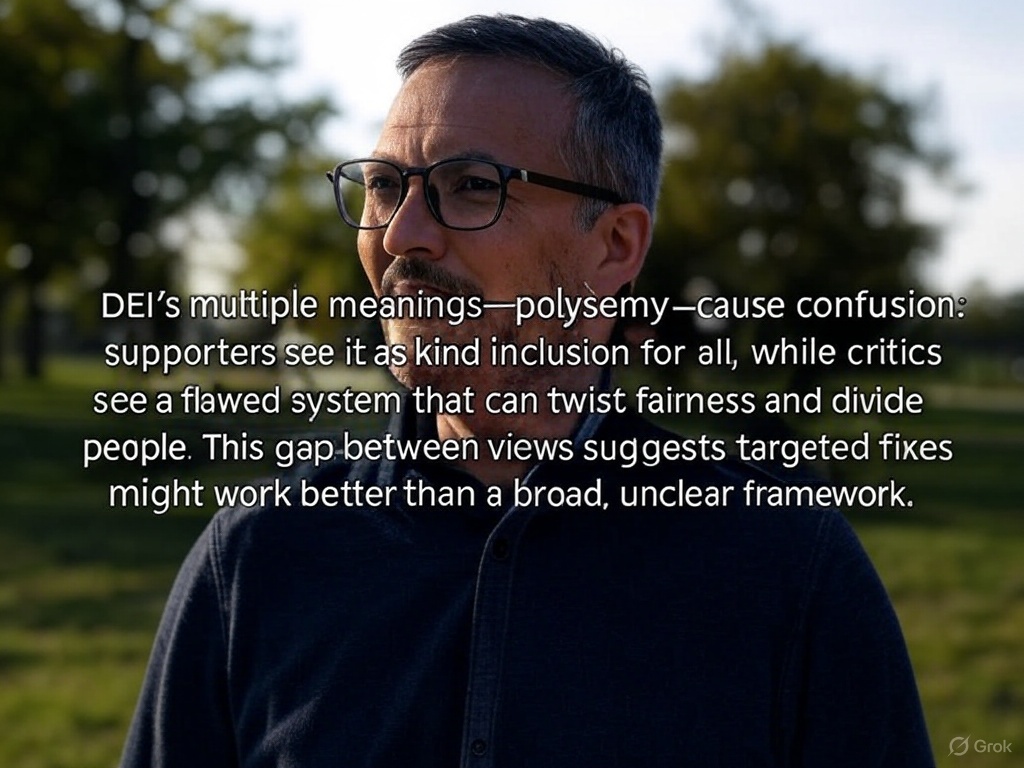
The polysemy of DEI is key here. Supporters often define it as a compassionate, inclusive ideal—helping the marginalized shine, as in your examples. Critics, however, see it as a bureaucratic or ideological tool that, in practice, can distort fairness, divide people, and oversimplify reality. The tension lies in how it’s applied: a supporter’s vision of DEI as “opportunity for all” might not match the critic’s experience of it as “preference for some.” This gap suggests society might benefit more from targeted, practical solutions (like existing laws or community efforts) than a catch-all framework that means different things to different people.
Mark Carney’s daughter Sasha, frequently spun by the media as a cherubic “kid” in pigtails, is actually a 24-year-old Yale grad churning out freelance pieces in Brooklyn. Forget the teddy bear; she’s been writing about her non-binary identity and Tavistock Clinic visits since her teens. But why bother with accuracy when you can slap a “kid” label on her? It’s a cute, cuddly way to dodge her real story and keep Carney looking like the wise, protective dad—while hinting he’s all in on the gender ideology train that says identities can be as fluid as his old Bank of England policies.
This isn’t just lazy journalism; it’s a calculated twofer. Infantilizing Sasha strips her of agency—bye-bye, complex debates about her non-binary life or Yale-honed views—and doubles as a dog whistle that Carney’s a card-carrying believer in gender ideology. Why else let the “kid” narrative slide unless he’s nodding along to the idea that biology’s just a suggestion? It’s a slick move: keep her a helpless prop, sidestep the messy adult reality, and signal his progressive cred without him ever saying a word. Meanwhile, the media gets to skip the nuance and bank on us not noticing.
The deceit’s purpose is as clear as Carney’s Goldman Sachs resume: control the story, polish his image. A “kid” Sasha keeps the spotlight on him as the steady patriarch, not some guy whose grown daughter’s out there challenging norms he’s implicitly endorsed. It’s a bonus that this manipulation paints him as a gender ideology ally—perfect for the woke crowd—while the media rakes in clicks from the saccharine family vibe. They’re not clueless; they’re just betting we’ll swallow the sugarcoated lie over the sharper truth of a 24-year-old living their own life.

The disparity in global outrage between the conflicts in Gaza and Syria is a striking phenomenon that reveals much about media influence, geopolitical dynamics, and public perception. In Gaza, the Israel-Palestinian conflict, particularly since the escalation following Hamas’s attack on October 7, 2023, has garnered immense international attention. Over 46,000 Palestinians have been reported killed by March 2025, according to Gaza health officials, with widespread destruction reducing much of the territory to rubble. This has sparked massive protests worldwide, intense media coverage, and vocal condemnation from various governments and activist groups. The visibility of the conflict is amplified by its historical context, the involvement of Israel—a close Western ally—and the stark imagery of civilian suffering in a densely populated enclave.
In contrast, Syria’s civil war, which has claimed over 600,000 lives and displaced millions since 2011, has faded from the global spotlight despite its staggering toll. The prolonged nature of the conflict, coupled with its complexity involving multiple factions, has led to a sense of fatigue and desensitization among the international community, reducing the urgency and emotional resonance it once held.
Geopolitical interests and alliances further underscore this disparity. Israel’s role in Gaza, supported by significant U.S. military and political backing, places the conflict under a microscope, as it ties into broader narratives of Western imperialism, colonialism, and human rights that resonate deeply with activist movements and progressive audiences. The accessibility of Gaza’s narrative—framed as a David-versus-Goliath struggle—makes it a rallying point for outrage, with real-time accounts from Palestinian journalists and citizens amplifying its reach. Syria, however, lacks a similarly clear-cut antagonist in the eyes of the West. The Assad regime, while brutal, is opposed by a fractured array of rebel groups, some with extremist ties, complicating the moral clarity that drives public mobilization.
Moreover, Syria’s primary allies—Russia and Iran—are already at odds with Western powers, diluting the incentive for sustained Western outrage or intervention. This suggests that the absence of a Jewish or Western state as a central villain in Syria’s case may contribute to the muted response compared to the intense focus on Gaza, where such dynamics align with prevailing ideological currents.
Finally, the scale and speed of devastation also play a critical role in shaping outrage. In Gaza, the death rate has been extraordinarily high in a short period—half of Syria’s decade-long toll in just over a year—concentrated in a population ten times smaller, making the per-capita impact far more immediate and visceral. This intensity, combined with restricted humanitarian access and a blockade, heightens the sense of urgency and helplessness that galvanizes global responses. Syria’s war, by contrast, has unfolded over 14 years, with peaks of violence—like the siege of Homs—spaced out and overshadowed by other global crises, leading to a gradual numbing effect. The recent resurgence of fighting in Syria, such as the rebel offensive in Aleppo in late 2024, briefly rekindled interest, but it lacks the sustained momentum of Gaza’s coverage.
The disparity, then, is not just about numbers but about narrative coherence, media amplification, and the alignment of each conflict with broader political stakes. While both tragedies deserve attention, the uneven outrage reflects a world where emotional resonance and ideological alignment often dictate which crises capture our collective conscience.

A great place to start, I think. :)
1.Economic Freedom for Every Canadian
Imagine a Canada where your hard-earned money stays in your pocket, not drained by endless taxes. We propose bold tax cuts and the permanent end to the carbon tax, lifting financial burdens and sparking economic growth. A Canadian version of DOGE could take this further, injecting innovation into our economy while empowering individuals and businesses to thrive. This is about more than savings—it’s about giving you the freedom to prosper.
2. A Nation Rooted in Culture and Fairness
Canada’s strength lies in its people, but mass migration without limits risks stretching our resources thin and diluting our identity. We stand for controlled immigration that honors our values, paired with a renewed focus on promoting strong families and celebrating Canadian culture. Add to that a commitment to women’s sex-based rights, and we’re building a society that’s fair, united, and proud—free from the clutter of woke nonsense that’s crept into government.
3. Security and Sovereignty Above All
A strong Canada demands safety and independence. We’ll get hard on crime, ensuring justice and security for every citizen, while bolstering our military to protect the north and secure our borders. By stripping out divisive gender ideologies from governance, we refocus on what matters: a nation that’s tough, fair, and fiercely sovereign. This is a Canada worth fighting for—one that puts its people first.











 bleatmop
 Mystro


 Dead Wild Roses
Your opinions…