
There is a moment in certain debates where everything speeds up. Morality is called subjective; subjectivity becomes preference; preference becomes power—and once power is named, the conversation is over. What began as a question about right and wrong turns into a contest of will. The move is effective because it presses on something real: if moral claims have no grounding beyond preference, it’s not obvious why anyone should follow them, especially when defection pays.
The pressure is genuine. The leap that follows is not.
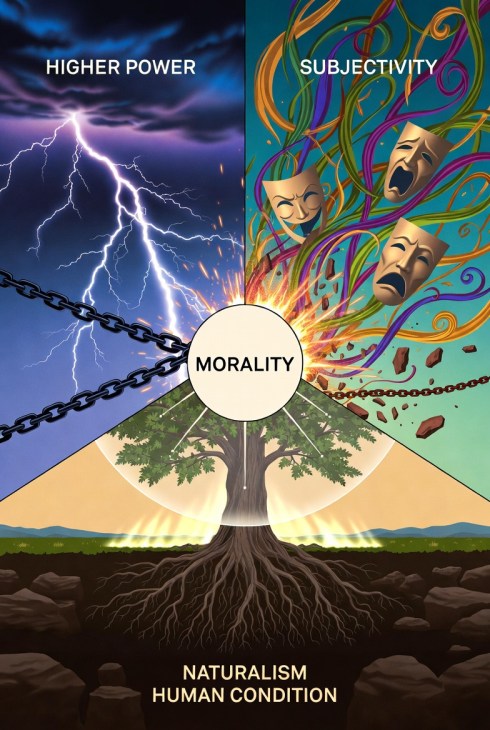
The argument doesn’t stop at identifying the problem. It slides past it. The claim arrives fully formed: without objective grounding, morality collapses into power; if there is grounding, it must lie beyond human beings. From there, the appeal to a higher authority presents itself as the only way out. It’s clean, decisive—and too quick. It skips a possibility that does not depend on metaphysics at all.
You don’t need a higher power to get constraint. You need a world that pushes back. That is already enough for science. The success of a model has little to do with who proposes it and everything to do with whether it survives contact with reality. When it fails, it fails for everyone. No appeal to authority rescues it. That is objectivity without metaphysical scaffolding.
Something similar appears in moral life, though in a different register. Human beings are not abstract choosers floating above circumstance. We are vulnerable, dependent, and locked into repeated interaction with others who are very much like us. That combination exerts pressure. Cooperation is not optional if anything stable is to be built; defection carries costs that accumulate; control over outcomes is partial at best; and roles do not remain fixed. Over time, those conditions shape what can persist.
Rules that cannot be justified beyond advantage tend to fracture. Norms that work only when you hold power lose their grip as soon as power shifts. Arrangements that fail under reversal—when you are no longer the beneficiary—erode the moment they are tested from the other side. You can see this in ordinary disputes: a speech rule that feels protective when applied to your side quickly feels suppressive when applied against it. None of this descends from above. It emerges from the conditions under which people have to live together.
“You don’t need a higher power to get constraint. You need a world that pushes back.”
This is why a simple question keeps resurfacing, even among people with no interest in philosophy: would this still make sense if I were on the receiving end? You don’t need theology to ask it. You don’t need a theory of value to feel when the answer is no. You need only to notice that positions change, that vulnerability is shared, and that rules have to survive that movement. That alone rules some things out. Not everything. But not nothing.
The familiar objection comes back quickly: if this is all human arrangement, isn’t it still just power? The answer is that power without constraint is unstable. Systems built on dominance invite resistance; rules applied asymmetrically invite defection; norms that cannot justify themselves beyond advantage lose legitimacy the moment advantage shifts. These are not floating intuitions. They are structural pressures. They can be ignored for a time. They do not disappear.
The point of the “nuke” is not to prove that morality is objective in the way gravity is objective, or that every moral question has a single correct answer waiting to be discovered. It does something narrower and more useful. It removes the claim that, absent a higher power, morality collapses into arbitrary preference backed by force. There is a third option: morality can be constructed and constrained at the same time—neither invented freely nor dictated from above, but shaped by the conditions under which human beings must deal with one another.
The attraction of higher grounding is easy to understand. It promises certainty, authority, final answers. Naturalism offers something thinner: no absolute guarantees, no universal enforcement, no resolution that settles every dispute. What it does offer is a way to sort between rules that hold up and those that don’t, to explain why some norms persist while others unravel, and to resist both relativism and coercion without appealing to anything outside the world.
Scientific objectivity does not require a perfect observer; it requires that models fail when they are wrong. Moral objectivity does not require a divine lawgiver; it requires that rules fail when they cannot withstand contact with the people they govern. That is a narrower claim than the one often made. It is also enough.
You can believe that morality ultimately rests beyond human beings. You can also see that, even without that belief, moral systems do not collapse into chaos. They bend, strain, and sometimes fail, then rebuild under pressure. They are not unconstrained—because we are not unconstrained.
And that pressure, more than any proclamation, is what gives morality its shape.











 bleatmop
 Mystro


 Dead Wild Roses
Leave a comment
Comments feed for this article