
You are currently browsing the category archive for the ‘Canada’ category.
This is what transgender ideology looks on the inside. The vulnerable narcissism, the victim/persecution complex, and the complete inability to function in normal society.
This is what happens when your beliefs cut you off from your family and friends. All you have left is your “glitter-family” whose support is conditional on your maintaining the cult ideals.
This is why people are starting to call out gender ideology (see SOGI 123 within Canada) in our schools and learning institutions. Gender ideology is inherently destabilizing for children and it sets them on a self and societal destructive path.
Just say “NO”.


Letter to the PM and Premier Doug Ford on the danger of “gender affirming care”. Share widely. 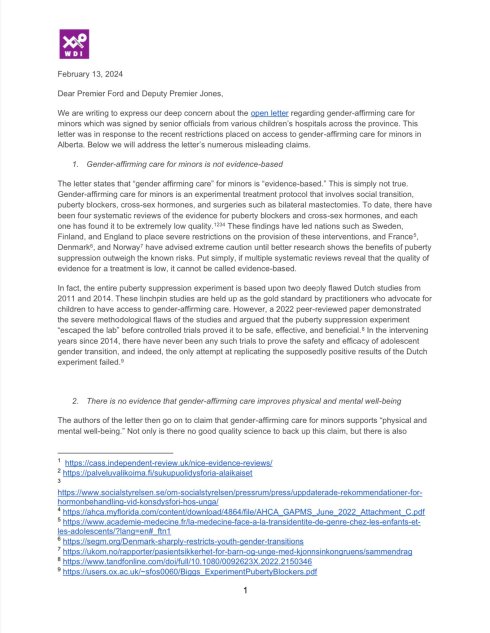

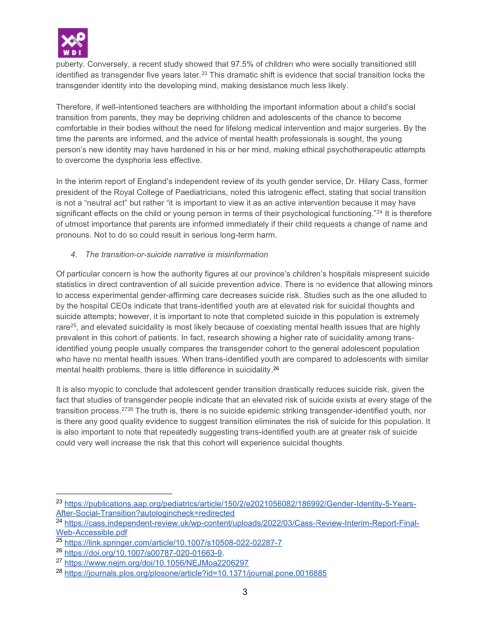

Heartening. :)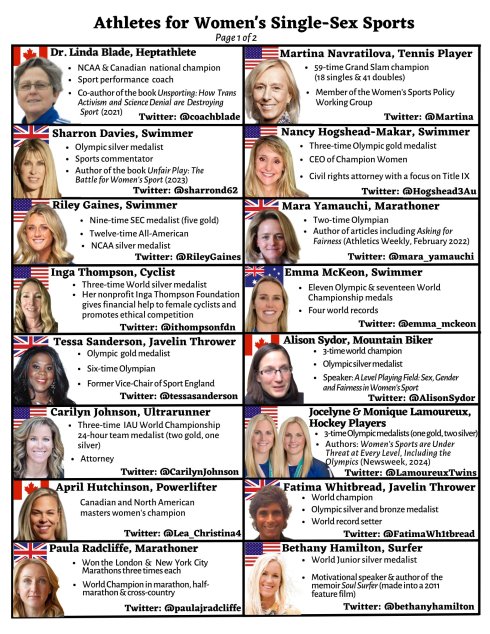
Reproduced in full – Find the original here.
“A common claim by Americans who oppose state restrictions on “gender-affirming care” is that Sweden, Finland, and the U.K. have not done away with hormonal interventions—and therefore that Republican lawmakers who seek such restrictions are going beyond Europe, and presumably against what European health authorities recommend. Jack Turban, a prominent voice in the affirmative-medicine movement and a notorious source of misinformation on this issue, has said that “not a single country” in Europe “has banned gender-affirming care for trans youth.” The claim is true in a narrow and technical sense, but highly misleading.
In the past few years, European health authorities conducted systematic reviews of evidence for the benefits and risks of puberty blockers and cross-sex hormones. The findings from these reviews—that the certainty of benefits is very low—guided the hand of policymakers there to restrict access to hormones. Currently, minors in these countries can access puberty blockers and cross-sex hormones only if they meet strict eligibility requirements as set out in the Dutch protocol and only in the context of a tightly controlled research setting.
As I’ve explained in pastwritings, the research from the Dutch clinics is championed even by American proponents of “affirmative” medicine as the gold standard in pediatric gender medicine. These advocates either don’t know or are deliberately misleading the public about the discrepancy between the Dutch protocol and what is actually happening in American clinics. The American approach effectively puts distressed teenagers in the driver’s seat of making risky and irreversible medical decisions. It assumes that “gender identity” is innate and immutable, that some kids are just born “trans” and can know this from as young as toddlerhood. It also uses the “minority stress” model to explain away co-occurring mental-health problems, which appear in roughly three-quarters of patients presenting at pediatric gender clinics.
In effect, once a child declares that he is trans, the role of doctors is to “affirm” that declaration medically. Parents are to consent to treatments or get out of the way. Mental-health professionals are there only to help the child cope with the stress that comes from being in a minority, since, as Turban puts it, “most of society is awful.”
One source of confusion, therefore, concerns what, exactly, white-gowned activists like Turban mean when they say “gender-affirming care.” As Hilary Cass noted in her report to the U.K.’s National Health Service, the American affirmative model removes the main guardrails put in place by the Dutch protocol, resulting in a lack of medical “safeguarding.” At least in its official policy, Europe is decidedly not practicing what Turban considers “gender-affirming care.”
To be sure, the problems with the American affirmative model should not conceal the fact that the Dutch study itself rests on a very shaky empirical foundation. The study’s flaws were discussed at length in a recent peer-reviewed article, but two in particular should be mentioned before considering the European systematic reviews.
First, the Dutch study’s lead author, Annelou de Vries, has admitted that “resolution of gender dysphoria” was its “main finding.” But this finding was based on a highly questionable use of the Utrecht Gender Dysphoria Scale—a measure originally developed for diagnostic purposes, not to assess treatment outcomes. The scale is sex-specific, which means that biological males and biological females are given different versions of it. Among other differences, the female version includes questions on menstruation while the male version includes questions about erections. In their follow-up assessments, the Dutch team gave boys who had undergone hormonal treatments the girls’ scale and girls who had undergone hormonal treatments the boys’ scale. Thus, biological males were asked whether experiencing menstruation caused them distress. Since even boys who “transition” do not get periods, those who answered the questionnaire reported a low level of distress. In other words, the plummeting scores in gender dysphoria that the Dutch team reported as their “main finding” was not necessarily due to actually resolved dysphoria, but more likely to switching the scales.
Second, replication is a bedrock of scientific analysis, yet the only attempt to date to replicate the Dutch study, conducted in the U.K., failed. Preliminary results from the study, which began in 2010, were reported as very unimpressive, with adolescents after one year of puberty suppression showing an “increase in internalising problems and body dissatisfaction, especially natal girls.” Moreover, the cohort that received puberty blockers showed no statistically significant difference from the cohort that received only psychotherapy. As Michael Biggs has pointed out, the full picture of the study’s findings became public only after a prolonged campaign to force the researchers to publish their findings.
Contrary to what American activists imply, the systematic reviews of evidence in Sweden, Finland, and the U.K. did not find that the Dutch study, on which the Dutch protocol is based, constitutes high-quality evidence. One of the core questions in the systematic review by the U.K.’s National Institute for Health and Care Excellence (NICE) was this: “In children and adolescents with gender dysphoria, what is the clinical effectiveness of treatment with GnRH analogues [puberty blockers] compared with one or a combination of psychological support, social transitioning to the desired gender or no intervention?” Using the Grading of Recommendations, Assessment, Development, and Evaluations (GRADE) system, NICE assessed the Dutch study for seven reported metrics of mental health impact: gender dysphoria, depression, anger, anxiety, body image, global functioning, and psychosocial functioning.
It found that evidence for benefits across all seven measures was of “very low” certainty. NICE’s conclusion about all the studies on puberty blockers, including the Dutch, was unequivocal: “Studies that found differences in outcomes could represent changes that are either of questionable clinical value, or the studies themselves are not reliable and changes could be due to confounding, bias or chance.” NICE conducted a separate systematic review for cross-sex hormones (which the Dutch study did not independently cover) and found that “[a]ll the studies . . . are uncontrolled observational studies, which are subject to bias and confounding and were of very low certainty using modified GRADE. A fundamental limitation of all the uncontrolled studies included in this review is that any changes in scores from baseline to follow-up could be attributed to a regression-to-the mean” (because patients tend to report for care at the peak of their distress).
The systematic reviews by Sweden’s Committee for Medical and Social Evaluation (SBU), meantime, likewise found that the evidence for the mental-health benefits of hormones, including from the Dutch study, was very uncertain, because of the “moderate to high risk of bias” in these studies. The studies exhibit numerous methodological shortcomings, including confounding factors, lack of control groups, and high rates of attrition. “The identified scientific basis regarding hormone treatment of children and adolescents with gender dysphoria,” SBU concludes, “is limited and it is not possible to draw any conclusions with moderate or high reliability. For most outcomes examined in this report, the evidence is insufficient and conclusions cannot be drawn.” SBU also reported “low confidence” in the assessed health risks of hormonal interventions in minors. In essence, Sweden recognizes this as a medical experiment with no high-quality, reliable data on long-term benefits or risks.
The results from the evidence review in Finland are harder to interpret because most of the studies evaluated involved adults, and the review did not rate the quality and reliability of the studies. In other words, the review did not try to assess the degree to which even the positive findings in the Dutch study were causally related to the hormonal treatments. Nevertheless, on the basis of this review, and a study published by Finnish gender clinicians shortly thereafter finding that “medical gender reassignment is not enough to improve functioning and relieve psychiatric comorbidities,” the country’s Council for Choices in Health Care (COHERE) issued new recommendations in 2020. Even for patients whose gender issues appeared first in childhood and intensified in adolescence (a pathway that is required for hormonal eligibility under the Dutch protocol but optional under the American-affirmative one), COHERE recommends that “the first-line treatment for gender dysphoria is psychosocial support and, as necessary, psychotherapy and treatment of possible comorbid psychiatric disorders.” In the same document, COHERE emphasizes that “gender reassignment of minors is an experimental practice.” This includes minors transitioned under the Dutch protocol.
Yes, Sweden, Finland, and the U.K. still allow a tiny subset of minors with gender issues access to puberty blockers and cross-sex hormones. But they are doing so under tight restrictions and against the findings of their own systematic reviews—or, as in the case of Finland, in full recognition that this constitutes medical experimentation on minors.
A good case can be made that Republicans who seek to ban these interventions entirely are being more faithful to the findings of the European evidence reviews. The real debate between red states in the U.S. and European health authorities is not about whether there is good evidence for pediatric gender transition. There isn’t. Rather, the debate is about whether children as young as eight with a strong desire for “gender affirming” drugs have the ability to understand fully and give informed consent to the long-term consequences of these interventions—and even if they can, whether this justifies enlisting them in an uncontrolled medical experiment.”
If you would like to learn more about Therapy First, to support our work, or to find a therapist for you or your child, please reach out: www.therapyfirst.org. Go to their website and check them out – they are mental health resource that puts therapy instead of the farce that is gender affirming care in the spotlight.
I have been a practicing psychologist for over two decades and this is, by far, the most difficult work I have ever engaged in. I can understand why many therapists do not feel equipped to work with young people who are convinced that the only way for them to live in their bodies is to transition socially and medically.
It is challenging to sustain a meaningful connection with someone who is stuck in a black/white mindset and who is exquisitely attuned to whether you participate in the culture and language of social justice and gender affirmation.
Depending on how committed an individual is to a transgender identity, he or she may not tolerate the slightest indication that the therapist questions or is agnostic with regard to the existence of “true trans”. They may see you as a good, kind, caring person for months and then, if in a moment of crisis, they don’t perceive you to be fully aligned with their belief system, they will reject you without hesitation.
At the same time, frightened and exhausted parents are putting their faith in you to loosen the vice-like grip that trans identification has on their child and, by extension, on every member of the family. Having been such a parent myself I feel enormous empathy.
I also know that most of the work has to happen at home, in the family. I am more than willing to offer guidance and support, and even clear instructions in real time on what to do and say when escalations happen.
When things go wrong, what rage parents and children cannot safely direct at each other will get directed at me. As a process-oriented clinician that’s what I sign up for.
In truth, I don’t possess skills or knowledge that any well-trained and experienced mental health practitioner doesn’t have or isn’t capable of acquiring. Therapy is still just therapy.
What’s different is the real damage that medicalized transition can do to young people who are in emotional pain and in need of thoughtful care and attention. What’s also different is the urgency with which families approach us hoping we might hold the key to pulling their children out of harm’s way. There’s so much on the line.
Clinicians who work with trans-identifying teens and young adults feel a pressure that we do not experience when faced with other issues that are no less serious than gender dysphoria. Moreover, we are doing this work in a professional and political climate that is hostile to the very ethical principle that we vow to live and work by, to first and foremost do no harm.
The good news is that since its establishment three years ago Therapy First (formerly GETA) has grown from a small handful of clinicians to now almost 400 strong. We are here for each other so that we can be there for you and your family. While the treatment of gender dysphoria has become weaponized, our aim is to move the focus away from the political and back to the clinic, back to the work we are confident and passionate about.
If you would like to learn more about Therapy First, to support our work, or to find a therapist for you or your child, please reach out: www.therapyfirst.org.
Nothing gets the juices flowing more than a little woke hypocrisy in the afternoon. Scrolling through facebook I saw a post for a choral get together with the goal of showing “the transphobes” how wrong they are.
My first reaction was one of exasperation because the individual who uttered it is currently kicking up a huge fuss in the choral community. The reason? She got in a disagreement with the conductor about whether wearing a “they/them” pronoun pin on stage was acceptable part of the dress code for a professional choir.
Pro-tip: It’s not. And she wouldn’t let it go – so Fing around and finding out involved not having her contract renewed with said professional choir. Play stupid games and win stupid prizes. Unfortunately, as it is with so many of the Woke zealots, she has an activist bent and has been wailing about how oppressive the decision was and how the ‘ENTIRE ORGANIZATION’ is transphobic. This is the standard tactic for the woke activist – you call something/someone transphobic until they relent to your demands or the organization crumbles. It’s bullshit and I hope the professional choir as the fortitude to withstand the struggle session it is being put through.
“They/them” othered their ideological opponents in a public comment and I found that to be infuriating because there is no sense of fairness in the statement. “Othering” is a one way problem.
People that meltdown when people are “othered” shouldn’t participate in the othering of their ideological opponents. Calling people you disagree with “transphobes” illustrates the strong lack of an ethical system behind followers of gender ideology.
So many people get taken in by the bullshit woke propaganda around gender ideology. People who usually ‘follow the science’ seem to turn off that part of their brain and go along with the “be kind, be inclusive” crowd without a second critical thought. Their behaviour boggles the mind.
The information is out there – heck – even in the Calgary Herald. Why are people suddenly so desperately incurious about issues they claim to be staunch and relentless defenders of?
From the Calgary Herald Dr. Roy Eappen Endocrinologist writes –
“As a practising endocrinologist who understands what these invasive and irreversible medical interventions can do to young people, I couldn’t be more supportive of Alberta’s decision to protect children. There’s not nearly enough evidence to justify their use on children, yet there’s plenty of evidence that they harm them.
Unsurprisingly, this move has come under swift attack from some in Canada’s “chattering classes” including journalists, some academics and a few politicians who are either unaware or don’t care about the realities of kids’ bodies.To that end, there has been a torrent of media coverage alleging that Alberta is endangering children and abandoning medicine. That’s false. Sex-reassignment interventions can do serious physical and mental damage, leading to lifelong health programs that would otherwise be avoided.
Besides, Canadians who uncritically support such physical interventions to children and teenage bodies would do well to broaden their horizons. They may be surprised to learn that international organizations and European countries that they commonly look to for leadership are urging the very caution that they oppose.”
Damn, I guess that would make the medical associations in the UK, Sweden, Norway, Finland, Denmark and France ALL SERIOUSLY TRANSPHOBIC.
Along with the hypocrisy the usual woke tactic is to call everything they disagree with as “insert slur here” rather than presenting an argument or compelling evidence.
Dr. Eappen continues:
“Consider the World Health Organization (WHO). Last month, the WHO declined to issue guidelines for transgender procedures for children, on the grounds that “the evidence base . . . is limited and variable regarding the longer-term outcomes.” The words “limited” and “variable” are significant and cautionary. The first, “limited,” means it’s far from clear that so-called “gender-affirming” medical interventions are beneficial. The second, “variable,” hints at the evidence that children who get these interventions suffer. Coming from the World Health Organization, that’s quite a statement indeed.
Or consider Europe. A growing number of countries have already banned or severely restricted children’s access to transgender interventions, based on systematic reviews of the science. That includes England, Sweden, Finland and Norway, while Belgium, France, Ireland and Italy have raised concerns. We’re talking about countries that are generally aligned with Canada, ideologically. They’re looking at the science and seeing red flags. What’s wrong with Alberta doing the same thing?Canadians who reflexively see gender transition as an extension of previous advocacy for gay civil rights should know that it’s not. Instead, “gender-affirming” care for children is essentially gay conversion therapy.Multiple studies have found that most kids who are confused or distressed about their sex end up realizing they’re gay — nearly two-thirds in a 2021 study of boys. Yet if they go down a transgender road, they’ll lose sight of who they really are.
Before England started taking child safeguarding seriously, clinicians at the country’s main transgender service referred to prescribing puberty blockers as “transing the gay away.” They also joked that “there would be no gay people left” if they continued helping kids medically transition. Is that really what Canadians want for our country’s gay and lesbian kids?
The fact is that about 80 per cent of children who believe they’re transgender eventually come to terms with their sex without surgical or pharmaceutical intervention. The worst thing we could do is prevent them from discovering who they really are by pushing them down the road of irreversible medical interventions.
Alberta has joined Saskatchewan and New Brunswick in doing the right thing. Now the rest of Canada should follow suit.”
So it looks like evidence based medicine is transphobic, material reality is transphobic, and really the truth must be at least doubly transphobic.
Link to the Calgary Herald – hhtps://calgaryherald.com/opinion/columnists/opinion-alberta-is-right-children-should-be-protected-from-transgender-procedures
Link to the paper cited – https://link.springer.com/article/10.1007/s11930-023-00358-x
Sorry folks just tired of the fact free hyperbole surrounding the issue. We need to get back to reality based arguments. The sooner the better.

The first of the manipulations, and the center of how it works, is the collectivization of the “LGBTQ2 community.”
This thing does not exist meaningfully. It’s not even a genuine coalition. Gay people, and so on, exist, but that acronym represents nothing but a lie.
However they spell the acronym, its purpose is to collectivize all of the people in certain descriptive demographics and to allow the radicals to speak for their entirety, making it appear like many “marginalized” people support Woke stuff when actually only few do.
That is, Queer Activism is being done in the names of a broad pseudo-coalition “community” denoted by the acronym, even though most individuals in that “community” aren’t represented by it and may even reject it outright. Queer Activists hide behind a synthetic coalition.
It bears repeating that throughout the Queer literature, it is stressed and stressed again that “Queer” is an oppositional political stance, not an identity at all. That proves, outside of the obvious rejection by people falsely claimed by the “community,” that it’s fake.
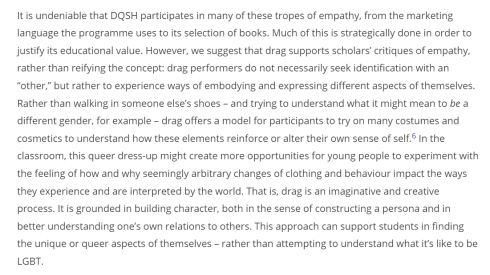

It also proves that the Queer Activists KNOW the “LGBTQ2 community” is an artificial construction that they’re manipulating to gain empathy and support they don’t deserve. Let that sink in. They KNOW it. They’re DOING IT ON PURPOSE, WILLFULLY. So here is the Liberal Party.
So this is the first huge manipulation here: making people believe in a broad “LGBTQ2 community” that doesn’t exist except as a manipulative pseudo-coalition that speaks for and hides behind sexual minorities so it can do destructive oppositional Queer Activism in its name.
The second huge manipulation here is the claim that anything resisting Queer Activism “harms” this “community.” First of all, no it doesn’t. It just doesn’t. Nobody is being “harmed” at all. That claim is the wail of a histrionic narcissist not getting his way.
Second of all, the community itself can’t be “harmed,” even if it existed (remember, it’s a fake pseudo-coalition ginned into existence by Queer Activists to hide behind). Only individuals can be harmed, and they could be treated individually rather than collectively if harmed.
This part of the manipulation twists the ethos but not the logic of civil rights into its inverse. The logic of civil rights is that no INDIVIDUAL should be harmed through discriminatory law or policy. It has nothing to do with groups or their rights, but this inverts that logic.
People have been led to think civil rights is about protecting groups (“protected classes”) when in reality “protected classes” refers to classifications under which all individuals are protected against discriminatory activity. Race, not specific races, is protected this way.
The third part of the manipulation is in the idea of “harm” itself. For Queer Theorists, not getting their way is “hate” and “harm.” They paint a picture of fringe cases where something bad happens as though they’re indicative of the population. They’re not.
They’re trying to claim that all members of a fictitious “community” are “harmed” so they can emotionally blackmail people into supporting radical agendas from within (Communist) Queer Theory, when in fact a few individuals have problems blamed on a system, rightly or wrongly.Their objective is to provide universal solutions that might be merited in a small number of individual cases by claiming “the community is harmed.” This is akin to doing universal screenings or treatments in medicine, which is strongly discouraged for good reasons.
Doing universal cancer screenings, for example, produces far more false positives than real positives and puts people into fear and onto courses of treatment that actually harm them when they don’t need them. This “community” stuff treats the whole community for a few bad cases.
It’s malpractice justified through collectivist empathy. The remedy is to install the praxis of Queer Activism everywhere so the few special cases don’t get missed and “harmed,” but Queer Activism harms everyone, and what you might hope it would be harms most people.
The reason they think this way is because Queer Theory posits that our true, essential nature is queer. Everybody is queer. It’s who we really are, and we have to be led BACK into realizing it because it’s socialized out of us by cisheteronormative society.
What this actually reveals about Queer Theory is that it’s a Gnostic or Hermetic cult (both, really). Our true nature is obscured from us, and we have to be led to remember it by escaping the evil forces obscuring it from us. We’re all “spiritually” queer but don’t realize it.
Since Rousseau and Marx, “spiritually” has meant collectively in society. Marxism is the belief that our true spiritual nature is “social(ist),” and we have to be re-socialized into realizing who we really are: a social species with the power to create itself and our world.
Queer Theory just posits that we’re all queer (abnormal and intrinsically opposed to limitations of normalcy), but we’ve been socialized to be “normal” instead. So denying Queer Activist praxis to ALL kids (and all people) “harms” them spiritually. That’s what they really mean.
We don’t have to put up with this emotional blackmail anymore, nor do we have to accept that a fringe of radical activists with demonstrable cult views gets to present itself as the “true” voice of a broad coalition that it holds out as tokens for empathy and support.











 bleatmop
 Mystro


 Dead Wild Roses
Your opinions…