
You are currently browsing the category archive for the ‘Culture’ category.
Women will bring peace to the world (if men don’t destroy it first) and they shall do it through understanding and listening to each other. Listen to the power of their words.
“Ten black mothers sat on the stage in an auditorium and looked into a diverse crowd of women in the audience. They were about to share something personal and hurtful with this room full of mostly strangers.
They were going to talk about something they didn’t normally share with their white friends or colleagues.
It was about to get real in that room.
In the aftermath of the killing of Michael Brown, an unarmed black teenager fatally shot by a white Ferguson, Missouri police officer, conversations about race in the St. Louis area have been loaded.
Christi Griffin, the president of The Ethics Project, wanted this to be different. She wanted to invite mothers of other races to hear directly from black mothers the reality of raising a black son in America. She wanted them to hear the words they each had said to their own sons, in different variations over the years, but all with the same message: Stay alive. Come home alive.
She wanted mothers who had never felt the fear, every single time their son walked outside or drove a car, that he could possibly be killed to hear what that felt like.
Griffin’s son, now grown, had never gotten in trouble nor given her any trouble growing up. But when her son was 14 years old, the family moved into an all-white neighborhood. She took him to the police department to introduce him to the staff. She wanted the officers to know that he belonged there, that he lived there.
When he turned 16, it was time for another talk. Every single time he got into his car to drive, she made him take his license out of his wallet and his insurance card out of the glove compartment.
“I did not want him reaching for anything in the car.”
He graduated from college with a degree in physics.
Marlowe Thomas-Tulloch said that when she noticed her grandson was getting bigger and taller, she laid bare a truth to him: Son, if the police stop you, I need for you to be humble. But I need more than that. I need for you to be prepared to be humiliated.
If they tell you take your hands out of your pockets, take your hands out. Be ready to turn your pockets out. If they tell you to sit down, be prepared to lie down.
You only walk in the street with one boy at a time, she told him.
“What?” her grandson said. In his 17-year-old mind, he hadn’t done anything wrong and nothing was going to happen to him.
“If it’s three or more, you’re a mob,” she said. “That’s how they will see you.”
She started to cry.
“Listen to me,” she begged. “Hear me.”
Finally, she felt him feel her fear.
If they ask you who you are, name your family.
Yes, sir and no, sir. If they are in your face, even if they are wrong, humble yourself and submit yourself to the moment.
“I’m serious,” she said. “Because I love you.”
She told him she would rather pick him up from the police station than identify his body at a morgue.
When her grandson left to go home, she called her daughter to tell her about the conversation. Her daughter asked her what she had said, because her son came home upset, with tears in his eyes.
“I hope I said enough to save his life,” Thomas-Tulloch said. “I’d rather go down giving him everything I got.”
The mothers talked about the times their sons had been stopped in their own neighborhoods because “they fit the description.” They shared the times their sons had come home full of rage and hurt for being stopped and questioned for no reason. And they told the other mothers how often they told their sons to simply swallow the injustice of the moment. Because they wanted them alive, above all.
Amy Hunter, director of racial justice at the YWCA in metro St. Louis, said it’s taken her 10 years to be able to share this story about her son without crying. She didn’t want her white friends to see her cry when she told it. She didn’t want to look weak.
Her four children are now older, but when one of her sons was 12, he decided to walk home from the Delmar Loop in University City where he had met some friends.
He saw a police officer circling him, and he knew. He was wearing Sperrys, a tucked-in polo shirt, a belt. He was 12, and he knew, but he was scared.
He lived five houses away, and he hadn’t done anything wrong.
“I knew you were home,” he said to his mom when he finally made it home after being frisked. “I knew I was about to get stopped, and I thought about running home to you.”
His mother froze.
“I forgot to tell him,” she said. “I forgot to tell him: Don’t run. Don’t run or they’ll shoot you.”
Her 12-year-old cried when he told her what had happened and asked if he was stopped because he was black.
“Probably, yeah,” she said.
“I just want to know, how long will this last?” he asked her.
That’s when she started to cry.
“For the rest of your life,” she said.
It doesn’t matter about your college degree, the car you drive, the street you live on, she told the moms in the audience. It’s not going to shield your child like a Superman cape. She admitted that it was difficult to share these painful moments.
Just one of the mothers on the stage asked a single question of the audience. Assata Henderson, who has raised three children, all college graduates, said she called her sons to ask them what they remembered about “the talk” she had given them about how to survive as a black man.
“Mama, you talked all the time,” they said to her.
It made her wonder, she said. She said she wasn’t pointing any fingers, but it made her wonder about the conversations the other mothers were having with their sons, who grow up to be police officers, judges and CEOs.
“You’re the mothers,” she said to the crowd. “What are the conversations you are having with the police officers who harass our children?”[
[Source]
More than you’d think really. Human beings seem to intrinsically value fairness and equality and yet, as of today have constructed societies based on moving as far away as possible from any sort of equitable norm.
Take note of the piece on John Rawls and how using the Veil of Ignorance idea as a cognitive filter for making decisions. I think it is a great idea adding to the list of processes one should go through in making tough decisions in the personal, moral and political sphere.
It is kind of amazing how Wikipedia manages to survive given all the anti-reality tendencies of the human race. Religion, extreme right and left politics – wikipedia manages to muddle through most of the time and present a version of truth that is mostly acceptable. More amazing is that the editors are more or less, like you and me.
Listen and watch Zittrain explain how the useful Wikipedia is and how it could be used in the future as a hands on tool for participatory citizenship.
 Why are drugs still illegal? I wrote a while ago about the success of Portugal, where all drugs were legalized, and the money previously used to enforce drug laws were instead used to fund social programs to help those with drug problems. Not only was Portugal’s drug abuse problem significantly reduced, but HIV and crime rates plummeted as well. It has been almost 15 years since Portugal started their non-prohibition experiment, with revolutionary results, and yet other countries still refuse to let go of their self-defeating War on Drugs.
I have recently read a fantastic interview with Johann Hari, on Sam Harris’ blog. Hari is a highly experienced and accredited journalist who has travelled the globe researching and writing a book on the War on Drugs, its history, and it’s effects on societies. While a good portion of the interview elaborated many of the points I was already familiar with, there was a massive amount of information that I had no previous notion of. For instance, while it is quite apparent that racism plays a big role in drugs issues today, I had no idea that racism played such a huge part in the War on Drugs’ inception. There are further insights that extend far beyond drug addiction as well. Hari also focuses quite a bit on individual stories, bringing a painfully absent human element to the discussion. It certainly provides a lot to think about. Here are a few excerpts, but I highly recommend reading the entire interview.
“Harry Anslinger was probably the most influential person that no one’s ever heard of. He took over the Department of Prohibition just as alcohol prohibition was ending … he was driven by two intense hatreds: One was a hatred of addicts, and the other was a hatred of African Americans…He was regarded as an extreme racist by the racists of the 1930s. This is a guy who used the “N” word in official memos so often that his own senator said he should have to resign.”
“But if you had said to me four years ago, “What causes, say, heroin addiction?” I would have looked at you as if you were a bit simpleminded, and I would have said, “Heroin causes heroin addiction.”
For 100 years we’ve been told a story about addiction that’s just become part of our common sense. It’s obvious to us. We think that if you, I, and the first 20 people to read this on your site all used heroin together for 20 days, on day 21 we would be heroin addicts, because there are chemical hooks in heroin that our bodies would start to physically need, and that’s what addiction is.
The first thing that alerted me to what’s not right about this story is when I learned that if you step out onto the street and are hit by a car and break your hip, you’ll be taken to a hospital where it’s quite likely that you’ll be given a lot of diamorphine. Diamorphine is heroin. It’s much more potent than what you get on the street, because it’s medically pure, not f***ed up by dealers. You’ll be given that diamorphine for quite a long period of time. Anywhere in the developed world, people near you are being giving loads of heroin in hospitals now.
If what we think about addiction is right, what will happen? Some of those people will leave the hospital as heroin addicts. That doesn’t happen.”
“You and I have probably got enough money in the bank that we could spend the next year drinking vodka and never stop. We could just be drunk all the time. But we don’t. And the reason we don’t is not because someone’s stopping us but because we want to be present in our lives. We’ve got relationships. We’ve got friends. We’ve got people we love. We’ve got books we want to read. We’ve got books we want to write. We’ve got things we want to do. Most of addiction is about not wanting to be present in your life.
And by the way, that’s true not just of drug addiction. If you’ve ever known a gambling addict, you see that the pleasure he’s getting is not the pleasure of the specific bet. It’s the pleasure of not being present in his own life. It’s the pleasure of being taken out of himself, even to what I regard as a very squalid and depressing world. It’s the same with sex addiction. There’s a continuity between drug addictions and other addictions that I think tells you something fundamental.”
“We need to create a society where people are less isolated and distressed. There are places in the world where that exists: Addiction is very low in Sweden, because it’s a very connected society with very low levels of insecurity. We can learn from that.”
The War on Drugs is society shooting itself in the foot. The U.S has escalated the war to shooting itself in the kneecaps and Canada is looking to follow suit. We need to stop this before we end up aiming even higher.
Well it had to happen sooner or later, the viciously anti-woman contingent of local forced birth brigade came to campus with their misleading fetus porn and all the lovely related argument for women to be incubators first and people second.
Thankfully the feminist and queer communities counter demonstrated to help push back some of the nonsense being spread.
 Life-Site News has a sad. Too bad fetus-fetishists.

Helpful hints for the local forced birth advocates.
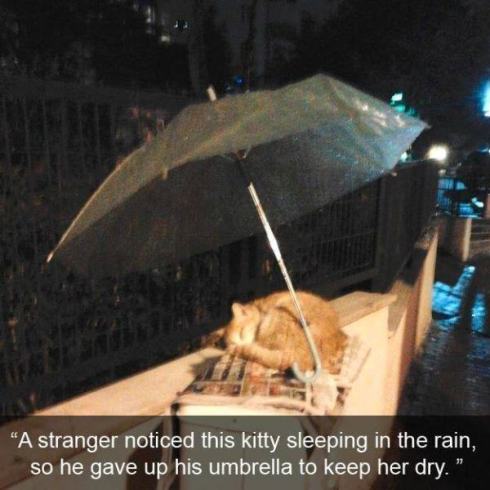
Sometimes we need a reminder that the world isn’t the news, that mostly(sometimes?), we are good people who do kind things for each other.



 I’m always impressed with La Belle Province and her ability to serve up controversy. Recently a judge in Quebec decided that a hijab was considered not to be suitable attire for her courtroom and dismissed a case when the litigant refused to comply with her request. The judge’s words courtesy of the CBC:
“Hats and sunglasses for example, are not allowed. And I don’t see why scarves on the head would be either,” Marengo says in the recording.
“The same rules need to be applied to everyone. I will therefore not hear you if you are wearing a scarf on your head, just as I would not allow a person to appear before me wearing a hat or sunglasses on his or her head, or any other garment not suitable for a court proceeding.”
The stage is set and the result:
“When El-Alloul first appeared before Marengo, the judge asked her why she had a scarf on her head. El-Alloul replied that it was because she is a Muslim. The judge then said she would take a 30-minute recess.
When Marengo returned, she told El-Alloul she had a choice: remove her headscarf immediately or apply for a postponement in order to consult a lawyer. El-Alloul replied that she couldn’t afford a lawyer and that she didn’t want to postpone the case. Marengo then adjourned the case indefinitely.”
Boom. Tinder meet match. Religious freedom versus the institutional values of a secular court.
There are a multitude of ways to look at what transpired in the courtroom but here are two that I think represent both sides of the argument.
A. In a secular court of law, the secular values and rules of a society must be followed. If a judge rules that what you’re wearing to be inappropriate for the proceedings it behooves you to follow the same standards that everyone else must follow.
B. Canada is a multicultural society and we respect and treasure the cultural practices that every Canadian brings to the table and, if secular protocol can be reinterpreted to allow for the diversity of cultural expression within secular institutions we should do so.
Before we go into further discussion we should note the reaction from El-Alloul, it was one of shock and dismay:
“[…] But what happened in court made me feel afraid. I felt that I’m not Canadian anymore.”
“El-Alloul said she’s speaking out because she doesn’t want what happened to her to happen to any other Muslim woman. When she insisted I should remove my hijab, really I felt like she was talking with me as … not a human being. I don’t want this thing to happen to any other lady. This is not the work of a judge. She doesn’t deserve to be a judge.”
El-Alloul is rightly quite upset at the outcome of her hearing (or lack thereof). There should be a more amenable solution available to the parties involved – a transfer to a different judge that has a more liberal interpretation of ‘suitably dressed’ might have saved a lot of ink and electrons as this story blossomed across Canadian news networks.
This seemingly simple case of what “suitably dressed” means and how it is enforced speaks to how intersectional an issue multiculturalism is. Institutional power in Canada remains largely white and male and thus reflects the normative values of what is considered ‘normal’ culture here in Canada. From this orthodoxy we get the notions such as:
1. Why should our Canadian institutions cater to every whim of the minorities?
2. If it is good enough for everyone else, what is the problem here?
3. Why aren’t secular Canadian values being learned by new Canadians?
Under the assumption that we are a multicultural society, clearly, point 1 is out to lunch. The very point of having a tolerant open society is that we appreciate and try to accommodate the everyone and their preferences within the state structure of Canada.
Point 2 is problematic because the words “everyone else” usually uses the dominant culture as a touchstone thus, by play of words, avoids the obvious racism associated with similar statements.
Point 3 has the most merit as new Canadians do adopt Canadian values and standards, but the process of acculturation takes a great deal of time, often generations before the values of the dominant culture are ingrained. It is unrealistic however to expect that somehow Canadians of all types have a switch that can be flipped instantaneously that would guarantee cultural assimilation.
The Hijab should be allowed in Canadian courtrooms as it does not interfere with workings of the court or the dispensing of justice.
However, as an open and tolerant secular society we should also have the ability to rightly name and not adopt cultural practices that would be corrosive to our society. For instance, honour killings and female genital mutilation, have no place in Canadian or any other civilized society and I can assert this claim with a good deal of confidence because we need only to discuss the negative impacts these practices have on those societies who still practice these modalities (cultural relativism be damned).











 bleatmop
 Mystro
 The Arbourist


 Dead Wild Roses
Your opinions…