
You are currently browsing the category archive for the ‘Culture’ category.
Totalitarianism doesn’t always arrive with jackboots and slogans. Sometimes it comes wrapped in compassion, weaponizing language to divide citizens into moral castes of “the good” and “the guilty.” As James Lindsay warns, every ideology that builds itself on purging an “enemy” eventually devours its own believers. Today’s soft totalitarianism operates not through force, but through narrative warfare—using labels like “Maple MAGA” or “anti-equity” to silence dissent and enforce ideological purity.

The Totalitarian Mindset in Our Midst
The belief in any totalitarian system is that there is some ‘enemy’ that holds back society. Once that enemy is destroyed and purged, society will flourish, or so the cult belief goes.” —James Lindsay
The Endless Enemy
James Lindsay’s observation is not a history lesson it’s a warning. Totalitarian movements always begin with the conviction that society’s ills can be traced to a corrupt class of people who must be identified and eliminated.
The logic is seductively simple: If only the enemy were gone, we could be free. But when the promised harmony never arrives, the search for hidden enemies intensifies. The hunt becomes perpetual, the paranoia self-sustaining. Every failure is blamed on infiltration, every setback on the persistence of the impure.
This cycle of purification is as old as ideology itself, but today it is being revived in softer, subtler ways—through moralized language, social shaming, and bureaucratic enforcement of political conformity.
The New Form: Narrative Warfare
In modern liberal democracies, totalitarianism doesn’t need guns or gulags. It begins with words. The authoritarian project of the 21st century is linguistic—it manufactures enemies through labels, controls discourse through moral accusation, and demands conformity under the banner of compassion.
In Canada and across the West, we see this in the weaponization of language: “Maple MAGA,” “anti-equity,” “white adjacent,” “problematic.” These aren’t analytical categories; they’re *filters of suspicion.* Once the label sticks, a person’s character and arguments no longer matter. They are marked.
This dynamic is a form of narrative warfare—the use of moralized storytelling to delegitimize opponents and consolidate cultural power. It’s the precondition of soft totalitarianism: control the story, and you control reality.
Weaponized Intersectionality: A Framework for Division
One of the key delivery systems for this mentality is **weaponized intersectionality**. Originally coined by legal scholar Kimberlé Crenshaw to describe overlapping forms of discrimination, the concept has been repurposed into a political sorting mechanism—one that divides society into immutable identity classes of “oppressors” and “oppressed.”
|Tactic |How It Works| Effect on Society |
| Labeling & Name-Calling | Terms like “Maple MAGA,” “far-right,” or “white adjacent” pre-empt debate and morally quarantine dissent. | Delegitimizes citizens instead of arguments; silences conversation. |
| Moral Purity Tests | Demands that allies demonstrate constant ideological conformity (“anti-racist,” “affirming,” “decolonized”). | Creates fear of speaking or questioning; enforces orthodoxy. |
| Institutional Capture | Activist vocabulary embedded in policy, HR, and education under “diversity” and “equity” mandates. | Bureaucratizes ideology; punishes dissent within organizations. |
| Perpetual Enemy-Hunting| “Privilege” and “bias” are re-discovered endlessly; the enemy is never gone, only hiding. | Normalizes suspicion; sustains revolutionary fervor without end. |
Each tactic reinforces the other. Together, they recreate the same cycle Lindsay describes: a social order sustained by perpetual purification.
The enemy is not gone; it is merely “in hiding.”
The Moral Mechanics of Control
Modern totalitarianism thrives on moral certainty rather than state terror. It convinces ordinary citizens that they are participating in justice, not oppression. To question the narrative is to expose oneself as suspect, and so the culture of fear spreads horizontally—through HR departments, social media platforms, and educational institutions.
This is how freedom erodes without a coup or revolution: through social coercion disguised as moral progress.
The power lies not in force, but in the internalization of guilt and fear. People censor themselves before anyone else has to.
What We Can Do About It
1. Recenter Universal Principles
Defend equality before the law, free inquiry, and human dignity—not inherited guilt or group virtue. Anchor civic life in the moral universals that totalitarian ideologies deny.
2. Name the Dynamic
When faced with ideological bullying, describe what’s happening: *“This is an attempt to morally disqualify rather than discuss.”* Naming the tactic exposes the manipulation and halts its momentum.
3. Build Parallel Forums for Open Debate
Create independent media, civic associations, and discussion circles where disagreement is respected. The antidote to coercion is community.
4. Refuse the Language of Division
Reject slurs and invented terms designed to fragment society. Language is not neutral—it’s the primary weapon of soft authoritarianism. Don’t wield theirs.
5. Practice Moral Courage
The first act of resistance is speech. Speak calmly, truthfully, and consistently—even when it’s uncomfortable. Silence is the oxygen of control.
Conclusion: The Old Lie in a New Form
Totalitarianism does not march under the same banners it once did. It arrives softly, wrapped in moral rhetoric and bureaucratic language, persuading good people that they are fighting for justice. But as Lindsay warns, every ideology that builds itself on purging an enemy eventually devours its own believers.
The only true defense is to reclaim our shared humanity—to judge one another by deeds, not descent; by actions, not affiliations. Freedom, as it turns out, depends not on the absence of enemies, but on the courage to refuse the hunt.
—
References
Lindsay, J. (2025, October 9). Why totalitarianism always produces mass murders. [Tweet]. X (Twitter). [https://x.com/ConceptualJames/status/1976724498213667156](https://x.com/ConceptualJames/status/1976724498213667156)
Crenshaw, K. (1989). Demarginalizing the Intersection of Race and Sex: A Black Feminist Critique of Antidiscrimination Doctrine, Feminist Theory and Antiracist Politics. University of Chicago Legal Forum.
Orwell, G. (1946). Politics and the English Language.
Arendt, H. (1963). Eichmann in Jerusalem: A Report on the Banality of Evil.
Popper, K. (1945). The Open Society and Its Enemies.
Hannah Arendt’s portrait of Adolf Eichmann as a thoughtless bureaucrat lingers as a caution against evil’s mundane guise. Christopher Browning’s Ordinary Men extends this indictment, trading Eichmann’s desk for the blood-soaked forests of Poland, where Reserve Police Battalion 101—500 Hamburg ‘everymen’—executed 39,000 Jews and deported 44,000 more to Treblinka in 1942-43. These were no zealots: middle-aged draftees, family men untouched by Nazi fervor, yet they pulled triggers with grim efficiency. Browning’s forensic reconstruction from postwar trials complements Arendt, illuminating how conformity, not conviction, forges complicity. In an age of ideological silos, their story warns that thoughtlessness scales from individual abdication to collective carnage.
Arendt diagnosed Eichmann’s evil as a failure to think—to judge actions against universal humanity—yielding obedience’s autopilot. Browning operationalizes this in RPB 101’s crucible. On July 13, 1942, in Józefów, Major Trapp’s order to slaughter 1,800 innocents included an opt-out: a dozen stepped forward, fathers haunted by their own children’s faces. The rest? They fired, vomited, and fired again, bound not by hatred but by the group’s inexorable pull. Peer pressure proved the deadliest weapon: to demur meant isolation, whispers of cowardice, or worse—standing alone amid the splatter of brains and pleas. As Browning dissects, “binding factors” like deference to authority and aversion to shame radicalized the reluctant. Initial nausea faded into routine; Jews devolved from neighbors to “bandits,” their deaths logged as quotas met. This mirrors Arendt’s “banality”: not demonic intent, but the quiet erosion of moral agency, where thinking cedes to fitting in.
Browning’s men prefigure Arendt’s broader fear—that totalitarianism thrives on unreflective masses. Unlike Eichmann’s abstracted ledgers, these policemen confronted the visceral: a mother’s wail, a child’s gaze. Yet empathy atrophied through diffusion—blame smeared across the chain of command—and progressive desensitization. A few resisted, sabotaging hunts or feigning illness, their conscience a fragile bulwark against the tide. Most drifted, careerism and alcohol dulling the sting. Browning invokes social experiments like Milgram’s obedience studies, positing such dynamics as human universals, not German pathologies—a riposte to claims of cultural exceptionalism.
This convergence sharpens lessons for our fractured present, where critical constructivism and woke Marxism summon conformity’s specter. Critical constructivism, an epistemological framework that treats knowledge as socially mediated and entwined with power—rejecting empirical objectivity for interpretive lenses shaped by culture and positionality—echoes RPB 101’s euphemisms, recasting dissent as dominance while evidence bows to constructed narratives. Proponents propagate without pause, their deference to “lived experience” a peer-enforced gag on Socratic probe. Woke Marxism, a repackaged Marxism applying class struggle to identity oppressions—framing queer theory as “gender Marxism” and intersectionality as “identity Marxism”—amplifies this through performative allegiance. Its rituals—DEI oaths, cancellation tribunals—demand uncritical adherence, sidelining judgment for allegiance, much as Trapp’s men traded qualms for camaraderie. Ordinary adherents comply, not from malice, but inertia: promotions hinge on nods, ostracism on silence.
Arendt and Browning converge on the antidote: reclaim thinking as defiant praxis. In algorithm-curated echo chambers, where ideologies brook no fracture, epistemic humility—questioning, pluralizing, judging—arrests the slide. Thoughtlessness is choice, not fate; conformity’s shadow lifts only through vigilant reflection. Honor the dead of Józefów not with memorials alone, but by fortifying the ordinary against atrocity’s call. Goodness demands depth; evil preys on the shallow. In choosing to think, we dismantle the battalion within.

References
Arendt, H. (1963). Eichmann in Jerusalem: A Report on the Banality of Evil. New York: Viking Press. (Primary source for the concept of the banality of evil and its philosophical underpinnings.)
Browning, C. R. (1992). Ordinary Men: Reserve Police Battalion 101 and the Final Solution in Poland. New York: HarperCollins. (Core historical analysis based on postwar judicial testimonies, detailing the battalion’s actions and psychological dynamics.)
Dead Wild Roses. (2025, August 25). “Unraveling the Roots—How ‘Woke’ Emerges from Social Construction.” https://deadwildroses.com/2025/08/25/unraveling-the-roots-how-woke-emerges-from-social-construction/. (Defines critical constructivism via Kincheloe’s assumptions, linking it to woke epistemology and power-mediated knowledge.)
Dead Wild Roses. (2022, April 6). “Queer Theory is Gender Marxism – James Lindsay.” https://deadwildroses.com/2022/04/06/20651/. (Critiques woke Marxism as repackaged identity-based Marxism, drawing on Lindsay’s analysis of queer theory and intersectionality.)
Goldhagen, D. J. (1996). Hitler’s Willing Executioners: Ordinary Germans and the Holocaust. New York: Alfred A. Knopf. (Contrasting thesis on German antisemitism, referenced by Browning to highlight universal rather than cultural explanations.)
Hilberg, R. (1961). The Destruction of the European Jews. Chicago: Quadrangle Books. (Foundational Holocaust scholarship on the “short, intense wave of mass murder” in 1942, informing Browning’s timeline.)
Milgram, S. (1963). “Behavioral Study of Obedience.” Journal of Abnormal and Social Psychology, 67(4), 371–378. https://doi.org/10.1037/h0040525. (Seminal experiment on authority compliance, invoked by Browning to explain diffusion of responsibility in RPB 101.)
Trunk, I. (1972). Judenrat: The Jewish Councils in Eastern Europe Under Nazi Occupation. New York: Macmillan. (Contextual background on Jewish councils’ coerced roles, paralleling themes of complicity under duress.)
When political violence erupts, it often looks random — a lone extremist, a protest that gets out of hand, or a clash between two angry groups. But much of what we’re seeing today, in both the United States and Canada, is not random at all. It is part of a deliberate strategy that activists call dialectical warfare — and it is tearing at the heart of our democratic societies.
The assassination of Charlie Kirk and the furious conservative backlash that followed are not isolated events. They are part of a larger spiral of violence and reaction, one that radicals hope will end with the collapse of our current system. To understand how, we need to unpack an old idea: the dialectic.
What is the Dialectic?
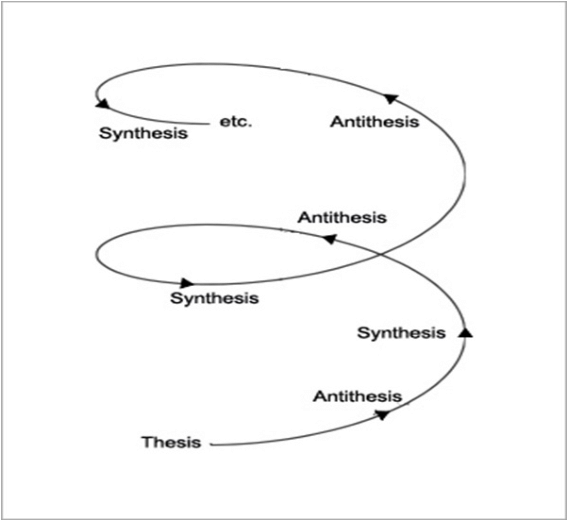
The word “dialectic” comes from philosophy, specifically the German thinker Georg Wilhelm Friedrich Hegel in the early 1800s. At its simplest, the dialectic is a way of describing how history moves forward through conflict.
- Thesis: the current system or status quo.
- Antithesis: the force that challenges it.
- Synthesis: a new system that emerges after the clash.
For Hegel, this was a way of understanding history as a story of progress. Marx later took this idea and made it the foundation of his revolutionary theory. For him, history was about class struggle: workers against capitalists. Capitalism, he argued, would eventually collapse under its contradictions and give way to communism.
The key point is this: conflict isn’t a bug in the system — it’s the engine of history.
From Philosophy to Political Activism
Fast forward to today. Many left-wing activists, consciously or not, operate with a dialectical mindset. They believe that society advances through conflict and breakdown, not peaceful debate.
That means chaos, division, and even violence can be seen as useful. If enough conflict is stirred up, the system will be forced to reveal its flaws, overreact, and eventually collapse — clearing the way for something new.
This isn’t conspiracy theory. Activist manuals, writings from radical groups, and historical revolutionary movements all share this logic. The goal is not stability. The goal is destabilization.
Dialectical Warfare Today
Dialectical warfare is what happens when activists deliberately create or amplify conflict to destabilize society. Here’s how it works in practice:
- Provocation: Protests or acts of violence designed to draw a harsh reaction.
- Overreaction: Authorities or opponents respond too aggressively, confirming the activists’ narrative.
- Crisis: The clash erodes faith in institutions and convinces people the system doesn’t work.
- Escalation: Each cycle of conflict moves society further up the spiral toward collapse.
It’s not about winning the argument. It’s about breaking the system so that something “better” (usually some form of socialist utopia) can be built on the ruins.
The Charlie Kirk Case
The recent assassination of Charlie Kirk shows this dynamic clearly. For the radical Left, the act of violence itself was a shock designed to destabilize. But what mattered more was the reaction.
Conservatives in power, outraged and furious, began employing the same tools that had once been used against them: censorship, cancel culture, and efforts to silence left-wing voices. In their anger, they began shredding the same democratic norms — free speech, due process, respect for law — that they had once fought to defend.
From the perspective of dialectical warfare, this is a victory for the radicals. The point was never just to kill one man. The point was to provoke an overreaction that would weaken the credibility of conservative leaders, make democratic institutions look fragile, and drive polarization even deeper.
Why This is Dangerous
Every time conservatives react by copying the authoritarian tactics of the Left, they confirm the radicals’ worldview. They prove that democracy is a sham, that free speech is a lie, and that the system is doomed.
This is exactly what the activist Left wants. They welcome conservative overreach, because it accelerates the collapse of the old order. The tragedy is that in fighting back, the right risks becoming what it hates: reactionary, authoritarian, and destructive of the very freedoms it claims to defend.
Lessons from History
We have seen this before. In the 20th century, totalitarian movements from Communism in Russia to fascism in Germany thrived on dialectical conflict. They used street violence, political assassinations, and manufactured crises to polarize society. Each overreaction by their opponents brought them closer to power.
The idea is seductive: “This system is broken. Only radical action can save us.” But the results are always catastrophic. Millions died under regimes that promised utopia and delivered tyranny.
A Simple Analogy
Think of democracy like a family car. It’s not perfect — sometimes it breaks down, sometimes it needs repairs. Activists practicing dialectical warfare are not trying to fix the car. They are trying to crash it on purpose, believing that after the wreck, they’ll be able to build a perfect new vehicle.
But history shows that after the crash, what you usually get is not a better car — it’s a dictatorship.
The Dialectical Spiral at Work
To make this crystal clear, here’s how activists see the spiral — and what really happens:
| Stage | Activist Left’s View | What Actually Happens |
|---|---|---|
| Provocation | Stir conflict (riots, violence, incendiary rhetoric) to expose “systemic oppression.” | Communities destabilize; trust erodes. |
| Reaction | Force conservatives into authoritarian overreach. | Free speech and rule of law weaken; institutions lose credibility. |
| Crisis | Show that democracy and capitalism can’t solve the conflict. | Cynicism deepens; polarization hardens. |
| Escalation | Push society up the spiral toward “revolution and utopia.” | Cycle repeats, leading not to utopia but greater instability. |
Why We Must Resist
The activists’ dream of a communist utopia is a fantasy that has failed every time it’s been tried. But their strategy of dialectical warfare is very real — and very effective at breaking societies apart.
The assassination of Charlie Kirk and the conservative overreaction it triggered are a warning. If we allow ourselves to be baited into authoritarian responses, we are not saving democracy — we are digging its grave.
The only way forward is to resist the spiral: to defend free speech, uphold the rule of law, and refuse to play into the radicals’ hands. Otherwise, we will all be dragged into the chaos they long for, and the freedoms that make Western society unique will vanish in the wreckage.
References
- Hegel, G.W.F. The Phenomenology of Spirit (1807).
- Marx, K. & Engels, F. The Communist Manifesto (1848).
- Arendt, H. On Violence (1970).
- Popper, K. The Open Society and Its Enemies (1945).
- Contemporary coverage: Reuters, Associated Press, Fox News (Sept. 2025) – reporting on the assassination of Charlie Kirk and ensuing political fallout.
Emanuel Brünisholz, a Swiss repairman, has made headlines for refusing to pay a fine imposed for a social-media comment stating what he says are biological truths: that there are only two sexes as determined by skeletal evidence. Because he wouldn’t pay the fine, he opted instead to serve 10 days in jail. He was convicted under Switzerland’s anti-discrimination laws (Art. 261bis), which have been expanded to include “sexual identities” beyond race, religion, etc. His statement was judged to belittle the LGBTQI community and violate human dignity, though Brünisholz insists he was speaking objective biological fact. (Reduxx)
This case is deeply troubling, because it illustrates a slippery slope: when a judge or prosecutor can criminalize speech that claims a biological fact, simply because some group interprets it as hateful. That is not far off from what proposed Canadian legislation threatens. The Combatting Hate Act, introduced in September 2025, would make it a criminal offence to “wilfully promote hatred” against identifiable groups (including on grounds of gender identity) by any public display or speech. It also aims to streamline prosecutions for “hate propaganda,” remove some procedural checks, and broaden the definition of hate. Critics warn that this will give activist minority claims outsized power over what counts as acceptable speech. (Government of Canada)
If Brünisholz’s case was an outlier, then Canada’s proposals make clear this is a trajectory, not a one-off. Under the proposed laws, someone could theoretically be prosecuted (and even imprisoned) for speaking truths about biological sex if a court determines that such statements violate the new definitions of hatred or hate speech. That means what is scientifically or biologically reality could become illegal speech, depending on who is offended and how strong the activist pressure is. In a Western democracy that claims to defend freedom of expression, this is simply unacceptable.
We must not accept that the mere possibility of offending a protected group is enough for criminal sanction. We must resist laws that hand over the power to judges or prosecutors (or activist complainants) to decide what biological truths are “hate.” Because once speech can be criminalized based on activist interpretation, the foundations of open, free inquiry, reason, and reality are at risk.
Key Comparisons: Swiss Case vs. Proposed Canadian Laws
| Feature | Swiss Case (Brünisholz) | Proposed Canadian Laws (Combatting Hate Act / related bills) |
|---|---|---|
| Nature of statement | Emphasis on binary sex; “only man and woman” skeleton argument | Biological sex, gender identity claims could be targeted under new definitions of hate |
| Punishment | Fine convertible to 10 days jail if unpaid | Proposed penalties include imprisonment, removal of procedural protections |
| Law basis | Anti-discrimination / hate speech law expanded to “sexual identities” in Switzerland | Criminal Code, Criminal Code’s hate propaganda provisions, amendments to CHRA, etc. |
| Risk of censorship | High — statement considered “belittling” a protected class despite appeal to biological evidence | Also high — definitions are broad; courts could side with activist interpretations over scientific or factual speech |
| Freedom of speech concern | Biologically rooted fact may be criminalized if deemed insulting or hateful | Same concern: scientific / truth claims could be suppressed if they conflict with activist definitions of what counts as acceptable speech |
Why This Matters
- Biological Truths Are Not “Opinions” Alone: Things like male vs. female biological sex are backed by sciences like genetics, anatomy, forensic anthropology. If those become “hate speech” when expressed, then reality is subject to legal veto by ideological enforcement.
- The Power to Define “Hate” is the Power to Silence: Under Canadian law, if definitions of hatred or hatred-motivated speech expand (especially by removing required consent, or giving prosecutors more discretion), then more speech becomes liable—not because it causes harm, but because someone claims it does.
- Free Speech is Not Optional: Western democracy is built in part on being able to speak even unpopular or uncomfortable truths. If truth becomes legally risky, we’re no longer free—even if the penalties aren’t always applied.
- Precedent Matters: Once speech is criminalized for some, even “harmless” speech tomorrow could become the target. Laws tend to expand in scope over time. The Brünisholz case shows how “harmless to some, hateful to others” becomes a legal equation.
What to Watch & What to Do
- Monitor what the final definitions are in Canadian bills: how they define hatred, “wilfully promoting hatred,” “identifiable groups,” and what defenses are permitted (e.g., truth, scientific basis).
- Watch penalties: whether fines only, or possibility of imprisonment; whether Criminal Code or human rights tribunal; how strong the burden of proof is.
- Pay attention to how administrative procedures work: whether prosecutors need prior approvals, whether individuals or groups can privately instigate charges/complaints, whether there’s ability to appeal.
- Support and defend free speech, especially for dissenting or scientific views. Speak out when persons are penalized for expressing what others call “politically incorrect truths.”

References
- “Swiss Man Opts For Jail Time Instead Of Fine After Being Charged Over ‘Transphobic’ Social Media Post”, Reduxx, Sept 26, 2025 — Brünisholz case. (Reduxx)
- “Combatting Hate Act: Proposed Legislation to Protect Communities Against Hate”, Government of Canada, Sept 19, 2025 — summary of proposed amendments, hate definitions, penalties. (Government of Canada)
- “Canada Introduces Legislation to Combat Hate Crimes, Intimidation, and Obstruction”, Department of Justice Canada news release, Sept 19, 2025 — details on new offences including intimidation, obstruction, containing identity grounds. (Government of Canada)
Every September 30th across Canada, Orange Shirt Day (now National Day for Truth and Reconciliation) is observed with solemnity. Citizens wear orange, school announcements, flags, ceremonies, all to remember Canada’s residential school system. It’s portrayed as a day to heal, teach and reconcile. But when you scratch beneath the surface, something troubling appears: decades of government dependence and ritual symbolism have not ended the suffering of Indigenous peoples; instead, they may have become a vector for grift, misdirection, and a self-hating narrative that benefits activists more than the communities they claim to help.
The origin story is widely told: Phyllis Jack Webstad, a six-year-old Indigenous girl, arrives at the St. Joseph Mission Residential School wearing a new orange shirt her grandmother bought, only to have it stripped from her, never to be returned. That orange shirt became a symbol: a signifier of loss, assimilation, the shaming of identity. The symbol is powerful. However, many of the policy promises, social programs, treaties, financial transfers, and activist campaigns tied to this narrative have failed to produce meaningful outcomes. Indigenous communities still suffer high rates of poverty, addiction, substandard housing, educational deficits, health disparities. Charities, NGOs, and governments use the orange shirt repeatedly — for visibility, for fund-raising, but without accountability or measurable improvement. The result? A recurring narrative of victimhood and dependence that seems endless.
Worse, this narrative is used to silence dissent. If you question the efficacy of current reconciliation policies, or ask why measurable metrics remain so poor, you are accused of “denial,” “insensitivity,” or “racism.” If you point to failures of governance, internal corruption, or poor leadership within Indigenous administrations, you are told you are denying colonial oppression’s continuing harm. The universal assumption is that the only problem is insufficient funding or lack of heartfelt apology — never that the policies themselves, or their administration, may be part of the problem. This is pernicious because it stifles honest discussion, innovation, and real solutions. Orange Shirt Day is no longer just a remembrance day; it’s become a sacred narrative that many are afraid to critique — and in a liberal democracy that prides itself on free speech, that should set off alarm bells.
Suggested Improvements / Alternatives
- Shift the emphasis from symbolism to outcomes: Measures of educational attainment, health improvements, housing quality in Indigenous communities compared over 10, 20, 30 years.
- Hold those in authority accountable: Indigenous governments, federal & provincial governments, NGOs — what have they done concretely?
- Allow critique: Encourage the voices of Indigenous people who say reconciliation policy has failed, rather than centering only activists’ rhetoric.
- Reduce dependency: Focus on policy reform that encourages independence, local governance, entrepreneurship, merit-based support, not perpetual victimhood.

References
- Orange Shirt Day, The Canadian Encyclopedia. Details on the origin with Phyllis Webstad, residential schools system, “Every Child Matters.”
- Al Jazeera: “What is Orange Shirt Day and how is it commemorated in Canada?” — background, statistics, origin story, ceremony and observance practices. (Al Jazeera)
- Centennial College Library Guides: institutional summary of Orange Shirt Day history & schooling context. (Centennial College Library Guides)
- Peace Arch News: Orange Shirt Society founder’s concern about Orange Shirt Day being co-opted, misremembered, or replaced in official messaging. (peacearchnews.com)
- Montreal CityNews: issues with merch, designers, t-shirts, people profiting off the symbol. (CityNews Montreal)
The Taliban’s gender apartheid in Afghanistan has erased decades of women’s rights, yet Western feminists remain largely mute. This selective outrage undermines global solidarity and demands scrutiny.
The Plight of Afghan Women
Since the Taliban’s 2021 return, Afghan women live under the harshest restrictions in the world. Girls are banned from schooling beyond sixth grade. Women are barred from most employment, forbidden from traveling without male chaperones, and compelled to wear full coverings. More than 80 edicts—54 targeting women—have stripped them of agency.
The results are devastating: suicide rates among Afghan women now exceed those of men, a stark marker of despair. The UN describes Afghanistan as the most repressive state for women globally, with its system of gender apartheid potentially amounting to a crime against humanity. Afghan women themselves say they feel “invisible, isolated, suffocated.”
The Silence of Western Feminists
Where is the outrage? Western feminists—so vocal on reproductive rights, pay gaps, and representation—have been notably quiet. In 1997, the Feminist Majority Foundation spearheaded a campaign against Taliban “gender apartheid,” mobilizing U.S. media and Congress. No such mobilization exists today.
Instead, Western feminist discourse remains centered on domestic struggles. Social media cycles amplify abortion battles or workplace equity, while Afghanistan’s crisis rarely trends. A 2022 Human Rights Watch panel highlighted Afghan women’s sense of abandonment—forgotten by those who once claimed solidarity. The silence is more than neglect; it erodes the credibility of a movement that champions global sisterhood.
The Opposition’s View
Defenders argue Western feminists are rightly focused on where they wield influence—local policy fights over abortion or workplace equity. Others fear that advocating for Afghan women risks repeating colonialist “savior” narratives, as post-9/11 rhetoric did.
But caution has curdled into apathy. Silence neither elevates Afghan voices nor restrains Taliban oppression. If anything, Western feminism’s past complicity in militarized “rescue” campaigns demands more careful, accountable solidarity—not retreat.
The Takeaway
Irony abounds: a movement quick to decry domestic patriarchy turns mute before a regime that has locked women in their homes. Afghan women are not asking for saviors, but for allies who will amplify their voices and challenge their erasure.
Consistency is the true test of principle. Championing equality at home while ignoring gender apartheid abroad is not solidarity—it is privilege. The Taliban’s repression is their crime, but Western feminim’s silence is a stain on its conscience.
References
- UN Women. Women in Afghanistan: From Almost Everywhere to Almost Nowhere. Link
- Human Rights Watch. Afghan Women and Western Intervention: A Conversation. Link
- Atlantic Council. In Afghanistan’s Gender Apartheid. Link
In Canada’s high-trust society, the rule of law cannot endure selective enforcement. When certain groups are shielded from consequences while others face harsh penalties for identical actions, the principle of equality before the law collapses. What emerges instead is favoritism by creed or identity—a betrayal that fragments unity and breeds resentment.
Uneven Standards in Practice
Toronto street prayers (August 2024). Hundreds of worshippers staged outdoor prayers at a busy downtown intersection, apparently without permits, halting traffic. Police did not intervene and later described the disruption as lawful. Few doubt how a Christian congregation attempting the same would have been treated: injunctions would be swift, fines inevitable. The point is not hostility toward prayer, but the evident double standard.[1]
Reckless firearm discharge in Muskoka (August 2025). Videos surfaced of men firing rifles and pistols from a snowmobile bridge near MacTier. Ontario Provincial Police confirmed an investigation, warning that careless use of firearms can bring Criminal Code charges. Yet similar celebratory gunfire at cultural festivals, whether at South Asian weddings or Indigenous gatherings, often receives muted responses or “contextual” exemptions. Danger is danger, regardless of tradition.[2]
Pro-Palestinian marches in Toronto (2024–2025). Demonstrations repeatedly blocked major roads, including rallies where smoke bombs were deployed from overpasses. Despite millions spent on policing, arrests remained rare—only 24 across hundreds of events by March 2024. Contrast this restraint with the 2022 Freedom Convoy in Ottawa, where the Emergencies Act was invoked, bank accounts were frozen, and police forcibly dismantled encampments. The contrast is glaring: enforcement appears to hinge less on infractions than on identity and political alignment.[3][4]
Mill’s Warning on Law and Liberty
John Stuart Mill, in On Liberty (1859), emphasized that genuine freedom depends on impartiality of the law. If rules are applied based on popularity or group identity, he argued, society replaces principle with prejudice, inviting arbitrary power. Selective enforcement, Mill warned, is a subtle but corrosive path to tyranny—not only by the state but by favored factions within society.[5]
Restoring Trust
A society built on trust cannot thrive under inconsistent law enforcement. The law must apply equally, regardless of race, religion, or political leaning. To preserve legitimacy, policing standards should be codified and subject to independent oversight. Discretion is unavoidable, but unreviewed discretion becomes favoritism. Equality before the law is not optional—it is the bedrock of Canadian unity. Without it, trust will wither, and division will prevail.

References
- “Toronto residents upset after Hamas supporters blockade busy intersection.” Juno News, Mar 21, 2025. Link
- “Gun video sparks OPP investigation.” MuskokaRadio.com, Aug 28, 2025. Link
“UPDATE: Bracebridge OPP investigating social media videos depicting unlawful firearm use.” MyMuskokaNow, Aug 28, 2025. Link
“OPP seek public help in identifying men firing guns off bridge in Mactier.” Barrie360.com, Aug 30, 2025. Link - “Police arrest two at pro-Palestinian rally that delayed Trudeau event in Toronto.” CityNews, Mar 15, 2024. Link
“Palestine solidarity protesters attacked by police in Toronto.” People’s Dispatch, Apr 3, 2024. Link
“Violent Crackdown at Land Day March.” The Grind Magazine, Mar 31, 2024. Link - “Canada convoy protest.” Wikipedia, accessed Sept 2025. Link
“TD Bank freezes accounts that received money for Canada protests.” Reuters, Feb 12, 2022. Link - Mill, J.S. On Liberty. London: John W. Parker and Son, 1859.











 bleatmop
 Mystro
 The Arbourist


 Dead Wild Roses
Your opinions…