
You are currently browsing the category archive for the ‘Education’ category.

We start our lives as the whole of the universe. Reality is completely comprised of our perceptions and any “outside” object that is blocked from our senses puffs out of existence. Eventually, we learn object permanence, and we recognized that things outside us actually do exist on their own, but we are still the centre of the universe. Then our universe grows a little bit and we can relate to those closest to us and we start to look out for our tiny group. And here, unfortunately, is were too many of us stop.
Empathy is hard. Damn hard. We may well have an innate ability for it, but it is only through a great deal of instruction, practice, and nurturing that empathy can develop and extend beyond our immediate circles. The ability to understand your fellow humans, to see how we’re connected, to look beyond one’s own limited perspective – these are skills that require much honing. They need to be taught.
Here is a short documentary on an empathy class in Japan. It is amazing. These 4th graders display moments of clarity, responsibility, and understanding that outshine many adults in the world. This is an immensely important project, one that needs to be adopted by schools around the world. Grab some tissues, this one is full of all kinds of strong emotions.
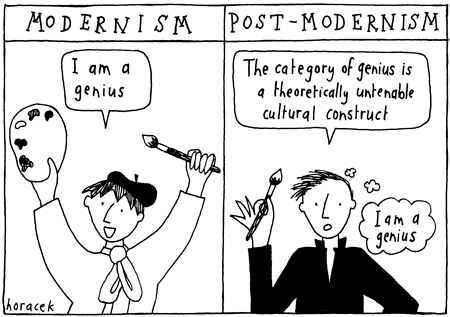 “How We Reached the Point Where We Can’t Hear Each Other” is a article on Counterpunch by Joseph Natoli. I’ve excerpted some of the beginning bits for context, but the best is when he focuses on what is happening in Education and how people are taught to think these days. I’m also a fan of his borrowing of radical feminist methodology that focuses on the the material reality of the situation and the naming of the problem. I heartily recommend you read the full article, as it suggests reasons why we are becoming less social despite ‘social’ media and the corrosive effect that identity politics, one of the crown jewels of post-modern theory, is having on our society.
[…]
“The intent of a past analog world to put us all on the same page so we could all direct ourselves in common to our common, societal problems is something now disseminated into an infinitude of self-designed enclaves. We have connectivity between the like-minded, or opinionated, but not conjunction which Bifo Berardi defines “as a way of becoming other.” (And: Phenomenology of the End, 2015)
If you want to reflect beyond the entrapment of your own personal experiences and the personal opinions derived from such, you are desiring something that has been superseded.
If you want not to be the blind man who feels the tail of an elephant and pronounces the elephant to be shaped like a snake, you are hoping for a door that leads out of the room of your own limited experience.
Unfortunately, there is no longer any need to leave that room because cyberspace has designed the whole world to be your room. You can blog, tweet, text. Video, emoji your reflections online without any intent to augment social knowledge or understanding or to encounter a counter-punch that will cause you to adjust your views.”
[…]
“We exist now within narratives, not impeccable logics and sound proofs, air-tight arguments or binding adjudications. For reasons too elaborate to condense, we have accepted Nietzsche’s view of reason as a pawn of power and have retreated to our own personal reasoning.
This retreat to personal arbitration of all matters is expressed in the politics of identity, a politics concerned with the full emancipation of the individual not as defined within any cultural, religious, historical, or anthropological notion of the individual, but defined by each and every variety of individual. It is as if the individual is a knowledge within itself.”
[…]
Education is also in a special dilemma considering the mission here is get a student to put his or her personal opinions and preferences and different experiences out of sight and attend to a rationally validated collective representation of a subject.
Nathan Heller points out that elite colleges find that the cultivation of the individual is not an easy matter when students will not leave their personal “experiential authority” at the door. (“The Big Easy,” The New Yorker May 30, 2016) One is not reading to extract eternal verities, the Enlightenment dream, or to deconstruct the pretenses of those same verities. In the climate that Heller describes, no content can be permitted to transgress the personally defined identity of the reader or listener.
An Oberlin student who Heller describes as “a trans man …educated in Mexico, walks with crutches, and suffers from A.D.H.D. and bipolar disorder …lately on suicide watch” objected to a discussion of Antigone without a trigger warning, i.e., characters in the play committed suicide. Identity-based oppression is responded to with a theory of intersectionality, which contends, “who knows what it means to live at an intersection better than the person there?” Thus, personal experiential authority now contends with a pedagogic tradition of minimizing the effects of personal experiential authority on objective, rational reflection.
Education attempts to respect individual arrangements of the results of critical thinking but not allow those arrangements to taint the process of critical thinking. This long standing agreement is no longer in effect. We have reached the point where we cannot engage in any way what may “trigger” our personal dislike or what may upset a private space we have self-designed. Long standing notions of both education and society are dissolving.
We now listen to our own voices and our clones in “social” media, a pathological condition that undermines much needed social and political communication and interrelationships. The way out, as with all pathologies, is to first recognize the condition, observe the point we have reached and reorient our compass.”
Teaching critical thinking in public education has always been a revolutionary activity, as this article confirms, it looks like it shall continue to be in the revolutionary category for quite some time.
I spent my years learning French in Highschool(and now forgotten). Now with double the disappointment as I realize how word-awesome German is.
Consider this small list of bon mots:
Weltschmerz – world weariness.
Schadenfreude – a feeling of enjoyment that comes from seeing or hearing about the troubles of other people
Backpfeifengesicht – It describes someone who you feel needs a slap in the face.
Sitzfleisch — (seat meat) – it describes a character trait. Those who possess a lot of seat meat are able to sit through and weather something incredibly hard or boring.
Dreikäsehoch (Three cheeses high) – However, what it describes is a person who is vertically challenged, implying they’re only as tall as three wheels of cheese placed on top of each other.
Schattenparker (Shadow parker) – This word is part of a series of insults for men which accuse them of unmanly behavior. In this case, of parking their car in the shadow to avoid heating up the interior.
Forget French as Canada’s second language it ought to be German. :>

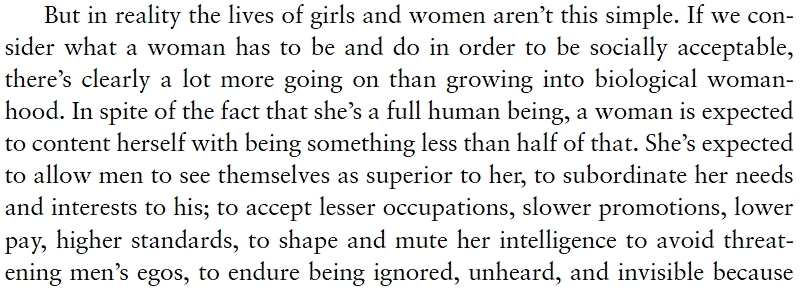


-Allan Johnson on compulsory femininity
(the systematic expectations and goals of female socialization)
David Cromwell excels at identifying key points of friction between public and private interests. In this excerpt he examines how higher learning is being bent to fulfil its corporately mandated responsibilities to society.
“This [Academia] is a privileged sector where critical thought and enquiry into human society, the natural world and the cosmos ought to be the norm; not where overwhelming pressure to conform to state-corporate interests should be exerted on teaching and research agendas.
How can academic ‘collaboration’ with large corporations which are, after all, centralised systems of illegitimate power, not lead to compromise, distortion or worse? It is clearly not in the interests of such institutions to promote rational and honest study into the problems of a corporate-shaped society. It is in their interests to commandeer the publicly-funded research while co-opting supposedly neutral and objective academia as ‘partners’. And all the better if highly trained university researchers working in narrow, focused disciplines remain disconnected from the interests in other disciplines, or more importantly, from the concerns of the general populace.
‘To work on a real problem (like how to eliminate poverty in a nation producing eight hundred billion dollars’ worth of wealth each year) one would have to follow that problem across many disciplinary lines without qualm, dealing with historical materials, economic theories, political obstacles’, observed historian Howard Zinn, author of The People’s History of the United States, who died in 2010. ‘Specialisation ensures that one cannot follow a problem through from start to finish. It ensures the functioning in the academy of the system’s dictum: divide and rule.’ Zinn provided a potent example: ‘Note how little work is done in political science on the tactics of social change. Both students and teacher deal with theory and reality in separate courses; the compartmentalisation safely neutralises them.’
Any management vision of how the university sector, or any place of higher education, ought to develop that does not recognize the nature of the iniquitous capitalist society in which the university finds itself embedded, is short-sighted. And, moreover, any such ‘vision’ that is not committed to making radical changes in the way society is structured is tacitly, if not actively, supporting the status quo. The same argument applies to any major institution in society.”

-David Cromwell. Why Are We The Good Guys? pp. 216 – 217
So, great you have a degree, well done sport! Did they teach you to comply or to question the society that you inhabit?











 bleatmop
 Mystro


 Dead Wild Roses
Your opinions…