
You are currently browsing the category archive for the ‘Feminism’ category.
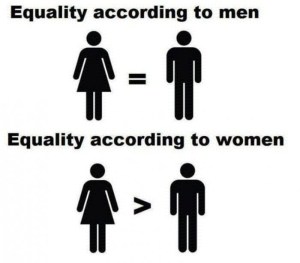
This message brought to you on behalf of entitled, scared men everywhere… (see more on the ‘equality trap’)
I do love my subscription to the OED word of the day mailing list, and metagrobolize is just too good a word to forget; thus I need to use it a bunch and get it implanted into my vocabulary, pardon my logophilia.
I’ve been reading with much more frequency as late definitions of feminism in which the stated goal of feminism is for women to achieve equal rights with men and then, once this goal has been achieved, *poof* the need for feminism is over. It would seem a large proportion of male commentators (and some females as well) believe that we have reached this post-feminist age and women should just STFU already and revel in how damn good it is for them.
I find this analysis of feminism problematic because if focuses on the individual struggle rather that the broader struggle women face as class in patriarchal society. Bell Hooks does an admirable job of describing exactly what is problematic with the focus of much of what liberal feminism is all about.
“Like revolutionaries working to change the lot of colonized people globally, it is necessary for feminist activists to stress that the ability to see and describe one’s own reality is a significant step in the process of self-recovery, but it only a beginning. When women internalized the idea that describing their own woe was synonymous with developing a critical political consciousness, the progress of feminist movement was stalled. Starting form such incomplete perspectives, it is not surprising that theories and strategies were developed that were collectively inadequate and misguided. To correct this inadequacy past analysis we must now encourage women to develop a keen, comprehensive understand of women’s political reality. Broad perspectives can only emerge as we examine both the personal that is political, the politics of society as a whole, and global revolutionary politics.
[…] By repudiating the popular notion that the focus of the feminist movement should be social equality of the sexes and by emphasizing eradication of the cultural basis of group oppression, our own analysis would require an exploration of all aspects of women’s political reality. This would mean that race and class oppression would be recognized as feminist issues with as much relevance as sexism.”
-Bell Hooks: Feminist Theory: From Margin to Center, p.26-27
The equality trap is quite endemic in liberal feminism, it is easily derailed by dudes into making feminism about them and their problems (many a precious male tear has been shed about specific instances where they happen to get the short end of the stick, thus proving that if you were *really* about equality you would fix this problem too). Past the problem of dudes (MRA’s in particular, whose goal seems only to be a race to sully as many comments sections as possible with their misogyny) that other problem is that much of liberal feminism largely ignores the structural features of society that reinforce, replicate, and promulgate the patriarchal norms of society that what are causing the problems in the first place.
How does one achieve ‘equality’ when the normative features of society intrinsically promote systemic inequality? Ignoring the power gradients and class structure of society in feminist analysis is essentially reinforcing the status quo. Dudes love much of what liberal feminism offers as their power and status in society is not threatened in the very least by much of what liberal feminism advocates. Grrl ‘power’ and exercising your ‘right’ to express your femininity may feel very empowerful as an individual, but does it advance the cause of women as a class (see also much of the dude positive, sex-positive ballyhoo that’s floating around)? This is not intended as a smackdown of any particular brand of feminism because engaging in any sort of feminist activity is in itself a revolutionary act.
However, sometimes a different tool-set is required to identify, undermine. and ultimately smash the toxic patriarchal constructs our society is based on – reading people like Bell Hooks, Gail Dines, Andrea Dworkin are a great place to start.
On my old blog, where I haven’t posted in years, I at one time had a series of posts called “spot the misogyny”, where I had been making an effort to document misogynist images and texts in my everyday environment. The rule was, I couldn’t go out looking for them; I had to just stumble across them in my everyday life. I can’t promise how often I’ll do it here, but I just happened to stumble across this ad today:

This isn’t as blatant, by a long shot, as some of the things I’ve captured, but it was a little microaggression getting in the face of every woman passing the sign. For what I find misogynist about this image, see below the fold. Read the rest of this entry »
An excerpt from The Feminist Battle After the Isla Vista Massacre by Rebecca Solnit:
“Six years ago, when I sat down and wrote the essay “Men Explain Things to Me,” here’s what surprised me: though I began with a ridiculous example of being patronized by a man, I ended with rapes and murders. We tend to treat violence and the abuse of power as though they fit into airtight categories: harassment, intimidation, threat, battery, rape, murder. But I realize now that what I was saying is: it’s a slippery slope. That’s why we need to address that slope, rather than compartmentalizing the varieties of misogyny and dealing with each separately. Doing so has meant fragmenting the picture, seeing the parts, not the whole.
A man acts on the belief that you have no right to speak and that you don’t get to define what’s going on. That could just mean cutting you off at the dinner table or the conference. It could also mean telling you to shut up, or threatening you if you open your mouth, or beating you for speaking, or killing you to silence you forever. He could be your husband, your father, your boss or editor, or the stranger at some meeting or on the train, or the guy you’ve never seen who’s mad at someone else but thinks “women” is a small enough category that you can stand in for “her.” He’s there to tell you that you have no rights.
Threats often precede acts, which is why the targets of online rape and death threats take them seriously, even though the sites that allow them and the law enforcement officials that generally ignore them apparently do not. Quite a lot of women are murdered after leaving a boyfriend or husband who believes he owns her and that she has no right to self-determination.”
Go read the rest.
The intro to an article I wish I had written.
How is that a man can leave a 140-page manifesto describing, in explicit detail, how much he hates women, why he hates women, why he thinks women deserve to be punished, and precisely how he plans to punish them — and then his subsequent killing spree is attributed to everything but misogyny?
Honestly, I’m sure it’s tempting to shy away from that painful truth. It’s comforting to pretend that future killings can be prevented just by making mental health care more easily accessible, or by locking up all the guns. Just like it’s comforting to pretend that rape can be prevented if women just wear modest clothes and cover our drinks. Acknowledge that Elliot Rodger’s killing spree was grounded in misogyny, and we have to acknowledge that preventing such tragedies isn’t about changes in laws —- it’s about changes in society, in a culture that supports the idea that women are objects and sex with a woman is a man’s god-given entitlement.
Misogyny is the issue.

Letting women die because of unsafe abortions is awesome!
Isn’t is cute when our politicians decide that keeping the zany religious fruit-bats in their ‘base’ happy is more important that saving women’s lives? Just ask our lovely PM Steven Harper all about appeasing the religious zealotry that makes up a portion of his base on how the blood of women will appease their ignoble quest to save ‘life’.
“According to the World Health Organization, 21.6 million women experience an unsafe abortion worldwide each year. The 47,000 who die make up about 13 per cent of annual maternal deaths.
As part of Millennium Development Goal No. 5, which aims to reduce the maternal mortality rate by 75 per cent from 1990 to 2015, the United Nations secretary general came up with a global strategy for women and children’s health. Among other things, it includes saving the lives of women who experience unsafe abortions.”
Letting 47,000 women die from unsafe abortions is par for the course for our noble “pro-life” constituency (because they love fetuses more that women). I may have already commented on this untidy dilemma our pro-life friends find themselves in.
Now what is our besieged PM to do?
Step One – Waffle with vague generalities about consensus.
The PM:
“We’re trying to rally a broad public consensus behind what we’re doing, and you can’t rally a consensus on that issue, as you know well in this country,” he said.
“It’s not only controversial here, it’s controversial and often illegal in many recipient nations.”
Harper doesn’t agree with the suggestion that he is exporting his beliefs abroad to other countries by not funding abortion services.
“We’re really not taking a position on that. We have taxpayers’ money and we have great needs,” he said to Thibedeau.
Step Two – Concede that the anti-choicers have a large home in his base and pissing them off makes Harper have a sad.
“And frankly, there’s more than enough things that we can finance, including contraception, without getting into an issue that really would be extremely divisive for Canadians and donors.”
Step Three – Say that supporting contraception is enough and to those bitchez that do get knocked up, so sorry about your luck… luv Canada.
Melinda Gates:
“One of the things we don’t invest in enough, as a world, are contraceptives. We put women in that situation because they don’t have access and when you talk to them in the developing world, they say, ‘I want that tool, I want that shot I used to get,'” she said.
“We can work upstream on these issues to help women where they are, so you don’t ever put them in that situation, and to me, that’s the smart investment to make.”
So yah, enjoy your unsafe abortions wimmenz cause Canada just ran out fucks to give about your situation.
The NDP Hélène Laverdière critic rightly lambasted Harper and his anti-choice concerns.
“Well, there’s 47,000 women who die each year from unsafe abortions,” she said in an interview with CBC News.
“So, if we want to save every woman, we have to address that issue too.”
According to the World Health Organization, 21.6 million women experience an unsafe abortion worldwide each year. The 47,000 who die make up about 13 per cent of annual maternal deaths.
This from a letter sent to Harper on May 28th:
“Global parliamentarians recommend that women’s reproductive health can only be achieved when the human rights of women, girls and youth are realized.
So if the abortion debate is over in Canada and abortion is a legal and reasonable part of the umbrella of women’s reproductive health, then what exactly is your problem Stephen? Or do women get their rights only when it is politically expedient?
[Source for Quotes: cbc.ca]
Ah, the familiar strains of the equalist argument blithly denying the power gradients and class structure present in society. It warms my heart when this old chestnut get brought out displaying the deep level of ignorance and self-importance of the dude that is usually mansplaining it to me.
But hey-hey, hyperskeptics lets look at some evidence…
Google Searches for Sexy Alcohol Ads

Sexy Alcohol

Google Search for Sexy Deodorant
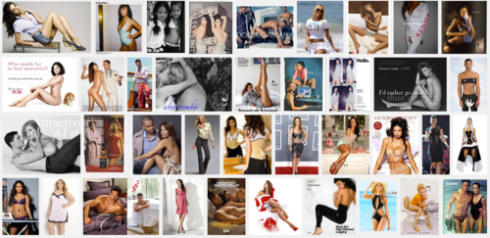
Google Search for Sexy Clothes

Google Search for Sexy Car Ad

Google Search for Sexy Burger Ad
Well daaaaaaamn son, it looks like there might be a slight difference in the level of objectification between women and men.
 It’s always good to keep an eye on what are fighting against and trying to dismantle.
 “Patriarchy is a political-social system that insists that males are inherently dominating, superior to everything and everyone deemed weak, especially females, and endowed with the right to dominate and rule over the weak and to maintain that dominance through various forms of psychological terrorism and violence. When my older brother and I were born with a year separating us in age, patriarchy determined how we would each be regarded by our parents.…[I] was told by my brother that “girls did not play with marbles,” that it was a boy’s game. This made no sense to my four- or five-year-old mind, and I insisted on my right to play by picking up marbles and shooting them. Dad intervened to tell me to stop. I did not listen. His voice grew louder and louder. Then suddenly he snatched me up, broke a board from our screen door, and began to beat me with it, telling me, “You’re just a little girl. When I tell you to do something, I mean for you to do it.” He beat me and he beat me, wanting me to acknowledge that I understood what I had done. His rage, his violence captured everyone’s attention. Our family sat spellbound, rapt before the pornography of patriarchal violence. After this beating I was banished-forced to stay alone in the dark. Mama came into the bedroom to soothe the pain, telling me in her soft southern voice, “I tried to warn you. You need to accept that you are just a little girl and girls can’t do what boys do.” In service to patriarchy her task was to reinforce that Dad had done the right thing by, putting me in my place, by restoring the natural social order.
…[T]his traumatic event… was a story told again and again within our family… [T]he retelling was necessary to reinforce both the message and the remembered state of absolute powerlessness. The recollection of this brutal whipping of a little-girl daughter by a big strong man, served as more than just a reminder to me’ of my gendered place, it was a reminder to everyone watching/remembering, to all my siblings, male and female, and to our grown-woman mother that our patriarchal father was the ruler in our household… This is the way we were experientially schooled in the art of patriarchy.”
Bell Hooks in Understanding Patriarchy (2006).











 bleatmop
 Mystro


 Dead Wild Roses
Your opinions…