
You are currently browsing the category archive for the ‘International Affairs’ category.
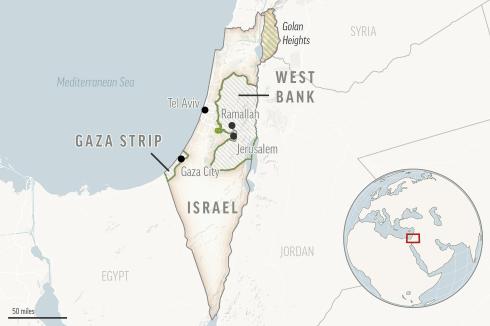
Israel faces a tough reality with enemies on nearly every side who openly call for its destruction, making secure borders an absolute necessity. Countries like Iran and groups such as Hezbollah and Hamas have not only talked about wiping Israel out but have acted on it with rocket attacks, border raids, and coordinated assaults like the one on October 7, 2023, which killed over 1,200 people. Some argue that walls and checkpoints hurt Palestinians by restricting their movement, and that’s a real concern. But these measures have proven effective, cutting down on terrorist attacks since the Second Intifada. Israel has to balance keeping its people safe with minimizing harm to others, and while it’s not perfect, strong borders with high-tech surveillance and intelligence are the best way to protect a nation under constant threat.
Taking out Hamas’s ability to wage war is crucial, not just for Israel’s safety but for any hope of a better future for Palestinians. Hamas has run Gaza since 2007, and its founding documents reject Israel’s existence entirely. They’ve fired thousands of rockets, over 12,000 since 2005, and built tunnels for attacks, often hiding among civilians. Critics say targeting Hamas risks innocent lives and could push more people toward extremism, which is a serious issue. But letting Hamas keep its weapons and control means more violence, less chance for peace, and Gaza staying stuck as a war zone instead of a place where people can build better lives. A focused effort to dismantle their military setup, alongside global help to rebuild Gaza with leaders who prioritize peace, is the tough but necessary path forward.
Keeping a strong security presence in Gaza is vital to stop new terrorist groups from taking root and to protect Israel’s way of life as a free, democratic nation in a region full of authoritarian regimes. Israel stands out with its open elections, independent courts, and free press, unlike many of its neighbors where power is tightly controlled. Some worry that staying involved in Gaza could make Israel look less democratic or anger Palestinians further, and that’s a valid point. But a smart security strategy, focused on gathering intelligence and stopping threats without overstepping, keeps Gaza from becoming a launchpad for attacks again, like it was under Hamas. Pairing this with efforts to support Palestinian self-rule and economic growth shows Israel’s commitment to both its values and stability, even when surrounded by those who want it gone.
The sentencing of Lucy Connolly, a 41-year-old childminder from Northampton, to 31 months in prison for an offensive X post represents a disturbing shift toward authoritarian governance in the United Kingdom. On July 29, 2024, Connolly posted a message urging “mass deportation now” and to “set fire” to hotels housing asylum seekers, in the context of the Southport attacks. As reported by the BBC, “The post was viewed 310,000 times before she deleted it within four hours.” Despite her guilty plea and expressions of remorse, the severe sentence, upheld on appeal in May 2025, prioritizes punishment over proportionality, signaling a state overreach that stifles free speech. This case exemplifies how legal mechanisms can be weaponized to suppress dissent, a hallmark of authoritarian regimes.
The legal basis for Connolly’s conviction, Section 19 of the Public Order Act 1986, allows broad discretion in criminalizing speech deemed to incite racial hatred. The Crown Prosecution Service noted, “Connolly admitted publishing material which was threatening, abusive or insulting and intended to stir up racial hatred.” However, the post’s rapid deletion and Connolly’s lack of prior convictions suggest a lighter penalty, such as a fine, could have sufficed. Instead, the court imposed a near-maximum sentence, with the appeal judges stating, “There is no arguable basis for saying the sentence was disproportionate,” as per The Independent. This rigid application of vague laws to punish speech mirrors authoritarian tactics, where the state uses legal ambiguity to silence controversial voices and deter open discourse.
The societal impact of Connolly’s sentence creates a chilling effect on free expression, a cornerstone of democracy. The Free Speech Union criticized the sentence as “plainly disproportionate,” warning of its broader implications for free speech. Public reaction, including a fundraiser exceeding £50,000, reflects widespread concern that the punishment outweighs the crime. When a single post, however offensive, leads to over two years in prison for a first-time offender, it signals that the state values ideological control over individual liberty. This echoes authoritarian governance, where dissent is swiftly penalized to enforce conformity, pushing citizens toward self-censorship out of fear of legal consequences.
Comparisons to other cases highlight the disproportionate nature of Connolly’s punishment, reinforcing perceptions of authoritarian overreach. For instance, Philip Prescott received 28 months for violent disorder, while Haris Ghaffar got 20 months, despite their actions involving physical harm rather than words. The Independent reported, “Tyler Kay was jailed for 38 months for sharing Ms. Connolly’s post,” showing how the state extends punishment to amplifying speech, widening the net of censorship. This prioritization of controlling narrative over addressing tangible harm is a tactic seen in authoritarian regimes, where speech is deemed a greater threat than physical acts, undermining democratic principles.
In conclusion, Lucy Connolly’s 31-month sentence for an offensive X post marks a dangerous slide toward authoritarian governance in the UK. By leveraging vague legal provisions to impose harsh penalties on rapidly retracted speech, the state demonstrates a preference for control over individual rights. The chilling effect on free expression, disproportionate sentencing compared to violent crimes, and public backlash all point to a system prioritizing ideological conformity. As the Free Speech Union’s critique suggests, such precedents risk normalizing state overreach, eroding democratic freedoms and paving the way for further authoritarian measures under the guise of public order.
References:
1. BBC News. “Lucy Connolly jailed for race hate post on X loses appeal.” https://www.bbc.com/news/articles/c3v5926yeqro
2. The Independent. “Why was Lucy Connolly jailed for a tweet and why was her appeal dismissed?” https://www.the-independent.com/news/uk/crime/lucy-connolly-court-jail-appeal-b2754556.html
3. Crown Prosecution Service. “Updated sentence: Childminder admits inciting racial hatred over social media post.” https://www.cps.gov.uk/cps/news/updated-sentence-childminder-admits-inciting-racial-hatred-over-social-media-post

High-trust societies are defined by robust interpersonal trust and shared ethical norms, enabling seamless cooperation and social stability. These societies rely on transparent governance, respected legal systems, and an unspoken confidence that individuals and institutions will act with integrity. This trust fuels efficiency—people leave doors unlocked or engage in transactions with minimal suspicion. In contrast, low-trust societies lack this cohesion, marked by skepticism, weak institutions, and reliance on tight-knit groups like family. Corruption and self-preservation dominate, stalling broader societal progress as trust remains scarce outside personal circles.
The 2025 incident involving two Australian Muslim nurses, Sarah Abu Lebdeh and Ahmad Rashad Nadir, at Bankstown Hospital exemplifies a severe breach of trust in a high-trust society. Caught on a viral video threatening to harm or refuse treatment to Israeli patients, their statements shattered the assumption that healthcare professionals prioritize care over prejudice. In Australia, where patients entrust their lives to medical staff without hesitation, this betrayal undermines confidence in a cornerstone institution. The public backlash and swift suspension reflect the shock of such behavior in a system built on mutual reliability.
This breach highlights why high-trust societies must impose strong sanctions. When trust is compromised, the fallout threatens social and economic harmony, as people question the safety of once-reliable systems. The nurses’ actions prompted criminal charges—threatening violence and menacing communication—carrying potential decades-long sentences, alongside professional bans. Such measures deter future violations and reaffirm societal standards. Without them, trust could erode, pushing Australia toward the inefficiencies and wariness of low-trust environments, where institutional faith is perpetually in doubt.
In low-trust societies, such threats might be shrugged off as routine bravado, met with cynicism rather than accountability. But in high-trust contexts, the expectation of integrity amplifies the need for a firm response. The nurses’ remarks, even if hyperbolic, exploit the openness of a trusting system, risking a broader chilling effect if unpunished. Australia’s reaction—legal action, political condemnation, and ongoing investigations—aims to preserve its high-trust framework, signaling that such behavior is anathema to its values.
Ultimately, strong sanctions in high-trust societies like Australia are vital to protect their fragile ecosystem of trust. The 2025 Bankstown incident underscores the stakes: tolerating such breaches could unravel the mutual reliance that distinguishes high-trust from low-trust worlds. By prosecuting the nurses and reinforcing ethical boundaries, Australia defends the trust that underpins its social order. This resolute stance ensures that the benefits of a high-trust society—cooperation, safety, and prosperity—endure against those who would exploit its openness.

The disparity in global outrage between the conflicts in Gaza and Syria is a striking phenomenon that reveals much about media influence, geopolitical dynamics, and public perception. In Gaza, the Israel-Palestinian conflict, particularly since the escalation following Hamas’s attack on October 7, 2023, has garnered immense international attention. Over 46,000 Palestinians have been reported killed by March 2025, according to Gaza health officials, with widespread destruction reducing much of the territory to rubble. This has sparked massive protests worldwide, intense media coverage, and vocal condemnation from various governments and activist groups. The visibility of the conflict is amplified by its historical context, the involvement of Israel—a close Western ally—and the stark imagery of civilian suffering in a densely populated enclave.
In contrast, Syria’s civil war, which has claimed over 600,000 lives and displaced millions since 2011, has faded from the global spotlight despite its staggering toll. The prolonged nature of the conflict, coupled with its complexity involving multiple factions, has led to a sense of fatigue and desensitization among the international community, reducing the urgency and emotional resonance it once held.
Geopolitical interests and alliances further underscore this disparity. Israel’s role in Gaza, supported by significant U.S. military and political backing, places the conflict under a microscope, as it ties into broader narratives of Western imperialism, colonialism, and human rights that resonate deeply with activist movements and progressive audiences. The accessibility of Gaza’s narrative—framed as a David-versus-Goliath struggle—makes it a rallying point for outrage, with real-time accounts from Palestinian journalists and citizens amplifying its reach. Syria, however, lacks a similarly clear-cut antagonist in the eyes of the West. The Assad regime, while brutal, is opposed by a fractured array of rebel groups, some with extremist ties, complicating the moral clarity that drives public mobilization.
Moreover, Syria’s primary allies—Russia and Iran—are already at odds with Western powers, diluting the incentive for sustained Western outrage or intervention. This suggests that the absence of a Jewish or Western state as a central villain in Syria’s case may contribute to the muted response compared to the intense focus on Gaza, where such dynamics align with prevailing ideological currents.
Finally, the scale and speed of devastation also play a critical role in shaping outrage. In Gaza, the death rate has been extraordinarily high in a short period—half of Syria’s decade-long toll in just over a year—concentrated in a population ten times smaller, making the per-capita impact far more immediate and visceral. This intensity, combined with restricted humanitarian access and a blockade, heightens the sense of urgency and helplessness that galvanizes global responses. Syria’s war, by contrast, has unfolded over 14 years, with peaks of violence—like the siege of Homs—spaced out and overshadowed by other global crises, leading to a gradual numbing effect. The recent resurgence of fighting in Syria, such as the rebel offensive in Aleppo in late 2024, briefly rekindled interest, but it lacks the sustained momentum of Gaza’s coverage.
The disparity, then, is not just about numbers but about narrative coherence, media amplification, and the alignment of each conflict with broader political stakes. While both tragedies deserve attention, the uneven outrage reflects a world where emotional resonance and ideological alignment often dictate which crises capture our collective conscience.

My choir is singing this at a late Remembrance Day Concert. I hope to get a recording of us performing, but until then the ASU concert choir does a masterful rendition for this most important of days.
We Remember Them
In the rising of the sun and in its going down,
we remember them.
In the blowing of the wind and in the chill of winter,
we remember them.
In the opening of buds and in the rebirth of spring,
we remember them.
In the blueness of the sky and in the warmth of summer,
we remember them.
In the rustling of leaves and in the beauty of autumn,
we remember them.
In the beginning of the year and when it ends,
we remember them.
When we are weary and in need of strength,
we remember them.
When we are lost and sick at heart,
we remember them.
When we have joys we yearn to share,
we remember them.
So long as we live, they too shall live, for they are now a part of us,
as we remember them.
Amnesty International continues to demonstrate how completely they have lost the plot. Here they are celebrating the removal female rights in Australia:

And when their bullshit gender ideology meets the real world they are forced to say inane things like their statement below.
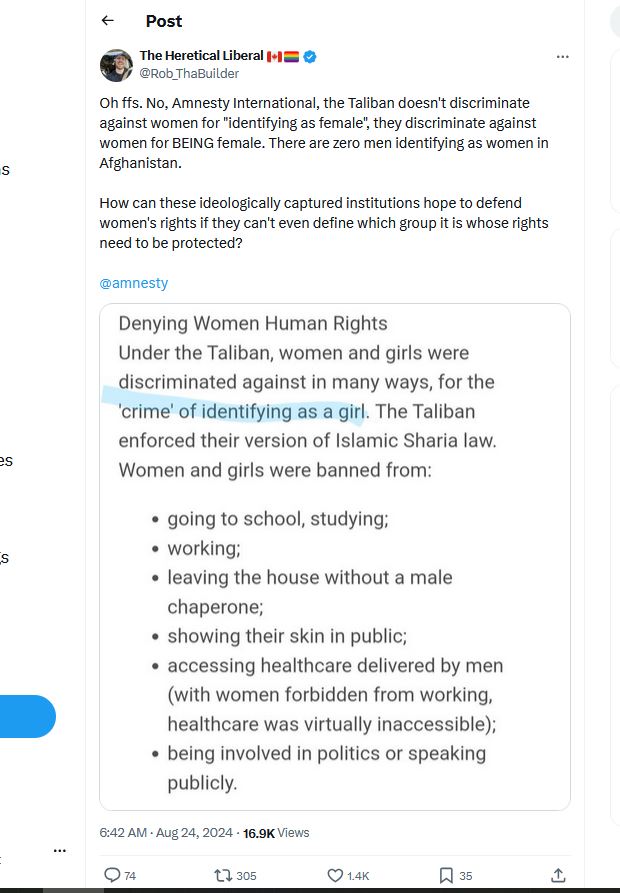
Just say no to gender ideology, you are flirting with becoming estranged from reality.
I look forward to the all the major news organizations issuing retractions for their untruthful reporting.











 bleatmop
 Mystro
 The Arbourist


 Dead Wild Roses
Your opinions…