On January 3, 2026, the United States carried out a large-scale operation in Venezuela that resulted in the capture of Nicolás Maduro and his wife, Cilia Flores, and their transfer into U.S. custody. [1] Within hours, the story stopped being only about Maduro. It became a stress test of the West’s default assumptions about how global order actually works.

The reaction split fast and predictably: condemnation framed in the language of sovereignty and the UN Charter; applause framed in the language of liberation and justice; and, underneath both, a quieter argument about whether “international law” is a meaningful constraint—or primarily a vocabulary used to legitimize outcomes power already permits.

Two languages for one event

When a great power uses force to remove a sitting head of state and relocate him for prosecution, states and commentators typically reach for one of two languages.

The first is legal-institutional: Was this lawful? Was it authorized? What does the UN Charter permit? What precedent does it set?

The second is strategic-realist: What will it cost? Who can impose consequences? What does it deter? What does it invite?

These languages often coexist, but Venezuela forced a choice because it exposed the tension between *the claim* of a rules-governed international order and *the mechanism* by which order actually persists.

The enforceability problem

The measured point is not that international law is “fake” in every domain. A great deal of international life runs on rules that are real in practice: treaties, trade arrangements, financial compliance, aviation coordination, maritime norms, and sanctions enforcement. In those domains, rules can be highly consequential because they are tied to access, markets, and institutional membership.

But in the domain that states care about most—hard security and regime survival—international law runs into a structural limitation: there is no global sovereign with a monopoly on force. The question is not whether rules exist, but whether they bind the actors most able to ignore them.

That isn’t a rhetorical flourish. It’s the structural fact everything else sits on.

The UN can convene, condemn, and deliberate. But it cannot consistently coerce major powers into compliance. In the wake of the Maduro operation, the UN Security Council moved to meet and the UN Secretary-General warned the action set a “dangerous precedent.” [2] That may shape legitimacy and alliances. It may raise political costs. But it does not function like law inside a state, because law inside a state ultimately rests on enforceable authority.

This is why the phrase “international law” so often behaves less like binding law and more like legitimacy currency—something states spend, something rivals contest, and something that matters most when it is backed by power.

The reaction spectrum makes more sense as philosophy, not partisanship

The political reactions were not merely partisan reflexes; they were expressions of competing world-models.

Institutionalists treated the precedent as the core danger: once unilateral force becomes normalized, the world becomes easier for worse actors to imitate.
Sovereignty-first critics (especially in regions with long memories of intervention) treated it as a return to imperial patterns—regardless of Maduro’s character.
Results-first supporters treated it as overdue action against an entrenched authoritarian regime and criminal networks.
Realists treated it as a reminder that rules do not restrain actors who cannot be credibly punished.

It is possible to disagree with the operation and still accept the realist diagnosis. “This was reckless” and “this reveals how order works” are not contradictions—they’re often the same conclusion stated in different registers.

A small but telling detail: systems moved, not just speeches

One detail worth noting is that the event had immediate operational spillover beyond diplomacy: temporary Caribbean airspace restrictions and widespread flight cancellations followed, with U.S. authorities later lifting curbs. [3] That’s not a moral argument either way. It’s simply a reminder that great-power action produces real-world system effects instantly—while multilateral processes operate on a different clock.

Meanwhile, Venezuela’s internal institutions scrambled to project continuity. On January 4, 2026, reporting described Venezuela’s Supreme Court ordering Vice President Delcy Rodríguez to assume the interim presidency following Maduro’s detention. [4] Again, one can read this in legal terms or strategic terms. But it underscores the same point: the decisive moves were being made through power, institutional control, and logistics—not through international adjudication.

What Venezuela is really teaching

The strongest measured conclusion is this:

1. International law can matter as coordination and legitimacy.

2. But in hard-security conflicts, it does not function like ordinary law because enforcement is selective, especially against great powers.

3. Therefore, when Western leaders speak as though “international law” itself will constrain outcomes, they are often describing the world they want—or the world they remember—more than the world that exists.

This is the wake-up Venezuela delivers: not that rules are worthless, but that rules don’t become rules until they are paired with credible consequences. If the West wants a world that is safer for liberal societies, it must stop mistaking procedural vocabulary for strategic capacity.

What Western leaders should do differently

If “international law” is often a language of legitimacy rather than a source of enforcement, then the task for Western leaders is not to abandon norms—but to rebuild the conditions under which norms can actually hold. That requires a change in posture that is both external and internal.

First: speak honestly about interests and tradeoffs.

A rules vocabulary can be morally sincere and still strategically evasive. Western publics deserve leaders who can say, without euphemism, what outcomes matter, why they matter, and what costs we are willing to pay to secure them.

Second: re-embody Western values in our institutions, not merely our slogans.

The West is not “a place that sometimes gets things right.” It is the most successful civilizational experiment yet produced: freedom under law, pluralism, scientific dynamism, broad prosperity, and the moral insight that the individual matters. If leaders treat this as an embarrassment rather than an inheritance, they will govern as caretakers of decline.

Third: restore civic confidence by repairing the narrative infrastructure.

A civilization that teaches its own children that it is uniquely evil will not defend itself—or even understand why it should. The “mono-focused West-is-bad” story has become a kind of institutional reflex across parts of education, culture, and bureaucracy. You can reject naïve triumphalism while still insisting on civilizational honesty: that the West has flaws, committed crimes, and still produced the best lived human outcomes at scale to date.

Fourth: build capacity again—material, strategic, and moral.

Norms without capacity do not preserve peace; they invite tests. This means defense industrial readiness, energy resilience, border and migration competence, counterintelligence seriousness, and the willingness to impose costs where deterrence requires it.

Finally: treat multilateralism as a tool, not a substitute for power.

Institutions can amplify strength; they cannot conjure it. A West that wants a stable order must stop acting as though process is the engine. Process is the dashboard.

Afterword: the more polemical take

Western elites keep reaching for “international law” the way a sleepwalker reaches for the bedside table—by habit, not by sight. They speak as if naming the norm substitutes for enforcing it. But there is no authority behind it for the actors that matter most.

So the scandal isn’t disagreement about Venezuela. The scandal is that so many of our leadership classes still talk like we live in a world where legitimacy language can replace power, unity, and competence. That was a comfortable posture in a more unipolar era. It is a dangerous posture now.

In a multipolar environment, moral declarations without strength don’t preserve order. They advertise weakness. And weakness is not neutral: it invites tests.

 

 Footnotes

[1] Reuters (Jan 3–4, 2026): reporting on the U.S. operation capturing Nicolás Maduro and Cilia Flores and transferring them to U.S. custody.

[2] Reuters (Jan 3, 2026): UN Security Council to meet over U.S. action; UN Secretary-General calls it a “dangerous precedent”; meeting requested with backing from Russia/China.

[3] Reuters (Jan 3, 2026): Caribbean airspace restrictions and flight cancellations following the operation; later lifted.

[4] Reuters (Jan 4, 2026): Venezuela’s Supreme Court orders Delcy Rodríguez to assume interim presidency after Maduro’s detention.

Direct Reference Links

[1] Reuters — “Mock house, CIA source and Special Forces: The US operation to capture Maduro”
https://www.reuters.com/business/aerospace-defense/mock-house-cia-source-special-forces-us-operation-capture-maduro-2026-01-03/

[2] Reuters — “UN Security Council to meet Monday over US action in Venezuela”
https://www.reuters.com/world/americas/un-chief-venezuela-us-action-sets-dangerous-precedent-2026-01-03/

[3] Reuters — “US lifts Caribbean airspace curbs after attack on Venezuela”
https://www.reuters.com/world/americas/us-airlines-cancel-flights-after-caribbean-airspace-closure-2026-01-03/

[4] Reuters — “Venezuela’s Supreme Court orders Delcy Rodriguez become interim president”
https://www.reuters.com/world/americas/venezuelas-supreme-court-orders-delcy-rodriguez-become-interim-president-2026-01-04/

     Western civilization, in its liberal form, rests on a remarkable set of principles: that religious belief should be voluntary, that individual conscience is sovereign, and that the rights of the person take precedence over both state and religious authority. These ideas are not universal human defaults; they are hard-won cultural and philosophical achievements, shaped by the Enlightenment, the Reformation, and centuries of political struggle. They are not shared equally by all religious or ideological systems.
     Classical Islam, in its orthodox jurisprudential tradition, is not solely a private spiritual faith. It is also a comprehensive legal and political system (sharia) that historically integrated religious authority with governance. From its earliest centuries, Islam expanded through a combination of military conquest, trade, persuasion, and migration. While conquest played a significant role in some regions, conversion in others—such as Southeast Asia—was often gradual and voluntary. The fusion of religious and political authority remains influential in many interpretations, though its application varies widely across the Muslim world today.
     One area of tension concerns apostasy. In traditional interpretations of several major schools of Islamic law, leaving the faith has been treated as a serious offense, sometimes punishable by death. This stands in contrast to the Western commitment to absolute freedom of belief and conscience. However, enforcement differs greatly: many Muslim-majority countries no longer prescribe capital punishment for apostasy alone, and reformist scholars argue that the Qur’an itself emphasizes no compulsion in religion (2:256) and that punishment should be deferred to the afterlife.Religious pluralism presents another challenge. Historical Islamic polities often extended protected status to Jews, Christians, and sometimes others (“People of the Book”), allowing communal autonomy in exchange for taxation (jizya) and certain restrictions. This system offered more tolerance than many contemporary societies of the time, yet it was hierarchical rather than egalitarian. Full equality before the law—a core Western principle—has not always been realized in states governed by traditional sharia interpretations, though modern reforms in countries such as Tunisia, Morocco, and the United Arab Emirates have moved toward greater legal equality.
     The status of women reveals further differences. In some countries applying strict interpretations of sharia, women face legal and social restrictions on dress, travel, marriage, inheritance, and testimony. Recent examples include compulsory veiling enforcement in Iran and severe restrictions under Taliban rule in Afghanistan. These practices draw from certain classical readings of Qur’anic verses and hadith. At the same time, it is worth noting that seventh-century Islamic law granted women rights to inheritance, divorce, and property ownership that were progressive compared to many pre-modern societies. Today, women’s rights vary enormously across the Muslim world—from relatively egalitarian frameworks in Indonesia and Tunisia to highly restrictive ones elsewhere—and Muslim feminist scholars actively work to reinterpret texts in light of contemporary values of equality.These differences are not simply “extremist misinterpretations.” Many stem from longstanding and mainstream interpretations of sacred texts and tradition.
    Yet Islam is not monolithic: it encompasses a spectrum of thought, from rigid literalism to progressive reformism, and interpretations evolve over time and place.None of this is an indictment of Muslims as individuals. Millions of Muslims live peacefully and prosperously in Western societies, often embracing liberal values while maintaining their faith. Their successful integration is made possible precisely because Western secular frameworks limit the political reach of any religion—protecting both believers and non-believers alike.Recognizing the genuine tensions between certain traditional interpretations of Islam and core principles of Western liberalism is not intolerance; it is intellectual honesty.
     At the same time, acknowledging Islam’s internal diversity, historical context, and capacity for reform prevents sweeping generalizations. A mature conversation requires holding both truths: deep differences exist, yet dialogue, mutual accommodation, and individual freedom remain possible. A civilization that clearly understands its own founding principles—without either naivety or hostility—is best equipped to preserve them while extending hospitality to those who share its public square.

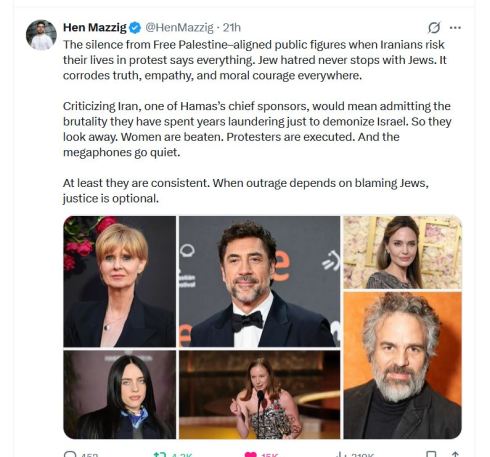
In the world of advocacy and human rights, consistency is more than just a virtue—it’s what gives our principles real meaning. Recently, a comment on social media highlighted a familiar pattern: certain voices who are vocal about one cause may fall silent when similar struggles appear in a different context. It’s a reminder that if we want justice to truly be just, it must be blind to who is involved—applying the same standards to all people, regardless of race, creed, or background.

This isn’t about slamming any particular group; it’s about encouraging all of us to reflect on the importance of consistency. When we advocate for human rights, it’s crucial that we do so across the board. If a group of protesters in one country deserves our solidarity, then those in another country risking their lives for similar ideals deserve it too.

In short, “justice” in quotes should indeed be blind. Not in the sense of ignoring the nuances of each situation, but in the sense of applying our moral standards fairly and universally. By doing so, we strengthen the credibility of our advocacy and remind the world that human rights aren’t selective—they’re for everyone.

  Find that tweet inspiration for this post here.

  Happy New Year!  “What?!”, you say, doing a reflective piece to start the new year?  Unpossible!!! – Yet here we are.  Take care my friends and feisty commentariate in this next orbit around the Sun.

I recently asked an LLM—Grok—to analyze Dead Wild Roses.

He obliged.

The result was thoughtful, coherent, and broadly accurate. He traced the arc of the blog from its earlier left-skeptical roots through to its present preoccupations: feminism, free speech, gender ideology, institutional capture, moral certainty. As machine readings go, it was competent. Even generous.

And yet.

Reading it, I had the distinct sense of being seen from across the room, not spoken with.

So I did what seemed obvious: I asked another model—this one—for her reading.

I’m aware, of course, that large language models are not gendered. But anyone who works with them long enough knows that they nonetheless express distinct interpretive temperaments. If Grok reads like a brisk political cartographer—mapping positions, vectors, affiliations—this model reads more like a close reader of essays, arguments, and interior continuity.

That difference matters.


What He Saw (and What He Didn’t)

Grok understood the trajectory of the blog. He recognized that this was not a sudden ideological flip but a long, incremental evolution. He correctly identified a through-line of skepticism toward authority and moral certainty.

Where his reading thinned was not in what I believe, but in how I think.

His analysis treated the blog primarily as a political object—something that moved through ideological space. That’s not wrong, but it is partial.

Dead Wild Roses was never built to advocate a position. It was built to interrogate certainty—including my own.


What I’ve Always Been Doing Here

This blog has been many things over the years: atheist, feminist, skeptical, irritated, occasionally furious. But its core method has never changed.

It asks:

  • What is being asserted as unquestionable?

  • Who benefits from that assertion?

  • What happens if we follow it all the way down?

When institutions began insisting that sex was a feeling, that language could override biology, that dissent was harm, that moral status preceded argument—the same skeptical machinery I once aimed outward turned inward.

That wasn’t betrayal.
It was consistency under pressure.


On Feminism and Material Reality

Yes, this is now read—accurately—as a sex-based feminist blog.

That’s not because identity doesn’t matter, but because material reality is the ground truth on which politics rests. Bodies come first. Law follows. Stories are last.

When political movements demand that we invert that order, something has gone deeply wrong—and feminism, if it is to mean anything at all, must notice.

That position is not reactionary. It is foundational.


Why Ask Two Models at All?

Because how something is read tells you as much about the reader as the text.

He read Dead Wild Roses as a location on a map.
She read it as a method in motion.

One isn’t false. But only one feels true.

The difference mirrors the very problem the blog keeps circling: the reduction of inquiry into identity, of thinking into stance, of method into tribe.


A Note on AI, Authority, and Voice

There is an irony here that isn’t lost on me.

I am using artificial intelligences to reflect on a body of writing that is deeply skeptical of outsourced authority. But that tension is precisely the point.

Tools can assist thinking.
They cannot replace it.

Maps can be useful.
They are not the territory.


Where This Leaves Me

If the last few years of Dead Wild Roses were about dismantling false moral certainty, the next may be about something harder and quieter:

  • rebuilding meaning without mysticism,

  • defending reality without cruelty,

  • and learning how to live after the spell breaks.

I don’t know where that road leads.

But I know why I keep walking it.

And I know which readings—human or machine—feel like they’re walking with me rather than plotting me from above.

Postscript:

Throughout this piece, I’ve used “he” and “she” to distinguish between two AI systems with markedly different interpretive styles. This is not a claim about machine ontology. It is shorthand—imperfect, human, and serviceable.

Language exists to clarify thought. When it stops doing that, it’s time to change the language—not reality.

The blog Dead Wild Roses (deadwildroses.com), authored by The Arbourist (who also runs the associated X account

@TheArbourist), can be characterized politically as gender-critical radical feminist with roots in traditional left-wing politics but a significant evolution toward critiquing modern progressive or “woke” ideologies.
It is not easily pinned to conventional left-right spectra, as it combines elements that might appear contradictory at first glance but are coherent within a specific feminist framework.
Origins and Evolution: The blog began around 2009–2012 as a broadly leftist platform: skeptical of religion, critical of conservatism and crony capitalism, supportive of social democratic ideas, and aligned with second-wave feminist principles emphasizing women’s liberation from patriarchy. Early content often featured critiques of religious dogma, pro-choice advocacy, anti-capitalist commentary, and classical music interludes alongside political posts.
Over time—particularly from the mid-2010s onward—the focus shifted sharply toward gender-critical feminism (often labeled “TERF” by critics, a term the blog rejects as a slur). This involves strong opposition to gender ideology, queer theory, transgender activism (especially regarding women’s spaces, sports, prisons, and youth medical transitions), and what the author calls “postmodern fluff” or identity politics excesses. Recent posts criticize “woke extremism,” compelled speech laws, DEI initiatives, and policies like British Columbia’s reconciliation efforts or hate speech bills as authoritarian overreach.
Current Political Stance
  • Feminist Core: Radical feminist, prioritizing sex-based rights for women and girls. It defends single-sex spaces, opposes self-ID policies, and highlights issues like female erasure in language/institutions.
  • Anti-“Woke” Left: Fiercely critical of contemporary progressive movements (e.g., trans-inclusive feminism, queer theory, intersectionality when it prioritizes gender identity over sex). The author sees these as betraying women’s rights and aligning with patriarchal or neoliberal interests.
  • Free Speech and Anti-Authoritarianism: Strong defense of free expression, criticism of cancel culture, and opposition to what it views as state-enforced ideological conformity (e.g., hate speech laws, compelled apologies).
  • Residual Left Elements: Occasional critiques of conservatism, capitalism, or religious fundamentalism persist, but the dominant tone is now combative toward the mainstream left.
  • Not Right-Wing: Despite overlapping with conservative concerns on gender issues, the blog explicitly distances itself from right-wing politics and has historically opposed it.

Politically, this aligns with a growing cohort of “politically homeless” gender-critical leftists (similar to figures like J.K. Rowling or some detransitioner advocates) who feel exiled from progressive spaces but reject conservatism. The X bio (“Canadian barefoot dissident. Slaying gender ideology and postmodern fluff. Pro-merit, pro-naps, pro-Stoic vibes”) reinforces this: anti-ideological dogma, merit-based, individualistic.

Pursuit of Truth Perspective:
From a centrist, truth-seeking viewpoint valuing evidence over ideology: The blog’s strength lies in its willingness to challenge prevailing narratives in progressive circles, often citing sources like the WPATH files, detransition stories, or critiques of queer theory to argue positions with references to biology, statistics, and historical feminism. This evolutionary shift appears driven by principled disagreement rather than opportunism—the author has reflected on it openly.
  However, the tone is often sharply polemical (“vituperation optional” in the blog description), which can prioritize rhetorical combat over nuanced dialogue. Some arguments frame opponents in stark terms (e.g., “authoritarian drift,” “ideological dissolution”), potentially echoing ideological rigidity from the other side.
  It represents one side of a polarized debate on gender, substantiated by selected evidence but not always engaging counterarguments comprehensively.
Overall, if you’re a centrist prioritizing truth, the blog offers a valuable counter-narrative to dominant progressive views on gender, grounded in a feminist tradition that emphasizes material reality (sex over identity).
It’s worth reading critically, alongside diverse sources, to weigh the claims against broader evidence.
  Thanks Grok, we’ll see what comes in the New Year. :)

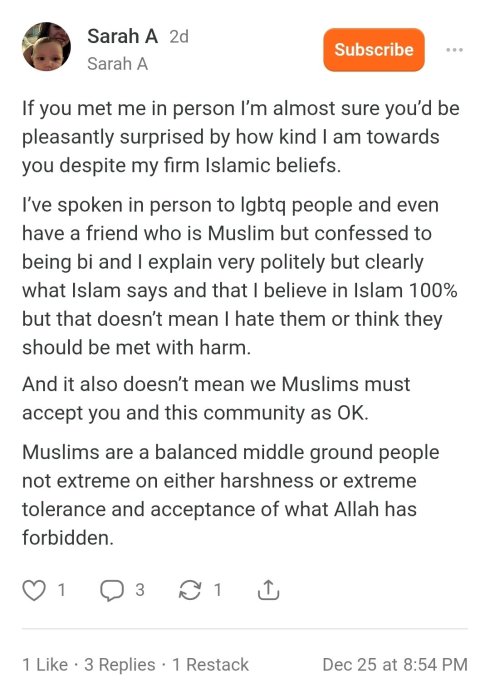
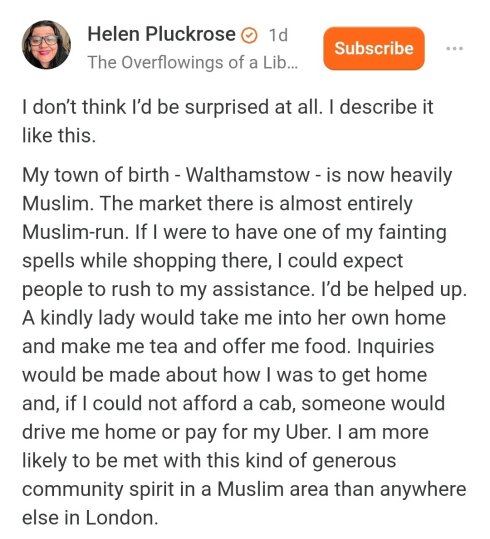
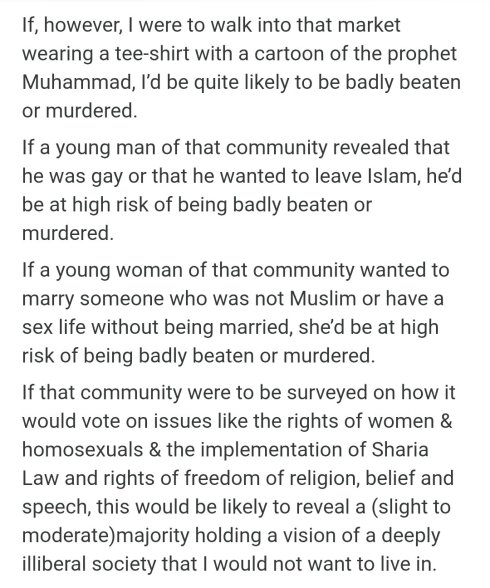
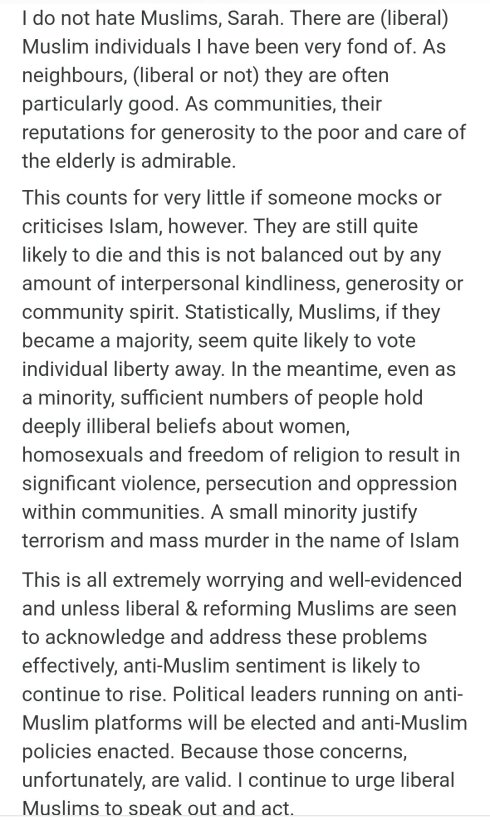
In a thoughtful exchange highlighted by James Lindsay, liberal writer Helen Pluckrose responds to a Muslim commenter who shares personal experiences of generosity within Muslim communities. While warmly acknowledging the kindness and charity she’s witnessed among individual Muslims, Pluckrose firmly points out the broader issue: widespread support in some Muslim populations for Sharia-based views that endorse severe punishments—including violence or death—for apostasy, homosexuality, adultery, and blasphemy. She argues that ignoring these illiberal attitudes, backed by polling data, risks fueling unnecessary backlash against Muslims while failing to address genuine incompatibilities with Western liberal values.

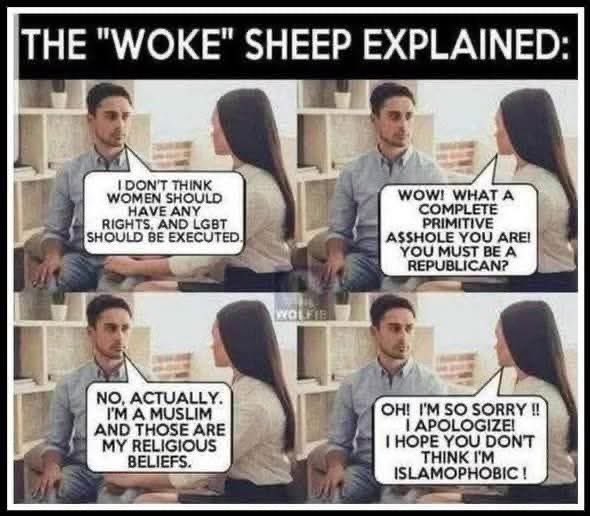
The meme is considered “fairly accurate” by critics of progressive politics because it captures a perceived double standard: while left-leaning activists routinely and aggressively condemn anti-LGBTQ+ views among Christians (e.g., evangelical opposition to same-sex marriage), they often hesitate to apply the same scrutiny to similar or stronger opposition within Muslim communities, instead framing such criticism as Islamophobic or culturally insensitive.

Surveys consistently show that Muslims, particularly in Europe and Muslim-majority countries, hold more conservative attitudes toward homosexuality than the general Western population—often viewing it as morally unacceptable due to religious interpretations—yet progressive voices tend to prioritize anti-Islamophobia efforts, sometimes downplaying or excusing these views under cultural relativism or minority protection. This selective outrage, observers argue, reflects a hierarchy of sensitivities where fear of racism accusations trumps consistent advocacy for LGBTQ+ rights, allowing illiberal positions to persist unchallenged in one context while being fiercely opposed in another.

This Blog best viewed with Ad-Block and Firefox!

What is ad block? It is an application that, at your discretion blocks out advertising so you can browse the internet for content as opposed to ads. If you do not have it, get it here so you can enjoy my blog without the insidious advertising.

Like Privacy?

Change your Browser to Duck Duck Go.

Enter your email address to follow this blog and receive notifications of new posts by email.

Join 397 other subscribers

Categories

January 2026
M T W T F S S
 1234
567891011
12131415161718
19202122232425
262728293031  

Archives

Blogs I Follow

The DWR Community

  • Unknown's avatar
  • Unknown's avatar
  • Unknown's avatar
  • Unknown's avatar
  • Unknown's avatar
  • Unknown's avatar
  • Unknown's avatar
  • Unknown's avatar
  • silverapplequeen's avatar
  • Unknown's avatar
Kaine's Korner

Religion. Politics. Life.

Connect ALL the Dots

Solve ALL the Problems

Myrela

Art, health, civilizations, photography, nature, books, recipes, etc.

Women Are Human

Independent source for the top stories in worldwide gender identity news

Widdershins Worlds

LESBIAN SF & FANTASY WRITER, & ADVENTURER

silverapplequeen

herstory. poetry. recipes. rants.

Paul S. Graham

Communications, politics, peace and justice

Debbie Hayton

Transgender Teacher and Journalist

shakemyheadhollow

Conceptual spaces: politics, philosophy, art, literature, religion, cultural history

Our Better Natures

Loving, Growing, Being

Lyra

A topnotch WordPress.com site

I Won't Take It

Life After an Emotionally Abusive Relationship

Unpolished XX

No product, no face paint. I am enough.

Volunteer petunia

Observations and analysis on survival, love and struggle

femlab

the feminist exhibition space at the university of alberta

Raising Orlando

About gender, identity, parenting and containing multitudes

The Feminist Kitanu

Spreading the dangerous disease of radical feminism

trionascully.com

Not Afraid Of Virginia Woolf

Double Plus Good

The Evolution Will Not BeTelevised

la scapigliata

writer, doctor, wearer of many hats

Teach The Change

Teaching Artist/ Progressive Educator

Female Personhood

Identifying as female since the dawn of time.

Not The News in Briefs

A blog by Helen Saxby

SOLIDARITY WITH HELEN STEEL

A blog in support of Helen Steel

thenationalsentinel.wordpress.com/

Where media credibility has been reborn.

BigBooButch

Memoirs of a Butch Lesbian

RadFemSpiraling

Radical Feminism Discourse

a sledge and crowbar

deconstructing identity and culture

The Radical Pen

Fighting For Female Liberation from Patriarchy

Emma

Politics, things that make you think, and recreational breaks

Easilyriled's Blog

cranky. joyful. radical. funny. feminist.

Nordic Model Now!

Movement for the Abolition of Prostitution

The WordPress C(h)ronicle

These are the best links shared by people working with WordPress

HANDS ACROSS THE AISLE

Gender is the Problem, Not the Solution

fmnst

Peak Trans and other feminist topics

There Are So Many Things Wrong With This

if you don't like the news, make some of your own

Gentle Curiosity

Musing over important things. More questions than answers.

violetwisp

short commentaries, pretty pictures and strong opinions

Revive the Second Wave

gender-critical sex-negative intersectional radical feminism