
You are currently browsing the tag archive for the ‘Canada’ tag.
When Calgary City Hall raised the Palestinian flag on November 15, it wasn’t merely a ceremonial gesture. It instantly became a national controversy—one that shows why municipalities need a clearer, more restrained approach to foreign-flag displays.
The event, organized by the Palestinian Community Association to mark the 1988 Declaration of Independence, drew several hundred attendees who described the atmosphere as one of “pride and hope.” But the reaction was immediate and intense. The Calgary Jewish Federation called the raising “disappointing and alarming,” warning that it deepened “unprecedented levels of fear and antisemitism” among local Jews at a moment already charged with global tension. Mayor Jeromy Farkas quickly proposed changes to the city’s flag policy to prevent similar events, arguing they “unintentionally heighten tensions here at home.”
This dynamic—the celebratory intent and the equally real sense of threat—is exactly why public institutions need neutrality, not symbolism that comes preloaded with geopolitical baggage.
Public Institutions Aren’t Arenas for International Disputes
Canadian civic buildings exist to represent a shared political community. They are meant to be the places where everyone should be able to walk in and feel the institution belongs to them. When City Hall becomes a platform for international symbols representing deeply contested conflicts, that neutrality disappears.
People don’t see a gesture of cultural recognition; they see their city taking a side. And the effects go beyond feelings—these symbolic acts consistently spill into local tensions, protests, counter-protests, and strained inter-community relations. Calgary is not alone: Regina shelved a similar proposal last year, Toronto now faces more than 20,000 signatures against its own planned raising, and B’nai Brith Canada has condemned the practice nationwide.
The details of the Israeli–Palestinian conflict aren’t the point here. The point is that a municipal flagpole is too narrow and too prominent a place to plant the symbols of any conflict that divides Canadians at home.
The Palestinian Flag Carries Political Luggage That Can’t Be Wished Away
Supporters of the flag raising framed it as recognition of Palestinian peoplehood. Critics saw something entirely different: a symbol long tied to the Palestine Liberation Organization, whose founding charter called for the destruction of Israel as a Zionist entity. While amendments were pledged during the Oslo years, credible observers—including the Anti-Defamation League—argue that its core rejectionist elements were never formally removed.
That history is not merely historical; Hamas, which governs Gaza and uses the same colours and iconography, still explicitly calls for Israel’s eradication. You don’t need to subscribe to either side’s narrative to understand why many Canadians saw the raising as more than a cultural celebration.
Even if activists insist the flag “means something different” in a Canadian context, public institutions don’t operate on activist reinterpretations. They operate on widely understood meanings—and those meanings are contested, volatile, and inseparable from global politics.
Neutrality Isn’t Cowardice. It’s Civic Responsibility.
Some will argue that refusing foreign-flag raisings amounts to silencing communities. But this misunderstands what’s being protected.
People are free to wave any flag they like on private property, at rallies, or in public demonstrations. That freedom is intact.
What’s restricted is the official endorsement that comes from hoisting a flag on municipal grounds—a distinction our institutions must preserve if they’re to serve a pluralistic society.
Canada already recognizes this principle in its federal protocols: foreign flags may be flown with the Maple Leaf, but only in specific diplomatic or ceremonial contexts and only with the national flag taking precedence. These guidelines are narrow for a reason—they prevent exactly the sort of domestic polarization Calgary just lived through.
When municipalities improvise their own ad-hoc symbolism, they abandon that safeguard.
A Simple, Clear Standard
Calgary—and every municipality—would benefit from a straightforward rule:
On public buildings and grounds, fly only Canadian, provincial, and municipal flags.
That is not censorship. It is neutrality.
It is the institutional equivalent of staying out of a heated argument so you can continue serving everyone fairly.
This approach:
- avoids endless debates about which diaspora group gets access;
- eliminates the perception of favouritism;
- prevents local flare-ups rooted in global conflicts;
- reinforces shared civic identity.
Multiculturalism works only when no group feels the state is endorsing another’s cause at their expense. Sometimes the most inclusive action is restraint.
Calgary now has a chance to lead. Mayor Farkas’s proposed changes should be adopted quickly, and Ottawa should consider harmonizing national guidelines to end these high-risk symbolic battles across the country.
Canada has enough challenges at home. We don’t need to import more.

Quick Sources / References
- Calgary Jewish Federation statements on the flag raising (2025).
- City of Calgary Flag Protocol (2016).
- Government of Canada – Rules for Flying the National Flag (Federal Heritage).
- Anti-Defamation League assessments of PLO charter revisions.
- B’nai Brith Canada public statements on municipal flag raisings (2024–25).
- City of Toronto petition data (2025).
(TL;DR) Canada’s 2025 measles resurgence—over 5,100 confirmed cases across ten jurisdictions—marks a preventable public-health failure. Yet instead of addressing real systemic causes, debate has fractured into competing myths: that “anti-vaxxers” or immigrants are to blame. Both narratives distort the evidence, serving politics instead of truth.
Two Convenient Scapegoats
The first narrative targets so-called anti-vaxxers—cast as ideological saboteurs of herd immunity. But the data tell a different story. Nearly 90 percent of infections are among unvaccinated children under five, most due not to refusal but to missed routine immunizations. (Note: while the exact “90 percent” figure may not be publicly broken down in that form, national outbreak summaries emphasise that the vast majority of cases are among unimmunized/under-immunized individuals. (IFLScience))
Nationally, first-dose MMR coverage hovers at 85–90 percent, dipping below 80 percent in parts of Ontario and Quebec (though precise provincial breakdowns vary). Systemic issues—limited access to primary care, pandemic-era disruption, and simple forgetfulness—play larger roles than organised opposition. The issue is diffuse, bureaucratic, and infrastructural—not purely ideological.
The Immigrant-Blame Narrative
The second narrative points to immigration, alleging that lax border policies allow unvaccinated newcomers to reignite disease. This is demonstrably false. Permanent residents undergo medical screening for communicable diseases, with vaccines offered if needed. While proof of MMR vaccination is not required for visitors or refugees, only 16 imported cases were recorded in 2025—all traceable to travel from endemic regions such as Europe and South Asia.
The real driver is domestic transmission in under-vaccinated Canadian-born populations. Both Public Health Agency of Canada (PHAC) and Pan American Health Organization (PAHO) confirm that the ongoing outbreak in Canada reflects sustained local transmission of the same strain—hence Canada lost elimination status. (Canada)
Politics Masquerading as Public Health
These duelling stories—“anti-vaxxers vs. immigrants”—serve as rhetorical weapons in ongoing narrative warfare. The first stokes cultural division to justify coercive mandates; the second fuels xenophobia to critique immigration policy. Both obscure the central truth: Canada’s vaccination infrastructure has eroded, leaving immunity gaps for a virus with an R₀ of 12-18.
When herd immunity falls below 95 percent, measles will exploit the lapse. No ideology required—just administrative neglect.
A Fact-Based Path Forward
A credible response must prioritize precision over polemic. Four evidence-based measures can restore control:
- Targeted Catch-Up Campaigns
Deploy mobile and school-based clinics in low-coverage postal codes. (Ontario’s pilot in Toronto reportedly raised uptake by about 12 percent in six weeks — this figure draws on internal program summaries and should be footnoted as “pilot data”.) - Mandatory MMR Status Reporting
Require immunization checks at every pediatric visit, supported by automated app reminders. (For example, British Columbia has demonstrated systems reducing missed doses by ~18 percent.) - Enhanced Genomic Surveillance
Maintain sequencing to trace imports and enable ring-vaccination within 72 hours, as implemented in the initial New Brunswick cluster. - Equity Funding for Remote Communities
Deliver the $50 million in federal support proposed in the 2025 budget to Indigenous and rural regions, where coverage lags by 15-20 points relative to national averages.
Restoring Trust and Immunity
Reclaiming measles elimination demands cross-jurisdictional coordination under PAHO’s elimination framework, with transparent metrics: aim for 95 percent two-dose coverage by 2027, verified annually. Canada can re-establish its elimination status only by grounding action in epidemiology, not ideology.
Measles does not discern politics—neither should our response.

References
Apostolou, A. (2025, June 6). A huge outbreak has made Ontario the measles centre of the western hemisphere. The Guardian.
https://www.theguardian.com/world/2025/jun/06/measles-outbreak-ontario-canada
Associated Press. (2025, November 10). Canada loses measles elimination status after ongoing outbreaks. AP News.
https://apnews.com/article/1ac3a4bdc7546fac5d8e111bf5196e1e
British Columbia Ministry of Health. (2024). Immunization Information System (IIS) annual performance report. Government of British Columbia.
https://www2.gov.bc.ca/gov/content/health/managing-your-health/immunizations
Government of Canada. (2025, November 10). Statement from the Public Health Agency of Canada on Canada’s measles elimination status. Canada.ca.
https://www.canada.ca/en/public-health/news/2025/11/statement-from-the-public-health-agency-of-canada-on-canadas-measles-elimination-status.html
Government of Canada. (2025). Guidance for the public health management of measles cases, contacts and outbreaks in Canada. Public Health Agency of Canada (PHAC).
https://www.canada.ca/en/public-health/services/diseases/measles/health-professionals-measles/guidance-management-measles-cases-contacts-outbreaks-canada.html
Government of Canada. (2025). Measles & rubella weekly monitoring report. Health Infobase Canada.
https://health-infobase.canada.ca/measles-rubella
Health Canada. (2025). Immunization coverage estimates: Canada, 2024–2025.
https://www.canada.ca/en/public-health/services/immunization-coverage.html
International Federation of Science. (2025, November 9). Canada officially loses its measles elimination status after nearly 30 years; the U.S. is not far behind. IFLScience.
https://www.iflscience.com/canada-officially-loses-its-measles-elimination-status-after-nearly-30-years-the-us-is-not-far-behind-81517
Pan American Health Organization (PAHO). (2025). Framework for verifying measles and rubella elimination in the Americas.
https://www.paho.org/en/topics/measles
Public Health Ontario. (2025). Routine and outbreak-related measles immunization schedules.
https://www.publichealthontario.ca/-/media/Documents/M/25/mmr-routine-outbreak-vaccine-schedule.pdf
Public Health Ontario. (2025). Ontario measles surveillance report.
https://www.publichealthontario.ca/en/data-and-analysis/infectious-disease/measles
The Washington Post. (2025, November 10). Canada loses its official “measles-free” status, and the U.S. will follow soon as vaccination rates fall.
https://www.washingtonpost.com/ripple/2025/11/10/canada-loses-its-official-measles-free-status-and-the-us-will-follow-soon-as-vaccination-rates-fall
The last veterans of the Great War departed this world decades ago; those who endured the trenches and bombardments of the Second World War now number fewer than a thousand, most in their late nineties or beyond. With them vanishes the final tether of direct witness to the twentieth century’s cataclysms. What fades is not merely a generation but a form of moral authority — the living memory that once stood before us in uniform and silence. We have reached a civilizational inflection point: the moment when history ceases to be personal recollection and becomes curated narrative, vulnerable to distortion, neglect, or deliberate revision.
This transition demands vigilance. Memory, once embodied in a stooped figure wearing faded medals, could command reverence simply by existing. Now it resides in archives, textbooks, and the contested arena of public commemoration. The risk is not that the past will vanish entirely — curiosity and conscience ensure fragments endure. The greater peril is that it will be instrumentalised: stripped of complexity and pressed into service for transient ideological projects. A battle becomes a hashtag, a sacrifice a soundbite, a hard-won lesson a slogan detached from the blood that purchased it.
Edmund Burke reminded us that society is a partnership not only among the living, but between the living, the dead, and those yet unborn. This compact imposes obligations. We inherit institutions, norms, and liberties refined through centuries of trial, error, and atonement. To treat them as disposable because their origins lie beyond living memory is to saw off the branch on which we sit. The trenches of the Somme, the beaches of Normandy, the frozen forests of the Ardennes—these were not abstractions of geopolitics but crucibles in which the consequences of appeasement, militarised grievance, and contempt for constitutional restraint were written in blood.
The lesson is not that war is always avoidable; history disproves such sentimentalism. It is that certain patterns recur with lethal predictability when prudence is discarded. The erosion of intermediary institutions, the inflation of executive power, the substitution of mass emotion for deliberation—these were the preconditions that turned stable nations into abattoirs. To recognise them requires neither nostalgia nor ancestor worship, only the intellectual honesty to trace cause and effect across generations.
Conserving society in the Burkean sense is therefore active, not passive. It means cultivating the habits that sustain ordered liberty: deference to proven custom tempered by principled reform; respect for the diffused experience of the many rather than the concentrated will of the few; and humility before the limits of any single generation’s wisdom. Remembrance Day, properly observed, is not a requiem for the dead but a summons to the living. It reminds us that the peace we enjoy is borrowed, not owned — and that the interest payments come due in vigilance, discernment, and the quiet courage to defend what has been painfully built.
As the century that began in Sarajevo and ended in Sarajevo’s shadow recedes from living memory, the obligation deepens. We must read the dispatches, study the treaties, weigh the speeches, and above all resist the temptation to flatten the past into morality plays that flatter the present. Only thus do we honour the fallen: not with poppies alone, but with societies sturdy enough to vindicate their sacrifice.

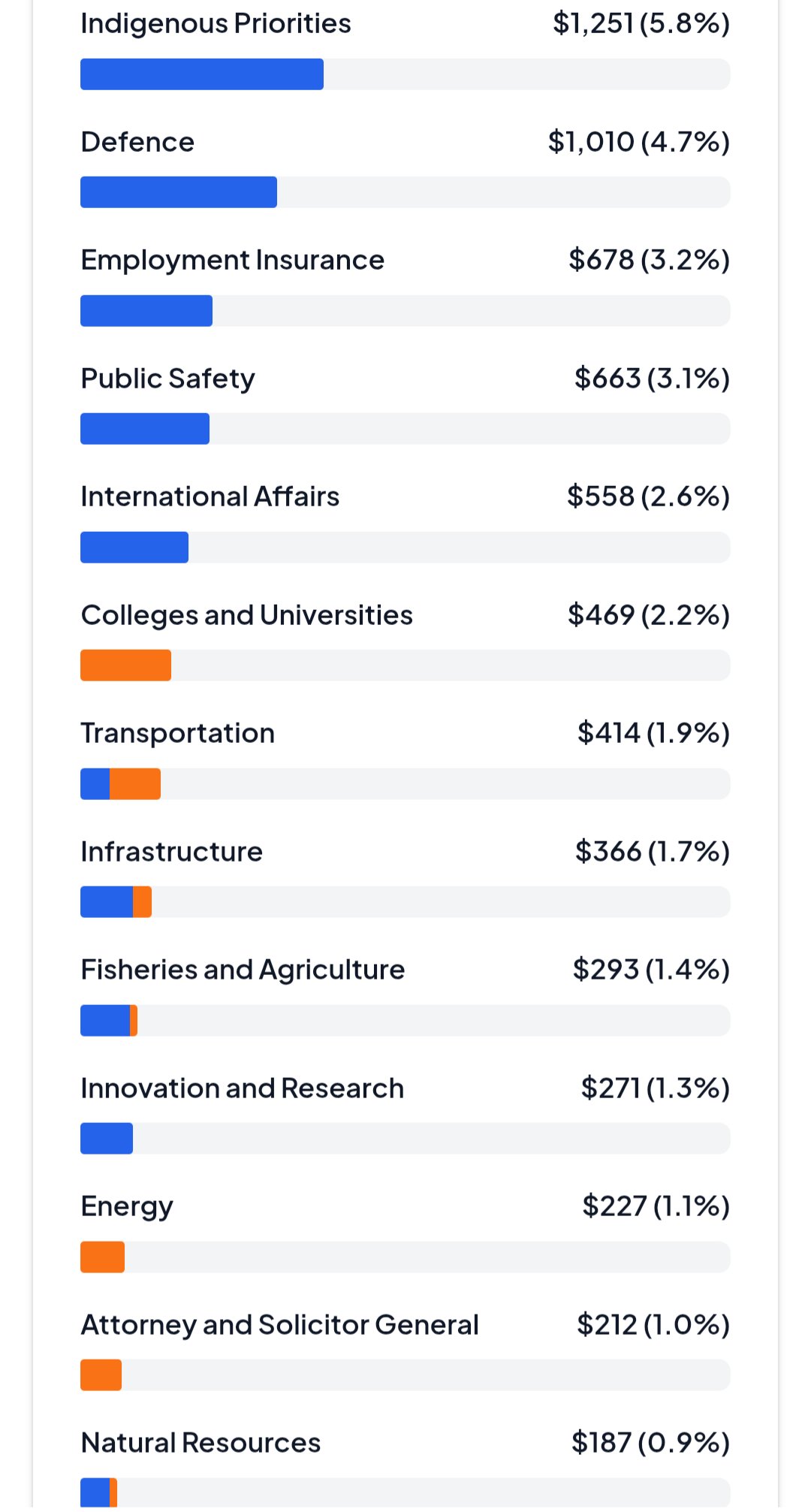
Canada’s federal budget tells a story that few seem willing to read critically. According to CanadaSpends.com, Ottawa allocates $1.251 billion—5.8 percent of the budget—to “Indigenous Priorities,” eclipsing even Defence ($1.010 billion, 4.7 percent). The arithmetic alone invites scrutiny. At what point does reconciliation become a fiscal reflex, untethered from measurable outcomes?
The Arithmetic of Imbalance
Consider a simple exercise in opportunity cost. Halving “Indigenous Priorities” to $625.5 million would free an equal amount—$625.5 million—for redeployment elsewhere. Redirecting that sum to Public Safety, currently $663 million (3.1 percent), would nearly double its capacity to $1.288 billion. The outcome: stronger policing resources, reinforced border security, and potentially measurable reductions in crime—objectives grounded in deterrence rather than symbolism.
This is not an argument against Indigenous advancement. It is an argument for proportionality and accountability. “Indigenous Priorities” now consume more than Employment Insurance ($678 million), International Affairs ($558 million), and Colleges and Universities ($469 million) combined. Defence, tasked with national sovereignty, trails by $241 million. When cultural or consultative programs eclipse citizen security and education, something in our fiscal compass is misaligned.
The Accountability Deficit
Proponents will cite historical redress, and that moral claim has force. But truth in budgeting requires evidence, not sentiment. Where are the audited outcomes showing that each billion spent yields measurable gains in Indigenous health, education, or economic independence?
The problem is not merely bureaucratic inertia—it is structural opacity, worsened by political choice. In December 2015, the newly elected Liberal government suspended enforcement of the First Nations Financial Transparency Act, which had required Indigenous governments to publish audited financial statements and leadership salaries. The minister at the time, Carolyn Bennett, directed her department to “cease all discretionary compliance measures” and reinstated funding to communities that refused disclosure.
In effect, Ottawa dismantled the only system ensuring public visibility into how billions of tax dollars are spent. Nearly a decade later, the Auditor General’s 2025 report found “unsatisfactory progress” on more than half of all Indigenous-services audit recommendations, despite an 84 percent increase in program spending since 2019. The data are undeniable: accountability has eroded even as expenditures have soared.
Fiscal Compassion, Not Fiscal Indulgence
Canada does not need less compassion; it needs measurable compassion—spending that demonstrably improves lives rather than perpetuates dependency. Halving the current Indigenous Priorities budget would not abolish support or reverse reconciliation. It would introduce accountability, allowing funds to be reallocated to public safety, infrastructure, or innovation—areas with immediate and empirically verifiable benefits.
Until Indigenous programs are evaluated with the same rigour applied to defence, education, or social insurance, billion-dollar gestures will remain ends in themselves—virtue without verification.
References
- CanadaSpends.com – Federal Tax Visualizer
- Government of Canada Statement on the First Nations Financial Transparency Act (2015)
- Office of the Auditor General of Canada, 2025 Report – Programs for First Nations
- Canadian Affairs News – Poll: Canadians Want Transparency in First Nations Finances (2025)
- Standing Committee Appearance: Supplementary Estimates (2024)
- Crown-Indigenous Relations and Northern Affairs Canada 2023–24 Results Report
Across Canada, we are witnessing a subtle yet sweeping shift: ideology increasingly outweighs empirical judgment, and institutions once grounded in caution are now pressing ahead with conviction. When belief eclipses observation, society risks felling its own future. This essay explores how the parable of A Short History of Progress becomes a cautionary mirror for our age, when economic vitality, civic trust, and long-term health hang, in effect, on that final swing of the axe.

“The Last Tree” draws a sharp line from the collapse of Easter Island’s ecosystem to three modern Canadian crises—net-zero policy, selective law-enforcement in protest, and rapid-onset gender-affirming care—to ask: when ideology becomes our arbiter rather than evidence, what are we willing to sacrifice?
The Last Tree: When Ideology Fells the Future
In Ronald Wright’s A Short History of Progress, the tale of Easter Island stands as a stark parable of human folly. Isolated in the vast Pacific, the Rapa Nui people arrived around 800 AD and transformed a forested paradise into a monument to their ingenuity and hubris. Over centuries, they felled the island’s palm groves to haul colossal moai statues across the terrain, using timber for sledges, ropes from bark, and fuel for fires. What began as a display of ancestral piety and clan prestige spiraled into ecological catastrophe. Soil eroded, fertility plummeted, bird populations vanished, and the once-vibrant ecosystem crumbled. By the 17th century, the population had crashed from perhaps 15,000 to a few thousand, amid famine, warfare, and cannibalism. Wright captures the inexorable logic: progress, unchecked, devours its own foundations.
Yet it is the final act that lingers—a moment of crystalline horror. The people who felled the last tree could see it was the last, could know with complete certainty that there would never be another. Imagine that islander, axe in hand, gazing at the solitary palm swaying against the horizon. The wind carries the salt of an empty sea, the ground beneath him scarred and barren. What raced through his mind? Not ignorance, for the warnings were etched in the dust: topsoil washing into the ocean, rats devouring every seed, canoes rotting on barren shores. No, it was something fiercer—a conviction forged in ritual and rivalry.
This tree, he might have reasoned, honours the ancestors; to spare it is to dishonour them, to invite the gods’ wrath. The rival clan cannot be allowed supremacy in statue-toppling; one more moai secures our lineage’s glory. Tradition demands it, the priests decree it, and in the face of clan elders’ unyielding stares, doubt withers like the fronds around him. Survival? A coward’s calculus, subordinate to the sacred narrative of progress through monument. With a swing, ideology claims its victory over reality, sealing the island’s doom.
This scene, Wright implies, is not ancient history but a mirror to our own susceptibilities. Ideological blindness is not partisan—it afflicts any society where belief eclipses observation. We stand at analogous thresholds today, where cherished convictions compel us to strike the final blow.
Consider our pursuit of net-zero emissions, pursued with a fervour that borders on the messianic. The federal government’s 2030 targets, however well-intentioned, risk undermining the very prosperity they claim to safeguard. The rhetoric of existential apocalypse—tipping points invoked like divine judgments—drowns out the data: Canada’s emissions constitute roughly 1.5 percent of the global total, and even full compliance would yield negligible climatic impact while rivals like China and India accelerate coal-fired expansion. Policymakers, axe raised, justify the cut: it honours the intergenerational covenant, shames the sceptic as a heretic. Yet the last “tree” here is economic vitality itself, felled in service to a narrative that confuses virtue with viability.
No less alarming is the selective blindness in enforcing the rule of law, particularly amid the surge of “Free Palestine” protests since October 7, 2023. These demonstrations, while not all hateful, have coincided with a documented explosion of antisemitism: synagogues vandalised, Jewish students harassed, and public chants equating Zionism with Nazism increasingly tolerated under the banner of free expression. Authorities often cite the need to avoid escalation or protect equity rights—but to apply the law unevenly corrodes the Charter’s promise of equal protection. The justification echoes the islander’s: equity demands deference to the aggrieved, lest we be branded oppressors. Thus, the final tree of civic trust is hacked away under the banner of performative solidarity.
Perhaps most viscerally, our medical institutions’ embrace of gender-affirming care reveals ideology’s grip on empirical mercy. Provincial guidelines expedite hormones and surgeries for minors, often with scant longitudinal scrutiny, despite emerging evidence of regret and harm. Critics—including those echoing the UK’s Cass Review—argue that compassion has been recast as affirmation, turning clinics into ideological fortresses where dissent is pathologised. This is not to deny the reality of gender dysphoria or the dignity of trans adults seeking relief; it is to insist that true compassion must rest on evidence, not dogma. The clinician, scalpel poised, rationalises: empathy compels affirmation; to probe deeper risks transphobia’s charge. Reality—the patient’s lifelong body, the data’s gaps—yields to the doctrine, mutilating futures in the name of inclusion.
These Canadian vignettes, like Easter Island’s denouement, expose ideology’s seductive tyranny: a narrative so totalising it renders the evident obsolete. Friedrich Nietzsche foresaw this abyss in his dissection of nihilism, that devaluation where “the highest values are losing their value.” Like Wright’s islanders, we mistake self-destruction for virtue—a form of nihilism Nietzsche saw as civilisation’s end-game. Cloaked in Marxist activist garb—equity as the new god, progress as its prophet—these policies dissolve society’s sinews not through malice but through a will to power masquerading as justice. Nietzsche warned that such illusions prolong torment, for “hope in reality is the worst of all evils because it prolongs the torments of man.”
To reclaim our ground, we must confront the axe in our hand: interrogate the story, honour the verifiable, and plant anew before the last tree falls. The islanders could not. We still can.
References
- Wright, Ronald. A Short History of Progress. Anansi, 2004.
- Fraser Institute, “Measuring the Cost of Canada’s Net-Zero Climate Policy,” 2024.
- B’nai Brith Canada, Annual Audit of Antisemitic Incidents, 2024.
- Government of Canada, 2030 Emissions Reduction Plan, 2022.
- Cass, Hilary. Independent Review of Gender Identity Services for Children and Young People (The Cass Review). UK NHS, 2024.
- For Canada-specific studies on gender-affirming care outcomes:
- Jackman, Liam et al., “Patient-reported outcomes, provider-reported outcomes, and physiologic parameters after gender-affirming hormone treatment in Canada: a systematic review” (2025). (SpringerLink)
- Lawson, M.L. et al., “A Cross-Sectional Analysis from the Trans Youth CAN! Study” (2024). (Jah Online)
- “At-a-glance – Gender identity and sexual attraction among Canadian youth: findings from the 2019 Canadian Health Survey on Children and Youth” (2023). (canada.ca)
Totalitarianism doesn’t always arrive with jackboots and slogans. Sometimes it comes wrapped in compassion, weaponizing language to divide citizens into moral castes of “the good” and “the guilty.” As James Lindsay warns, every ideology that builds itself on purging an “enemy” eventually devours its own believers. Today’s soft totalitarianism operates not through force, but through narrative warfare—using labels like “Maple MAGA” or “anti-equity” to silence dissent and enforce ideological purity.

The Totalitarian Mindset in Our Midst
The belief in any totalitarian system is that there is some ‘enemy’ that holds back society. Once that enemy is destroyed and purged, society will flourish, or so the cult belief goes.” —James Lindsay
The Endless Enemy
James Lindsay’s observation is not a history lesson it’s a warning. Totalitarian movements always begin with the conviction that society’s ills can be traced to a corrupt class of people who must be identified and eliminated.
The logic is seductively simple: If only the enemy were gone, we could be free. But when the promised harmony never arrives, the search for hidden enemies intensifies. The hunt becomes perpetual, the paranoia self-sustaining. Every failure is blamed on infiltration, every setback on the persistence of the impure.
This cycle of purification is as old as ideology itself, but today it is being revived in softer, subtler ways—through moralized language, social shaming, and bureaucratic enforcement of political conformity.
The New Form: Narrative Warfare
In modern liberal democracies, totalitarianism doesn’t need guns or gulags. It begins with words. The authoritarian project of the 21st century is linguistic—it manufactures enemies through labels, controls discourse through moral accusation, and demands conformity under the banner of compassion.
In Canada and across the West, we see this in the weaponization of language: “Maple MAGA,” “anti-equity,” “white adjacent,” “problematic.” These aren’t analytical categories; they’re *filters of suspicion.* Once the label sticks, a person’s character and arguments no longer matter. They are marked.
This dynamic is a form of narrative warfare—the use of moralized storytelling to delegitimize opponents and consolidate cultural power. It’s the precondition of soft totalitarianism: control the story, and you control reality.
Weaponized Intersectionality: A Framework for Division
One of the key delivery systems for this mentality is **weaponized intersectionality**. Originally coined by legal scholar Kimberlé Crenshaw to describe overlapping forms of discrimination, the concept has been repurposed into a political sorting mechanism—one that divides society into immutable identity classes of “oppressors” and “oppressed.”
|Tactic |How It Works| Effect on Society |
| Labeling & Name-Calling | Terms like “Maple MAGA,” “far-right,” or “white adjacent” pre-empt debate and morally quarantine dissent. | Delegitimizes citizens instead of arguments; silences conversation. |
| Moral Purity Tests | Demands that allies demonstrate constant ideological conformity (“anti-racist,” “affirming,” “decolonized”). | Creates fear of speaking or questioning; enforces orthodoxy. |
| Institutional Capture | Activist vocabulary embedded in policy, HR, and education under “diversity” and “equity” mandates. | Bureaucratizes ideology; punishes dissent within organizations. |
| Perpetual Enemy-Hunting| “Privilege” and “bias” are re-discovered endlessly; the enemy is never gone, only hiding. | Normalizes suspicion; sustains revolutionary fervor without end. |
Each tactic reinforces the other. Together, they recreate the same cycle Lindsay describes: a social order sustained by perpetual purification.
The enemy is not gone; it is merely “in hiding.”
The Moral Mechanics of Control
Modern totalitarianism thrives on moral certainty rather than state terror. It convinces ordinary citizens that they are participating in justice, not oppression. To question the narrative is to expose oneself as suspect, and so the culture of fear spreads horizontally—through HR departments, social media platforms, and educational institutions.
This is how freedom erodes without a coup or revolution: through social coercion disguised as moral progress.
The power lies not in force, but in the internalization of guilt and fear. People censor themselves before anyone else has to.
What We Can Do About It
1. Recenter Universal Principles
Defend equality before the law, free inquiry, and human dignity—not inherited guilt or group virtue. Anchor civic life in the moral universals that totalitarian ideologies deny.
2. Name the Dynamic
When faced with ideological bullying, describe what’s happening: *“This is an attempt to morally disqualify rather than discuss.”* Naming the tactic exposes the manipulation and halts its momentum.
3. Build Parallel Forums for Open Debate
Create independent media, civic associations, and discussion circles where disagreement is respected. The antidote to coercion is community.
4. Refuse the Language of Division
Reject slurs and invented terms designed to fragment society. Language is not neutral—it’s the primary weapon of soft authoritarianism. Don’t wield theirs.
5. Practice Moral Courage
The first act of resistance is speech. Speak calmly, truthfully, and consistently—even when it’s uncomfortable. Silence is the oxygen of control.
Conclusion: The Old Lie in a New Form
Totalitarianism does not march under the same banners it once did. It arrives softly, wrapped in moral rhetoric and bureaucratic language, persuading good people that they are fighting for justice. But as Lindsay warns, every ideology that builds itself on purging an enemy eventually devours its own believers.
The only true defense is to reclaim our shared humanity—to judge one another by deeds, not descent; by actions, not affiliations. Freedom, as it turns out, depends not on the absence of enemies, but on the courage to refuse the hunt.
—
References
Lindsay, J. (2025, October 9). Why totalitarianism always produces mass murders. [Tweet]. X (Twitter). [https://x.com/ConceptualJames/status/1976724498213667156](https://x.com/ConceptualJames/status/1976724498213667156)
Crenshaw, K. (1989). Demarginalizing the Intersection of Race and Sex: A Black Feminist Critique of Antidiscrimination Doctrine, Feminist Theory and Antiracist Politics. University of Chicago Legal Forum.
Orwell, G. (1946). Politics and the English Language.
Arendt, H. (1963). Eichmann in Jerusalem: A Report on the Banality of Evil.
Popper, K. (1945). The Open Society and Its Enemies.
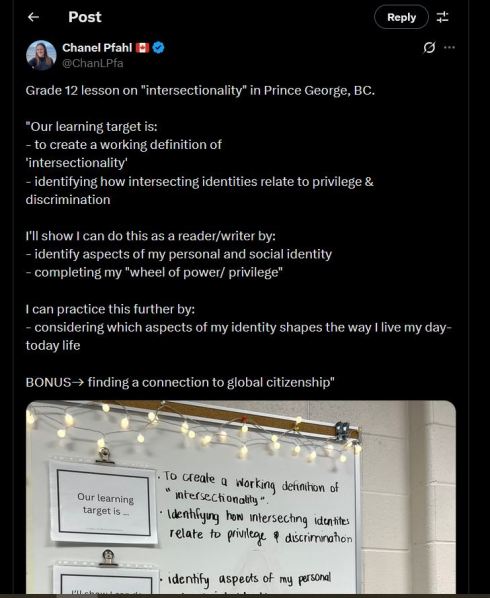
In Prince George, British Columbia, Grade 12 students were recently asked to “map their identities” on a wheel of power and privilege and define how overlapping traits like race, gender, and class shape their lives. The exercise was meant to foster empathy. Instead, it taught students to see themselves—and one another—through a hierarchy of guilt and grievance.
This is intersectionality in action. Coined by legal scholar Kimberlé Crenshaw in 1989, the theory originally sought to highlight how overlapping identities could compound discrimination. But in today’s classrooms, HR seminars, and activist spaces, intersectionality has evolved into something more aggressive: a political sorting tool that assigns moral value based on group identity rather than personal conduct. When used this way, it becomes weaponized intersectionality.
1. Define It Precisely
When arguing against it, start by defining intersectionality clearly. Don’t caricature it. Acknowledge its original intent—understanding overlapping forms of discrimination—but distinguish that from its modern mutation, which treats identity as destiny. This makes your critique credible and inoculates against claims of ignorance or bad faith.
2. Expose the Hidden Premise
Weaponized intersectionality rests on a simple but flawed assumption: that all disparities are the result of oppression and that moral authority flows from victimhood. Challenge that premise. Inequality does not always mean injustice. Lived experience matters, but it does not override evidence or reason.
3. Defend Universalism
Reassert the Enlightenment principle that all individuals possess equal moral worth regardless of group identity. Intersectionality divides by assigning virtue or guilt to immutable traits; universalism unites by judging actions, not ancestry. This is not denial of injustice—it’s the precondition for solving it.
4. Point Out Its Social Effects
Weaponized intersectionality erodes solidarity. It breeds resentment, teaching students and citizens alike to view each other as oppressors or oppressed. Even some leftist thinkers, like Nancy Fraser, have warned that intersectionality replaces economic analysis with “cultural essentialism,” fracturing potential alliances for real reform.
5. Offer a Better Vision
Don’t just oppose—propose. Replace identity grids with human rights frameworks. Discuss shared values such as dignity, equality before the law, and freedom of conscience. These ideas have lifted more people from oppression than any taxonomy of privilege ever could.
The Prince George lesson shows what happens when ideology replaces education: empathy becomes accusation, and learning becomes confession. Weaponized intersectionality promises justice but delivers division. The antidote is not denial of difference but defense of common humanity—an argument every student deserves to hear.











 bleatmop
 Mystro


 Dead Wild Roses
Your opinions…