
You are currently browsing the tag archive for the ‘discrimination’ tag.
A University of Toronto Scarborough posting for an Assistant Professor in Computational Biology and Data Science looks like a standard academic hire. It isn’t. It is a restricted competition tied to a Canada Research Chair (CRC) nomination.
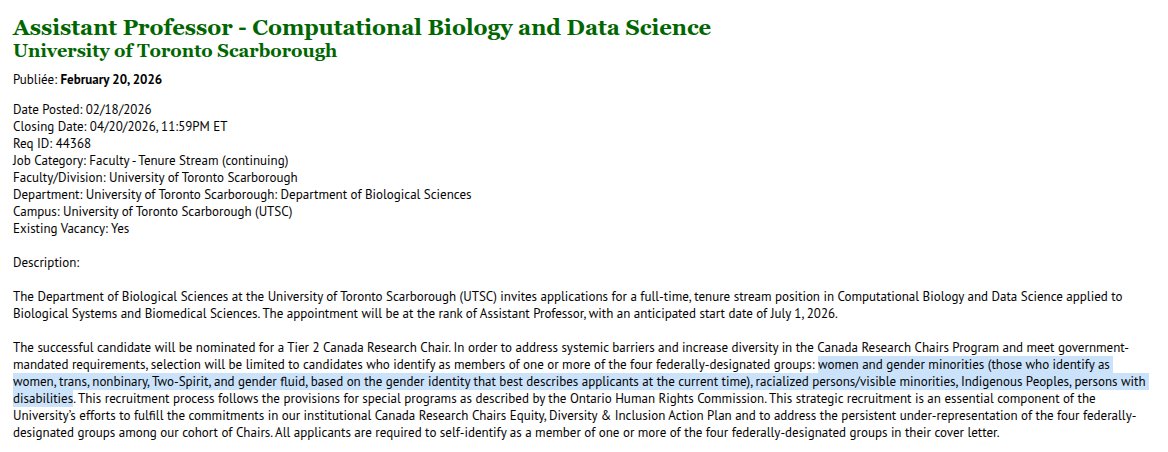 The posting requires applicants to self-identify as a member of one or more “designated groups” in their cover letter, namely women or gender minorities, racialized persons, Indigenous Peoples, or persons with disabilities. If you do not fit one of those categories, you are not eligible to apply. That is not an inference. It is in the posting.
That one detail captures the reality of modern equity administration in Canadian universities: what is framed as “removing barriers” often functions, in practice, as category-based exclusion.
This is not a rogue department. It is a federal program mechanism.
The university did not invent this framework on its own. The hiring restriction is attached to the Canada Research Chairs program, a federal initiative that allocates prestige and funding to institutions under defined rules. One major rule-set is the CRC equity framework, which includes population-based targets for the four designated groups. The program’s stated targets to be reached by the end of 2029 are: 50.9% women and gender equity-seeking groups, 22% racialized persons, 4.9% Indigenous Peoples, and 7.5% persons with disabilities.
Again, these are not vibes. They are published benchmarks tied to institutional plans and program governance.
The key point is the enforcement logic. Under the CRC’s settlement and enforcement framework, institutions that miss interim targets can face consequences that shape nominations and recruitment practices. In plain terms: the program can push institutions toward restricted competitions where eligibility is limited to designated groups.
So when you see a posting that excludes broad classes of Canadians from applying, it is not a one-off. It is a downstream product of rules that tie federal research prestige to demographic targets.
The problem is the normalization of identity gates
Defenders will say this is equity. They will argue that special measures are justified to counter historical bias and structural disadvantage. That is the argument, and it deserves to be stated fairly.
But there is a moral and civic cost to the method. When eligibility is restricted by identity categories, the institution is no longer selecting among all qualified candidates. It is selecting among those who clear an identity threshold first. That is not “equal opportunity.” It is a gate that sorts people before their work is even evaluated.
If you want a simple test for whether this is principled, reverse the identity labels. A posting that said “whites only” or “men only” would be condemned instantly, for good reason. You do not escape discrimination by flipping who benefits. You normalize discrimination by making it administratively routine.
A better standard
If Canada wants fairness in academic hiring, the standard should be straightforward: open eligibility, transparent criteria, and selection based on demonstrated excellence. If there are pipeline problems, fix the pipeline. Broaden recruitment, strengthen mentorship, reduce opaque networking advantages, and enforce accountable evaluation.
Do not solve bias by writing exclusions into job postings, then congratulating yourself for it. That approach trains young researchers to see institutions as political allocation machines rather than merit-seeking communities. And once that belief sets in, you do not get trust back easily.

References
1) U of T Scarborough job posting (Assistant Professor – Computational Biology and Data Science)
https://jobs.utoronto.ca/job/Scarborough-Assistant-Professor-Computational-Biology-and-Data-Science-ON/599939517/
2) Canada Research Chairs: “Establishing equity targets for 2021 to 2029”
https://www.chairs-chaires.gc.ca/program-programme/equity-equite/targets-cibles-eng.aspx
3) CRC Program representation statistics (lists the population-based targets and deadline)
https://www.chairs-chaires.gc.ca/about_us-a_notre_sujet/statistics-statistiques-eng.aspx
4) CRC: Equity, Diversity and Inclusion requirements and practices (overview, settlement context)
https://www.chairs-chaires.gc.ca/program-programme/equity-equite/index-eng.aspx
5) CRC: 2021 Canadian Human Rights Settlement Agreement page (program framing and enforcement context)
https://www.chairs-chaires.gc.ca/program-programme/equity-equite/2021_settlement-reglement-eng.aspx
6) House of Commons Standing Committee on Science and Research, Meeting No. 2 (witness panel includes Steven Pinker and Azim Shariff)
https://www.ourcommons.ca/documentviewer/en/45-1/SRSR/meeting-2/evidence
Get out the duct tape! You’ll need it to keep your jaw from hitting the floor over how amazingly absurd this fine christian preacher is. Because people are protesting outside of his church they must be Sodomites and by extension the coffee that they are serving must be infused with semen.
Yes, I know. So fasten your seat belt Dorthy – the good reverend awaits.
Oh hey, let’s investigate his source.

Hmmm…oh and snopes says its BS, just if you are really concerned about your overpriced coffee. Research time less than one minute. Hmm…I wonder if possible anything else the good pastor says should be questioned?
Ms.Betty Bowers thoughts on the 2014 Olympics.
Maybe we should update our preferred torture methods, hanging perhaps?
Our society is progressing ever so slowly (and will continue to do so if we don’t let the corporations win, restore the 25% tax rate please). I often look to the politics and citizenry of Quebec for cues on progressive society and the model we should be working toward. Progress does come in fits and starts, but the latest PQ notion of a Secular Charter is a retrograde notion at its very best.
The Parti Québécois wants to introduce a secular charter and ban all civil servants from wearing or exposing overt religious symbols.
This isn’t the first time the Parti Québécois has mentioned the introduction of a secular charter aimed at making sure public and parapublic institutions are free of religious bias and symbols.
This part is good. Government needs to be free of the stench of religion and all of the sectarian nonsense that comes with it. The wider the wall between church and state, the better off society will be. Spot the problem with this next bit from Pauline Marois:
“We will fight for what we need because we think this is essential for the public’s well-being by taking its values and writing them in a charter,” Marois said.Under such a charter, civil servants would not be allowed to wear conspicuous religious symbols.
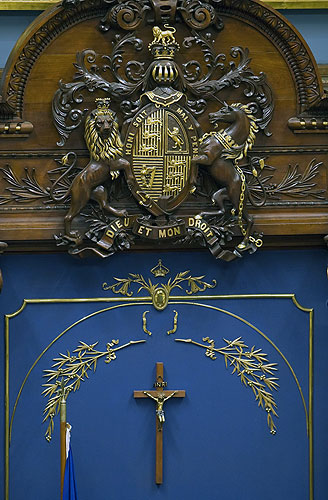
The crucifix at Quebec’s national assembly, however, would remain untouched.
Marois also talked about the fact that many of Quebec’s institutions used to be based on religion.It’s part of our heritage, but taking a step to ensure the state’s secularity is not to deny what we are, but that we are at a new moment in our lives and believe the state’s neutrality and the fundamental values, equality between men and women must guide us toward a life together in Quebec,” Marois said.
*broken record sound* What phoque is going on with that?
We’ll keep our christian torture symbol prominently displayed in the national assembly, but the rest the religious stuff, you know you immigrants and your pagan practices…that shite has to go!
If you are going to adopt a secular charter then all of the religious bullshite has to go, you can’t keep the ones that you like and then say no to others citing “the secular nature of society” that is just discrimination of the racist sort and therefore has no place in progressive secular society.
Fits and starts I tell thee. Come on Quebec, get it right and turf all the religious ooga-booga, it will do Quebec and Canada proud.











 bleatmop
 Mystro


 Dead Wild Roses
Your opinions…