
You are currently browsing the tag archive for the ‘Identity Politics’ tag.
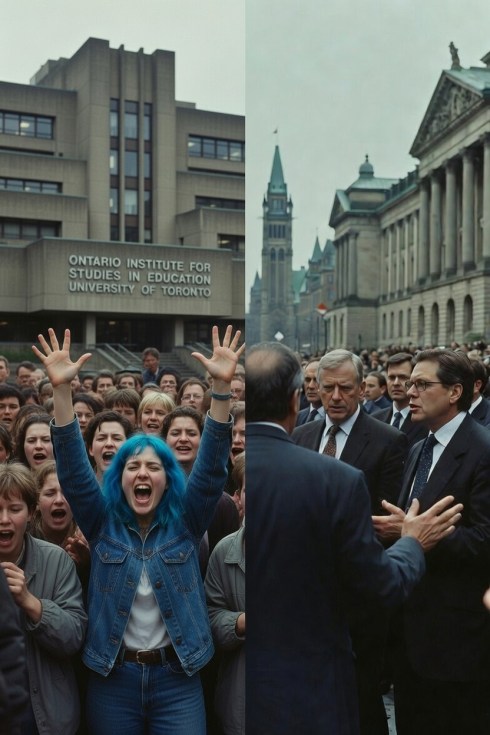
The Ontario Institute for Studies in Education at the University of Toronto is hosting its 13th annual decolonizing conference from March 12 to 14, 2026. The title tells you plenty: Colonial Ruptures: Unmasking Ongoing Coloniality and Fostering Counter Insurgency, Resistance and Liberatory Possibilities. The event materials describe a gathering of scholars, activists, educators, artists, Elders, and community leaders committed to critical reflection, collective action, and “decolonial futures.” They speak of resisting “global capital extractivism and supremacist thinking,” rejecting “colonial binaries,” and advancing liberatory possibilities. This is not an outside caricature. It is the institution describing itself.
That matters because OISE is not a fringe collective borrowing university space for a weekend. It is one of the country’s most influential faculties of education, and CIARS is one of its public-facing centres. A conference like this does not define every part of OISE, but it does reveal a real moral and intellectual current inside one of Canada’s most important teacher-forming institutions. When an institution like that adopts the language of rupture, insurgency, resistance, and decolonial struggle, critics are entitled to ask a basic question: is this education in the ordinary civic sense, or ideological formation dressed in educational language?
To be fair, proponents would say the purpose is not social fragmentation but repair. They would say decolonizing education means confronting historical blind spots, taking Indigenous and anti-racist perspectives seriously, and widening the moral vocabulary of the classroom. Fine. That case should be acknowledged. But public language still matters. When a flagship faculty of education foregrounds coloniality, rupture, counter-insurgency, and resistance, it signals something more than curricular broadening. It signals an adversarial posture, even when softened by the language of care, solidarity, and reimagined futures.
That is the real concern. The problem is not that Canada’s injustices are being taught. A serious country should teach its history honestly. The problem is that teacher formation may be drifting toward a framework in which critique stops being a tool of civic improvement and becomes the default grammar through which the society itself is read. In theory, decolonial approaches and core educational goals can coexist. In practice, the public-facing language here suggests a hierarchy of concerns in which ideological critique increasingly outranks institutional competence, shared citizenship, and academic pluralism.
“What the public sees is not repair but drift: a professional class fluent in rupture and resistance while the country struggles to do ordinary things well.”
People notice that shift because they are already living inside a country under strain. Canada has struggled with weak productivity for years. The OECD’s 2025 survey says the outlook was worsened by trade uncertainty and tariffs, projects a decline in GDP from the second quarter of 2025 because of falling exports to the United States, and devotes sustained attention to the problem of raising business-sector productivity. Housing is worse. CMHC said in 2025 that restoring affordability to 2019 levels would require roughly 430,000 to 480,000 new housing units per year until 2035, about double the recent pace. That is not ideological spin. It is the national housing agency saying the country is not building nearly enough homes.
So people look around and see weak productivity, punishing housing costs, trade pressure, strained public capacity, and thinning civic confidence. Then they watch elite educational institutions pour moral energy into conferences on colonial rupture and liberatory counter-insurgency. The disconnect is hard to miss. Citizens who want functional schools, affordable homes, competent government, and some residue of common national identity are told, again and again, that the deeper task is deconstruction. Not reform. Not competence. Deconstruction.
That is one reason disillusionment has grown. The problem is not honest history. It is not the inclusion of neglected perspectives. The problem is that “decolonizing” has become, in practice, a legitimating language for ideological sorting. It shifts attention away from what institutions are for and toward the moral drama of permanent critique. In education, that is a serious danger. A teacher should be equipped to help students read, write, reason, deliberate, and live with others in a shared society. If the training environment increasingly teaches that the shared society itself is morally suspect at the root, the civic consequences are unlikely to be good.
Canada does not need amnesia. It does not need self-flattery either. But it also does not need a professional class trained to interpret the country chiefly through the grammar of oppression, rupture, and resistance. A society held together by trust, inheritance, and common rules cannot sustain indefinite elite suspicion toward its own foundations. If public institutions want to recover legitimacy, they will have to rediscover a language of citizenship, competence, pluralism, and shared belonging. Until then, more Canadians will keep feeling that the country they were told to love is being taught to despise itself.
References
OISE / CIARS conference page
https://www.oise.utoronto.ca/ciars/ciars-2026-xiii-decolonizing-conference-1
OISE / SJE newsletter page on the conference
https://www.oise.utoronto.ca/sje/newsletter/march-2026/CIARS-newsletter-conference
OISE February 2026 conference notice
https://www.oise.utoronto.ca/home/sje/newsletter/february-2026/CIARS-conference
CIARS centre page
https://www.oise.utoronto.ca/ciars
CMHC housing supply report page
https://www.cmhc-schl.gc.ca/professionals/housing-markets-data-and-research/housing-research/research-reports/accelerate-supply/canadas-housing-supply-shortages-a-new-framework
CMHC housing supply gap explainer
https://www.cmhc-schl.gc.ca/observer/2025/updating-canada-housing-supply-shortages-new-housing-supply-gap-estimates
CMHC news release on housing supply gaps
https://www.cmhc-schl.gc.ca/media-newsroom/news-releases/2025/cmhc-releases-latest-housing-supply-gaps-report
OECD Economic Survey of Canada 2025
https://www.oecd.org/en/publications/2025/05/oecd-economic-surveys-canada-2025_ee18a269.html
OECD full report
https://www.oecd.org/en/publications/2025/05/oecd-economic-surveys-canada-2025_ee18a269/full-report.html
OECD chapter on raising business-sector productivity
https://www.oecd.org/en/publications/2025/05/oecd-economic-surveys-canada-2025_ee18a269/full-report/raising-business-sector-productivity_443bcd88.html
Glossary
Decolonizing
A broad academic and political term for efforts to challenge ideas, institutions, and practices seen as shaped by colonial power.
Coloniality
The claim that power structures formed under colonial rule can persist long after formal colonial administration ends.
Counter-insurgency
Traditionally, efforts to resist or suppress insurgent movements. In academic settings it is often used metaphorically, which is part of why it sounds so militant.
Colonial binaries
Simple oppositions said to come out of colonial thinking, such as colonizer/colonized or civilized/uncivilized.
Liberatory
A term used to describe ideas or practices aimed at freeing people from oppression or domination.
Extractivism
An economic model focused on intensive resource extraction, usually criticized for environmental damage or unequal power.
Academic pluralism
The principle that higher education should make room for genuine intellectual diversity rather than one dominant ideological framework.
Civic order
The shared rules, institutions, and habits that allow people with real differences to live together in one political community.
Collin May has published a long, ambitious essay in the C2C journal (Hearts of Darkness: How the Left Uses Hate to Fuel its 21st Century Universal Imperium) on cancel culture, “hate” rhetoric, and the modern left’s moral posture. It is broader than I would write, more philosophical than most readers will tolerate, and occasionally overbuilt. But it names a pattern that matters, and one I return to often here: once “hate” becomes a universal accusation, institutions stop persuading and start policing.
May’s most useful contribution is not just the complaint (“cancel culture exists”) but the mechanism: “hate” stops being a moral description and becomes a category that pre-sorts who may be argued with and who may simply be managed.
That is the issue.
Not whether hatred exists. It does. Not whether some speech is vicious. It is. The issue is what happens when “hate” becomes the default label for disagreement, skepticism, refusal, dissent, or plain moral and factual judgments that cut against elite narratives.
At that point, the term stops describing and starts doing administrative work.
You can watch this happen across the institutions that shape public life: media, HR departments, professional bodies, universities, bureaucracies, and the expanding quasi-legal space around speech regulation. The sequence is familiar. Someone raises a concern about policy, ideology, language rules, school programming, medical ethics, public safety, immigration, religion, or sex-based rights. Instead of answering the argument, the institution reframes the speaker. Not wrong—harmful. Not questioning—spreading hate. Not participating in democratic friction—a threat to social order.
That move changes the rules of engagement. A wrong claim can be debated. A “hateful” claim can be quarantined. Once a claim is reclassified as harm rather than argument, the institutional response changes with it: less rebuttal, more restriction.
This language matters because it is not only moral language. It is managerial language. It justifies deplatforming, censorship, professional discipline, reputational destruction, and exclusion from ordinary civic legitimacy. It creates a class of people whose arguments no longer need to be answered on the merits. It also trains bystanders to confuse moral panic with moral seriousness.
May explains this through a large historical and philosophical genealogy. Fair enough. I am less interested in the full genealogy than in the practical result in front of us. In plain terms: the rhetoric of “hate” is often used to centralize authority in institutions that no longer trust the public and no longer feel obliged to reason with them.
That is one reason trust keeps collapsing.
People can live with disagreement. They can even live with policies they dislike. What they do not tolerate for long is being handled—being told their questions are illegitimate before they are heard. Once citizens conclude that institutions are using moral language as a shield against scrutiny, every future statement gets discounted. Even true statements are heard as spin.
And then the damage compounds. If “hate” is defined so broadly that it includes dissent, genuinely hateful speech becomes harder to identify and confront. The category gets inflated, politicized, and cheapened. Meanwhile, ordinary democratic disagreement becomes harder to conduct without professional or social risk.
That is not a confident free society. It is a managerial one.
Canada is not exempt. We have our own versions of this habit: speech debates reframed as safety debates, policy criticism recoded as identity harm, and public disputes (including over schools, sex-based rights, and even routine civic rituals like land acknowledgements) routed through tribunals, regulators, HR offices, and media scripts instead of open argument. The details vary by case. The mechanism does not. This tactic is not unique to one political tribe, but it is now especially entrenched in progressive-managerial institutions, which is precisely why it has so much reach.
The answer is not to deny hatred exists, or to become casual about cruelty. The answer is to recover civic discipline.
Name actual incitement when it occurs. Enforce existing laws where there are real threats, harassment, or violence. But stop using “hate” as a catch-all for disfavoured views. Stop treating condemnation as a substitute for evidence. Stop teaching institutions that the way to win an argument is to disqualify the speaker.
May quotes Pope Francis on cancel culture as something that “leaves no room.” Whether or not one follows his full historical argument, that phrase captures the operational problem.
A liberal society cannot function if citizens are only permitted to disagree inside moral boundaries drawn in advance by bureaucrats, activists, and legacy media.
The test is simple: can a claim be examined without first being moralized into silence?
If the answer is no, that is not moral confidence. It is institutional insecurity backed by power.
That is the pattern worth naming. And that is why essays like May’s, even when they overshoot, remain worth reading.

References
Collin May, “Hearts of Darkness: How the Left Uses Hate to Fuel its 21st Century Universal Imperium,” C2C Journal (February 16, 2026), https://c2cjournal.ca/2026/02/hearts-of-darkness-how-the-left-uses-hate-to-fuel-its-21st-century-universal-imperium/. (C2C Journal)
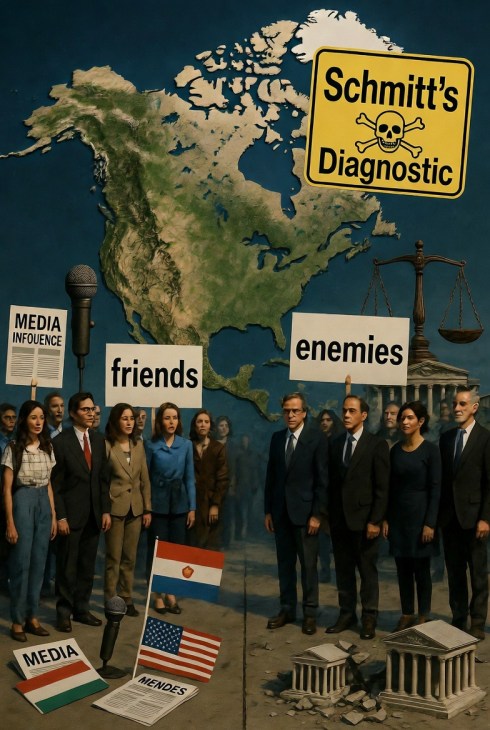
Modern North American politics is increasingly conducted as if the other side is not an opponent but a threat. Not “wrong,” but illegitimate. Not “mistaken,” but dangerous. Once that framing takes hold, everything downstream gets harder: legislating, compromising, trusting institutions, even sharing a country.
There’s a name for this move, and it’s older than social media: the friend–enemy distinction associated with the German jurist Carl Schmitt. Use it carefully. Attribute it correctly. Treat it as a warning label, not a blueprint.
The Schmitt paragraph (correct attribution without laundering)
In The Concept of the Political (first as an essay in 1927; expanded as a book in 1932), Carl Schmitt argued that what is distinctively political is not morality, economics, or aesthetics, but the capacity to sort human beings into friends and enemies—public groupings that can reach the highest intensity and, in the extreme case, make violence thinkable. (Stanford Encyclopedia of Philosophy) Schmitt is a morally compromised figure: he joined the Nazi Party in 1933 and wrote in support of the regime, which makes him “radioactive” as an authority. (Wikipedia) That’s precisely why the concept should be handled as a diagnostic for a recurring political pattern—not as an endorsement of Schmitt’s politics, and not as a permission slip to treat fellow citizens as foes.
That’s the frame. Now the point: you can reject Schmitt’s politics and still find his definition useful for recognizing when a society is sliding from politics-as-bargaining into politics-as-threat-management.
1) What the friend–enemy distinction is (and isn’t)
Schmitt’s core claim is often quoted badly. The clean version is this:
- It’s public, not personal. “Enemy” is not your private dislike. It’s a public adversary, a category applied at the level of groups. (Stanford Encyclopedia of Philosophy)
- It’s about intensity and stakes. The distinction becomes political when disagreement is framed as a contest over a community’s existence or way of life—when coercion becomes not just imaginable but morally narratable. (Stanford Encyclopedia of Philosophy)
- It’s not reducible to morality. In Schmitt’s framing, you can judge an enemy morally good and still treat them as an enemy; the political is not the same thing as ethics. (Stanford Encyclopedia of Philosophy)
So the friend–enemy distinction is less a philosophy lesson than a switch. When it flips on, political disagreement stops being about what we should do and becomes about who is allowed to be “us.”
2) The observable move: how to spot it in the wild
You’re watching friend–enemy politics when rhetoric shifts from:
- “Their plan won’t work” → “They cannot be permitted to govern.”
- “We’ll reverse this policy later” → “If they win, the country is finished.”
- “We can bargain on X” → “Any compromise is betrayal.”
- “Institutions are imperfect” → “Institutions are legitimate only when they deliver our outcomes.”
Here’s the part that matters: this is not just “heated language.” It’s a legitimacy test. The argument isn’t “our side has better ideas.” It’s “the other side is outside the moral community.”
What it sounds like now (no special villains required)
Over the last decade, ordinary campaign language has absorbed a new register: catastrophe certainty. You hear it when routine electoral competition is narrated as a point of no return not “we’ll reverse their policy,” but “if they win, the country is over.” You hear it when every institution that fails to deliver your preferred outcome becomes not merely flawed but captured—courts, schools, public health bodies, legacy media, election administration. Once those are recast as enemy infrastructure, the next step is predictable: treating compromise as collaboration.
That’s the Schmittian escalator: it turns normal democratic rivalry into a kind of internal cold war.
3) Why this maps onto polarization in the U.S. (with verifiable anchors)
American public opinion data increasingly fits the emotional profile you would expect in a friend–enemy environment: high frustration, high anger, low confidence, and pervasive negativity toward the opposing party.
Pew Research Center (survey fielded Sept. 22–28, 2025) reports that roughly half of U.S. adults say each party makes them feel angry (Democratic Party 50%, Republican Party 49%), and large majorities say each makes them feel frustrated (Democratic Party 75%, Republican Party 64%). (Pew Research Center) Pew also reports that majorities view both parties as too extreme (GOP 61%, Democrats 57%). (Pew Research Center)
That doesn’t “prove Schmitt.” It shows a climate where it’s easy for elites and activists to plausibly say: “The other side isn’t just wrong; they’re dangerous.”
Political science has a name for the emotional side of this: affective polarization which is the tendency for partisans to dislike and distrust the out-party as a social group. Iyengar, Sood, and Lelkes argue that affect increasingly operates through social identity dynamics rather than ideological distance alone. (Political Communication Lab)
Affective polarization supplies the fuel. Friend–enemy rhetoric supplies the spark.
4) Why Canada is not “the same,” but not immune
Canada has its own stresses: regional tensions, institutional distrust, culture-war imports, and an online ecosystem shared with the U.S. but it is still a mistake to claim Canada is simply America north.
A careful comparative point looks like this: research summarized by UBC Magazine reports Canadians show moderate affective polarization and lower levels of deeper hostility (political sectarianism) than Americans; divisions exist, but they are less intense, and fewer people treat the other side as morally beyond the pale. (UBC Alumni Magazine)
A note on insulation (not immunity) 🧯
Canada also has some built-in insulation: parliamentary governance can make politics feel less like a single, winner-take-all presidency; multi-party dynamics can prevent a total two-tribe monopoly; party discipline can concentrate bargaining inside caucuses rather than turning every vote into a public loyalty test. None of that makes Canada immune especially in a shared online ecosystem with American media incentives but it helps explain why Canadian polarization can be real without being identical.
5) Why identity politics dovetails so easily (even when it starts as justice) 🧩
“Identity politics” is a term that gets used as a slur, so define it cleanly. The Stanford Encyclopedia of Philosophy describes identity politics as political activity and theorizing rooted in shared experiences of injustice among members of particular social groups, often aiming to secure political freedom for a marginalized constituency. (Stanford Encyclopedia of Philosophy)
That definition is not inherently friend–enemy. You can organize around group experiences without treating dissenters as enemies.
So why the dovetail?
Because identity politics—left and right—naturally foregrounds group boundaries: who counts, who belongs, who’s harmed, who threatens, who is owed what. Schmitt’s point is that any distinction ethnic, cultural, religious, linguistic, and ideological can become politically decisive if it becomes a marker of collective identity with enough intensity. (Stanford Encyclopedia of Philosophy)
Now add moralization. Finkel and colleagues define political sectarianism as “the tendency to adopt a moralized identification with one political group and against another.” (Political Communication Lab) Once politics is moralized at the identity level, compromise starts to look like apostasy: you don’t bargain with evil; you resist it.
Here’s the dovetail in one line:
Identity makes the boundary salient; moralization makes it sacred; friend–enemy logic makes it coercive.
The accelerant: attention economics
The friend–enemy move also fits the modern information economy. Outrage travels; nuance doesn’t. Platforms and partisan media ecosystems reward content that converts complexity into moral clarity so we get villains, victims, emergencies, and betrayal. That incentive structure doesn’t invent the friend–enemy distinction, but it mass-produces it, because existential framing is the most reliable way to keep attention and discipline the in-group.
6) The cost: why friend–enemy politics jams the machinery of governance
When politics is friend–enemy:
- Compromise becomes betrayal.
Not merely “a bad deal,” but disloyalty to the tribe. - Institutions become contested terrain.
Courts, legislatures, bureaucracies, and media are judged not by process but by whether they serve “us.” Legitimacy becomes outcome-dependent. - Policy friction skyrockets.
Even mutually beneficial reforms become hard because the other side’s win is treated as loss of status or existential risk. - Moderation gets punished.
The moderate’s basic civic move—“I’ll grant you partial legitimacy and bargain” gets rebranded as weakness or collaboration.
The social cost (quiet, cumulative, real)
The damage isn’t confined to legislatures. Friend–enemy framing erodes social trust: people self-censor at work, avoid neighbours, and retreat into curated friend-only spaces. Institutions become identity badges your media, your university, your charities, your professional associations until public life resembles a network of gated communities with competing moral jurisdictions.
7) The steelman (and the answer)
Steelman: sometimes the other side really is dangerous. Sometimes a movement is openly anti-democratic, violent, or committed to permanent domination. In those cases, “enemy” language can feel like moral clarity.
Answer: danger exists. But friend–enemy framing is cheap to claim and expensive to live under. The burden of proof has to be high, because once you normalize existential threat talk, you train citizens to treat routine democratic alternation as intolerable. You also incentivize mirroring: nobody wants to be the only player insisting it’s “just politics” while being branded a threat.
Friend–enemy politics is a ratchet. It rarely turns only one way.
8) A short field guide: “know it when you see it”
You’re in friend–enemy territory when you hear:
- “They’re illegitimate.”
- “If they win, the country is over.”
- “Neutrality is complicity.”
- “Compromise is betrayal.”
- “The system is rigged—unless we win.”
- “Your neighbour’s vote is violence / treason / conquest.”
And you’re watching it spread when those claims expand outward to tag neutral institutions and ordinary citizens: not just the party but anyone who isn’t for us is with them.
9) The exit ramp: moderation without naïveté
This is not a call for civility theatre. It’s a call for civic hygiene.
A workable politics of moderation has one core rule:
Treat opponents as lawful rivals unless and until they clearly demonstrate otherwise and even then, be precise.
Practically, that means:
- Argue policy in terms of tradeoffs, constraints, second-order effects (the language of governing, not excommunication).
- Reserve “enemy” language for genuinely exceptional cases, and specify evidence and predictions that could, in principle, be falsified.
- Defend institutional legitimacy as a process, not a scoreboard.
If you can’t do that, you don’t just intensify conflict you corrode the shared premise that makes democratic disagreement possible: that losing an election is not losing the country.
Closing: the consequence if we don’t name it
Schmitt’s concept is dangerous partly because it’s accurate as a description of how politics can harden. Once a society trains itself to see politics as friend versus enemy, it will eventually demand enemy-handling tools: purges, blacklists, emergency powers, legitimacy tests, permanent distrust. The policy state becomes brittle; the civic culture becomes suspicious; moderation becomes a vice.
The friend–enemy distinction is not merely an idea. It’s a habit of mind. And habits, unlike ideologies, don’t require formal assent. They spread by imitation.
The minimum defensive act is to recognize the move when it’s being done to you, and when you’re tempted to do it back. 🧭
Glossary
Affective polarization — Dislike, distrust, and social hostility toward supporters of the opposing party, treated as a group identity rather than merely a set of policy positions. (Political Communication Lab)
Catastrophe register / no-return framing — A rhetorical mode that describes ordinary electoral competition as an existential point of no return (“if they win, the country is over”).
Friend–enemy distinction (Schmitt) — The claim that the political is defined by the capacity to distinguish friend from enemy in a public sense, with sufficient intensity that coercion or violence becomes thinkable in extreme cases. (Stanford Encyclopedia of Philosophy)
Identity politics — Political activity and theorizing grounded in shared experiences of injustice among members of particular social groups, typically aimed at securing political freedom for a marginalized constituency. (Stanford Encyclopedia of Philosophy)
Legitimacy denial — Treating the opposing side as outside the set of lawful rivals who may govern; shifting from “they’re wrong” to “they must not rule.”
Political sectarianism — “The tendency to adopt a moralized identification with one political group and against another,” borrowing the metaphor of religious sects rather than mere teams. (Political Communication Lab)
Process legitimacy — The idea that institutions are legitimate because procedures are lawful, stable, and fairly applied—not because they produce outcomes you like.
Citations (Sources)
- Carl Schmitt (Stanford Encyclopedia of Philosophy), overview of Schmitt and the friend–enemy distinction. (Stanford Encyclopedia of Philosophy)
- Background note on The Concept of the Political and Schmitt’s Nazi Party membership (reference context). (Wikipedia)
- Pew Research Center (Oct 30, 2025), party feelings: anger/frustration measures. (Pew Research Center)
- Pew Research Center (Oct 30, 2025), views of both parties: “too extreme” findings. (Pew Research Center)
- UBC Magazine (Dec 2, 2025), summary of Canadian polarization research and comparative claims. (UBC Alumni Magazine)
- Iyengar, Sood, & Lelkes (2012), “Affect, Not Ideology,” on affective polarization as social identity. (Political Communication Lab)
- Finkel et al. (Science, 2020), “Political sectarianism in America,” definition and framework. (Political Communication Lab)
- Identity Politics (Stanford Encyclopedia of Philosophy), definition and scope. (Stanford Encyclopedia of Philosophy)
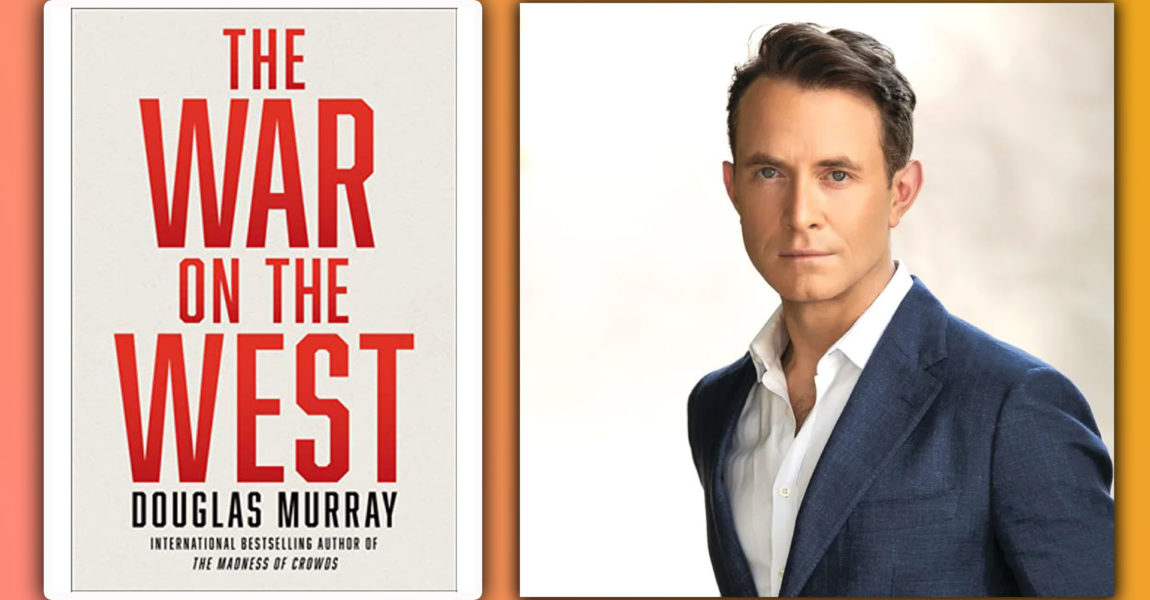
In an age that demands shame from the West, Douglas Murray deploys the ultimate counterstrike:
“I don’t especially think of myself as being white and don’t particularly want to be cornered into thinking in such terms. But if you are going to corner me, then let me give you an answer to the best of my ability.
“The good things about being white include being born into a tradition that has given the world a disproportionate number, if not most, of the things that the world currently benefits from. The list of things that white people have done may include many bad things, as with all peoples. But the good things are not small in number. They include almost every medical advancement that the world now enjoys. They include almost every scientific advancement that the world now benefits from. No meaningful breakthrough in either of these areas has come for many centuries from anywhere in Africa or from any Native American tribe. No First Nation wisdom ever delivered a vaccine or a cure for cancer.
“White people founded most of the world’s oldest and longest-established educational institutions. They led the world in the invention and promotion of the written word. Almost alone among any peoples it was white people who—for good and for ill—took an interest in other cultures beyond their own, and not only learned from these cultures but revived some of them. Indeed, they have taken such an interest in other peoples that they have searched for lost and dead civilizations as well as living ones to understand what these lost peoples did, in an attempt to learn what they knew. This is not the case with most other peoples. No Aboriginal tribe helped make any advance in understanding the lost languages of the Indian subcontinent, Babylon, or ancient Egypt. The curiosity appears to have gone almost entirely one way. In historical terms, it seems to be as unusual as the self-reflection, the self-criticism, and indeed the search for self-improvement that marks out Western culture.
“White Western peoples happen to have also developed all the world’s most successful means of commerce, including the free flow of capital. This system of free market capitalism has lifted more than one billion people out of extreme poverty just in the twenty-first century thus far. It did not originate in Africa or China, although people in those places benefited from it. It originated in the West. So did numerous other things that make the lives of people around the world immeasurably better.
“It is Western people who developed the principle of representative government, of the people, by the people, for the people. It is the Western world that developed the principles and practice of political liberty, of freedom of thought and conscience, of freedom of speech and expression. It evolved the principles of what we now call ‘civil rights,’ rights that do not exist in much of the world, whether their peoples yearn for them or not. They were developed and are sustained in the West, which though it may often fail in its aspirations, nevertheless tends to them.
“All this is before you even get onto the cultural achievements that the West has gifted the world. The Mathura sculptures excavated at Jamalpur Tila are works of exceptional refinement, but no sculptor ever surpassed Bernini or Michelangelo. Baghdad in the eighth century produced scholars of note, but no one ever produced another Leonardo da Vinci. There have been artistic flourishings around the world, but none so intense or productive as that which emerged around just a few square miles of Florence from the fourteenth century onward. Of course, there have been great music and culture produced from many civilizations, but it is the music of the West as well as its philosophy, art, literature, poetry, and drama that have reached such heights that the world wants to participate in them. Outside China, Chinese culture is a matter for scholars and aficionados of Chinese culture. Whereas the culture created by white people in the West belongs to the world, and a disproportionate swath of the world wants to be a part of it.
“When you ask what the West has produced, I am reminded of the groups of professors assigned to agree on what should be sent in a space pod into orbit in outer space to be discovered by another race, if any such there be. When it came to agreeing on what one musical piece might be sent to represent that part of human accomplishment one of the professors said, ‘Well, obviously, it will be Bach’s Mass in B Minor.’ ‘No,’ averred another. ‘To send the B Minor Mass would look like showing off.’ To talk about the history of Western accomplishments is to be put at great risk of showing off. Do we stay just with buildings, or cities, or laws, or great men and women? How do we restrict the list that we put up as a preliminary offer?
“The migrant ships across the Mediterranean go only in one direction—north. The people-smuggling gangs’ boats do not—halfway across the Mediterranean—meet white Europeans heading south, desperate to escape France, Spain, or Italy in order to enjoy the freedoms and opportunities of Africa. No significant number of people wishes to participate in life among the tribes of Africa or the Middle East. There is no mass movement of people wishing to live with the social norms of the Aboriginals or assimilate into the lifestyle of the Inuit, whether those groups would allow them in or not. Despite everything that is said against it, America is still the world’s number one destination for migrants worldwide. And the next most desirable countries for people wanting to move are Canada, Germany, France, Australia, and the United Kingdom. The West must have done something right for this to be the case.
“So if you ask me what is good about being white, what white people have brought to the world, or what white people might be proud of, this might constitute the mere beginnings of a list of accomplishments from which to start. And while we are at it, one final thing. This culture that it is now so fashionable to deprecate, and which people across the West have been encouraged and incentivized to deprecate, remains the only culture in the world that not only tolerates but encourages such a dialogue against itself. It is the only culture that actually rewards its critics. And there is one final oddity here worth noting. For the countries and cultures about which the worst things are now said are also the only countries demonstrably capable of producing the governing class unlike all of the others.
“It is not possible today for a non-Indian to rise to the top of Indian politics. If a white person moved to Bangladesh, they would not be able to become a cabinet minister. If a white Westerner moved to China, neither they nor the next generation of their family nor the one after that would be able to break through the layers of government and become supreme leader in due course. It is America that has twice elected a black president—the son of a father from Kenya. It is America whose current vice president is the daughter of immigrants from India and Jamaica. It is the cabinet of the United Kingdom that includes the children of immigrants from Kenya, Tanzania, Pakistan, Uganda, and Ghana and an immigrant who was born in India. The cabinets of countries across Africa and Asia do not reciprocate this diversity, but it is no matter. The West is happy to accept the benefits this brings, even if others are not.”
-Douglas Murray from the Conclusion of War on the West.
James Lindsay’s *New Discourses* podcast (July 9, 2020) contends that Marxist-inspired critical theories—queer theory, critical race theory (CRT), and postcolonial theory—undermine childhood innocence to destabilize Western society. According to this view, “innocence” is not a universal good but a social construct, one that maintains oppressive structures such as heteronormativity and white privilege. In this framing, schools become the frontline where innocence is dismantled, often through social-emotional learning (SEL) and comprehensive sex education, exposing children to adult categories of sexuality and race earlier than previous generations.
This essay acknowledges the conspiratorial risks of Lindsay’s framing but nonetheless argues that there is a coherent intellectual genealogy behind today’s educational shifts. By situating them in the work of Lukács, Marcuse, Gramsci, and Freire, and by engaging primary texts and empirical evidence, the essay concludes that premature sexualization and racialization of children carry measurable psychological risks and are best understood as destabilizing strategies with ideological consequences.
—
Queer Theory: Liberation or Destabilization?
Judith Butler’s *Gender Trouble* (1990) famously argued that identity is performative, “a stylized repetition of acts” rather than a fixed essence.[^1] For advocates, this opens liberatory possibilities, freeing individuals from restrictive norms. Eve Sedgwick similarly contended that destabilizing binaries allows marginalized groups to resist cultural oppression.[^2] In practice, queer pedagogy has translated into inclusive curricula—GLSEN (2022) reports that 43% of LGBTQ students feel safer in schools with gender-affirming materials.[^3]
Yet destabilization comes at a cost. Lindsay connects Butler’s performativity with Herbert Marcuse’s *Eros and Civilization* (1955), where liberation from sexual repression is imagined as a step toward a “non-repressive reality principle.”[^4] Marcuse’s focus was on adult emancipation, but his call for “mature individuals” leaves ambiguity when applied to educational contexts. Graphic materials such as *Gender Queer* (Fairfax County, 2021) in school libraries illustrate how theory, once filtered through activist pedagogy, risks exposing children to sexual content beyond developmental readiness.
Empirical concerns are not negligible: the American Psychological Association (2004) found that early sexualization is associated with depression and anxiety.[^5] While proponents highlight empowerment and reduced bullying, Lindsay’s point stands: identity destabilization in children risks long-term psychological harm.
Sexualization in Schools: Protection or Premature Exposure?
Comprehensive sex education is promoted as a health intervention. The Guttmacher Institute (2022) notes it is implemented in 39% of U.S. states, with studies showing reductions in risky sexual behaviors and teen pregnancy.[^6] Organizations like SIECUS (2021) argue that early, inclusive curricula protect sexual minorities by giving them language and resources.
The counterpoint, however, is about **age-appropriateness**. Some curricula, such as exercises in North Carolina’s 7th-grade program requiring public discussion of bodily changes,[^7] cross into territory that can be experienced as intrusive or shaming. Materials with explicit depictions of sex, regardless of intent, blur the line between protection and premature exposure.
Here Lindsay’s thesis holds: while not designed as “grooming,” the net effect can mimic destabilization. Children’s innocence functions as a developmental safeguard, and undermining it—however well-meaning—risks exploitation rather than empowerment.
Critical Race Theory: Equity or Burden?
Critical Race Theory reframes “racial innocence” as an illusion, a shield for systemic racism. Charles Mills’s *The Racial Contract* (1997) argues that white society maintains domination through unacknowledged compacts.[^8] In educational practice, this has meant materials like Ibram X. Kendi’s *Antiracist Baby* (2022), which encourage young children to see themselves in racial categories early. Advocates such as the American Educational Research Association (2021) claim this reduces bias, and SEL programs aligned with CRT have been adopted in roughly 35% of schools.[^9]
But here too, risks surface. Children may experience racial labeling as destabilizing, especially when framed in terms of guilt or privilege. The National Institute of Mental Health (2022) reports a 25% rise in youth anxiety,[^10] though causation is complex. Lindsay interprets this trend as evidence that CRT primes children for grievance and division. Whether or not one accepts that conclusion, the risk of prematurely burdening children with adult racial narratives deserves scrutiny.
Lukács and the Frankfurt School: The Intellectual Roots
George Lukács’s *History and Class Consciousness* (1923) criticized Christian morality as an impediment to revolution. In the short-lived 1919 Hungarian Soviet Republic, he promoted radical educational reforms, including sexual education programs, which opponents claimed encouraged promiscuity.[^11] While some historians downplay this episode as exaggerated,[^12] it remains clear that Lukács saw morality and family life as barriers to revolutionary consciousness.
The Frankfurt School developed this trajectory further. Marcuse in particular fused Freud with Marx, arguing that capitalism relies on sublimated sexuality.[^13] Though intended for adults, modern applications—whether in SEL or in the normalization of explicit material in schools—echo Marcuse’s suspicion of repression, sometimes at children’s expense.
Gramsci, Freire, and Pedagogical Inversion
Antonio Gramsci’s *Prison Notebooks* (1971) emphasized that family and education sustain cultural hegemony.[^14] Paulo Freire’s *Pedagogy of the Oppressed* (1968) reframed education as a site of liberation, recasting students as oppressed subjects.[^15] These ideas empower marginalized voices, as bell hooks celebrated in *Teaching to Transgress* (1994).[^16]
But Lindsay notes a darker possibility: that reorienting children as political subjects destabilizes family authority and primes youth for activism before they are developmentally prepared. Historical parallels, such as Mao’s Red Guards, show how youth mobilization can lead to intergenerational rupture and social turmoil.[^17]
The Family Under Pressure
Modern legislation such as California’s FAIR Education Act (2019), mandating LGBTQ-inclusive curricula, is framed as inclusive and affirming. Surveys support benefits: GLSEN (2022) found reduced bullying in such schools.[^3] Yet CDC (2023) data also show a steep rise in youth mental health crises—up 30% in a decade—raising questions about unintended consequences.[^18]
Gramsci’s prediction that family would be a central site of ideological struggle seems borne out. When curricula bypass or override parental values, trust between parent and child can erode, leaving children caught between competing moral frameworks.
Addressing Conspiratorial Risks
It is important not to collapse every educational reform into a single Marxist “plot.” CRT, sex education, and SEL are diverse movements with many non-Marxist motivations. Critics such as Angela Harris note that CRT is primarily a legal framework for examining structural racism, not a revolutionary program.[^19] Similarly, sex education advocates highlight empirical successes in health outcomes.
The stronger critique, therefore, is not that Marxists control education, but that Marxist categories—sexual liberation, identity destabilization, cultural hegemony—have been influential in shaping educational trends. Once filtered through activist practice, these categories can be misapplied to children with destabilizing effects.
Conclusion: Safeguarding Development
From Lukács’s early experiments to Marcuse’s liberationist theory and Freire’s pedagogical inversion, critical theory has consistently targeted family, morality, and cultural transmission as barriers to social change. Applied to adults, these ideas invite debate. Applied to children, they risk harm.
The evidence suggests that early exposure to explicit sexual material and premature racial labeling correlate with increased anxiety and depression in youth.[^5][^18] Protecting childhood innocence is not a reactionary fantasy but a developmental necessity.
Parents, educators, and policymakers should insist on transparency in curricula, ensure age-appropriate content, and preserve the family’s role as the primary context for moral and cultural formation. Resistance is less about conspiracy-hunting than about reaffirming a principle as old as education itself: children deserve protection while they grow.

References
[^1]: Butler, J. (1990). *Gender Trouble: Feminism and the Subversion of Identity*. Routledge.
[^2]: Sedgwick, E. K. (1990). *Epistemology of the Closet*. University of California Press.
[^3]: GLSEN. (2022). *National School Climate Survey*. [https://www.glsen.org/research](https://www.glsen.org/research)
[^4]: Marcuse, H. (1955). *Eros and Civilization*. Beacon Press.
[^5]: American Psychological Association. (2004). *Report of the APA Task Force on the Sexualization of Girls*. [https://www.apa.org/pi/women/programs/girls/report](https://www.apa.org/pi/women/programs/girls/report)
[^6]: Guttmacher Institute. (2022). *Sex and HIV Education*. [https://www.guttmacher.org/state-policy/explore/sex-and-hiv-education](https://www.guttmacher.org/state-policy/explore/sex-and-hiv-education)
[^7]: Wake County Public Schools. (2021). *Healthful Living Curriculum*.
[^8]: Mills, C. (1997). *The Racial Contract*. Cornell University Press.
[^9]: National Center for Education Statistics. (2021). *School Survey on Social and Emotional Learning*.
[^10]: National Institute of Mental Health. (2022). *Youth Mental Health Data*. [https://www.nimh.nih.gov](https://www.nimh.nih.gov)
[^11]: Tormay, C. (1920). *An Outlaw’s Diary: The Hungarian Revolution*. London: Allen & Unwin.
[^12]: Anderson, K. (2010). *Marx at the Margins: On Nationalism, Ethnicity, and Non-Western Societies*. University of Chicago Press.
[^13]: Marcuse, H. (1955). *Eros and Civilization*, p. 87.
[^14]: Gramsci, A. (1971). *Selections from the Prison Notebooks*. International Publishers.
[^15]: Freire, P. (1968). *Pedagogy of the Oppressed*. Continuum.
[^16]: hooks, b. (1994). *Teaching to Transgress: Education as the Practice of Freedom*. Routledge.
[^17]: Dikötter, F. (2016). *The Cultural Revolution: A People’s History, 1962–1976*. Bloomsbury.
[^18]: Centers for Disease Control and Prevention. (2023). *Youth Risk Behavior Survey*. [https://www.cdc.gov/healthyyouth/data/yrbs](https://www.cdc.gov/healthyyouth/data/yrbs)
[^19]: Harris, A. (2001). *Critical Race Theory*. International Encyclopedia of the Social & Behavioral Sciences.
The atheist movement, once a beacon of skepticism and rational inquiry, was significantly disrupted by the emergence of Atheism+ in the early 2010s. Atheism+, an attempt to merge atheism with progressive social justice ideologies, particularly feminism and identity politics, shifted the focus from critiquing religious dogma to enforcing ideological conformity on issues like gender and sexuality. This pivot alienated many atheists who valued the movement’s original emphasis on evidence-based reasoning. As Amarnath Amarasingam notes in The Rise and Fall of the New Atheism, the integration of identity politics created tensions within the movement, with activists like Jen McCreight, who spearheaded campaigns like Boobquake, highlighting the schism by prioritizing feminist concerns over universal skeptical principles. The resulting infighting, as seen in online forums like Reddit’s r/atheism, fractured the community, with many feeling that Atheism+ mirrored the dogmatic rigidity it once opposed.
This ideological shift led some atheists to adopt tactics reminiscent of religious apologetics—name-calling, shaming, and deflections—particularly when defending progressive stances on biological sex. Rather than applying the same skepticism they used to dismantle theistic claims, many “woke” atheists embraced gender ideology without rigorous scrutiny, treating it as an unassailable truth akin to a new deity. Posts on X from 2021 highlight this irony, with users like @SwipeWright observing that a significant portion of the atheist community “fully bought into gender ideology and sex denialism,” abandoning critical thinking for ideological loyalty. This uncritical acceptance echoes the blind faith atheists once criticized, as arguments about biological sex are often dismissed with moralistic fervor rather than engaged with empirically, revealing a departure from the movement’s foundational commitment to reason.
The implosion of the atheist movement, driven by these internal conflicts, underscores a broader lesson: skepticism must be consistently applied, whether to gods or to fashionable ideologies. The New Atheism, once galvanized by figures like Dawkins and Harris, faltered as it became entangled with identity politics, losing its coherence as a unified force. Today, the movement’s legacy is a cautionary tale of how even rationalist communities can succumb to ideological pressures, adopting the same dogmatic tactics they once decried. For atheism to reclaim its intellectual rigor, it must return to its roots, questioning all claims—divine or secular—with unflinching skepticism.

The recent protests at McGill University, where anti-Israel activists physically blocked access to lecture halls and disrupted classes, represent a troubling departure from the principles of free speech and Canadian values. On April 2, 2025, as reported by B’nai Brith Canada, masked protesters in the Bronfman Building prevented students from attending classes, with chants of “McGill, McGill you can’t hide, you’re complicit in genocide” echoing through the campus. While protest is a protected right, these actions crossed into intimidation and coercion, as students were denied their fundamental right to education. Free speech in Canada is about expressing ideas without fear of retribution, not about obstructing others’ rights or creating a hostile environment. Such behavior is distinctly un-Canadian, as it undermines the nation’s commitment to mutual respect, dialogue, and the rule of law—values that have long defined Canadian society.
McGill University’s response to these protests highlights a glaring abdication of responsibility. Despite the disruptions, which forced some classes online and led to acts of vandalism, the university’s initial reaction was tepid, only implementing ID-based access controls on April 4, 2025, after days of chaos. Advocacy groups like the Canadian Friends of Simon Wiesenthal Center and concerned individuals have called for decisive action, pointing to the hostile environment created for Jewish students and the broader student body. McGill’s failure to swiftly address the physical blockades and ensure safe access to education sends a dangerous message: that the university prioritizes appeasing disruptive activists over protecting the rights of all students. This inaction not only erodes trust in the institution but also sets a precedent for tolerating intimidation under the guise of activism, further emboldening such behavior on Canadian campuses.
The protests at McGill reveal a deeper issue: a two-tier system of justice that is profoundly divisive for Canadian society. While the protesters faced little immediate consequence for their actions, students attempting to attend classes were left to fend for themselves, as seen in videos where individuals were physically blocked from entering lecture halls. This disparity in treatment—where one group’s “right” to protest is elevated above others’ rights to safety and education—creates a fractured campus environment. Jewish students, in particular, have reported feeling unsafe, with advocacy groups framing the protests as antisemitic. Meanwhile, some individuals with differing views supported the protesters, accusing Israel and its supporters of enabling genocide. This polarization reflects a broader societal trend where identity-based grievances are weaponized, pitting groups against each other rather than fostering unity, a core Canadian ideal.
My blog post *The Oblivious Irony of Canada’s Progressive Left* provides a stark illustration of this trend, noting, “The progressive left’s obsession with identity politics has created a hierarchy of victimhood, where certain groups are given carte blanche to act with impunity, while others are silenced or vilified.” This observation captures the essence of the McGill protests, where the activists’ cause—framed as a fight against oppression—seemingly justified their coercive tactics, while the rights of other students were dismissed. Identity politics, as I argue, has become a divisive force in Canada, eroding the shared values of fairness and equality that once united the nation. The McGill protests are a microcosm of this larger societal shift, where the pursuit of “justice” for one group comes at the expense of others, deepening divisions and resentment.
In conclusion, the actions at McGill University are not a legitimate exercise of free speech but a violation of the principles that define Canada as a nation. By allowing protesters to intimidate and obstruct, McGill has failed its students, particularly those who felt targeted or unsafe, and has contributed to a two-tier system of justice that undermines Canadian unity. The divisive impact of identity politics, as highlighted in previously, underscores the urgent need for a return to shared values—respect, dialogue, and equal treatment under the law. Canadian society cannot thrive when one group’s rights are prioritized over another’s, and institutions like McGill must take responsibility to ensure that campuses remain spaces for learning, not coercion. Only by upholding these principles can Canada reclaim its identity as a nation of fairness and inclusion for all.











 bleatmop
 Mystro


 Dead Wild Roses
Your opinions…