
You are currently browsing the tag archive for the ‘Multiculturalism’ tag.
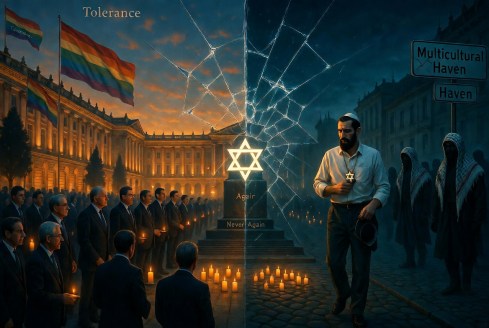
Europe has spent years congratulating itself on becoming too enlightened for its old demons. The old hatreds, we were told, belonged to a darker age: church prejudice, blood-and-soil nationalism, crude ethnic chauvinism, all safely archived in museums and memorial culture. Modern Europe would be different. Liberal. Secular. Therapeutic. Post-tribal. Above all, tolerant.
And yet here we are again, with Jews across Europe reporting that open Jewish life feels risky, visibility feels costly, and public confidence in their safety has eroded badly. The European Union Agency for Fundamental Rights found in its 2024 survey that antisemitism remains a reality for many Jewish people in the EU and that most feel unable to live openly Jewish lives. The agency’s 2026 follow-up stated it even more starkly: Jewish people in the EU face antisemitism on a “nearly constant basis.”
That is the irony. Europe built an entire moral identity around remembering the Jewish catastrophe, and yet in large parts of Europe it has become normal again for Jews to calculate where to wear a kippah, whether to hide a Star of David, and which neighbourhoods are best avoided. The continent has mastered the liturgy of remembrance while struggling with the elementary duty of protection.
The preferred story, of course, is that the danger must still come from the approved villains of European memory: the nationalist brute, the Christian reactionary, the provincial right-wing throwback with too much history and not enough sociology. Sometimes it does. The far right remains real, and in Germany, for example, Reuters reported in June 2025 that the watchdog RIAS recorded 8,627 antisemitic incidents in 2024, nearly double the 4,886 recorded in 2023, and that far-right offenders were responsible for around three times as many incidents as Islamists. That fact matters, and serious people should not airbrush it away for narrative convenience.
But that is not the whole story, and everyone knows it is not the whole story.
“Europe still loves Jews in theory, in memory, in curriculum, in the high-church ceremony of remembrance days. It is the living, visible, inconvenient Jew who keeps committing the unforgivable sin of existing in public.”
What liberal Europe finds harder to admit is that some of the antisemitism now making Jewish life more precarious arrives under the cover of other sacred commitments: multicultural innocence, asylum romanticism, anti-colonial theatre, imported sectarian fury, and elite cowardice dressed up as nuance. The old hatred has not vanished. It has diversified. It now marches under more than one banner. It can wear a bomber jacket, a keffiyeh, or a university lanyard. It can quote medieval slanders or postcolonial jargon. It can shout in the street or whisper in institutional euphemism.
That is what makes the present moment so revealing. Europe did not abolish prejudice. It changed the etiquette around which prejudices could be named plainly. It became exquisitely skilled at denouncing the safe forms of antisemitism, especially the dead ones, while growing clumsy, evasive, or selectively blind toward the live ones.
So the spectacle becomes almost comic in its hypocrisy. Politicians attend Holocaust memorials by day and govern societies by night in which Jews are advised to be discreet. Institutions publish statements about inclusion while Jewish students need security. Commentators deliver lectures on democratic values while treating Jewish fear as awkward, politically inconvenient, or in need of contextualization. Europe still loves Jews in theory, in memory, in curriculum, in the high-church ceremony of remembrance days. It is the living, visible, inconvenient Jew who keeps committing the unforgivable sin of existing in public.
The deepest irony may be this: a civilization that prides itself on tolerance has become so attached to its self-image that it cannot honestly describe the forms of intolerance now flourishing inside its own borders. And when a society cannot name a problem because naming it would embarrass its governing myths, the problem does not disappear. It metastasizes.
A decent society does not prove its virtue by hosting remembrance days, curating moral vocabulary, or posting the correct slogans after each outrage. It proves its virtue when Jews can walk its streets without calculation. Europe remembers what happened. Good. It should. But remembrance that does not cash out in ordinary public safety is beginning to look less like moral seriousness than civilizational vanity.
References
European Union Agency for Fundamental Rights, Jewish People’s Experiences and Perceptions of Antisemitism (11 July 2024). Survey overview and key findings page.
European Union Agency for Fundamental Rights, Monitoring and recording antisemitism in the EU – State of play and ways forward (27 January 2026). Overview and introduction page.
Reuters, “Antisemitic incidents in Germany almost double in 2024, report says” (4 June 2025).
Raymond Ibrahim, “The Irony of Europe’s Antisemitism Problem — Jewish Safety, Migration, and a Failed Narrative,” Hungarian Conservative (21 January 2026). Used here as thematic inspiration rather than as a primary evidentiary source.
 I’m always impressed with La Belle Province and her ability to serve up controversy. Recently a judge in Quebec decided that a hijab was considered not to be suitable attire for her courtroom and dismissed a case when the litigant refused to comply with her request. The judge’s words courtesy of the CBC:
“Hats and sunglasses for example, are not allowed. And I don’t see why scarves on the head would be either,” Marengo says in the recording.
“The same rules need to be applied to everyone. I will therefore not hear you if you are wearing a scarf on your head, just as I would not allow a person to appear before me wearing a hat or sunglasses on his or her head, or any other garment not suitable for a court proceeding.”
The stage is set and the result:
“When El-Alloul first appeared before Marengo, the judge asked her why she had a scarf on her head. El-Alloul replied that it was because she is a Muslim. The judge then said she would take a 30-minute recess.
When Marengo returned, she told El-Alloul she had a choice: remove her headscarf immediately or apply for a postponement in order to consult a lawyer. El-Alloul replied that she couldn’t afford a lawyer and that she didn’t want to postpone the case. Marengo then adjourned the case indefinitely.”
Boom. Tinder meet match. Religious freedom versus the institutional values of a secular court.
There are a multitude of ways to look at what transpired in the courtroom but here are two that I think represent both sides of the argument.
A. In a secular court of law, the secular values and rules of a society must be followed. If a judge rules that what you’re wearing to be inappropriate for the proceedings it behooves you to follow the same standards that everyone else must follow.
B. Canada is a multicultural society and we respect and treasure the cultural practices that every Canadian brings to the table and, if secular protocol can be reinterpreted to allow for the diversity of cultural expression within secular institutions we should do so.
Before we go into further discussion we should note the reaction from El-Alloul, it was one of shock and dismay:
“[…] But what happened in court made me feel afraid. I felt that I’m not Canadian anymore.”
“El-Alloul said she’s speaking out because she doesn’t want what happened to her to happen to any other Muslim woman. When she insisted I should remove my hijab, really I felt like she was talking with me as … not a human being. I don’t want this thing to happen to any other lady. This is not the work of a judge. She doesn’t deserve to be a judge.”
El-Alloul is rightly quite upset at the outcome of her hearing (or lack thereof). There should be a more amenable solution available to the parties involved – a transfer to a different judge that has a more liberal interpretation of ‘suitably dressed’ might have saved a lot of ink and electrons as this story blossomed across Canadian news networks.
This seemingly simple case of what “suitably dressed” means and how it is enforced speaks to how intersectional an issue multiculturalism is. Institutional power in Canada remains largely white and male and thus reflects the normative values of what is considered ‘normal’ culture here in Canada. From this orthodoxy we get the notions such as:
1. Why should our Canadian institutions cater to every whim of the minorities?
2. If it is good enough for everyone else, what is the problem here?
3. Why aren’t secular Canadian values being learned by new Canadians?
Under the assumption that we are a multicultural society, clearly, point 1 is out to lunch. The very point of having a tolerant open society is that we appreciate and try to accommodate the everyone and their preferences within the state structure of Canada.
Point 2 is problematic because the words “everyone else” usually uses the dominant culture as a touchstone thus, by play of words, avoids the obvious racism associated with similar statements.
Point 3 has the most merit as new Canadians do adopt Canadian values and standards, but the process of acculturation takes a great deal of time, often generations before the values of the dominant culture are ingrained. It is unrealistic however to expect that somehow Canadians of all types have a switch that can be flipped instantaneously that would guarantee cultural assimilation.
The Hijab should be allowed in Canadian courtrooms as it does not interfere with workings of the court or the dispensing of justice.
However, as an open and tolerant secular society we should also have the ability to rightly name and not adopt cultural practices that would be corrosive to our society. For instance, honour killings and female genital mutilation, have no place in Canadian or any other civilized society and I can assert this claim with a good deal of confidence because we need only to discuss the negative impacts these practices have on those societies who still practice these modalities (cultural relativism be damned).











 bleatmop
 Mystro


 Dead Wild Roses
Your opinions…