
One of the stranger features of modern public life is watching people who can spot religious dogma at fifty paces lose the gift the moment the dogma arrives in institutional clothing.
Put the claim in a pulpit and they reach for their Voltaire.
Put it in a workshop binder with equity on the cover and suddenly everyone is very concerned about tone.
That is not an argument against every claim made under DEI. Some discrimination is real. Some institutions have treated people badly while congratulating themselves for being fair. There is nothing strange about wanting hiring, schooling, policing, or public services to be less arbitrary and less cruel. A serious society should be able to hear those claims without flinching.
But hearing is not kneeling.
There is a difference between ordinary anti-discrimination work and the more ambitious creed that often travels under the same acronym. Widening a hiring pool is not the same thing as treating every statistical gap as proof of moral corruption. Removing needless barriers is not the same thing as teaching employees to confess inherited guilt in approved vocabulary. One belongs to public argument. The other starts looking for candles.
Religion, at least, usually admits when it is dealing with sacred things. It has altars, prayers, prohibitions, confessions, authorized interpreters, and a long memory for people who ask the wrong questions. The newer version arrives with less incense and more paperwork: forms, trainings, hiring rubrics, grant language, land acknowledgements, and small ceremonial statements read into microphones before everyone gets on with the actual event.
The room knows what is happening.
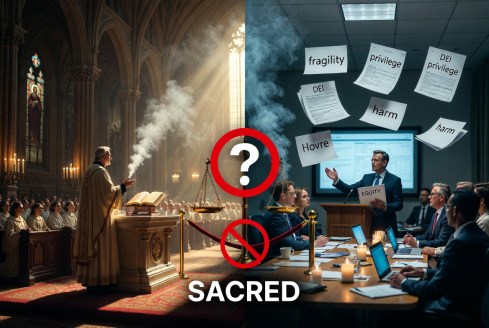
You may ask questions, technically. You may even be praised for your “curiosity,” provided your curiosity walks on a leash. Ask what equity means in practice. Ask who measures it. Ask what evidence would count against the program. Ask whether disagreement is permitted or merely pathologized. The temperature changes. Chairs shift. Someone smiles too carefully.
The comparison here is not that DEI managers are burning heretics in the town square. Scale matters. A missed promotion, HR complaint, grant denial, public scolding, or quiet reputational warning is not the Spanish Inquisition, and pretending otherwise only makes the critic sound unserious.
But mechanisms matter too. Church authorities once treated doubt as spiritual failure. Modern DEI culture often treats dissent as fragility, privilege, bigotry, or harm. The accusation has moved from the soul to the psychology, but the social lesson is familiar enough: you are not merely wrong; your question has exposed something unclean in you.
People notice. They adjust their faces. They save the real conversation for the parking lot.
That is how sacred subjects survive in public institutions. Not because everyone believes. Not even because the doctrine is especially persuasive. They survive because enough people learn the price of candour. A teacher nods through the training module. A board member lets the phrase pass. A musician reads the little ritual line because this is supposed to be a concert, not a committee war. An employee keeps the objection in his throat because rent is due and reputational damage compounds quickly.
And if DEI wants to remain in the world of policy rather than piety, it has to answer ordinary policy questions. Does the training work? Compared with what? At what cost? Does it reduce discrimination, or merely produce better-trained public language? Does it improve decisions, or teach people to repeat approved formulas while moving their actual thoughts elsewhere? Mandatory unconscious-bias training, in particular, has hardly earned the right to be treated as revealed truth. Some interventions may help in some contexts. Fine. Then test them, measure them, revise them, and stop treating skepticism as contamination.
Power has always enjoyed borrowing moral language. Traditional religion needed scrutiny for that reason. So does DEI. So does nationalism. So does environmentalism. So does any movement that claims authority over public life while placing its own premises behind velvet rope.
The question is not whether a belief is religious or secular. The question is whether it can be challenged without punishment.
What do you mean?
How do you know?
Who benefits?
Who pays?
What happens to the person who says no?
Those are not hostile questions. They are the minimum price of entering public argument. A doctrine that cannot tolerate them is not being protected from cruelty. It is being protected from accountability.
The old religions taught us what happens when moral certainty gets institutional shelter. The new secular religions are generous enough to provide a refresher course, complete with handouts, acronyms, and a sign-in sheet.
No belief gets immunity because it flatters itself as compassion.
And when ordinary people start moving their honest conversations out of the room, the institution has already chosen the sermon over the argument.











 bleatmop
 Mystro
 The Arbourist


 Dead Wild Roses
1 comment
Comments feed for this article
May 17, 2026 at 9:04 am
tildeb
Preach!
LikeLiked by 2 people