
You are currently browsing the category archive for the ‘Education’ category.
I’ve had yet another battle this week with the NA Gods about a women’s meeting I run being female only, & trans exclusive.
I’ve been “asked” to unaffiliated our Women’s Recovery Meeting from NA after another complaint that my rule of female only attendees is “transphobic”. Here’s the issue:
Many women in recovery have experienced severe sexual abuse. They have traumas I couldn’t repeat as to do so would be to describe horrific acts of child exploitation & sexual abuse. When the women who come in to recovery do so, they must be able to talk about what happened to them. We have a triage team who know how to help. We’ve been running for almost 4 years now & are one of the only guaranteed female only meetings that exists.
We need to be trans exclusive because of men – the male kind – who take advantage of the meetings online format to put on a wig & some lipstick & sneak in to specifically listen to the descriptions of sexual trauma that women have endured. Some men (not all men, not even most men, but some) sexually enjoy watching devastated women recount the details of what has been done to them at the hands of men. I’ve been in other meetings where men are clearly recording the testimonies of women & seen men clearly openly masturbating on camera. It’s vile, it’s well known to happen & no one on the front lines would ever doubt that this is a recurring issue.
What shocks me is that it is not men who are making complaints about our meeting. If a man is so perverted that he seeks out ways to watch women talk about what they call “trauma porn”, he may try subtly to come in but will not risk exposing himself by drawing attention to what he is trying to do. Instead, he will tell women in other groups that a trans friend of his has recently overdosed & died & name my Women’s Only meeting as the culprit, then the women will become outraged & team up to make complaints or even infiltrate the meeting themselves & cause trouble.
Women who have found recovery have already beaten so many odds against them. The vulnerable young women who find us have found a supportive, strong group of sisters who will be able to protect their safe space & help them through recovery. Without the meeting, which is once a week, many wouldn’t have made it.
People say this never happens. It does. Men are posing as trans women online to go on to Zoom meetings set up for women in recovery & preying on us. That needs to stop, or at the very least women who are further in to recovery need to be able to firmly set boundaries & keep our meetings running without endless pressure for trans inclusion. The trans women I know could never & would never object to a female only recovery meeting.
We must be allowed to retain female only spaces & services for the most vulnerable women in our communities & cannot afford to have any loophole which nullifies our already strained resources.
I’ve been threatened by a woman this week who will be “outing me on Twitter” as a “transphobe” for retaining the female only boundary for our women’s only meeting. So there – I’ve outed myself. I do not believe it is “transphobic” to keep perverted men away from traumatised, vulnerable women in early recovery.
I will not bow to the handmaidens of predatory men over protecting vulnerable women. It is not trans women I wish to keep away from our meeting – they are a casualty of the perverted actions of pornsick men. Please kindly stop enabling them to abuse women.
Women deserve single sex services. There is no time to be politically correct when it comes to the recovery of abuse survivors: they are likely to talk about what has happened to them for the first time in a meeting like ours, surrounded by only women. Men did that damage & women are trying to undo what we can & help the healing begin.
I cannot believe it is women who object & can’t see that to include *males in women’s only services is to nullify them.
I will not compromise or be bullied in to putting women at risk. No.
Case in point:NASA.
NASA stands for National Aeronautics and Space Administration. This is their mission statement from the NASA website – “NASA explores the unknown in air and space, innovates for the benefit of humanity, and inspires the world through discovery.”
Nasa is spending its resources on making pretty pictures representing questionable ideological movements.

Compare and contrast with the Chinese and European space agencies:
“A European experiment aboard China’s Chang’e 6 mission has recorded previously undetected charged particles on the moon’s surface, a catalog of which enables astronomers to better probe the chemical makeup of the moon’s regolith.
These particles, which are essentially gases excited by sunlight, were detected at the landing spot of the Chang’e-6 spacecraft in the southern pocket of the Apollo crater, which lies within the South Pole-Aitken Basin on the moon’s far side. The ion detector was the first European Space Agency instrument to land on the moon.”
If given a choice between a space sciences body that does ideological posturing and one that does; well… Space Science I know which one I would choose with regards to advancing our knowledge of the cosmos. So let’s work backwards and use the keen example of Toaster-Fucking to illustrate why NASA is spending its time and resources on questionable virtue signals that have exactly zero to do with its stated mandate – conducting space science.
I give full credit to Devon Eriksen on “X” for the TF explanation.
“Some of you may be wondering why the entire bureaucratic caste of the USA is completely obsessed with weird sex stuff.
Sure, we can all have good fun ranting about how insane this cult is, and watching them melt down when we leave skid marks on their sacred icons, but sooner or later, you gotta ask… why.
It’s the toaster-fucker problem. Some of you may be familiar. Goes like this, and I quote:
I blame the internet. Back in the days before it, we had to learn to live with those around us, now you can just go out and find someone as equally stupid as yourself.
I call it the toaster fucker problem. Man wakes up in 1980, tells his friends “I want to fuck a toaster” Friends quite rightly berate and laugh at him, guy deals with it, maybe gets some therapy and goes on a bit better adjusted.
Guy in 2021 tells his friends that he wants to fuck a toaster, gets laughed at, immediately jumps on facebook and finds “Toaster Fucker Support group” where he reads that he’s actually oppressed and he needs to cut out everyone around him and should only listen to his fellow toaster fuckers.
Apply this analogy to literally any insular bubble, it applies as equally to /r/thedonald as it does to the emaciated Che Guevara larpers that cry thinking about ringing their favourite pizza place.
But the toaster fucker problem doesn’t stop there.
Because every social group has an axis of prestige. They have to compete with each other for status somehow. That’s what humans do.
And in the toaster-fucking group, the axis of prestige aligns with fucking toasters.
So first they compete to see who can fuck the most toasters.
Then, when that is saturated, they one up each other by being most open with the general public about their toaster fucking ways.
Then they make toaster-fucker pride t-shirts and hats and bumper stickers.
Then they move on to bragging about how they sneak into other people’s kitchens and fuck their toasters, too, and swap tips for how to introduce kids to the joys of toaster-fucking.
But it doesn’t stop there, either.
Pretty soon normal people, who ten years before would shrugged and said “that’s weird”, are now sick of toaster-fucker flags everywhere and their kids being told to fuck toasters by sickos, and now they’re going to burn every toaster-fucker flag they see, and Florida just passed a law requiring you to be 21 years old with proof of ID to buy a toaster. And Utah has banned toasters altogether and the Mormons have stopped even eating toast, bagels, waffles, or any other heated bread product.
But it doesn’t stop there, either.
Because a few toaster-fuckers get beaten with fence posts by people sick of hearing about toaster-fucking, and other people, who didn’t see or hear the toaster-fuckers’ prior behavior, say “holy shit, toaster fuckers really are oppressed”. And they decide to become “toaster-fucker allies”, despite the fact that they haven’t the slightest real interest in fucking any toasters themselves.
But it doesn’t stop there.
Because toaster-fucking has become a sacred cause, it must now must compete with other sacred causes for the minds of highly programmable non-player characters, and there are clashes in the streets between the Toaster Fucker Pride March and the Stop Raccoon Shaving protests.
This is what “go outside and touch grass” really means. It doesn’t mean that plants magically cure insanity, it means go encounter randomly selected people who have nothing to do with you other than geographic proximity.
The purpose of this is to remember what normal people are like, and what normalcy is.
It’s not that normal people don’t do weird things. Maybe they like their pancakes with ketchup. Maybe they consider midgets to be the height of sex appeal. Maybe they never wash their socks, but just throw them away and buy more instead.
What makes normal people normal is that they keep that shit to themselves when it isn’t relevant.
Like when you’re an institute for space exploration.
Not toaster fucking.
Space exploration.
Remember?
Our institutions need a serious wake up call to help them “remember” what they are supposed to be about.
Cutting to the heart of the matter as usual, J.K. Rowling on single sex spaces.

Unfortunately male socialization and the violence that is inherent with it remains the problem. This isn’t a plea to ‘sensitize’ men. Nothing of the sort, males, in the process of their socialization need to be taught to respect the boundaries and rights of others. They need to be taught to be cognizant that other people experience and act in the world differently than they do.
I am all for a rough and tumble socialization experience for both sexes, we need to seek environments for our children that encourage the adoption of anti-fragile attitudes and strategies. Our lives are filled with challenges and hard tasks that require the habits physical and mental resiliency to be in place before reaching maturation. We need to steer away from male and female socialization and more toward “good people” socialization – in which people are raised to be assertive, creative, and respectful of themselves and others.
“Good people” socialization is an end goal though, first we must deal with the sex stereotypes that harm both women and men – that is the first step.
A primer on the sad state of Canadian Universities.
University of Toronto Professor Leigh Revers and Peter Boghossian discuss challenges in STEM education, including the integration of indigenous science and the use of diversity criteria in academic evaluations. Leigh highlights the need for academic rigor and criticizes oversimplified teaching methods, emphasizing the importance of maintaining intellectual diversity in education. His experience with this is firsthand – this year, the University of Toronto Mississauga sanctioned him for using Spectrum Street Epistemology in the classroom. Leigh Revers is an Associate Professor at the Institute for Management & Innovation at the University of Toronto Mississauga.
It so very important to know how the activist Left uses words. Logan Lancing helps illuminate all that goes into the term “Culturally Relevant Teaching”.
“Ok,” I thought. “Let’s figure out what culturally relevant teaching is.” I was curious. I wanted to know what it was and how it was tied to “equity.” I wanted to know how I had never encountered the term in my early schooling, yet it was now ubiquitous on every district page I looked at. “It had to have come from somewhere,” I thought. Who created it?
I moseyed on over to Google Scholar for the first time in over a decade. I searched for “culturally relevant teaching,” and hit “enter.” I received over three million results in a tenth of a second. Whoa! The results overwhelmed me, so I set my eyes on the two most cited – Toward a theory of culturally relevant pedagogy (over 12 thousand citations); and But that’s just good teaching! The case for culturally relevant pedagogy (over 6 thousand citations).
Both articles were authored by Gloria-Ladson Billings in the mid-1990s. I started with Toward a theory of culturally relevant pedagogy, the most cited result. It was there that I first encountered the term “critical consciousness,” which Billings identifies as the central learning objective culturally relevant teaching. “Culturally relevant teaching must,” she wrote, “[lead to the] development of a sociopolitical or critical consciousness.” I now know that critical consciousness is the cult belief that everything in society is designed to oppress you, and the only way to come to know “the truth” of the world is to become a Marxist committed to the “prophetic vision of social justice,” to quote Henry Giroux (writing about Paulo Freire’s critical theory of education.) But, at the time, all I knew was that I needed to know more. “Wait… what? The central goal of education is the development of a *political* consciousness,” I thought. “What the hell is going on here?” I was curious.
In But that’s just good teaching, I encountered Paulo Freire’s name for the first time. I learned that culturally relevant teaching is an “approach similar to that advocated by noted critical pedagogue Paulo Freire.” I also learned that “critical consciousness” was something Ladson-Billings wasn’t mincing words about. “Students,” she said, echoing her statement in Toward a theory of culturally relevant pedagogy, “must develop a critical consciousness through which they challenge the status quo of the current social order.”
“Excuse me?!” Culturally relevant teaching was all the rage in every school district I investigated. I now recognized Gloria’s name all over the source documents I found. Why on earth are all of the schools invested in a program that teaches kids to “challenge the status quo of the current social order?” Who is Paulo Freire? What are “inequities,” and why must students learn to “critique the cultural norms, values, mores, and institutions that produce and maintain” them? How did all of this become “good teaching”?
When I was learning to become a teacher this stuff was just starting to be integrating into the teaching curriculum. What sticks out now is a workshop I attended during one of the many teaching conventions I attended. They suggested that instead of the teacher following the curriculum and laying out the school year to be taught, instead, the first step was to ‘brainstorm’ with the students to see what they were interested in and then plan backwards from the student responses. I actually tried with my class to do that. The project got as far as tabulating the results on the board.
It turns out that retrofitting the curriculum into the specific interests of the class was a colossal project and since I was (and still am not) made of time we would be following a more traditional path. Now having looked at the genesis of ‘student centred learning’ I can see what I was eventually going to be signing up for. The teaching of critical consciousness instead of reading, writing, and arithmetic… Not a good trade off if my intended goal was to prepare children for a successful path in the current society.
The second part of my series on conversational gambits and habits that are annoying, funnily enough, happened in the first Gambits post I made. Go check out the comment section as I will be pulling my example for this post directly from the text of a commentor.
“Guilt by association” is also near the top of the list of ‘argumentative styles’ that are prevalent online and also happen to annoy me. Let us begin.

My last post was about how people, in order to avoid arguing, conflate disagreement with hate. Let’s search for the counter argument presented here. Let’s break it down.
- “As to the Alabama, Christian Fundamentalist position you advocate on this blog.”
Analysis: It would be enlightening to know what the Alabama Christian Fundamentalist position is, and really if my arguments mirror theirs, does that make the argument in question wrong?
2. “The research has already spoken (although it will refine over time).”
Analysis: Just saying that “research has spoken” is not in anyway an argument especially if there is no evidence presented to qualify your claim. Hitchens said that a claim presented without evidence can be be dismissed without evidence. That is the case here.
3. “Who knows, maybe sensitive and loving treatments will change, either way.
Analysis: This is the informal fallacy of Begging the Question. With regards to gender affirming care and the mutilation of minors via surgery and cross-sex hormones there are no “sensitive and loving treatments” to be had. Permanent sterilization and the amputation of healthy tissue in no way can be considered “sensitive and loving” and yet that very conclusion was embedded in the statement.
4. “Right now, that’s where the science is.”
Analysis: This is a claim presented without evidence. “The science” currently states that the quality of the evidence for the efficacy of Gender Affirming Care and the procedures involved is poor at best. Several national health services, including Britain, France, Norway, Sweden, and Denmark have all either stopped or slowed GAC because of the lack of evidence. In reality – most children that experience ‘gender dysphoria’ will have their symptoms disappear with the onset of puberty – in the range of 80% to 90% (link to study). Be wary of anyone conclusively stating “what the science says”. The process of doing science is never complete as with new information theories will change to move closer toward the truth.

1. “There are scientists who said smoking doesn’t kill, and those who say climate change is a leftist/Jewish hoax. Your dissenting scientists as well as the right wing deplorables you site to trumpet them, are in that group.”
Analysis: Several processes are going on here, let’s tackle the overarching motif first. The setup is as follows: Group A (scientists in favour of Smoking) that, as history has illustrated, were wrong. In Group B (Other Scientists and right-wing deplorables) are exactly the same as group A. We should not follow group B because of a comparison (that contains a conclusion) has been drawn, in this case without charity or evidence provided.
It doesn’t follow that group B must share the same failings of group A, yet we are to condemn group B because the person who is making the argument says so. It’s quite bizarre.
Also, to address the guild by association angle the legitimate studies and credible scientists that have found and published evidence that does not “fit” with Brian’s world view must be spuriously associated with so called ‘deplorables’ and people who were wrong in the past. Who you are aligned with, or associate with does not affect the quality of the arguments you make. A solid argument from a reprehensible individuals is still a solid argument regardless of social standing.
So, the guilt by association ploy is used in the place of presenting an argument that has a solid factual base. This route of argumentation is rooted in emotional social coercion rather than presenting a counter argument that is based in fact.
Look at this clear example I culled from Twitter. It fits the coercive guilt by association tactic perfectly.

It is a textbook example of how not argue. Stay frosty and cogent folks, and learn to recognize poor argumentation when it comes your way. :)
I’m up to Chapter 3 so far and would highly recommend this book to those who want understand the ‘why & how’ of what is happening in our society. Understanding post-modernism is the first step. This is a short summary gleaned from ‘Goodreads’ is a part of what the book is explaining about Postmodern thought.
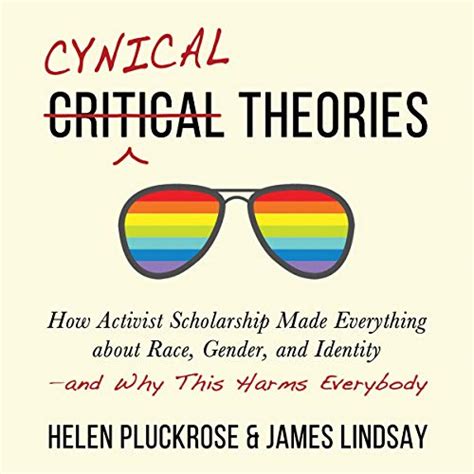
“The online Encyclopedia Britannica defines postmodernism as: “a late 20th-century movement characterized by broad scepticism, subjectivism, or relativism; a general suspicion of reason; and an acute sensitivity to the role of ideology in asserting and maintaining political and economic power.” The authors of this book mentions the two principles and four themes of postmodernism thus:
1. The postmodern knowledge principle: Radical skepticism about whether objective knowledge or truth is obtainable and a commitment to cultural constructivism.
2. The postmodern political principle: A belief that society is formed of systems of power and hierarchies, which decide what can be known and how.
The Four Major Themes
1. The blurring of boundaries
2. The power of language
3. Cultural relativism
4. The loss of the individual and the universalNow, to translate this to words of one syllable.
The first principle means that we can never know the objective truth: indeed, it is doubtful whether it exists at all. The second principle means that what is known as the truth is decided by the power hierarchy inside the system.
Thus, in one fell swoop, postmodernism dethroned science from its pedestal – because if we are not sure whether there is objective truth at all, why spend time looking for it? And in the colonial world, most of the objective knowledge was based upon colonial viewpoints; so a deconstruction of this was essential, especially as Orientalism was holding sway in the West.
(However, this doesn’t negate the power of science – but the fallout of postmodernism has engendered dangerously unscientific attitudes.)
Now let’s move on to the themes.
The blurring of boundaries means categorisations are no longer trusted. Not only the boundaries between objective and subjective and between truth and belief have been blurred, but also those between science and the arts, the natural and the artificial, high and low culture, man and other animals, and man and machine, and between different understandings of sexuality and gender as well as health and sickness. Everything is a spectrum.
The power of language emphasises that it is through language that we define power structures in a society. Under postmodernism, many ideas that had previously been regarded as objectively true came to be seen as mere constructions of language. In postmodern thought, language is believed to have enormous power to control society and how we think and thus is inherently dangerous. It is also seen as an unreliable way of producing and transmitting knowledge. To summarise: we create reality through language.
In a world where there is no objective truth, no boundaries, and where everything is created through how we speak and think, truth and knowledge are different for each and every culture and no one from outside that culture can comprehend it. This is called cultural relativism.
Consequently, to postmodern theorists, the notion of the autonomous individual is largely a myth. The individual, like everything else, is a product of powerful discourses and culturally constructed knowledge. Equally, the concept of the universal—whether a biological universal about human nature; or an ethical universal, such as equal rights, freedoms, and opportunities for all individuals regardless of class, race, gender, or sexuality —is, at best, naive. At worst, it is merely another exercise in power-knowledge, an attempt to enforce dominant discourses on everybody. This leads to the loss of the individual and the universal.
I totally get this. It’s a very nice intellectual exercise: and I must say that in the field of arts, literature and sociology, it has got valid uses. The only place I take the high road while postmodernists take the low road is when it comes to the concept of the individual and the universal, which I do believe are required as valid concepts if we need an equitable world. And also, for all our subjective perceptions, science has discovered many objective truths through its powerful method, which are not dependent upon language and/ or culture.
But now, the authors started talking about Theory (with a capital T: applied postmodernism) and the concept of Social Justice; and I started getting a bit alarmed – because I could now make sense of how I was annoying all those woke people.











 bleatmop
 Mystro
 The Arbourist


 Dead Wild Roses
Your opinions…