
You are currently browsing the category archive for the ‘Religion’ category.
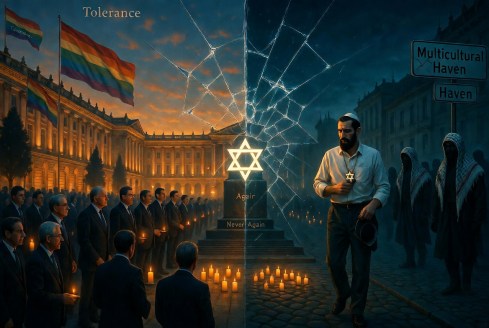
Europe has spent years congratulating itself on becoming too enlightened for its old demons. The old hatreds, we were told, belonged to a darker age: church prejudice, blood-and-soil nationalism, crude ethnic chauvinism, all safely archived in museums and memorial culture. Modern Europe would be different. Liberal. Secular. Therapeutic. Post-tribal. Above all, tolerant.
And yet here we are again, with Jews across Europe reporting that open Jewish life feels risky, visibility feels costly, and public confidence in their safety has eroded badly. The European Union Agency for Fundamental Rights found in its 2024 survey that antisemitism remains a reality for many Jewish people in the EU and that most feel unable to live openly Jewish lives. The agency’s 2026 follow-up stated it even more starkly: Jewish people in the EU face antisemitism on a “nearly constant basis.”
That is the irony. Europe built an entire moral identity around remembering the Jewish catastrophe, and yet in large parts of Europe it has become normal again for Jews to calculate where to wear a kippah, whether to hide a Star of David, and which neighbourhoods are best avoided. The continent has mastered the liturgy of remembrance while struggling with the elementary duty of protection.
The preferred story, of course, is that the danger must still come from the approved villains of European memory: the nationalist brute, the Christian reactionary, the provincial right-wing throwback with too much history and not enough sociology. Sometimes it does. The far right remains real, and in Germany, for example, Reuters reported in June 2025 that the watchdog RIAS recorded 8,627 antisemitic incidents in 2024, nearly double the 4,886 recorded in 2023, and that far-right offenders were responsible for around three times as many incidents as Islamists. That fact matters, and serious people should not airbrush it away for narrative convenience.
But that is not the whole story, and everyone knows it is not the whole story.
“Europe still loves Jews in theory, in memory, in curriculum, in the high-church ceremony of remembrance days. It is the living, visible, inconvenient Jew who keeps committing the unforgivable sin of existing in public.”
What liberal Europe finds harder to admit is that some of the antisemitism now making Jewish life more precarious arrives under the cover of other sacred commitments: multicultural innocence, asylum romanticism, anti-colonial theatre, imported sectarian fury, and elite cowardice dressed up as nuance. The old hatred has not vanished. It has diversified. It now marches under more than one banner. It can wear a bomber jacket, a keffiyeh, or a university lanyard. It can quote medieval slanders or postcolonial jargon. It can shout in the street or whisper in institutional euphemism.
That is what makes the present moment so revealing. Europe did not abolish prejudice. It changed the etiquette around which prejudices could be named plainly. It became exquisitely skilled at denouncing the safe forms of antisemitism, especially the dead ones, while growing clumsy, evasive, or selectively blind toward the live ones.
So the spectacle becomes almost comic in its hypocrisy. Politicians attend Holocaust memorials by day and govern societies by night in which Jews are advised to be discreet. Institutions publish statements about inclusion while Jewish students need security. Commentators deliver lectures on democratic values while treating Jewish fear as awkward, politically inconvenient, or in need of contextualization. Europe still loves Jews in theory, in memory, in curriculum, in the high-church ceremony of remembrance days. It is the living, visible, inconvenient Jew who keeps committing the unforgivable sin of existing in public.
The deepest irony may be this: a civilization that prides itself on tolerance has become so attached to its self-image that it cannot honestly describe the forms of intolerance now flourishing inside its own borders. And when a society cannot name a problem because naming it would embarrass its governing myths, the problem does not disappear. It metastasizes.
A decent society does not prove its virtue by hosting remembrance days, curating moral vocabulary, or posting the correct slogans after each outrage. It proves its virtue when Jews can walk its streets without calculation. Europe remembers what happened. Good. It should. But remembrance that does not cash out in ordinary public safety is beginning to look less like moral seriousness than civilizational vanity.
References
European Union Agency for Fundamental Rights, Jewish People’s Experiences and Perceptions of Antisemitism (11 July 2024). Survey overview and key findings page.
European Union Agency for Fundamental Rights, Monitoring and recording antisemitism in the EU – State of play and ways forward (27 January 2026). Overview and introduction page.
Reuters, “Antisemitic incidents in Germany almost double in 2024, report says” (4 June 2025).
Raymond Ibrahim, “The Irony of Europe’s Antisemitism Problem — Jewish Safety, Migration, and a Failed Narrative,” Hungarian Conservative (21 January 2026). Used here as thematic inspiration rather than as a primary evidentiary source.

Western public culture has no trouble speaking in the language of conquest, so long as the conqueror is European. We can list the crimes of empire in a catechism: invasion, extraction, settlement, forced conversion, slavery, and the slow grinding down of local institutions. We teach it. We ritualize it. We build moral identity around denouncing it.
But history did not outsource conquest to Europe.
From the 7th century onward, Muslim-ruled polities participated in a major, long-running arc of territorial expansion: the early Arab conquests across the Levant, Egypt, North Africa, and Persia; the push into Iberia; later Turkic and Ottoman expansion through Anatolia and into the Balkans; and, further east, Muslim dynasties consolidating power across parts of South Asia. This was not a tea party with trade agreements. It was war, regime change, tribute systems, and durable social hierarchies that reordered whole regions for centuries.
Even where rule was comparatively tolerant by the standards of its time, it was still rule. Non-Muslim populations were commonly governed as dhimmi, protected yes, but subordinate. They often paid special taxes, faced legal asymmetries, and lived under conversion pressures that, in some contexts, ranged from overt coercion to the long, quiet incentives of status and security. The story differs by place and century. The pattern does not disappear.
Then there is slavery, another topic where our moral accounting often becomes selective. The trans-Saharan, Red Sea, and Indian Ocean systems ran for many centuries and involved very large numbers, though estimates vary widely. They fed household servitude, military slavery, and sex slavery. In the Mediterranean, North African corsairing and “Barbary piracy” produced European captives well into the early modern era. Some historians argue for totals in the low millions across those centuries, though the higher figures are disputed and other scholars propose substantially lower estimates. Either way, the phenomenon is real, and it is rarely integrated into the default Western “slavery story,” which typically means plantations, the Atlantic triangle, and racial chattel bondage. The Ottoman system also included practices like devshirme, the levy of Christian boys for state service, and imperial governance across religious communities was often managed by layered legal categories. Stability was purchased with inequality.
None of this is a claim that Muslim-majority societies are uniquely violent. They are not. It is a claim that they were human societies with power, ambition, and the usual imperial toolkit. Sometimes it was tempered by pragmatism. Sometimes it was sharpened by ideology. It was always shaped by the incentives of rule.
So why does so much Western academic and activist discourse treat “colonialism” as if it is a European invention, or at minimum reserve the hottest moral language for European cases?
You can see the asymmetry in ordinary cultural output. A student can finish a humanities degree with a fluent vocabulary for “settler-colonialism,” “whiteness,” and “decolonization,” and still never be asked to apply the same conceptual machinery to the Islamization of North Africa, the Turkification of Anatolia, or the Ottoman imperial management of the Balkans. The knowledge exists. The integration often does not.
A few mechanisms are doing the work:
First: the moral map is drawn around modern Western guilt. Universities and NGOs in the West operate inside a story where the primary purpose of historical consciousness is to discipline our civilization. That can be valuable. Self-critique is healthier than propaganda. But it also creates a spotlight effect. If the goal is penance, you do not look for other sinners. You look for mirrors.
Second: postcolonial theory often frames power in a one-directional way. “Colonizer” and “colonized” become fixed identities rather than recurring historical roles. Once the roles harden into moral identities, describing conquest by non-Western empires becomes conceptually awkward. It scrambles the script.
Third: fear of misuse leads to silence. Many scholars and activists worry, often reasonably, that frank discussion of Islamic conquest will be weaponized by bigots. But the answer to bad faith is not selective amnesia. When institutions pre-censor reality to prevent “the wrong people” from citing it, they teach the public a fatal lesson. The gatekeepers do not trust the truth.
Fourth: selective “harm literacy” is now a career incentive. Some topics are safe, rewarded, and legible within current moral fashion. Others are professionally risky, easily smeared, or administratively discouraged. This does not require a conspiracy. It is simply an ecosystem where the costs and benefits are asymmetrical.
The result is not denial, exactly. It is a pattern of omission. Certain conquests are treated as the central moral lesson of history. Others are treated as context, complication, or footnote, no matter how long they lasted, how many people they reordered, or how durable their legal hierarchies proved.
If “colonization” is a real category, and if it means conquest, extraction, tribute, settlement, cultural subordination, and the restructuring of life under new rulers, then it has to apply wherever the pattern appears. Otherwise it is not analysis. It is choreography. 🎭

So here is the question Western institutions should be willing to answer plainly: Why is one empire’s violence treated as the moral template, while another empire’s violence is handled like a reputational hazard, especially when the same victims, religious minorities, conquered peoples, and enslaved captives, are supposed to matter in our universalist ethics?
Because the cost of selective memory is not merely academic. It trains citizens to distrust the referees. When respectable institutions signal, through omissions and asymmetrical moral urgency, that certain truths are too dangerous to say out loud, audiences will go looking for people who will say them. Often crudely. Often with their own distortions. And the gatekeepers will have manufactured the very problem they feared.
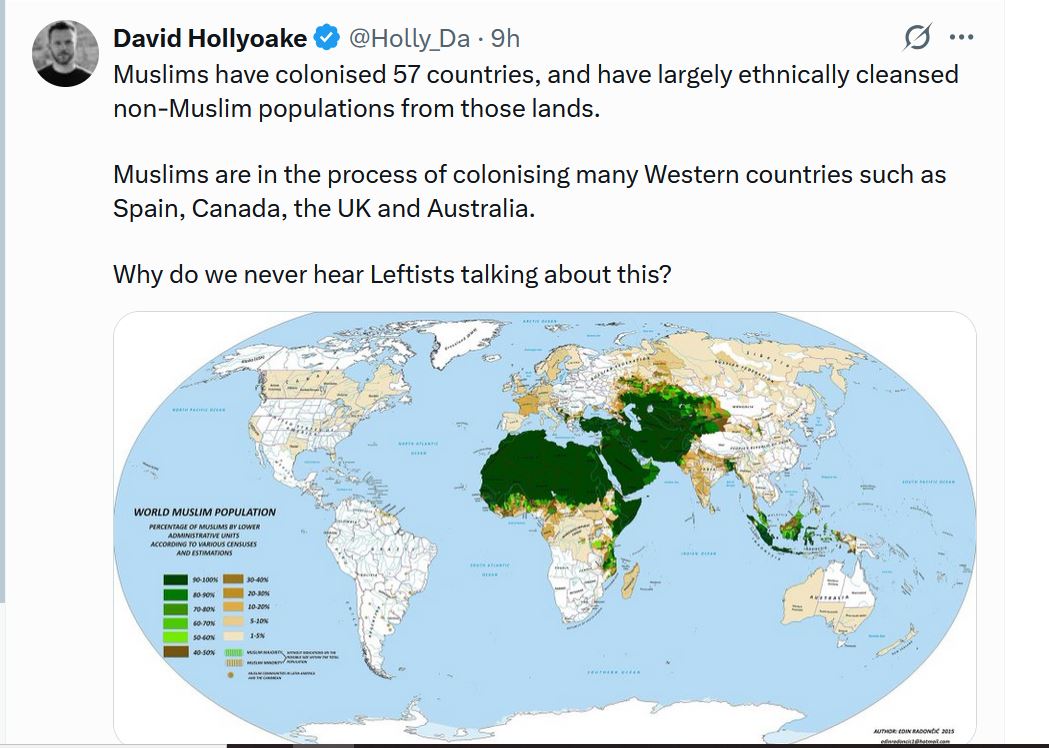
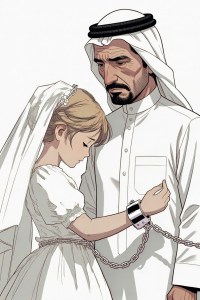
In Iran, child marriage isn’t merely a whispered rural custom; it’s a practice that can breathe because the law gives it room. A Radio Free Europe/Radio Liberty report tells the story of “Leila,” married at ten to a fifteen-year-old boy—an arrangement delivered to her in the night, a ring placed on her finger like a stamp. She describes the aftermath not as romance or “tradition,” but as fear, pain, and a body treated as if it were already spoken for.
The scandal here is not that bad people exist; it’s that systems can normalize the bad. The report states that marriage is legal for girls at 13 with parental consent, and that younger girls can be married with a judge’s permission (and that the legal age cited for boys is 15). It also cites 37,000 underage marriages registered in the last Iranian year ending in March (as of 2016), while noting that unregistered unions mean the true number is likely higher.
A society’s moral temperature shows up in what it excuses, and what it calls “inevitable.” The piece reports that the UN Committee on the Rights of the Child urged Iran to raise the marriage age and expressed concern that the legal framework permits sexual intercourse with girls as young as nine lunar years, alongside gaps in criminalization of other sexual abuse against very young children. This isn’t “culture” in the harmless sense; it’s power arranged into a rite, with a child paying the cost.
Bibliography 📚
-
Radio Free Europe/Radio Liberty (Radio Farda), “Childhood’s End: Forced Into Marriage At Age 10 In Iran” (Nov. 17, 2016).
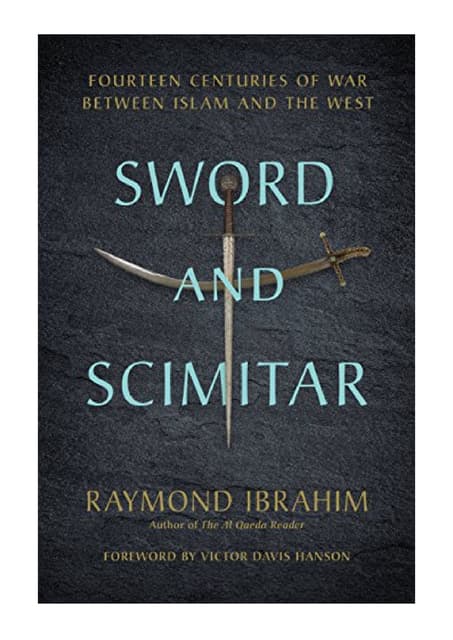
This week’s “book I want to read (but haven’t yet)” is Raymond Ibrahim’s Sword and Scimitar: Fourteen Centuries of War between Islam and the West. The book is pitched as a long, battle-driven military history: landmark encounters, vivid narration, and a claim that these wars illuminate modern hostilities. It’s explicitly framed as “Islam vs. the West” as a historical through-line, and it advertises heavy use of primary sources (notably Arabic and Greek) to tell that story. (Barnes & Noble)
The thesis, as Ibrahim presents it in descriptions and interviews, is that the conflict is not merely politics or economics—it’s substantially religious and civilizational in motive and self-understanding across centuries. In short: jihad (as an animating concept) and sacred duty are treated as durable drivers; key episodes are used to argue continuity rather than accident. Even the “origin story” in some blurbs is framed in explicitly religious terms (conversion demand → refusal → centuries-long jihad on Christendom), which signals the interpretive lens: ideas and theology matter, and they matter a lot. (Better World Books)
Why I’m flagging it for the DWR Sunday Religious Disservice: it’s a strong claim, not a neutral survey—and it’s the kind of claim you should read with a second book open beside it. Supportive reviews praise it as a bracing corrective to “sanitized” histories; skeptical academic commentary warns that it can function as an intervention that frames Islam first and foremost through antagonism and “civilizational conflict,” which can flatten variation across time, place, and Muslim societies. So the honest pitch is: this is Ibrahim’s argument; it may sharpen your sight—or narrow it—depending on what you pair it with. (catholicworldreport.com)
Endnotes
- Publisher/retailer description (scope + primary sources framing): (Barnes & Noble)
- “Origin story” / jihad framing in overview copy: (Better World Books)
- Interview-style framing of “landmark battles” thesis: (Middle East Forum)
- Critical scholarly pushback (civilizational conflict lens): (Reddit)











 bleatmop
 Mystro


 Dead Wild Roses
Your opinions…