
You are currently browsing the category archive for the ‘Religion’ category.
 Parastoo Ahmadi sang without a hijab. For that, an Iranian court has reportedly sentenced her to seventy-four lashes, along with a two-year travel ban and a ban on artistic work.
Eight members of her musical and production team reportedly face the same punishment.
The ruling may still be appealed. That matters legally. It does not rescue the moral situation. A state has looked at a woman singing in an online performance and answered with the threat of the lash.
The official language is familiar: public decency, immoral content, religious propriety, social order. There is always a phrase ready when power wants to punish disobedience. But the facts remain plain enough. Ahmadi performed without submitting to Iran’s compulsory hijab laws, accompanied by male musicians, in a concert released online. The court treated the performance not as art, but as contamination.
That is what theocratic rule does. It turns a woman’s hair, voice, clothing, movement, and public presence into political territory.
A hijab freely chosen may be an act of faith, modesty, identity, or personal conviction. A hijab enforced by courts and police is something else. It becomes a sign of state power. Once punishment enters the picture, the language of choice disappears.
Western societies often become nervous when speaking about this. Ordinary Muslims in Canada, Britain, France, or the United States are not responsible for the crimes of the Islamic Republic. Many Muslims reject this kind of rule entirely. Many Iranian women resisting the regime come from Muslim families and communities themselves.
But that distinction cannot become an excuse for silence.
Islam as private belief is one thing. Islam as state power is another. When religious law governs women’s dress, restricts women’s voices, polices women’s bodies, and punishes public disobedience, it stands in direct conflict with the liberal inheritance the West should still be willing to defend: freedom of conscience, freedom of expression, equality before the law, and the right of the individual to live without clerical supervision.
Those values are not always honoured here. The West fails them often enough. But their failures do not make them false. Their absence is visible in places where a woman can be dragged through courts for singing.
Ahmadi’s alleged offence was not violence. It was not theft. It was not corruption. It was a performance. The regime’s response reveals the insecurity beneath the theology. A system confident in its moral authority would not need to threaten artists with flogging. A faith secure in itself would not require police, courts, and punishment to preserve public obedience.
“A hijab freely chosen belongs to the woman. A hijab enforced by courts and police belongs to the state.”
This is where polite multicultural language often fails. Respect for persons does not require respect for the laws that crush them. We can defend the dignity of peaceful Muslims while saying plainly that theocratic rule in Iran is oppressive, anti-liberal, and especially brutal toward women.
Sweeping that conflict under the multicultural rug does nothing for women like Ahmadi. It only protects the comfort of people far away from the consequences. The women living under these laws do not get the luxury of abstraction. They live with patrols, summonses, bans, fear, and the knowledge that a song can become evidence.
The phrase “Women, Life, Freedom” became powerful because it named what the regime fears most: women living as full human beings rather than managed subjects. Ahmadi’s performance belongs to that same moral territory. Under a regime like Iran’s, a woman singing uncovered is not merely performing. She is refusing.
And for that refusal, the state reaches for the lash.
Parastoo Ahmadi should be free to sing. Iranian women should be free to uncover their hair, make art, criticize their rulers, choose their faith, reject faith, and live without being disciplined by men who mistake control for morality.
A society that must threaten to whip women into obedience has already lost the argument.
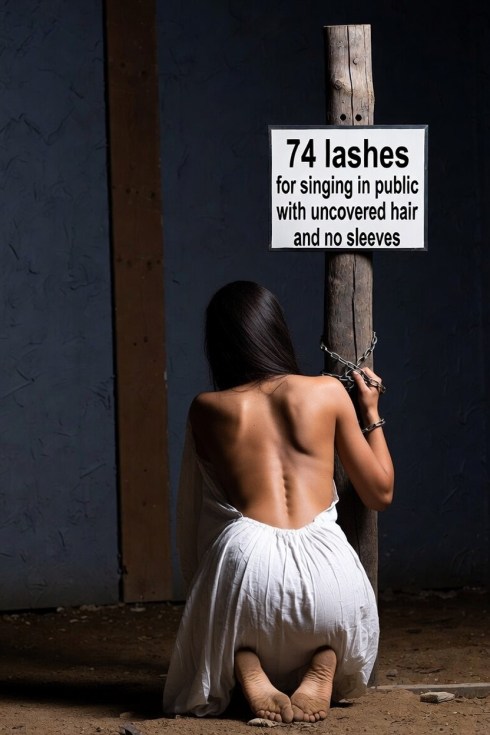
Seventy-four lashes for a song — the price of a woman’s uncovered voice in Iran.”
References
The Guardian. “Iranian star Parastoo Ahmadi reportedly sentenced to 74 lashes for singing without hijab.” June 18, 2026.
https://www.theguardian.com/world/2026/jun/18/iran-parastoo-ahmadi-74-lashes-singing-without-hijab
Radio Free Europe/Radio Liberty. “74 Lashes For A Song: Iranian Artist Sentenced For Virtual Concert.” June 2026.
https://www.rferl.org/a/iran-singer-sentence-flogging-morality-police-ban-women-life-freedom-hijab-concert-youtube/33783873.html
IranWire. “Caravanserai Concert Staff Sentenced to Flogging and Artistic Bans.” June 2026.
https://iranwire.com/en/news/153871-caravanserai-concert-staff-sentenced-to-flogging-and-artistic-bans/
Amnesty International. “Iran: New compulsory veiling law intensifies oppression of women and girls.” December 10, 2024.
https://www.amnesty.org/en/latest/news/2024/12/iran-new-compulsory-veiling-law-intensifies-oppression-of-women-and-girls/

The Taliban understand something too many Western progressives pretend not to: the education of women is civilization-level power.
That is why they ban it. That is why they silence girls. That is why they bury half the country alive and call it virtue.
A society that fears educated women is not protecting tradition. It is confessing its own cowardice.
Canada did not need less concern for possible graves at former residential schools. It needed more truth, earlier. The residential school record contains real wrongs: family separation, cultural suppression, abuse, neglect, disease, and documented deaths. But when the Kamloops announcement broke in 2021, the public story moved very quickly from ground-penetrating radar findings to language of “discovered remains” and “mass graves.” That distinction mattered. Ground-penetrating radar does not find bodies. It identifies disturbances, anomalies, and possible grave-like features that require verification.
The mechanism is familiar: narrative hardened faster than evidence. Grief became certainty. Certainty became accusation. Accusation became permission. A country already primed to view churches as historical villains suddenly had a simple moral script: children had been found, churches were responsible, rage was righteous. After that, Canada saw a wave of church fires and vandalism. A CBC investigation later reported that at least 33 Canadian churches had burned to the ground since May 2021; 24 were confirmed arsons, two were ruled accidental, and the remaining cases were suspicious or under investigation.
That caveat matters. We should not replace one sloppy narrative with another. Not every burned church was necessarily revenge for residential schools. Not every vandal was acting from the same motive. Some Indigenous leaders condemned the arsons, and some churches destroyed or damaged were themselves part of Indigenous communities. But it is also dishonest to pretend the atmosphere had nothing to do with it. The grave announcements were absorbed into a wider moral panic, and churches became symbols onto which anger could be poured.
This is the disservice. Public institutions, media, and political leaders helped sanctify a narrative before the evidence was ready to carry it. Then, when churches burned, the response was often strangely muted, hedged, or morally embarrassed. The same society that had no trouble speaking in grand certainties about historical guilt suddenly discovered nuance when actual churches were being attacked.
The answer is not denial of residential-school harms. It is truth over narrative, regardless of whose narrative is being protected. Children suffered. Families were broken. Some children died. Some claims also outran the evidence. A serious country should be able to say all of that at once. If Canada wants reconciliation rather than ritualized accusation, it has to stop treating careful factual distinctions as blasphemy. Truth does not become less necessary because the cause is emotionally powerful.
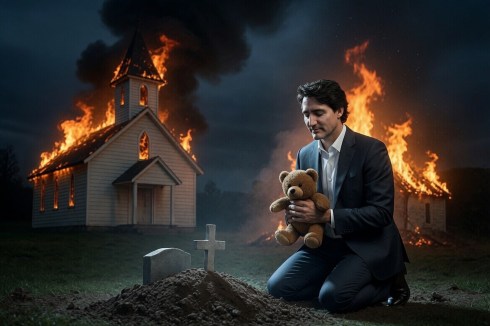
Canada needed truth, not ritual certainty. When narrative outran evidence, churches became symbols for rage.
Works Referenced
Tk’emlúps te Secwépemc. “Remains of Children of Kamloops Indian Residential School Discovered.” May 27, 2021.
https://tkemlups.ca/wp-content/uploads/05-May-27-2021-TteS-MEDIA-RELEASE.pdf
Sarah Beaulieu. “Ground-Penetrating Radar Preliminary Survey: Kamloops Indian Residential School.” Canadian Archaeological Association PDF.
https://canadianarchaeology.com/sites/default/files/page/gpr_at_kamloops_irs_sarah_beaulieu.pdf
Tk’emlúps te Secwépemc. “Media Release.” July 15, 2021.
https://tkemlups.ca/wp-content/uploads/July15_Media-Release_Final.pdf
Terry Reith, CBC News. “At least 33 Canadian churches have burned to the ground since May 2021. So far, 24 are confirmed arsons.” January 10, 2024.
https://www.cbc.ca/news/canada/edmonton/church-fires-canada-1.7055838
Angelus News. “Report: 33 churches in Canada destroyed since May 2021.” January 17, 2024.
https://angelusnews.com/news/nation/canada-churches-destroyed/
CBC News. “‘Unacceptable and wrong’: Trudeau condemns attacks on churches.” July 2, 2021.
https://www.cbc.ca/news/politics/trudeau-churches-arson-attacks-1.6088237
There are few modern spectacles more interesting than Richard Dawkins speaking warmly about Christianity.
Not converting. Not recanting The God Delusion. Not wandering into Evensong with a softened heart and a sudden interest in incense. But speaking warmly, nevertheless.
 Dawkins has called himself a “cultural Christian.” He remains an atheist, which is what makes the admission interesting. He is not saying Christianity is true. He is noticing that Christianity helped form a civilization in which he could become Richard Dawkins: skeptical, eloquent, publicly irreverent, protected enough to criticize sacred things, and still culturally at home among the ruins and residues of the faith he rejects.
For a long time, many secular Westerners treated Christianity as something they had outgrown. It was old, morally complicated, often hypocritical, and associated with repression, scolding, and bad Sunday mornings. Keep the music, perhaps. Keep the architecture. Keep Christmas, provided no one gets doctrinal about it. The rest could be packed away.
There were reasons for that impatience. Churches persecuted, censored, lied, protected abusers, cozied up to power, and sometimes confused institutional self-interest with the will of God. No honest appreciation of Christian civilization can skip that part. But there is a difference between remembering the failures of an inheritance and forgetting that we inherited anything worth having.
The West was not built from one source. It is a quarrelsome inheritance: Greek reason, Roman law, Jewish moral seriousness, Christian theology, Germanic custom, common law, Reformation fracture, Enlightenment skepticism, scientific inquiry, and the long institutional habit of limiting power. Christianity did not invent every virtue from nothing, but it became one of the great furnaces in which those virtues were universalized, moralized, preached, contradicted, betrayed, and recovered.
Modern liberalism did not merely inherit Christian assumptions and put them in nicer clothes. It built institutions Christianity often resisted: robust free speech, religious disestablishment, broader suffrage, empirical science protected from clerical authority, and legal equality that went well beyond what most Christian societies were willing to grant. Some of the freedoms Dawkins enjoys were made possible by Christian moral inheritance. Others required sharp breaks from dominant Christian practice.
That tension is the point. The West is the product of argument, correction, rebellion, restraint, and institutional memory.
This is what modern secular people often miss. We imagine ourselves as freestanding moral adults. We believe in human dignity, equality before the law, freedom of conscience, care for the vulnerable, suspicion of tyranny, and the right to criticize authority. Fine. Keep all of that. But those commitments have a history. They were not produced by vibes, nor assembled last Tuesday by a committee with a land acknowledgement and a catering budget.
They came through centuries of conflict, doctrine, reform, law, blood, repentance, philosophy, institutional restraint, and exhaustion after too many people had killed each other over ultimate things.
To appreciate that inheritance is not to baptize every part of it. Christendom was not gentle. Christianity often had to be forced into better conduct by dissidents, reformers, scientists, heretics, abolitionists, and Christians reading their own scriptures more honestly than their institutions did. The West’s moral inheritance was not a clean gift. It was an argument, often conducted under pressure.
“The West is the product of argument, correction, rebellion, restraint, and institutional memory.”
But the argument happened inside a civilization shaped deeply by Christianity.
The freedom to doubt, mock religion, publish irreverent books, leave a faith, criticize clerics, and live without being ruled by priests was not inevitable. Nor was the expectation that women may walk unveiled, educated, employed, politically equal, and legally protected. These are achievements produced by particular histories, institutions, and moral restraints.
That is where Dawkins’ comparison with Islam enters the discussion, though it needs care.
The issue is not Muslim neighbours. Millions of Muslims live peacefully, work hard, raise families, keep faith privately, and want the ordinary goods everyone else wants: safety, dignity, friendship, decent schools, and a stable life. A serious argument begins by refusing collective suspicion.
The harder question is what happens when Islamic doctrine becomes politically confident and expects the wider society to accommodate its rules around blasphemy, apostasy, religious offence, sex roles, homosexuality, and public criticism. Outcomes differ by interpretation, education, migration patterns, and host-society confidence, but liberal societies still cannot survive by pretending every moral and legal order is equally compatible with liberal freedom.
Dawkins seems to understand that cultural Christianity has learned to live with disbelief in a way many religious systems have not. The Anglican church may annoy you. It may bore you. It may produce beige sermons, awkward committees, and hymns sung by twelve people spread across a nave built for three hundred. But it is unlikely to demand the state punish you for mocking it, which is not a small thing.
“But criticism without gratitude curdles into contempt, and contempt is a poor steward of anything worth preserving.”
The Sunday lesson, then, is not “become Christian or die,” nor “atheists secretly know God is real,” nor “all Muslims are enemies.” It is more modest and more useful: know where you are standing.
If you live in the West, you live inside an inheritance. You may criticize it. You should criticize it. The tradition itself contains the tools for doing so. But criticism without gratitude curdles into contempt, and contempt is a poor steward of anything worth preserving.
Secular liberalism has been living partly off inherited moral capital for a long time, even while adding real achievements of its own. Compassion, rights, conscience, equality, dissent, human dignity, forgiveness, reform, and care for the weak remained available, but the story of how they arrived became unfashionable.
A culture can run on inherited habits for a while. Maybe longer than its critics expect. But inheritance is not self-renewing, and gratitude alone is not repayment. If people are taught only to sneer at what formed them, they will not know what to keep, what to reform, what to defend, or what to pass on. If they merely admire the ruins, they become tourists in their own civilization.
Dawkins has not found God. He has noticed a debt.
The harder question is whether a civilization can repay that debt without pretending to believe what many of its citizens no longer believe.
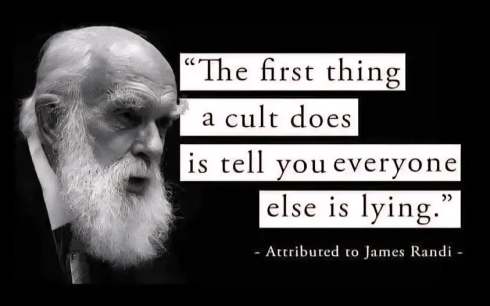
Check it with your favourite religion/ideology. The quote has a wide range of applicability.

Jane Elliott’s famous classroom exercise functions less like an argument and more like a secular parable.
The audience is presented with a moral test. Nobody stands. The silence becomes confession. The lesson is declared revealed.
But notice what is happening structurally.
The participants are not asked to examine evidence, define terms, compare variables, or challenge premises. They are placed inside a ritualized moral frame where refusing the conclusion becomes socially dangerous. The emotional pressure is the mechanism. The audience is guided toward public affirmation through implied guilt.
That is why these exercises often feel spiritually familiar.
Traditional religion used testimony, confession, symbolic reenactment, and moral witness to move people toward conviction. Modern ideological movements often use remarkably similar tools while insisting they are merely “educating.”
The problem is not asking people to care about injustice. Serious injustice exists. The problem begins when emotional coercion replaces open inquiry.
What precisely does “treated the way black citizens are treated” mean?
Compared to whom?
Measured how?
Across what institutions?
At what time scale?
What evidence complicates the claim?
What tradeoffs emerge from proposed solutions?
Those questions are absent because the exercise is not designed to survive interrogation. It is designed to produce moral alignment.
That distinction matters.
Once disagreement becomes evidence of moral failure, accountability starts collapsing. The audience is no longer participating in an argument. They are participating in a liturgy.
And liturgies tend to react poorly when someone interrupts the ritual to ask whether the sermon is true.
One of the stranger features of modern public life is watching people who can spot religious dogma at fifty paces lose the gift the moment the dogma arrives in institutional clothing.
Put the claim in a pulpit and they reach for their Voltaire.
Put it in a workshop binder with equity on the cover and suddenly everyone is very concerned about tone.
That is not an argument against every claim made under DEI. Some discrimination is real. Some institutions have treated people badly while congratulating themselves for being fair. There is nothing strange about wanting hiring, schooling, policing, or public services to be less arbitrary and less cruel. A serious society should be able to hear those claims without flinching.
But hearing is not kneeling.
There is a difference between ordinary anti-discrimination work and the more ambitious creed that often travels under the same acronym. Widening a hiring pool is not the same thing as treating every statistical gap as proof of moral corruption. Removing needless barriers is not the same thing as teaching employees to confess inherited guilt in approved vocabulary. One belongs to public argument. The other starts looking for candles.
Religion, at least, usually admits when it is dealing with sacred things. It has altars, prayers, prohibitions, confessions, authorized interpreters, and a long memory for people who ask the wrong questions. The newer version arrives with less incense and more paperwork: forms, trainings, hiring rubrics, grant language, land acknowledgements, and small ceremonial statements read into microphones before everyone gets on with the actual event.
The room knows what is happening.

You may ask questions, technically. You may even be praised for your “curiosity,” provided your curiosity walks on a leash. Ask what equity means in practice. Ask who measures it. Ask what evidence would count against the program. Ask whether disagreement is permitted or merely pathologized. The temperature changes. Chairs shift. Someone smiles too carefully.
The comparison here is not that DEI managers are burning heretics in the town square. Scale matters. A missed promotion, HR complaint, grant denial, public scolding, or quiet reputational warning is not the Spanish Inquisition, and pretending otherwise only makes the critic sound unserious.
But mechanisms matter too. Church authorities once treated doubt as spiritual failure. Modern DEI culture often treats dissent as fragility, privilege, bigotry, or harm. The accusation has moved from the soul to the psychology, but the social lesson is familiar enough: you are not merely wrong; your question has exposed something unclean in you.
People notice. They adjust their faces. They save the real conversation for the parking lot.
That is how sacred subjects survive in public institutions. Not because everyone believes. Not even because the doctrine is especially persuasive. They survive because enough people learn the price of candour. A teacher nods through the training module. A board member lets the phrase pass. A musician reads the little ritual line because this is supposed to be a concert, not a committee war. An employee keeps the objection in his throat because rent is due and reputational damage compounds quickly.
And if DEI wants to remain in the world of policy rather than piety, it has to answer ordinary policy questions. Does the training work? Compared with what? At what cost? Does it reduce discrimination, or merely produce better-trained public language? Does it improve decisions, or teach people to repeat approved formulas while moving their actual thoughts elsewhere? Mandatory unconscious-bias training, in particular, has hardly earned the right to be treated as revealed truth. Some interventions may help in some contexts. Fine. Then test them, measure them, revise them, and stop treating skepticism as contamination.
Power has always enjoyed borrowing moral language. Traditional religion needed scrutiny for that reason. So does DEI. So does nationalism. So does environmentalism. So does any movement that claims authority over public life while placing its own premises behind velvet rope.
The question is not whether a belief is religious or secular. The question is whether it can be challenged without punishment.
What do you mean?
How do you know?
Who benefits?
Who pays?
What happens to the person who says no?
Those are not hostile questions. They are the minimum price of entering public argument. A doctrine that cannot tolerate them is not being protected from cruelty. It is being protected from accountability.
The old religions taught us what happens when moral certainty gets institutional shelter. The new secular religions are generous enough to provide a refresher course, complete with handouts, acronyms, and a sign-in sheet.
No belief gets immunity because it flatters itself as compassion.
And when ordinary people start moving their honest conversations out of the room, the institution has already chosen the sermon over the argument.











 bleatmop
 Mystro


 Dead Wild Roses
Your opinions…