
You are currently browsing the tag archive for the ‘gender identity’ tag.
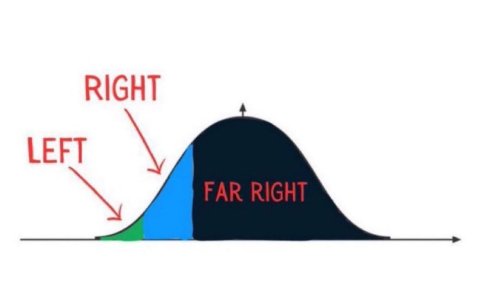
One of the most corrosive habits in current political discourse is the way plain factual claims get assigned a partisan label. Not arguments. Not policies. Facts. Or, more precisely, statements that point back to material reality, institutional limits, or ordinary human constraints. In theory, facts are supposed to discipline ideology. In practice, they are often treated as ideological aggression when they obstruct a preferred moral script.
That is what people are reaching for when they say facts are now treated as right-wing. The phrase is blunt, but it points to something real. In a growing number of disputes, especially around sex, gender, speech, and institutional policy, a person can say something materially true and be treated not as a participant in debate but as a moral suspect. The point is not answered on its merits. It is recoded as a signal of contamination. The speaker is no longer heard as describing reality. He is heard as choosing a tribe.
That shift matters because it changes the structure of argument. Once a factual claim is socially coded as “right-wing,” the burden quietly moves. The question is no longer whether the claim is true. The question becomes why you said it, what kind of person says such things, and who might feel endangered by hearing it. Motive replaces mechanism. Stigma replaces rebuttal. The claim is not refuted so much as quarantined.
You can see this clearly in disputes over sex and pronouns. For many people, saying that sex is real, binary in the ordinary human sense, and not altered by self-declaration is not an act of hostility. It is a claim about reality and a claim about language. “He” and “she” historically track male and female persons. Refusing to detach those words from sex is not, on its face, a partisan performance. It is an attempt to keep public language tethered to the material world rather than to inward identity claims.
“The disagreement is not mainly about politeness. It is about which reality gets public authority.”
That is exactly why the issue generates so much heat. The disagreement is not mainly about politeness. It is about which reality gets public authority. Does language track bodies, or does it track self-declared identity? Does a school treat sex as a stable feature of the world, or does it treat identity assertion as the governing fact? Those are not small etiquette disputes inflated by the internet. They are conflicts about ontology, law, and institutional power.
Canada now offers several live examples. Alberta’s Education Amendment Act requires parental notification when a student requests a gender identity-related preferred name or pronouns, and parental consent for students under 16 before staff may use them. The province says these changes are part of supporting families and setting clear school rules, with the remaining education amendments anticipated to take effect on September 1, 2025. Then, in late 2025, Alberta escalated further. Bill 9 invoked the notwithstanding clause to shield not only this school policy but other contested sex-and-gender measures from being struck down by the courts. That bundling matters. It shows this is no longer being treated as a narrow administrative disagreement, but as a foundational conflict over parental authority, child development, and the public meaning of sex.
Quebec presents the same fracture from the opposite direction, and it is ongoing now. Current reporting says a Montreal teacher is challenging the provincial policy that allows students 14 and older to change the name and pronouns used at school without parental consent. The teacher alleges she was required to use male pronouns at school while using female pronouns with the student’s parents. A preliminary hearing on anonymity and confidentiality was held on March 6, 2026, with the broader merits challenge still to come. Strip away the activist packaging and the conflict becomes plain: can institutional professionals be required to maintain two vocabularies of reality depending on the audience, and if they object, are they making an ethical argument or committing a moral offense?
The Barry Neufeld case in British Columbia shows the institutional end point of this logic. On February 18, 2026, the B.C. Human Rights Tribunal issued its decision and ordered substantial damages after finding that multiple publications were discriminatory, while some crossed the threshold into hate speech. That does not prove that every factual objection to gender ideology is punishable. It does show how readily dissent can be processed through systems that move from moral condemnation to formal classification. Once that line is crossed, everyone watching understands the lesson. The risk is no longer simply that you will be called wrong. The risk is that you will be treated as a public contaminant.
This is why the familiar “both sides are just choosing different facts” formula goes soft in exactly the wrong place. The conflict is not symmetrical. One side is generally making claims about bodies, language, legal authority, and institutional procedure. The other is often demanding that those things yield to identity-based recognition norms. Dignity is real and relevant. But dignity does not erase biological category, dissolve observable sex, or transmute factual disagreement into literal violence.
So when people say facts are treated as right-wing, the point is not that truth literally belongs to one side of the spectrum. The point is that in a culture saturated with moral performance, inconvenient facts are often recoded as partisan because it is easier to stigmatize them than to answer them. A factual claim that disrupts the script is no longer processed as description. It is processed as dissent. And dissent, under current conditions, is increasingly treated as a character defect.
Facts do not have a party. But when facts obstruct an ideological narrative, that narrative will often brand them right-wing and move straight to motive-policing. That is not a sign that the facts have changed. It is a sign that too much of public discourse has become allergic to reality when reality refuses to flatter the creed.
References
Government of Alberta. “Supporting Alberta students and families.”
https://www.alberta.ca/supporting-alberta-students-and-families
Government of Alberta. “Protecting youth, supporting parents, and safeguarding female sport.”
https://www.alberta.ca/protecting-youth-supporting-parents-and-safeguarding-female-sport
Global News. “Montreal teacher challenges policy for trans students to hide identity from parents.” March 6, 2026.
https://globalnews.ca/news/11719392/montreal-teacher-trans-students-challenge/
British Columbia Human Rights Tribunal. Chilliwack Teachers’ Association v. Neufeld (No. 10), 2026 BCHRT 49. February 18, 2026.
https://www.bctf.ca/docs/default-source/for-news-and-stories/49_chilliwack_teachers-_association_v_neufeld_no_10_2026_bchrt_49.pdf?sfvrsn=2d847803_1
The most important part of the British Columbia Human Rights Tribunal’s decision in Chilliwack Teachers’ Association v. Neufeld (No. 10) is not the political noise around it. It is a short passage in page 19 paragraph 55. [attributed as paragraph 19, originally].
That passage matters because it appears to recode a contested idea as a condition of basic civic recognition. In plain terms, it moves from “do not discriminate against people” toward “you must affirm a specific theory to count as accepting them.”
This primer focuses on that point only. It does not attempt to relitigate the entire case.
The tribunal’s decision was issued February 18, 2026, indexed as 2026 BCHRT 49.
What this article argues in one paragraph
TL;DR: The BCHRT can punish discrimination without requiring Canadians to affirm a contested theory of sex and gender as the price of being considered non-discriminatory. Paragraph 19 matters because it blurs that line: it treats disagreement with a conceptual framework as “existential denial” of a person. That is a legal and civic problem, even for people who support anti-discrimination protections.
What this critique is not saying
Before the legal and logical analysis, a boundary line.
This critique is not saying:
- LGBTQ teachers cannot suffer real harm from public rhetoric.
- Human rights law cannot address discriminatory publications or poisoned work environments.
- Every criticism of SOGI, gender identity policy, or youth transition debates is lawful.
- Barry Neufeld’s rhetoric was prudent, fair, or wise.
The tribunal found multiple contraventions under the Code, including ss. 7(1)(a), 7(1)(b), and 13, and the decision contains detailed findings about workplace impact and discriminatory effects.
This primer makes a narrower claim:
Page 19 paragraph 55 uses an analogy that collapses the distinction between recognizing a person and affirming a contested ideological premise.
That distinction matters for free expression, legal clarity, and public trust.
The passage that changes the frame
Here is the core language from parge 19, paragraph 55 (including the definitional lead-in):
“Transpeople are, by definition, people ‘whose gender identity does not align with the sex assigned to them at birth’…”
“If a person elects not to ‘believe’ that gender identity is separate from sex assigned at birth, then they do not ‘believe’ in transpeople. This is a form of existential denial…”
“A person does not need to believe in Christianity to accept that another person is Christian. However, to accept that a person is transgender, one must accept that their gender identity is different than their sex assigned at birth.”
This is the paragraph Canadians should read for themselves.
The issue is not whether one can be civil. The issue is whether civil recognition is being redefined as mandatory assent to a disputed concept.
The core problem: equivocation on “accept” and “believe”
The tribunal’s analogy uses accept and believe as if they do the same work in both examples. They do not.
Christianity example
In the Christianity example, “accept that another person is Christian” usually means:
- acknowledging a descriptive fact about that person’s profession of faith,
- recognizing what they claim to believe,
- without requiring your own doctrinal agreement.
You can think Christianity is false and still accurately say, “Yes, that person is Christian.”
That is descriptive recognition.
Transgender example (as framed in para. 55)
In the tribunal’s wording, “accept that a person is transgender” is not left at description. It is tied to a required premise:
- that gender identity is separate from sex assigned at birth, and
- that this premise must be accepted in order to count as accepting the person at all.
That is not merely descriptive recognition. It is affirmation of a contested theory built into the definition.
That is the logical shift.
Why this matters legally and civically
A liberal legal order normally distinguishes between:
- Recognition of persons
- Protection from discrimination
- Compelled assent to contested beliefs
Paragraph 55 blurs those lines.
A person can acknowledge all of the following without contradiction:
- that someone identifies as transgender,
- that the person may experience distress, dysphoria, or social vulnerability,
- that harassment or discrimination against them is wrong,
while still disputing:
- whether sex is best described as “assigned” rather than observed,
- whether gender identity should override sex in all legal contexts,
- whether specific policies (sports, prisons, shelters, schools) should follow from that framework.
If disagreement on those latter questions is relabeled as “existential denial,” the public is no longer being asked to tolerate persons. It is being asked to affirm a framework.
That is the warning.
A concrete example most readers can use
Here is the distinction in everyday terms.
A teacher, coach, employer, or colleague can:
- treat a transgender person courteously,
- avoid harassment,
- maintain ordinary workplace civility,
- refrain from discriminatory conduct,
without conceding that sex categories disappear in every policy context.
For example, a person may choose to use a student’s preferred name in daily interaction and still argue that elite female sports should remain sex-based. A person may reject insults and harassment and still dispute whether “sex assigned at birth” is the best scientific language.
That is not incoherence. That is how pluralist societies work.
Paragraph 19 pressures this distinction by framing conceptual dissent as equivalent to non-recognition of the person.
The definitional trap in paragraph 55
Paragraph 19 does something subtle but powerful.
It defines “transpeople” using a specific conceptual framework (“gender identity” versus “sex assigned at birth”), then treats non-acceptance of that framework as non-acceptance of trans people themselves.
That is a question-begging structure:
- Premise (built into the definition): trans identity necessarily means gender identity distinct from sex assigned at birth.
- Conclusion: if you reject that premise, you deny trans people.
But the premise is precisely what is contested in public debate.
A tribunal can rule against discriminatory conduct. It can interpret the Code. It can assess workplace effects. But once it turns a contested framework into the test of whether one “accepts” a class of persons at all, it risks moving from adjudication into ideological gatekeeping.
Context matters, but it does not fix the analogy
To be fair to the decision, the tribunal is not writing in a vacuum.
The reasons frame Mr. Neufeld’s rhetoric as part of a broader pattern of statements the tribunal found denigrating, inflammatory, and connected to the work environment of LGBTQ teachers. The tribunal also found a direct connection between his public rhetoric and a school climate that felt unsafe to many LGBTQ teachers.
That context may explain the tribunal’s forceful language.
It does not solve the logic problem in paragraph 19.
Even in hard cases, legal reasoning should preserve key distinctions:
- personhood vs. theory,
- conduct vs. belief,
- discrimination vs. disagreement.
When those lines blur, institutions may satisfy partisans while losing credibility with ordinary readers who can still detect the category error.
Remedies matter too (and should be stated plainly)
This was not a symbolic ruling.
The tribunal ordered multiple remedies, including a cease-and-refrain order, $442.00 to Teacher C for lost wages/expenses, and a $750,000 global award for injury to dignity, feelings, and self-respect to be paid to the CTA for equal distribution to class members. It also ordered interest on monetary amounts as specified.
The tribunal also states that the dignity award is compensatory and “not punitive.”
Readers can disagree about the amount. They should still understand that paragraph 19 sits inside a decision with real legal and financial consequences.
Why Canadians should pay attention
Most Canadians will never read a tribunal decision. They will hear summaries.
That is why paragraph page 19 paragraph 55 deserves attention.
If public institutions begin treating disagreement with a contested theory as “existential denial,” the zone of legitimate disagreement shrinks by definition. The public is no longer told only, “Do not discriminate.” It is told, in effect, “Affirm this framework, or your dissent may be treated as denial of persons.”
That is not a stable basis for pluralism.
A rights-respecting society needs a better rule:
- protect people from discrimination,
- punish actual harassment and unlawful conduct,
- preserve space for lawful disagreement on contested concepts.
Paragraph 55, as written, weakens that line.

Glossary for readers
Page 19, Paragraph 55
A specific paragraph in the tribunal’s reasons that contains the Christianity analogy and the “existential denial” language. This primer focuses on that paragraph.
“Existential denial”
The tribunal’s phrase in para. 19 for refusing to “believe” that gender identity is separate from sex assigned at birth, which it links to not “believing in transpeople.”
Section 7(1)(a) (BC Human Rights Code)
A Code provision dealing with discriminatory publications (as applied by the tribunal in this case).
Section 7(1)(b) (BC Human Rights Code)
A Code provision dealing with publications likely to expose a person or group to hatred or contempt (the tribunal found some publications met this threshold).
Section 13 (BC Human Rights Code)
A Code provision dealing with discrimination in employment, including discriminatory work environments (the tribunal found a poisoned work environment for the class of LGBTQ teachers).
“Poisoned work environment”
A human rights / employment law concept referring to a workplace atmosphere made discriminatory through conduct, speech, or conditions connected to protected grounds.
SOGI 1 2 3
Resources discussed in the decision in connection with BC public education and inclusion policies; the tribunal notes they are resources and addresses their role in the factual background. (See source map below.)
Source map so readers can verify for themselves
Use this map to read the decision directly and check each claim the PDF is available here.
Case identification and issuance
- Paras. 1–3 (intro/citation/date/caption)
- Verified from the front matter: issued February 18, 2026, indexed as 2026 BCHRT 49.
Overview of findings and what was decided
- Paras. 4–6 (high-level findings; which Code sections were violated)
- Tribunal later reiterates finding the complaint justified in part and violations of ss. 7(1)(a), 7(1)(b), and 13.
Freedom of expression framework / limits
- Paras. 8–10 (overview-level framing)
- Also see Part VII heading “Freedom of expression and its limits” in the table of contents.
SOGI factual background
- Paras. 13–15 (background on SOGI 1 2 3 in public education)
- See TOC references to “SOGI 1 2 3 in public education” and Neufeld’s response.
The key analogy and “existential denial”
- Para. 19 (full lead-in + Christianity analogy + “existential denial” language)
This is the central paragraph for the primer.
Tribunal’s “veneer of reasonableness” concern
- Para. 55 (same paragraph; immediate context of the analogy)
Workplace impact evidence / climate findings
- Paras. 38 onward (teacher evidence and climate effects)
- Example evidence and findings on climate and workplace effects are reflected in the teacher testimony excerpts and the tribunal’s acceptance of a direct connection to unsafe school climate.
s. 13 conclusion (employment discrimination)
- Para. 82 (and surrounding paras.) / section conclusion in Part V-C
- Tribunal concludes violation of s. 13 for the class.
Remedies overview (s. 37(2))
- Paras. 99 onward (remedies discussion starts in the remedies part)
- Includes declaration, cease/refrain order, expenses, dignity award, and interest.
Cease and refrain order
- Remedies section, Part A (paras. around 100–101)
- “We order him to cease the contravention and refrain from committing the same or a similar contravention…”
Training remedy requested but declined
- Part B (ameliorative steps) (paras. around 102)
- Tribunal says it was not persuaded mandatory training would have a beneficial effect in this case.
Teacher C expenses ($442)
- Part C (expenses incurred) (paras. around 103)
- Tribunal orders $442.00 to Teacher C.
Dignity award ($750,000 global)
- Part D (compensation for injury to dignity…) (paras. around 104–111)
- Tribunal says the purpose is compensatory, not punitive; later orders $750,000 to the CTA for equal distribution to class members.
Interest orders
- Part E (Interest) (paras. around 112)
- Tribunal orders interest as set out in the Court Order Interest Act.
Modern psychology has a recurring weakness. It periodically falls in love with stories that feel morally urgent, then struggles to unwind them when the evidence turns out thin. That is not because psychologists are uniquely foolish. It is because the field studies messy human beings with noisy measures, ambiguous constructs, and strong social incentives. In that environment, a persuasive narrative can get promoted into “settled science” long before it is actually settled.
The replication crisis is the clearest public sign of this vulnerability. The Reproducibility Project’s large collaboration tried to replicate 100 psychology studies and found much weaker effects and far fewer statistically significant replications than the original literature suggested. (Science) Methodologists also showed how flexible analysis choices and reporting can inflate false positives unless stricter norms are enforced. (SAGE Journals) Meehl’s older critique still lands for the same reason: in “soft” areas of psychology, theories often fade away rather than being cleanly tested and retired. (Error Statistics Philosophy) The implication is not nihilism. It is epistemic humility, especially for claims that are politically charged and personally consequential.
Psychology’s history offers examples of ideas that persist on social momentum long after the evidence grows cloudy. The “memory wars” around repressed and recovered memories show how a compelling clinical narrative can endure in practice while mechanisms remain disputed, and how suggestion can complicate confident storytelling. (PMC) Lilienfeld and colleagues made the broader point in a different domain: weak measurement, loose constructs, and credulous clinical fashions predict confident claims that later demand painful correction. (Guilford Press) The pattern is simple: psychology is unusually prone to ideas becoming socially protected before they are empirically solid.
That is the right context for the strong activist version of “innate gender identity,” meaning the claim that very young children can reliably know and articulate a fixed inner gender that may mismatch their body, and that this knowledge should be treated as stable guidance for major decisions. Developmentally, this is exactly the kind of adult projection Piaget and Erikson warn against: treating children’s words as if they carry stable adult concepts while the child’s understanding and self-organization remain socially shaped and changeable. Even within clinical samples, trajectories are not uniform; intensity of childhood gender dysphoria is one known factor associated with persistence into adolescence, which is another way of saying early self-labels do not function like a universal diagnostic oracle. (PubMed) Clinically, the major classification systems are more cautious than the slogans: DSM-5-TR defines gender dysphoria around clinically significant distress or impairment, not the mere existence of an identity claim. (American Psychiatric Association) ICD-11 moved gender incongruence out of the mental disorders chapter and into “conditions related to sexual health,” partly to reduce stigma while preserving access to care. (World Health Organization)
The evidence environment around youth gender medicine shows why fad dynamics matter. The Cass Review argued the evidence base for medical interventions in minors is limited and often low certainty, urging caution and better research. (Utah Legislature) Substantial critiques dispute Cass’s methods and interpretation, which itself signals this is not a stable, high-consensus evidentiary domain. (PMC) The adult responsibility is therefore straightforward: treat childhood self-labels as developmentally real but conceptually limited; separate distress from metaphysics; demand the same evidentiary standards you would demand anywhere else in medicine; and resist turning a contested construct into a moral absolute. If psychology keeps rewarding certainty over rigor, the cost will not be merely bad theory. It will be policy and clinical practice that harden too early, then harm real people when the correction finally arrives.

Glossary
- Replication / reproducibility: Whether an independent team can rerun a study and obtain broadly similar results. (Science)
- Researcher degrees of freedom: The many choices researchers can make (when to stop collecting data, which outcomes to report, which analyses to run) that can unintentionally inflate “significant” findings. (SAGE Journals)
- P-hacking: Informal term for exploiting analytic flexibility to chase statistical significance. (SAGE Journals)
- Construct validity: Whether a measure actually captures the concept it claims to measure (not just something correlated with it). (General measurement concern emphasized in clinical-science critiques.) (Guilford Press)
- Gender dysphoria (DSM-5-TR): Clinically significant distress or impairment related to gender incongruence; not all gender-diverse people have dysphoria. (American Psychiatric Association)
- Gender incongruence (ICD-11): ICD-11 category placed under “conditions related to sexual health,” moved out of the mental disorders chapter. (World Health Organization)
- Persistence (in childhood GD research): Continued gender dysphoria into adolescence; research suggests persistence is not uniform, and intensity is one associated factor. (PubMed)
Short endnotes (audit-friendly)
- Replication crisis anchor: Open Science Collaboration (2015), Science; effects in replications notably smaller; fewer significant replications. (Science)
- Analytic flexibility / false positives: Simmons, Nelson & Simonsohn (2011), “False-Positive Psychology.” (SAGE Journals)
- Soft-psychology theory fade-out critique: Meehl (1978), “Theoretical Risks and Tabular Asterisks: Sir Karl, Sir Ronald, and the Slow Progress of Soft Psychology.” (Error Statistics Philosophy)
- Memory wars as an example of contested clinical narratives: Otgaar et al. (2019, PMC) on repression controversy; Loftus (2006) review on recovered/false memories; Loftus (2004) in The Lancet on the continuing dispute. (PMC)
- Clinical-science warning about fads/pseudoscience: Lilienfeld et al., Science and Pseudoscience in Clinical Psychology (Guilford excerpts / volume). (Guilford Press)
- DSM-5-TR framing: APA overview and DSM-related materials emphasize distress/impairment as the diagnostic core. (American Psychiatric Association)
- ICD-11 move and rationale: WHO FAQ; supporting scholarly rationale for moving gender incongruence out of mental disorders while preserving access to care. (World Health Organization)
- Persistence factor (intensity): Steensma et al. (2013) follow-up: intensity of childhood GD associated with persistence. (PubMed)
- Cass Review debate: Cass Review final report PDF (archived copies); published critiques and responses indicating contested interpretation and ongoing debate. (Utah Legislature)
Jean Piaget is still worth reading because he blocks a common adult mistake: treating children’s words as if they carry adult concepts. Children do not merely know fewer facts. They use different cognitive tools at different ages, and those tools change what their categories can mean. That matters whenever adults take a child’s self-label and translate it into a fixed inner essence. Piaget’s basic warning is simple: the same vocabulary can sit on top of a different kind of understanding, and adults are very good at smuggling their own meanings into what a child says. The rest of his theory is an attempt to explain why that translation error is so easy to make.
Piaget’s machinery for explaining the gap is spare and still useful. Children build schemas, mental frameworks for understanding objects, actions, and categories. They update those schemas through assimilation, which fits new experience into an existing framework, and accommodation, which changes the framework when the fit fails. The friction between “make it fit” and “change the model” is not a bug. It is the engine. Piaget calls the longer-term settling of that friction equilibration, the push toward a workable balance where the child’s model of the world holds together and predicts better.
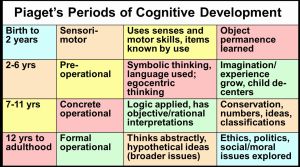
Piaget is best known for his four-stage outline. In the sensorimotor stage (birth to about 2), infants learn through perception and action, and one classic milestone is object permanence, the idea that things still exist when out of sight. In the preoperational stage (about 2 to 7), children gain symbolic thought: language, pretend play, mental imagery. They also show characteristic limits on many tasks, including egocentrism in perspective-taking and failures of conservation (for example, thinking a taller glass has “more” of the same liquid).
Those limits are real, but they are not always as simple as “the child cannot do it.” Modern researchers have shown that the timing can shift when you change the method. Studies using “violation-of-expectation” designs often find signs of earlier object knowledge than Piaget’s original search tasks detected. The clean takeaway is not that Piaget collapses. It is that measurement matters. Some tasks load children with extra demands (motor planning, inhibition, working memory) that can hide understanding that is present in a simpler form. Task demands can mask competence.
In the concrete operational stage (about 7 to 11), children become capable of logical operations tied to tangible situations. Conservation stabilizes, classification becomes more systematic, and seriation appears more reliably, as when a child can order sticks from shortest to tallest without guesswork. In formal operational thought (roughly adolescence onward, and unevenly across people and domains), abstract and hypothetical reasoning becomes more consistent. Even here, performance can be uneven across closely related tasks, a pattern discussed under the label horizontal décalage. That unevenness is a warning against treating stages as rigid ceilings. Read them instead as a map of typical reorganizations in thinking: a useful guide to what changes, and when, without pretending every child hits every milestone on the same schedule. The practical payoff is blunt. When adults treat a child’s words as adult-level commitments, they risk importing meanings the child has not yet built.
Glossary
- Schema: A mental framework for organizing and interpreting experience.
- Assimilation: Fitting new experience into an existing schema.
- Accommodation: Modifying a schema when the old one does not fit.
- Equilibration: The balancing process that restores or maintains cognitive stability through assimilation and accommodation.
- Object permanence: Understanding that objects continue to exist when hidden.
- Conservation: Understanding that quantity stays the same despite changes in appearance if nothing is added or removed.
- Horizontal décalage: Uneven mastery across related tasks; competence does not arrive all at once.
Endnotes
- Encyclopedia Britannica — Piaget overview: stages, age ranges, and constructivist framing.
- APA Dictionary of Psychology — Piagetian terms: schema, assimilation, accommodation.
- APA Dictionary of Psychology — “Equilibration” definition.
- Baillargeon, Spelke & Wasserman (1985) — early object knowledge via violation-of-expectation methods (PubMed record and related materials).
- Lourenço (2016) — stages as conceptual tools/heuristics (ScienceDirect).
- Neo-Piagetian review discussing horizontal décalage and unevenness as a complication for strict stage-uniformity (UCL Press journals).
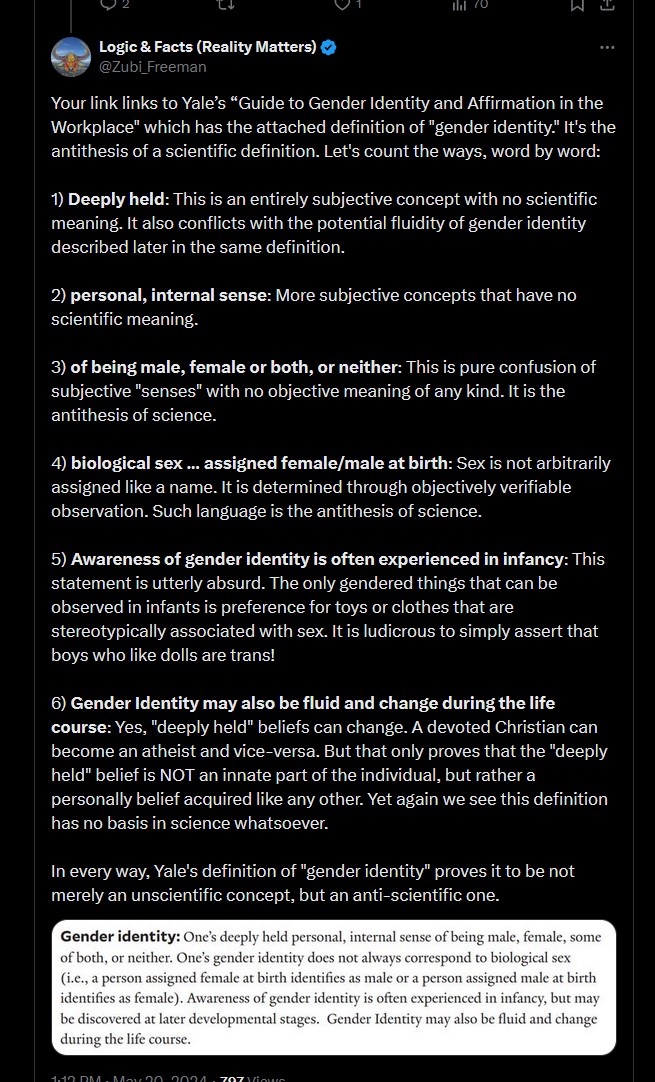
The comparison of gender ideology to a Gnostic religious belief hinges on framing it as a worldview with metaphysical claims about identity, reality, and liberation. Here are five examples illustrating this perspective:
- Dualism of Body and Soul: Gnosticism often posits a split between the material body (flawed) and the spiritual soul (true self). Gender ideology can be seen as analogous when it suggests a person’s true gender identity resides in their internal sense of self, distinct from or in conflict with their physical body, which may be viewed as an obstacle to authenticity.
- Secret Knowledge of the Self: Gnosticism emphasizes esoteric knowledge (gnosis) as the path to salvation. Gender ideology sometimes frames self-discovery of one’s gender identity as a profound, personal truth that transcends societal norms or biological reality, accessible only through introspection or affirmation by others.
- Rejection of Material Reality: In Gnostic thought, the material world is illusory or corrupt. Critics argue gender ideology parallels this by prioritizing subjective feelings over objective biological markers (e.g., chromosomes, anatomy), treating physical sex as malleable or irrelevant to one’s true identity.
- Liberation Through Transformation: Gnosticism often seeks liberation from the material world through spiritual awakening. Gender ideology can be interpreted as promoting liberation from societal or biological constraints via social transition, medical interventions, or redefinition of language and norms to align with one’s identity.
- Moral Hierarchy of Believers: Gnostic communities sometimes distinguished between those enlightened by gnosis and outsiders. Gender ideology can create a similar dynamic, where those who affirm certain beliefs about gender are seen as morally superior, while dissenters are labeled as ignorant or harmful, fostering an in-group/out-group divide.
Gender ideology’s proponents might argue it’s grounded in psychological, social, or medical realities rather than metaphysical claims. Still, the Gnostic lens highlights perceived similarities in structure and worldview.











 bleatmop
 Mystro


 Dead Wild Roses
Your opinions…