
You are currently browsing the tag archive for the ‘Politics’ tag.
Class based analysis of the system is what is required in order to raise consciousness so the work can be done to change the ground rules that are making a hot mess of things .
“A now-retired colleague of Marxist persuasion once remarked on what he saw as a telling omission on the part of many academics who study inequality. He observed that while everyone agrees that racism and sexism are wrong and should be eradicated, few people make the same argument about class. “Why is it imperative to oppose racism and sexism,” he asked, “and not class?” Between us, it was mostly a rhetorical question. We knew that the answer had to do with academics’ class privilege and need to embrace an ideology of meritocracy to justify that privilege. To call class into question would be to question not just a system of inequality but our own deservingness.
While social scientists certainly haven’t ignored class, the attention we’ve paid to it usually takes one of two forms: using class as a variable to predict the attitudes or behaviors of individuals; or studying the lives of people in certain class categories (e.g., ethnographic studies of working-class communities). Such studies can be useful for showing how people experience and are affected by their class locations. What’s typically missing, however, is analysis of how the class system works—how it is used by those who control the means of production and administration—to generate and maintain the inequalities that shape people’s lives.
Part of the problem is that some of the conceptual language useful for unpacking these matters has been stigmatized. The language exists but using it carries a high risk of being dismissed as an ideologue. To speak of a growing gap between productivity and wages over the last thirty years is acceptable. To speak of wage stagnation as a partial result of declining union membership is okay. To speak of ever more wealth accruing to the richest 1% is now within respectable bounds. But to speak of an increasing rate of expropriation enabled by capitalist victories in the class struggle is to invite trouble. Or invisibility.
This is not just a matter of how class is talked about in academic circles. How we study, talk about, and write about class has wider consequences. Focusing solely on diversity, inclusion, privilege, and mobility means having little to contribute when it comes to challenging capitalist power, advancing working-class interests, or transforming capitalism as a whole. It means, in effect, accepting a soft ringside seat.”
by Michael Schwalbe (writing in Counterpunch).
Dear US citizens who want to move to Canada because of the election,
Recently your country has elected Donald Trump to be your president for the next four years. This concerns a great deal of us up here in Canada (and conversely there are some up here that think it’s a great idea). I’m sure it concerns many of you too. In fact I know it as it is hard to escape this reality. The blogosphere, Facebook, Reddit, and even the coffee room is abuzz with this. #Notmypresident is a thing now. People are talking about impeachment before Trump has served a day in office. I get it, people are upset. However I have a few talking points I would like to convey to you at present.
First off, Canada is not a consolation prize, it is a privilege to live here and one that is very difficult to achieve. Just because you don’t like the outcome of your election doesn’t mean we want you here. Quite frankly, we don’t have room. I mean if we even take half of the people who voted for Clinton then we would double our population. But to be honest, we don’t really want you here. We like being your neighbours, but we don’t really want you to move into our house when your left hand is upset with your right hand.
Second, I think you are needed in the USA. Honestly. I really do. Someone has to undo the damage your Democratic Party has done to its base. What they did to Bernie and his supporters is beyond the pale. Actively working against one candidate and for another when they were supposed to be impartial, gaslighting Bernie’s supporters when they complained, impugning their integrity after Wikileaks proved you worked against them, telling them you could win the election without them and you were better off without them. Give your head a shake. You need to make up with these people and then you need to come up with a way to join together. Otherwise what you are looking at in your home is going to become a very familiar story.
Third, you need to get over the delusion that things were that much better under Obama. Obama also has been bombing the shit out of brown people, more so than Bush ever did. He gave you a shitty healthcare option that only gave the health insurance companies more power when he could have pushed for single payer when the democrats owned the Presidency, the House and the Senate. He never did close Guantanamo nor did he even stop the torture that was happening there. Then there was the incident where that man literally went to Flint, Michigan and drank poisonous water and declared it safe. Sure, harm was very unlikely to come to him from drinking such a little amount however is sure as fuck was and still is, to this day and beyond, to all the residents of Flint whom are still there being forced to deal with what I would describe as Hell. If you think I’m being facetious about Flint, think again. If you were the mother of a small child in Flint and are without means, your options are to knowingly poison your children and let them die a slow death or to deny them water and let them die a fast death. The icing on this Hell Cake is when the guy who is supposed to be on your side, Obama, the President of the people, comes to Flint, and you get your hopes up that he’s going to fix this mess but then he not only doesn’t but he almost literally stabs you in the back instead. So Trump might be a lot of things but to date I don’t think he’s ever actually perpetuated the poisoning of an entire community.
Fourth, and finally (not because I couldn’t go on, but because this is getting too long to retain the reader’s interest) you have one of the biggest privileges known to man in this word, that being having citizenship in the most powerful country in the world. With that citizenship you can actually get involved in the democratic process and be the change you want to see. Bernie supporters, this goes double for you. You need to double down and get involved in the party you were so motivated to elect Bernie to just a few months ago. Bernie always said he couldn’t do this alone, that he needed people like him to be elected in all the different offices aside him for him to do the things he wanted to do. This remains true today. And it is now, the “quiet” periods of politics where these shifts really happen. If you want the revolution that Bernie offered then now is the time to go out and make it happen! It certainly won’t happen if you run away to a different country.
“White working-class women appear to be more open than men are to progressive appeals (62 percent of them voted for Trump, as opposed to 72 percent of their male counterparts). That suggests that the most promising path forward would be to agitate for a robust economic agenda focused on women’s needs: a $15 minimum wage, universal child care and pre-K, paid family leave, free college, and tough laws that crack down on wage theft and guarantee fair scheduling and equal pay for women. One of the strengths of such an agenda is that its appeal is hardly limited to women. In our brave new economy, increasing numbers of men now labor under the kinds of precarious working conditions—low wages, minimal benefits, little if any security—that have traditionally characterized women’s employment. Policies like these would help the men, too. They would not be not just righteous, but politically pragmatic.
But it’s not only the Democratic Party that is badly in need of reform. The feminist movement, too, needs to reorient itself. Feminists would be well-advised to ease up on pop culture navel-gazing and corporate pseudo-feminist drivel like Lean In. They need to shift their central focus from the glass ceiling to the sticky floor, which, after all, is the place where most women dwell. A feminism that delivers for working-class women by addressing their material needs could expand feminism’s base and bring about a much-needed feminist revival. A feminism that delivers for working-class women by addressing their material needs could radically expand feminism’s base. And should feminism once again become a vibrant bottom-up mass movement instead of a top-down elite concern, there’s no telling how far it could go.”
 Scholar and feminist activist Jasmine Curcio addresses this polemic and the domination of men in leftist politics, especially around issues pertaining to feminism:
“And so many years on, feminist discussions around the left continue to be subtly dominated by men and their perspective, with the aid of theoretical frameworks that marked disdain towards feminism in decades past. Men have become gatekeepers of feminist discussion, and many debates take place with ignorance, disdain, and sometimes subtle tactics of bullying. Phenomena that lie outside of the bourgeois-proletarian contradiction are not really taken on board as material facts, but either made to fit with constructed orthodoxy or they are discarded.”
Paradoxically, when women point this out, the reality of sexism bites back and they are regarded as “bitches,” “whores,” and even shut down both on social media and in public forums.
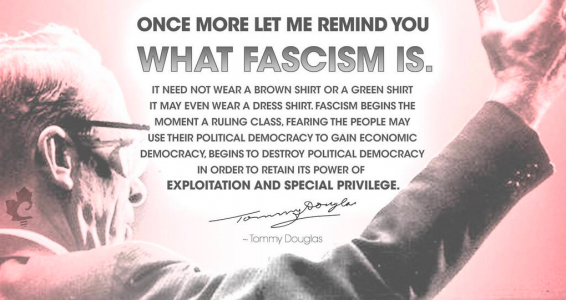
“It need not wear a brown shirt or a green shirt. It may even wear a dress shirt. Fascism begins the moment a ruling class, fearing the people may use their political democracy to gain economic democracy, begins to destroy political democracy in order to retains its power of exploitation and special privilege. – Tommy Douglas
Who doesn’t like to kick back and watch the US primary election campaign? I just scan the highlights, but John Feffer is big picture prognosticating with his recent article on Tom’s Dispatch titled Donald Trump and America B. The article examines the disaffected people who make up America B and who have bought into his faux-populist message. I encourage you to follow the above link and read the entire article as it is well written and laden with trenchant political observations that stretch into the near future.
In the 1990s, the United States changed its political economy. It was not quite as dramatic a shift as the regime changes that took place across Eurasia, but it had profound consequences for the realignment of voting patterns in America.
During that decade, the U.S. economy accelerated its shift from manufacturing — along with the well-paying blue-collar jobs that sector had once generated — to an ever more dominant service economy. In terms of employment, manufacturing jobs dropped from 18 million in 1990 to 12 million in 2014, while wages for such jobs tumbled as well. Over that same period, the health-care and social assistance sector alone grew from 9.1 million to more than 18 million jobs. At one end of that service economy were the 1% in financial services making stratospheric sums, particularly as compensation packages soared from the mid-1990s on. On the other end were the people who had to add shifts at McDonald’s or Walmart to their full-time jobs or monetize their spare time by driving for Uber just to make what they or their parents once earned with one job at the local factory.
America was not alone in undergoing this shift. Thanks to technological innovations like computers and robotics, greater access to cheap labor in places like Mexico and China, the rise of the Internet, and the deregulation of the financial world, the global economy was being similarly transformed. Blue-collar workers no longer played as vital a role in any advanced economy.
In the U.S., put bluntly, the imagination of America A no longer needed the muscle of America B.
[…]
“Falling behind economically and feeling betrayed by politicians on both sides of the aisle, America B might have moved to the left if the United States had a strong socialist tradition. In the 2016 primary campaign, many of the economically anxious did, in fact, support Bernie Sanders, particularly the younger offspring of America A fearful of being deported to America B. Unlike Europe B, however, America B has always been more about rugged individualism than class solidarity. Its denizens would rather buy a lottery ticket and pray for a big payout than rely on a handout from Washington (Medicare and Social Security aside). Donald Trump, politically speaking, is their Powerball ticket.
Above all, the inhabitants of America B are angry. They’re disgusted with politics as usual in Washington and the hypocritical, sanctimonious political elite that goes with it. They’re incensed by how the wealthy have effectively seceded from American society with their gated estates and offshore accounts. And they’ve focused their resentment on those they see as having taken their jobs: immigrants, people of color, women. They’re so desperate for someone who “tells it like it is” that they’ll look the other way when it comes to Donald Trump’s inextricable links to the very elite who did so much to widen the gap between the two Americas in the first place.”
[…]
“America B has a fondness for Donald Trump and his almost childlike audacity. (Gosh, kids say the darndest things!) Right now, his fans are attached to an individual, rather than a platform or a party. Many of his supporters don’t even care whether Trump means what he says or not. If he loses, he will fade away and leave nothing behind, politically speaking.
The real change will come when a more sophisticated politician, with an authentic political machine, sets out to woo America B. Perhaps the Democratic Party will decide to return to its more populist, mid-century roots. Perhaps the Republican Party will abandon its commitment to entitlement programs for the 1%.
More likely, a much more ominous political force will emerge from the shadows. If and when that new, neo-fascist party fields its charismatic presidential candidate, that will be the most important election of our lives.
As long as America B is left in the lurch by what passes for modernity, it will inevitably try to pull the entire country back to some imagined golden age of the past before all those “others” hijacked the red, white, and blue. Donald Trump has hitched his presidential wagon to America B. The real nightmare, however, is likely to emerge in 2020 or thereafter, if a far more capable politician who embraces similar retrograde positions rides America B into Washington.
Then it will matter little how much both liberals and conservatives rail against “stupid” and “crazy” voters. Nor will they have Donald Trump to kick around any more. In the end, they will have no one to blame but themselves.”
End game summary here is this – actual politicians are watching to see how successful DT is. The pull of false populism is strong and in the right(wrong) hands could be forged into a general election winning platform that will take America into a new darker age. So if we see in 2020 the new charming face of proto-fascism rise in the US, remember Tom Dispatch and DWR called it first in 2016.
 Did you want to get the gist of Edward Herman and Noam Chomsky’s master work ‘Manufacturing Consent’ but not have to read that long, dryly informative tomb? Have I got the book for you. ‘Why are we the Good Guys?’ by David Cromwell runs on essentially the same thesis but is many more times engaging and yet at the same time, marginally less academically verbose than Manufacturing Consent. I thoroughly enjoyed the entire work and would like to share a pertinent excerpt on how media coverage perpetuates the destructive cycles (the financial meltdown of 2008 et cetera) we see in our society.
“All the media samples we’ve seen so far in this chapter are indicative of the narrow spectrum of permitted corporate and political opinion on the financial and economic crisis. Viewpoints are heavily biased toward the status quo, with only occasional fig leave of mild dissent. This spectrum of news reporting and commentary is systemically biased; it avoids scrutiny of an economic system that is both fundamentally flawed and stacked against the majority of humanity.
As Shutt notes, one of the most striking features of the ongoing crisis is: “the uniformly superficial nature of the analysis of its causes presented by mainstream observers, whether government officials, academics or business representatives. Thus it is commonly stated that the crisis was caused by a combination of imprudent investment by bankers and others […] and unduly lax official regulation and supervision of markets. Yet the obvious question begged by such explanations – of how or why such a dysfunctional climate came to be created – is never addressed in any serious fashion”. Shutt continued: ” The inescapable conclusion […] is that the crisis was the product of a conscious process of facilitating ever greater risk of massive systemic failure.”
With a few ruffled feathers here and there, Western leaders and their faithful retinue in the media and academia continue to deceive the public about the global economic crisis and its root causes; because power and profits demand it. Otherwise these elites run the serious risk of a huge slump in public confidence in the current system and even in what passes for democratic policies. As it turned out, the chair of the prestigious US law firm Sullivan & Cromwell was not far off in his prediction that ‘Wall Street, after getting billions of taxpayer dollars, will emerge from the financial crisis looking much the same as before the markets collapsed.’ Indeed it was strengthened, as explained by Simon Johnson, former chief economist of the IMF: ‘Throughout the crisis the [US] government has taken extreme care not to upset the interests of the financial institutions, or to question the basic outlines of the system that got us here.’ Moreover, the ‘elite business interests … [who] played a central role in creating the crisis, making ever-larger gambles, with the implicit backing of the government, until the inevitable collapse … are now using their influence to prevent precisely the sorts of reforms that are needed, and fast, to pull the economy out of its nosedive’ while ‘the government seems helpless, or unwilling to act against them.’ As Chomsky notes: this is ‘no surprise, at least to those who remember their Adam Smith,’ and adds, ‘The outcome was nicely captured by two adjacent front-page stores in the New York Times, headlined “$3.4 Billion Profit at Goldman Revives Gilded Pay Packages” and “In Recession, a Bleaker Path for Workers to Slog.”‘
-David Cromwell. Why Are We The Good Guys? pp 174 – 175
Cheery stuff I realize, but its good to know who is doing what to who. Perhaps during the next collapse we’ll hold the bastards accountable.











 bleatmop
 Mystro


 Dead Wild Roses
Your opinions…