
You are currently browsing the monthly archive for March 2026.
The UK’s immigration argument increasingly sounds like destiny rather than policy. People don’t just disagree about numbers; they disagree about whether the state can still enforce boundaries, integrate newcomers into a shared civic order, and speak plainly about what’s happening. When those basic functions look weak or evasive, the vacuum gets filled with bigger stories—decline, betrayal, “takeover,” inevitability.
A sober view starts with what can be verified quickly.
What the numbers say
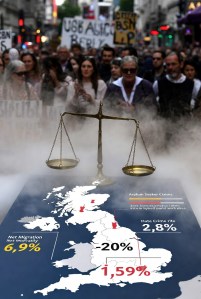
Recent UK migration trends are not a one-way escalator. The Office for National Statistics (ONS) estimates long-term net migration at 204,000 in the year ending June 2025, down from 649,000 the year before. In the same release, ONS estimates long-term immigration at 898,000 and emigration at 693,000.
That decline doesn’t instantly relieve pressure on housing, schools, or services—those systems lag. But it does mean any serious argument has to acknowledge that inflows can change materially under policy and economic conditions.
At the same time, irregular Channel crossings remain the public symbol of “rules don’t work,” regardless of their share of total immigration. Home Office statistics report 46,000 detected arrivals via illegal routes in the year ending December 2025, including 41,000 small-boat arrivals. Politics runs on salience: one visible failure can outweigh many invisible successes.
The asylum system itself is measurable. In the year ending December 2025 the Home Office reports 101,000 asylum claims, 135,000 initial decisions, a 42% grant rate, and 64,000 people awaiting an initial decision at end-December—along with large numbers receiving asylum support, including hotel use. Whatever your values, those are not vibes; they are levers.
Why the argument stays hot even when net migration falls
The debate persists because it is not only about totals. It is about legitimacy: can the state say, credibly, we know who is coming, under what rules, and we can enforce outcomes?
Legitimacy gets harder when estimates change and messaging sounds like PR. The House of Commons Library notes revisions that lowered the estimated net migration figure for the year ending December 2024 (revised to 345,000 from a previously published 431,000). Revisions happen in good faith in statistical work. The political problem is how they land: when people already suspect evasiveness, revisions are read as concealment.
A skeptic will object that “competence” isn’t merely a technical problem; it’s a political one. The worry is not that the state lacks spreadsheets, but that it lacks will: that enforcement is endlessly promised and rarely delivered, and that the system is managed as public relations rather than rule-of-law administration. That objection can’t be waved away. It’s precisely why visible targets, transparent reporting, and demonstrable closure matter: they are the only antidote to the suspicion that the system is performative.
In that atmosphere, administrative failure is quickly translated into moral narrative: the public stops arguing about systems and starts arguing about betrayal.
A necessary constraint: Britain is not a “monolith” story
If you want a steelmanable argument, you have to keep two truths in view.
First, the UK has genuine capacity and integration questions. Second, collective suspicion is both wrong and self-defeating.
A useful demographic anchor: in the 2021 Census for England and Wales, 6.5% of the population (3.9 million) identified as Muslim, up from 4.9% in 2011. That is a significant minority, not a majority—nor a single political bloc. Treating millions of people as a unified will is rhetorical convenience, not analysis.
And the cost of careless rhetoric is not theoretical. A Commons committee report cites 4,478 hate crimes against Muslims in England and Wales in the year ending March 2025. When systems feel out of control, scapegoating rises. Competence is therefore not just technocratic; it’s preventative.
None of this requires pretending integration is automatic. Some communities integrate faster than others; neighbourhood concentration, school pressures, and public-order flashpoints are real issues in parts of the country. The serious question is not whether problems exist, but whether the UK can measure them honestly—language attainment, employment, educational outcomes, and crime (victimization and offending) by clear categories—and then enforce civic norms consistently without collapsing into group blame.
The real lesson: competence drains the market for fate stories
The UK does not need prophecy. It needs closure—visible, lawful closure.
That means:
- Fast, transparent processing of asylum claims and appeals, with published targets and plain reporting. (Throughput has already moved; durability is the test.)
- A credible “no” alongside a humane “yes”—because if failed claims rarely produce timely outcomes, the public stops distinguishing between migration streams and everything becomes one undifferentiated panic.
- Clear public separation of migration categories (work, study, family, humanitarian, irregular entry), so “migration” stops being a fog-word that guarantees misunderstanding. Oxford’s Migration Observatory is a model of that clarity.
- An integration bargain that isn’t embarrassed of itself: language acquisition, equal protection under law, and consistent enforcement against coercive practices—paired with a refusal to treat entire communities as enemies.
When the state can do those things, public debate becomes governable again. When it cannot, the loudest narratives will always be the simplest: destiny, decline, takeover. Not because they are the best explanations, but because they match what people feel.
References
1) Office for National Statistics (ONS) — Long-term international migration, provisional: year ending June 2025
https://www.ons.gov.uk/peoplepopulationandcommunity/populationandmigration/internationalmigration/bulletins/longterminternationalmigrationprovisional/yearendingjune2025
2) UK Home Office — Immigration system statistics, year ending December 2025: Summary of latest statistics
https://www.gov.uk/government/statistics/immigration-system-statistics-year-ending-december-2025/summary-of-latest-statistics
3) UK Home Office — Immigration system statistics, year ending December 2025: Illegal entry routes (detail page)
https://www.gov.uk/government/statistics/immigration-system-statistics-year-ending-december-2025/how-many-people-come-to-the-uk-via-illegal-entry-routes
4) UK Parliament — House of Commons Library: Recent updates to UK migration estimates (CBP-10446)
https://commonslibrary.parliament.uk/research-briefings/cbp-10446/
5) Office for National Statistics (ONS) — Religion, England and Wales: Census 2021
https://www.ons.gov.uk/peoplepopulationandcommunity/culturalidentity/religion/bulletins/religionenglandandwales/census2021
6) UK Parliament — Women and Equalities Committee report (PDF): Discrimination, harassment and abuse against Muslim women
https://committees.parliament.uk/publications/51305/documents/285022/default/
7) Oxford Migration Observatory — Who migrates to the UK and why?
https://migrationobservatory.ox.ac.uk/resources/briefings/who-migrates-to-the-uk-and-why/
Paul Brandt is not a fringe troll with a microphone. He’s a mainstream Canadian artist with a public record of philanthropy, and he’s closely associated with “Not In My City,” a project focused on combating sexual exploitation and trafficking. So when he was slated to appear as a keynote speaker at Alberta’s North Central Teachers’ Convention and then disappeared from the final program, the obvious question is not “what did he tweet?” It’s simpler:
Who made that decision, and why won’t they say so plainly?
The reporting to date suggests Brandt was initially scheduled, then “not included in the final schedule,” with no substantive explanation offered beyond that. That’s not a scheduling explanation. That’s a refusal to explain.
And refusals matter, because when institutions won’t tell the truth in normal language, people assume the worst—and sometimes they’re right.
The Mechanism: Institutional Silence Creates Political Meaning
If you remove a speaker at the last minute and provide no reason, you create a vacuum. That vacuum fills with the most plausible theory available.
In this case, the most widely circulated theory is that Brandt’s public comments touching Alberta independence politics annoyed someone. Is that proven? No. It remains inference. But it is an inference made easier by the ATA ecosystem’s habits: highly political instincts, high message discipline, low transparency.
If the truth is mundane—contract issue, travel issue, logistical conflict—then say it. If the truth is “we didn’t want this topic,” then say that, too. Adults can handle disagreements. What they can’t handle is managerial fog deployed as reputational control.
Precision: Who Is “The ATA” Here?
One important correction: teachers’ conventions are not simply “the ATA” as a monolith. Convention programming is organized by convention associations and boards; the ATA is part of the structure, but local governance and planning matter.
That distinction doesn’t let anyone off the hook. It just tells us where accountability should point: the convention organizers and the ATA officials involved need to identify the decision-maker.
Not “we didn’t include him.”
Not “the schedule changed.”
Not “it was complicated.”
Name the person or committee. Publish the rationale. Own it.
The Drag Bingo Contrast (What We Can Prove, and What We Can’t)
Let’s also clean up another point, because credibility matters more than vibes.
There is evidence that at least one ATA local (Calgary Public Teachers, ATA Local 38) has promoted drag bingo events for teachers—adult social programming and fundraising, including a “Drag Bingo 2.0” event advertised for February 28, 2026 at Hudsons Canada’s Pub. Other posts and recaps indicate this has been a recurring event.
What that does not prove is “drag queen programming for children in classrooms.” If you want to make that claim, you need separate documentation. This piece doesn’t need it.
The point is narrower and stronger:
ATA-affiliated organizations are willing to put their name to drag entertainment for adults, as part of educator culture—and yet they won’t clearly explain why a speaker connected to anti-exploitation advocacy was removed from a major professional gathering.
That mismatch doesn’t prove bad intent. It proves something else: selective transparency. When the programming is ideologically safe, the institution is loud. When the programming might trigger internal conflict, the institution becomes a ghost.
The Real Issue Isn’t Paul Brandt. It’s Institutional Governance.
If you are a teacher paying dues, you should be furious—not necessarily because Brandt is the perfect keynote, but because your professional association is behaving like a risk-management shop instead of a member-serving institution.
Here are the questions that require answers:
- Who made the call to remove him from the program?
- What criterion was used—professional relevance, conduct, political sensitivity, “safety,” reputation risk?
- When was the decision made?
- Was Brandt given a reason, and is that reason publishable?
- Will the organizers commit to a transparency standard going forward?
If those questions can’t be answered, the institution has a bigger problem than one cancelled keynote. It has a legitimacy problem.
Because once you normalize silent removals, you don’t just manage controversy. You teach your own members that power flows upward, speech gets filtered, and you’re expected to smile.
Verdict
You can disagree about Alberta independence. You can dislike country music. You can even decide a trafficking-focused keynote doesn’t fit your convention theme. Fine. That’s politics.
But if you can’t say it openly—if your default mode is bland non-answers and managerial evasion—then you’re not leading educators. You’re managing a brand.
And Alberta parents are right to notice. When the people tasked with protecting children won’t speak plainly about their own choices, they don’t look principled. They look captured.
Albertans deserve better than that. And teachers do too.

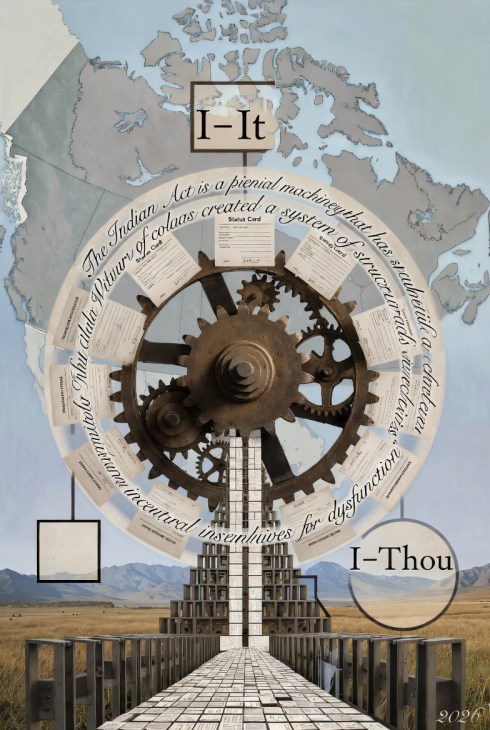
Canada still runs a legal category of “Indian” through federal law. Not as history. As operating code. The Indian Act governs registration, band governance, and the reserve framework. Identity becomes partly administered by statute, not only lived in community. (laws-lois.justice.gc.ca) When a state maintains a separate legal lane for a class of people, it does more than recognize difference. It reproduces difference through process and permanence.
Get the timeline right because this is where critics go hunting. The Indian Act was assented to on April 12, 1876, as a consolidation of laws “respecting Indians.” (sac-isc.gc.ca) Consolidation is not an accident. It is a choice to centralize control, define membership, and keep Indigenous life routed through Ottawa’s legal plumbing. Once you do that, you create a stable incentive loop. Governments manage liability and jurisdiction. Communities defend the gateways through which rights, services, and recognition pass. The system is not neutral simply because it is administrative.
Martin Buber’s vocabulary helps name the moral move without turning this into a sermon. An I–It posture treats people as objects. They become cases, stakeholders, units, problems to be managed. An I–Thou posture treats them as subjects with agency and dignity. A system that sorts people into different legal kinds makes I–It governance easier. Bureaucratic proxies replace encounter. Resentment follows because the relationship becomes instrumental even when the language stays compassionate.
You can watch the machine work in Alberta right now. Elections Alberta issued a Notice of Initiative Petition in late January 2026 for a citizen initiative proposing an Alberta independence referendum question. (elections.ab.ca) First Nations responded with litigation arguing the province had constitutional duties to consult on the impacts of such a referendum and failed to do so. (globalnews.ca) Alberta’s population reached 5.0 million in Q4 2025. (economicdashboard.alberta.ca) That is a large public, a loud politics, and a long list of grievances looking for a target. In that environment, it becomes easy to blame “Indians” as a block instead of blaming the architecture that turns every dispute into a status-mediated struggle over courts, duties, and jurisdiction.
The safest conclusion is also the strongest. Treat this as structure, not as villains. There are Indigenous voices, including William Wuttunee, who argued decades ago that the reserve-dependency model traps people and that integration on Indigenous terms was a path out. (uofmpress.ca) You do not need to adopt his full program to accept the warning. As long as legal status remains the main conduit for dignity, power, and money, Canada will keep reproducing otherness by design. Too many institutions cannot cash their cheques any other way.
References
Source Speech (YouTube)
Indian Act (R.S.C., 1985, c. I-5) — Justice Laws (official text)
https://laws-lois.justice.gc.ca/eng/acts/i-5/
Indian Act, 1876 (“amend and consolidate…”) — SAC-ISC archival text
https://www.sac-isc.gc.ca/eng/1100100010252/1618940680392
Martin Buber (I–It / I–Thou) — Stanford Encyclopedia of Philosophy
https://plato.stanford.edu/entries/buber/
Elections Alberta — Notice of Initiative Petition issued (Jan 27, 2026)
New Citizen Initiative Application Approved, Notice of Initiative Petition Issued
Alberta separation petition legal challenge context — Global News (Jan 23, 2026)
3 Alberta First Nations say separation petition is unconstitutional
Alberta population (5.0M in Q4 2025) — Government of Alberta Economic Dashboard
https://economicdashboard.alberta.ca/dashboard/population-quarterly/
William Wuttunee / Ruffled Feathers — University of Manitoba Press
https://uofmpress.ca/books/still-ruffling-feathers











 bleatmop
 Mystro
 The Arbourist


 Dead Wild Roses
Your opinions…