
You are currently browsing The Arbourist’s articles.
What does “queer” actually mean? Far from a simple label for sexual minorities, queer theory defines itself in opposition to normality. Drawing on David Halperin’s Saint Foucault, this piece explains how queer became a philosophical stance of resistance—an “identity without an essence.”
The word queer has traveled a long road—from an insult meaning “strange” or “abnormal” to a proud rallying cry and the foundation of an entire intellectual movement: queer theory. At its core, the term doesn’t just describe sexual minorities; it represents a philosophical rebellion against everything considered “normal.”
One of the most influential queer theorists, David M. Halperin, explains this in his 1995 book Saint Foucault: Towards a Gay Hagiography. For Halperin, queer is not a stable identity but a position of resistance.
“Queer identity need not be grounded in any positive truth or in any stable reality. As the very word implies, ‘queer’ does not name some natural kind or refer to some determinate object; it acquires its meaning from its oppositional relation to the norm. Queer is by definition whatever is at odds with the normal, the legitimate, the dominant… It is an identity without an essence.”
(Halperin, 1995, p. 62)
In plain language, queer is not like gay or lesbian, which refer to specific sexual orientations. Queer means whatever challenges or defies the normal order. It’s an umbrella term for standing against social expectations—whether those expectations involve heterosexual marriage, gender roles, family structure, or even conventional ideas of decency or success.
Halperin calls it “an identity without an essence.” That means being queer isn’t about belonging to a group with shared traits; it’s about rejecting the very idea of fixed identity. If society defines what’s “normal,” queer theory defines itself by refusing that definition. It is a form of perpetual opposition.
He even jokes that queer could include “some married couples without children, or even (who knows?) some married couples with children—with, perhaps, very naughty children.” His point is that queer has no natural limits. Anything that unsettles the norms of family, sexuality, or respectability can count as queer.
Queer as Permanent Rebellion
In this sense, queer is not just a sexual category—it’s a political and philosophical stance. It seeks to expose and subvert the power structures that make certain ways of living “normal” and others “deviant.”
To be queer, in Halperin’s sense, is to stand in intentional opposition to society’s standards of legitimacy, authority, and order. That’s why queer theorists often speak of “queering” institutions—education, law, art, religion—meaning to challenge or destabilize their traditional foundations.
This also means that queer can never be fully accepted into normal society without losing its essence. The moment it becomes “normal,” it ceases to be queer. Its identity depends on remaining at odds with whatever is considered conventional, natural, or moral.
What This Reveals
For ordinary readers trying to make sense of today’s cultural debates, this definition clarifies something crucial: “queer” doesn’t simply describe non-heterosexual people. It’s a theoretical commitment to resisting normativity itself.
Where older gay rights movements sought inclusion—the right to marry, raise families, and participate equally in civic life—queer theory often seeks subversion: to question whether those norms should exist at all. It replaces the pursuit of equality with the pursuit of deconstruction.
In short, queer stands in opposition to what most people call normal life—not necessarily out of hatred for it, but out of a conviction that “normality” itself is a social construct that limits freedom. Understanding that distinction helps explain why many ordinary people feel confused or alienated by “queer” politics today: it is not asking to join society, but to transform or even overturn its organizing principles.
Key Takeaways: What “Queer” Actually Means
- 1. Queer is not an identity, it’s opposition.
“Queer” doesn’t describe who someone is but how they stand—against whatever society considers normal, moral, or legitimate. - 2. Queer has no fixed boundaries.
Anything that defies traditional norms—about sex, family, gender, or behavior—can be called queer. It’s a fluid, open-ended stance of resistance. - 3. Queer exists only in contrast to the normal.
The concept depends on rejecting normality itself. The moment “queer” becomes accepted or mainstream, it loses its defining feature—its rebellion.

Reference
Halperin, David M. Saint Foucault: Towards a Gay Hagiography. Oxford University Press, 1995, p.

Christopher Hitchens, ever the unflinching provocateur, levels a stark charge against religion: it imperils morality, breeding selfishness and stupidity under the guise of piety. In his words, the evidence mounts on every side that faith not only fails as a moral arbiter but actively corrodes human potential, turning inward gazes toward dogma rather than outward toward shared humanity. This critique resonates when one pores over sacred texts or historical annals, where contradictions abound and ethical lapses reveal the frail scaffolding of divine claims. Yet such scrutiny, while indispensable, risks eclipsing a broader vista, where religion’s flaws yield to its functional virtues in the grand theater of human society.
For the vast middle stratum of humanity, those ensnared by daily exigencies and spared the luxury of philosophical rumination, religion serves as an unpolished but efficacious bulwark. It furnishes hope amid despair, direction in disarray, and a rudimentary moral compass to steer the uninitiated through existential tempests. Empirical patterns affirm this role: religious priming fosters prosocial behaviors, from amplified generosity to bolstered communal ties, while global surveys depict faith as a stabilizing force across diverse polities. Here, the institution transcends its doctrinal frailties, operating less as metaphysical truth than as sociological salve, channeling primal impulses toward cohesion rather than chaos. To dismiss it outright ignores how it equips the multitude for endurance, sparing them the abyss of unexamined voids.
This duality underscores a profound tension: religion thrives inversely to the intensity of its interrogation. Up close, it falters, inviting Hitchens’s scorn; at scale, it endures, a pragmatic hedge against nihilism’s chill. As secular currents erode its grip, one must ponder whether its communal scaffold will atrophy into irrelevance or harden into reactionary fervor. The verifiable record tilts toward adaptation, not extinction, reminding us that truth in such matters demands not polemic but proportion—a measured reckoning that honors critique without forsaking utility. In threading this needle, we glimpse religion not as eternal verity or infernal deceit, but as a human artifact, imperfect yet indispensable in its hour.
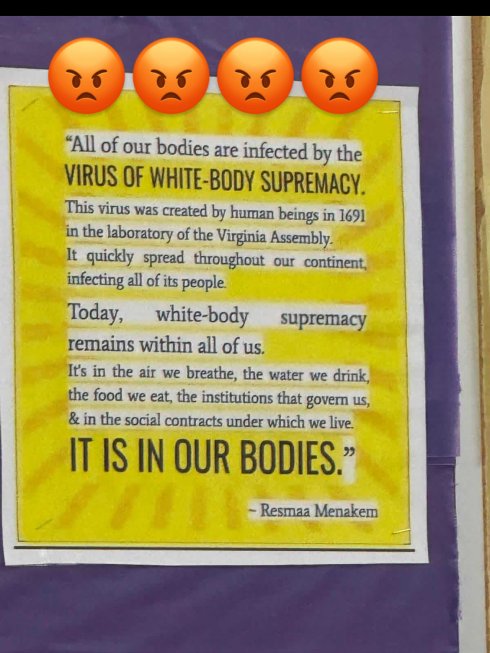
The poster’s quotation from Resmaa Menakem’s My Grandmother’s Hands—a work on “somatic abolitionism”—masquerades as profound insight while peddling a corrosive myth: that white supremacy originated as a deliberate “virus” engineered in 1691 by the Virginia Assembly and now lives in every human body like an inescapable plague. This is not scholarship; it is narrative alchemy, transmuting concrete historical injustices into a metaphysical pathology that demands perpetual atonement from those deemed its carriers.
The verifiable record tells a different story. In 1691, the Virginia General Assembly did indeed enact a statute prohibiting interracial marriage and prescribing banishment for violators, declaring such unions “always to be held and accounted odious.” This and earlier laws—like the 1662 act establishing that a child’s enslaved status followed the condition of the mother—were instruments of economic control designed to stabilize a plantation system dependent on enslaved labor. They reflected cruelty and racial hierarchy, but to describe the Assembly as a “laboratory” that “created a virus” is to abandon historical analysis for political mythmaking.
Menakem’s metaphor extends beyond history into biological moralism. He claims the “virus of white-body supremacy” infects all people—Black, white, and otherwise—but insists that “white bodies” were its original vector. In doing so, his language transforms a moral failing into a physical contamination, pathologizing not actions or institutions but entire human beings. This rhetoric does not enlighten; it indicts an entire lineage for ancestral crimes, regardless of individual conscience or conduct.
The psychological consequence is predictable: self-loathing disguised as virtue. By teaching that “white bodies” are inherently supremacist, this ideology demands that people view their very physiology and heritage as polluted. It secularizes the ancient idea of inherited guilt, substituting ritual “somatic abolition” for redemption. The irony is tragic: the same civilization Menakem condemns also produced the philosophical and political revolutions—the Enlightenment, abolitionism, universal rights—that made slavery morally indefensible in the first place.
Finally, the metaphor corrodes civic trust. The Virginia Assembly, for all its failings, was also one of the earliest elected legislatures in the New World. To recast it as a “mad scientist’s lab” birthing a contagion of supremacy is to delegitimize the democratic experiment at its roots, suggesting that all institutions derived from it remain vectors of infection rather than imperfect vessels of self-correction and progress. Such thinking feeds cynicism, not justice, and erodes the moral foundations of the very equality it claims to seek.
Slavery and racial hierarchy were evils of human design, not biological inevitabilities. We honor truth by condemning those evils as moral and political wrongs—without collapsing into the superstition that guilt resides in the body or that redemption requires permanent contrition. The only real contagion here is the idea that identity determines virtue.
References
- Menakem, Resmaa. My Grandmother’s Hands: Racialized Trauma and the Pathway to Mending Our Hearts and Bodies. Las Vegas: Central Recovery Press, 2017.
— Source of the “virus of white-body supremacy” metaphor and “laboratory of the Virginia Assembly” phrasing. - Hening, William Waller (ed.). The Statutes at Large; Being a Collection of All the Laws of Virginia, from the First Session of the Legislature in the Year 1619. Vol. 3. New York: R. & W. & G. Bartow, 1823.
— Contains the 1662 and 1691 acts (“Act XII” of 1662 and “Act XVI” of 1691) establishing hereditary slavery and banning interracial marriage. - Morgan, Edmund S. American Slavery, American Freedom: The Ordeal of Colonial Virginia. New York: W.W. Norton & Co., 1975.
— Authoritative analysis of how race-based slavery evolved in colonial Virginia as a means of stabilizing class hierarchies. - Davis, David Brion. The Problem of Slavery in Western Culture. Ithaca: Cornell University Press, 1966.
— Foundational work tracing slavery’s intellectual and moral contexts in Western thought. - Berlin, Ira. Many Thousands Gone: The First Two Centuries of Slavery in North America. Cambridge: Harvard University Press, 1998.
— Historical survey of the transformation from indentured servitude to race-based chattel slavery. - Bailyn, Bernard. The Ideological Origins of the American Revolution. Cambridge: Harvard University Press, 1967.
— Explores the moral and political inheritance of the Virginia Assembly and the paradox of liberty coexisting with slavery. - Popper, Karl. The Open Society and Its Enemies. Princeton: Princeton University Press, 1945.
— Classic defense of open inquiry and individual moral responsibility against collectivist and totalizing ideologies.

In October 2025, Brighton witnessed a stark confrontation between feminist and trans activist groups, culminating in the vandalism of the FiLiA conference venue by the direct-action group Bash Back. This incident has sparked widespread debate over the boundaries of free speech, the safety of women-only spaces, and the tactics employed in the defense of trans rights.
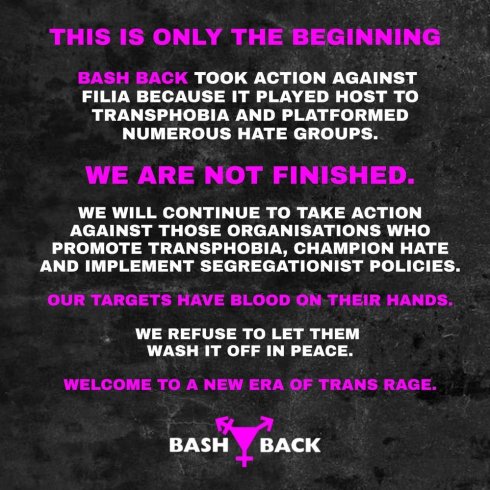
In the seaside city of Brighton, where the English Channel laps against shores long synonymous with progressive ideals, a gathering of women became the target of deliberate aggression last weekend. The FiLiA conference—Europe’s largest feminist event, drawing over 2,400 delegates from around the world—convened from October 10 to 12, 2025, to confront the unyielding realities of women’s lives: domestic abuse, sexual violence, lesbian safety, anti-racism, health equity, and political organizing. What should have been a sanctuary for sisterhood instead became a stage for intimidation, vandalism, and moral inversion, carried out by activists who cloaked their belligerence in the guise of righteous victimhood. This was no spontaneous protest; it was an orchestrated assault on women’s autonomy, executed through the psychological tactic known as DARVO—Deny, Attack, Reverse Victim and Offender—flipping aggressor and victim roles to confuse and shame the true defenders.
FiLiA, the Feminist International Leadership and Action charity, has championed women’s voices and sex-based rights since its founding in 1982 as Feminists in London. Rebranded in 2019, the organization organizes workshops, advocacy campaigns, and international solidarity events, explicitly excluding male speakers to foster unmediated discourse. Alumni include figures like J.K. Rowling, and sessions routinely interrogate male violence without apology. In Brighton, hosted at the council-owned Brighton Centre, FiLiA aimed to advance this mission amid escalating threats to female-only spaces. Organizers preemptively requested a Public Spaces Protection Order from Brighton and Hove Council to mitigate anticipated disruptions, only to be rebuffed—a decision that left delegates exposed to the very dangers the conference sought to address.
The aggression began hours before the conference doors opened on October 10. Activists associated with the direct-action group Bash Back vandalized the venue: windows were shattered, purple paint—symbolizing queer defiance—splashed across entrances, and graffiti labeled FiLiA “transphobic” and worse. As women arrived on Saturday, masked protesters surrounded them, chanting, jeering, filming without consent, and blocking access to the entrance. One man was bundled into a police van amid the chaos. Sussex Police launched an investigation, but the damage was done: a conference on male violence against women had itself been disrupted by male violence.
This incident exemplifies DARVO in practice. Attacks were simultaneously denied or minimized as mere “direct action,” while FiLiA was cast as inherently bigoted for prioritizing biological sex in discussions of oppression. Reversal of victimhood followed swiftly: women convening to safeguard their rights were recast as provocateurs, deserving retaliation. Green MP Sian Berry’s comments faulting organizers for “inflaming division” exemplify this inversion, as if women’s speech is a privilege revocable at the whim of the offended. Online, Bash Back celebrated targeting “hate groups” like the LGB Alliance and Transgender Trend, further amplifying the narrative of moral righteousness while eroding accountability. Eyewitness reports indicate that many of the aggressors were male, cross-dressing in the guise of protest—a striking irony in a city branding itself a “City of Sanctuary.”
The Brighton disruption is part of a broader pattern of hostility toward women’s spaces, where the veneer of inclusivity is used to justify exclusion. Militant transactivism often prioritizes gender self-identification over material sex realities, demanding access to refuges, prisons, and sports at the expense of female safety. By framing sex-based protections as inherently “transphobic,” these tactics erode the foundations of feminism: the recognition that sex is the axis of patriarchal power and a critical factor in protecting women from violence. The FiLiA delegates were not debating abstract theory—they were strategizing for survival against rape, trafficking, and erasure. To disrupt their forum is to reinforce the patriarchal dynamics they resist.
The path forward requires vigilance and clarity. DARVO’s manipulations must be unmasked; women’s sex-based rights defended without apology; and discourse reclaimed from those who mistake volume and spectacle for moral authority. Only then can women gather safely, unmolested, to build the liberation FiLiA envisions—a liberation grounded in reality, accountability, and the enduring fight against male violence.
📚 References
- “Council refused feminists security after trans activists smashed venue.” The Times, October 10, 2025. (The Times)
- “Trans activists vandalise feminist conference.” Yahoo News Canada, October 10, 2025. (Yahoo News)
- “Trans group ‘BASH BACK’ targets Brighton Centre – FiLiA has ‘blood on their hands’.” Scene Magazine, October 10, 2025. (Scene Magazine)
- “FiLiA Conference Sparks Trans Rights Protests In Brighton.” Evrimagaci, October 10, 2025. (Evrim Ağacı)
- “FiLiA.” Wikipedia, October 2025. (Wikipedia)
- “Bash Back!” Wikipedia, October 2025. (Wikipedia)
Totalitarianism doesn’t always arrive with jackboots and slogans. Sometimes it comes wrapped in compassion, weaponizing language to divide citizens into moral castes of “the good” and “the guilty.” As James Lindsay warns, every ideology that builds itself on purging an “enemy” eventually devours its own believers. Today’s soft totalitarianism operates not through force, but through narrative warfare—using labels like “Maple MAGA” or “anti-equity” to silence dissent and enforce ideological purity.

The Totalitarian Mindset in Our Midst
The belief in any totalitarian system is that there is some ‘enemy’ that holds back society. Once that enemy is destroyed and purged, society will flourish, or so the cult belief goes.” —James Lindsay
The Endless Enemy
James Lindsay’s observation is not a history lesson it’s a warning. Totalitarian movements always begin with the conviction that society’s ills can be traced to a corrupt class of people who must be identified and eliminated.
The logic is seductively simple: If only the enemy were gone, we could be free. But when the promised harmony never arrives, the search for hidden enemies intensifies. The hunt becomes perpetual, the paranoia self-sustaining. Every failure is blamed on infiltration, every setback on the persistence of the impure.
This cycle of purification is as old as ideology itself, but today it is being revived in softer, subtler ways—through moralized language, social shaming, and bureaucratic enforcement of political conformity.
The New Form: Narrative Warfare
In modern liberal democracies, totalitarianism doesn’t need guns or gulags. It begins with words. The authoritarian project of the 21st century is linguistic—it manufactures enemies through labels, controls discourse through moral accusation, and demands conformity under the banner of compassion.
In Canada and across the West, we see this in the weaponization of language: “Maple MAGA,” “anti-equity,” “white adjacent,” “problematic.” These aren’t analytical categories; they’re *filters of suspicion.* Once the label sticks, a person’s character and arguments no longer matter. They are marked.
This dynamic is a form of narrative warfare—the use of moralized storytelling to delegitimize opponents and consolidate cultural power. It’s the precondition of soft totalitarianism: control the story, and you control reality.
Weaponized Intersectionality: A Framework for Division
One of the key delivery systems for this mentality is **weaponized intersectionality**. Originally coined by legal scholar Kimberlé Crenshaw to describe overlapping forms of discrimination, the concept has been repurposed into a political sorting mechanism—one that divides society into immutable identity classes of “oppressors” and “oppressed.”
|Tactic |How It Works| Effect on Society |
| Labeling & Name-Calling | Terms like “Maple MAGA,” “far-right,” or “white adjacent” pre-empt debate and morally quarantine dissent. | Delegitimizes citizens instead of arguments; silences conversation. |
| Moral Purity Tests | Demands that allies demonstrate constant ideological conformity (“anti-racist,” “affirming,” “decolonized”). | Creates fear of speaking or questioning; enforces orthodoxy. |
| Institutional Capture | Activist vocabulary embedded in policy, HR, and education under “diversity” and “equity” mandates. | Bureaucratizes ideology; punishes dissent within organizations. |
| Perpetual Enemy-Hunting| “Privilege” and “bias” are re-discovered endlessly; the enemy is never gone, only hiding. | Normalizes suspicion; sustains revolutionary fervor without end. |
Each tactic reinforces the other. Together, they recreate the same cycle Lindsay describes: a social order sustained by perpetual purification.
The enemy is not gone; it is merely “in hiding.”
The Moral Mechanics of Control
Modern totalitarianism thrives on moral certainty rather than state terror. It convinces ordinary citizens that they are participating in justice, not oppression. To question the narrative is to expose oneself as suspect, and so the culture of fear spreads horizontally—through HR departments, social media platforms, and educational institutions.
This is how freedom erodes without a coup or revolution: through social coercion disguised as moral progress.
The power lies not in force, but in the internalization of guilt and fear. People censor themselves before anyone else has to.
What We Can Do About It
1. Recenter Universal Principles
Defend equality before the law, free inquiry, and human dignity—not inherited guilt or group virtue. Anchor civic life in the moral universals that totalitarian ideologies deny.
2. Name the Dynamic
When faced with ideological bullying, describe what’s happening: *“This is an attempt to morally disqualify rather than discuss.”* Naming the tactic exposes the manipulation and halts its momentum.
3. Build Parallel Forums for Open Debate
Create independent media, civic associations, and discussion circles where disagreement is respected. The antidote to coercion is community.
4. Refuse the Language of Division
Reject slurs and invented terms designed to fragment society. Language is not neutral—it’s the primary weapon of soft authoritarianism. Don’t wield theirs.
5. Practice Moral Courage
The first act of resistance is speech. Speak calmly, truthfully, and consistently—even when it’s uncomfortable. Silence is the oxygen of control.
Conclusion: The Old Lie in a New Form
Totalitarianism does not march under the same banners it once did. It arrives softly, wrapped in moral rhetoric and bureaucratic language, persuading good people that they are fighting for justice. But as Lindsay warns, every ideology that builds itself on purging an enemy eventually devours its own believers.
The only true defense is to reclaim our shared humanity—to judge one another by deeds, not descent; by actions, not affiliations. Freedom, as it turns out, depends not on the absence of enemies, but on the courage to refuse the hunt.
—
References
Lindsay, J. (2025, October 9). Why totalitarianism always produces mass murders. [Tweet]. X (Twitter). [https://x.com/ConceptualJames/status/1976724498213667156](https://x.com/ConceptualJames/status/1976724498213667156)
Crenshaw, K. (1989). Demarginalizing the Intersection of Race and Sex: A Black Feminist Critique of Antidiscrimination Doctrine, Feminist Theory and Antiracist Politics. University of Chicago Legal Forum.
Orwell, G. (1946). Politics and the English Language.
Arendt, H. (1963). Eichmann in Jerusalem: A Report on the Banality of Evil.
Popper, K. (1945). The Open Society and Its Enemies.
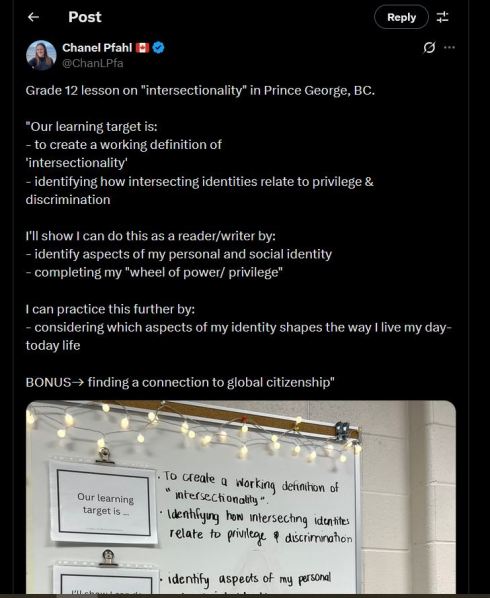
In Prince George, British Columbia, Grade 12 students were recently asked to “map their identities” on a wheel of power and privilege and define how overlapping traits like race, gender, and class shape their lives. The exercise was meant to foster empathy. Instead, it taught students to see themselves—and one another—through a hierarchy of guilt and grievance.
This is intersectionality in action. Coined by legal scholar Kimberlé Crenshaw in 1989, the theory originally sought to highlight how overlapping identities could compound discrimination. But in today’s classrooms, HR seminars, and activist spaces, intersectionality has evolved into something more aggressive: a political sorting tool that assigns moral value based on group identity rather than personal conduct. When used this way, it becomes weaponized intersectionality.
1. Define It Precisely
When arguing against it, start by defining intersectionality clearly. Don’t caricature it. Acknowledge its original intent—understanding overlapping forms of discrimination—but distinguish that from its modern mutation, which treats identity as destiny. This makes your critique credible and inoculates against claims of ignorance or bad faith.
2. Expose the Hidden Premise
Weaponized intersectionality rests on a simple but flawed assumption: that all disparities are the result of oppression and that moral authority flows from victimhood. Challenge that premise. Inequality does not always mean injustice. Lived experience matters, but it does not override evidence or reason.
3. Defend Universalism
Reassert the Enlightenment principle that all individuals possess equal moral worth regardless of group identity. Intersectionality divides by assigning virtue or guilt to immutable traits; universalism unites by judging actions, not ancestry. This is not denial of injustice—it’s the precondition for solving it.
4. Point Out Its Social Effects
Weaponized intersectionality erodes solidarity. It breeds resentment, teaching students and citizens alike to view each other as oppressors or oppressed. Even some leftist thinkers, like Nancy Fraser, have warned that intersectionality replaces economic analysis with “cultural essentialism,” fracturing potential alliances for real reform.
5. Offer a Better Vision
Don’t just oppose—propose. Replace identity grids with human rights frameworks. Discuss shared values such as dignity, equality before the law, and freedom of conscience. These ideas have lifted more people from oppression than any taxonomy of privilege ever could.
The Prince George lesson shows what happens when ideology replaces education: empathy becomes accusation, and learning becomes confession. Weaponized intersectionality promises justice but delivers division. The antidote is not denial of difference but defense of common humanity—an argument every student deserves to hear.











 bleatmop
 Mystro
 The Arbourist


 Dead Wild Roses
Your opinions…