
You are currently browsing the category archive for the ‘Culture’ category.
 Our society is being influenced negatively by the consumerist culture that we, collectively, have taken our hands off the tiller and have let the market decide what is best for us and our cultures.
The idea that we can consume our way to happiness, well-being, or even a more just society would not compute without people being constantly conditioned to believe that individuality is end-goal of life. The power of community and people working together has been the dynamo that has pushed our societies forward for the benefit of everyone (well except for the status-quo) and it is this power that has been waning since corporate capitalism has kicked into high gear under the guise of neo-liberalism. Neo-liberalism undermines community, collective action, and critical thought it is a stupefying tonic – that when served to the masses – creates a calm disquiet that grinds societies away, but in return keeps people isolated, fixated on themselves, and most importantly: manageable.
This piece by Nick Turse is a preface for a America’s disconnect between its citizenry and the army said citizenry supports. The dissonance is palatable as one reads the article. What should concern you is that the disconnect described has been carefully and intentionally cultivated. A feature of our current system, and most certainly not a bug .
“I can’t tell you exactly why I clicked on the article, but it was probably the title: “The Double-Tap Couple.” To me, a “double tap” is the technique of firing two gunshots in quick succession or employing two strikes in a row, as when U.S. drones or Hamas carry out attacks and then follow-up strikes to kill first-responders arriving at the scene. But this piece was about something very different. The headline referred to the popular app Instagram where you double-tap to “like” a photo.
The article turned out to be a profile of two twenty-somethings, a married couple who go by the noms de social media, FuckJerry and Beige Cardigan. They are, says author David Yi, “micro-celebrities” of the modern age. He is “tall, with a chiseled face, handsome”; she “has big doe eyes with cherub-like cheeks.” They dropped out of college and — first he and then she — became Instagram meme curators; that is, they find photos with wry or funny captions elsewhere on the internet and post them for their millions of followers. “Though both are social media sensations, neither is quite content with what they’ve accomplished,” Yi tells us. She “wants to pursue her first love, fashion, but isn’t quite sure what she’d want to do.” He’s currently cashing in with FuckJerry merchandise — hats, t-shirts, even “Vape juice.”
I read the article to the point at which FuckJerry (née Elliot Tebele) told Yi about his long slog up the Instagram follower food-chain: “It took a shit ton of time to get to, and it took a long time with a lot of work.” I stared at my phone in abject confusion. Something wasn’t right, so I scrolled to the beginning of the article and started again. But it was just the same. Justin Bieber is a fan. Followers include the “Kardashian-Jenner family.” He wears “skinny jeans and vintage Nikes.” She sports a “statement coat and a pair of sparkling Chloe boots.” Then I hit that quote: “shit ton of time… a lot of work.” I still couldn’t make sense of it and began studying the article as if it were a riddle. I read it maybe five times and again and again when I hit those phrases about time and work my brain would buckle.
At that moment, I was nearing the end of a month-long reporting stint in South Sudan and waiting to find out if I’d be able to talk to a teenage girl, a late millennial with more than memes on her mind. She had rebuffed the 60-something man her family had arranged for her to marry and her relatives had displayed their displeasure by beating her to the point of unconsciousness. That conversation never happened, but I’d already logged several weeks’ worth of interviews with shooting survivors, rape victims, mothers of murdered sons, wives of dead husbands. All this in a country where, for firewood and water — that is, the means of life — women walk desperately far distances in areas where they know that men with AK-47s may be lurking, where many are assaulted and violated by one, two, or even five men. In other words, a land where few would consider meme curation to be “a lot of work.”
I’d obviously hit that unsettling juncture where voices from home become dulled and distorted, where you feel like you’re hearing them from deep underwater. I’m talking about the vanishing point at which your first-world life collides with your crisis-zone reality — the point of disconnect. Mark Wilkerson knows it well. He found himself in just such a state, serving with the U.S. Army in civil-war-torn Somalia during the 1990s. That’s where he begins his inaugural TomDispatch piece, a rumination on his journey from soldier to veteran to chronicler of the all-too-brief life of another veteran, in his recent and moving book, Tomas Young’s War.
I eventually gave up on Yi’s article, unsure why I couldn’t understand the life and times of FuckJerry. After I got back to the U.S., however, I signed up for Instagram and took a look at his account and Yi’s story began to make more sense to me, if only in a tragi-comic way. Later in the piece, he writes of his subjects being “caught in the maelstrom” when a competitor is criticized for “stealing” memes. It’s a strange society that produces both meme maelstroms and, in distant lands, lethal ones that leave millions dead, maimed, desperate, or displaced. So before you become FuckJerry’s 9,200,001st follower, let Wilkerson guide you through slivers of two American conflicts, their aftermaths, and the points of disconnect along the way.”
–Nick Turse’s Preface to Batman in a Hospital Bed by Mark Wilkerson @Tom’s Dispatch
The disconnection that Turse illustrates resonates with me enough though to make it the focus of my article, however Wilkerson’s article is also very good, so I recommend following the link.
 How profitable an industry is seems to be related to how regulated said industry is. Consider the length of time necessary to regulate tobacco and disseminate the information that, yes indeed, smoking is bad for your health.
Pornography, also bad for your health and your relationships, is in the same category and for the most part is left to its own devices. The damage caused to society by pornography is enormous and will only get worse if nothing is done.
“Those who claim that pornography is simply “fantasy” with no bearing on reality will have a hard time explaining the prevalence of pubic hair removal among young women in Western cultures; the dramatic increase in the demand for labiaplasty; or the fact that anal sex has increasingly become part of the heterosexual repertoire, despite both young men and women expecting it to be painful and unpleasant for the woman. It is singularly unconvincing to argue that pornography is not influencing current sexual norms, and that those sexual norms do not primarily involve the objectification and violation of women’s bodies.” – Julia Long
The pornification of our culture is happening right now, and as Ms.Long says, it happens to be revolving around the objectification and violation of women’s bodies which bodes ill for all of society.
Did you need your daily LoLsob, well check out the headless women of hollywood tumblr and bathe in the cool waters of women decapitated, anatomized and passively portrayed for the male gaze. Misogyny, fresh from the pop cultural centre of the universe, to you, faithful readership. Whoo-haa….:/
And dudes, do note the link regarding the inevitable WATM outcry. Please follow and read it; save us both some time. :)
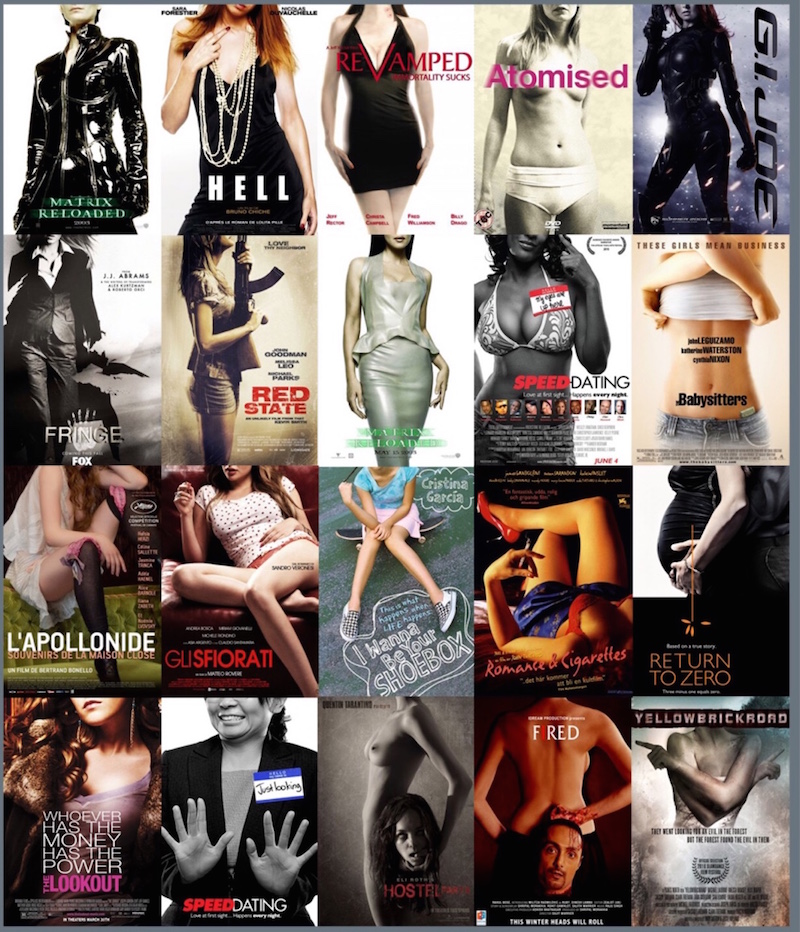
“The point is (of course) not that every poster we see objectifies and fragments female bodies. The point is that many do and that cutting up female bodies into consumable, sexualized parts is such an accepted and standard marketing practice across the board – people tend not to even notice.
It is something that is not done to men in the same way, but that is not dismissing problems that face men. It is merely focusing on a specific problem that affects women. (See: http://headlesswomenofhollywood.com/post/143241005563/headlesswomenofhollywood-what-about-the)
Even for movies that already objectify women as their main purpose (which maybe one day won’t be an entire genre??????) by cutting off the head of the woman on the poster, the dehumanization of her body is taken a step further. And her pleasure and consent are taken completely out of the equation.”

I spent my years learning French in Highschool(and now forgotten). Now with double the disappointment as I realize how word-awesome German is.
Consider this small list of bon mots:
Weltschmerz – world weariness.
Schadenfreude – a feeling of enjoyment that comes from seeing or hearing about the troubles of other people
Backpfeifengesicht – It describes someone who you feel needs a slap in the face.
Sitzfleisch — (seat meat) – it describes a character trait. Those who possess a lot of seat meat are able to sit through and weather something incredibly hard or boring.
Dreikäsehoch (Three cheeses high) – However, what it describes is a person who is vertically challenged, implying they’re only as tall as three wheels of cheese placed on top of each other.
Schattenparker (Shadow parker) – This word is part of a series of insults for men which accuse them of unmanly behavior. In this case, of parking their car in the shadow to avoid heating up the interior.
Forget French as Canada’s second language it ought to be German. :>

 Prostitution hurts women. It doesn’t matter whether the trade in commercial rape is legal or not – reducing women to the role of fuckable object corrodes their body, mind, and soul.
But it can’t be all that bad for everyone, right? Let’s see what Rae Story, one of the ‘lucky’ high class escorts has to say on her experiences.
“Towards the end of my work as an “escort” I was thoroughly exhausted. The brothel work had been brutal on my body, but the “independent escort” work had exhausted my spirit. Whereas once I just ran the gamut of garden-variety sexual activities with, at best, a distant smile and a “good day to you,” I now had been obsessing over my appearance, my apartment, my advertising, and my “image” as well. I’d been made to adopt the most insidious of all contracts: The Girlfriend Experience — winsome, involved, overly nurturing, and available. Intelligent enough to understand but never enough to contradict. Lying to “clients” about my background, my views, and my habits in order to demonstrate a pleasing personhood for the paying male ego.
Friends had also left brothels in droves and began to navigate this landscape of pretense for themselves. According to “clients,” we didn’t drink heavily, smoke, do drugs, swear, speak coarsely (other than at appropriate sexual moments) argue, have opinions, or refuse to gratify. In truth, most of the women I knew had problems with drink, drugs, eating disorders, mental health problems, and anger issues. We may not have been routinely beaten by punters or raped (although it does happen), but our self-esteem and self-assurance was as paper thin as our digital platforms.We pretended to be happy, empowered, sexy, and comfortable in our roles as sponges for immediate male satisfaction while pushing our maladies and distresses down the sides of the sofa… just like those women detailed by Betty Friedan: isolated housewives, secretly quaffing vodka and pills to deal with their controlled misery. In each of our separate apartments, the “high class escorts” I knew were indeed like those housewives, only now it was more than one “husband” we served to keep a roof over our heads.”
— Rae Story
It would seem that centring your existence around pleasing of others (men) – the traditional and expected role for females – is a shit job no matter how you package it.
[Source]
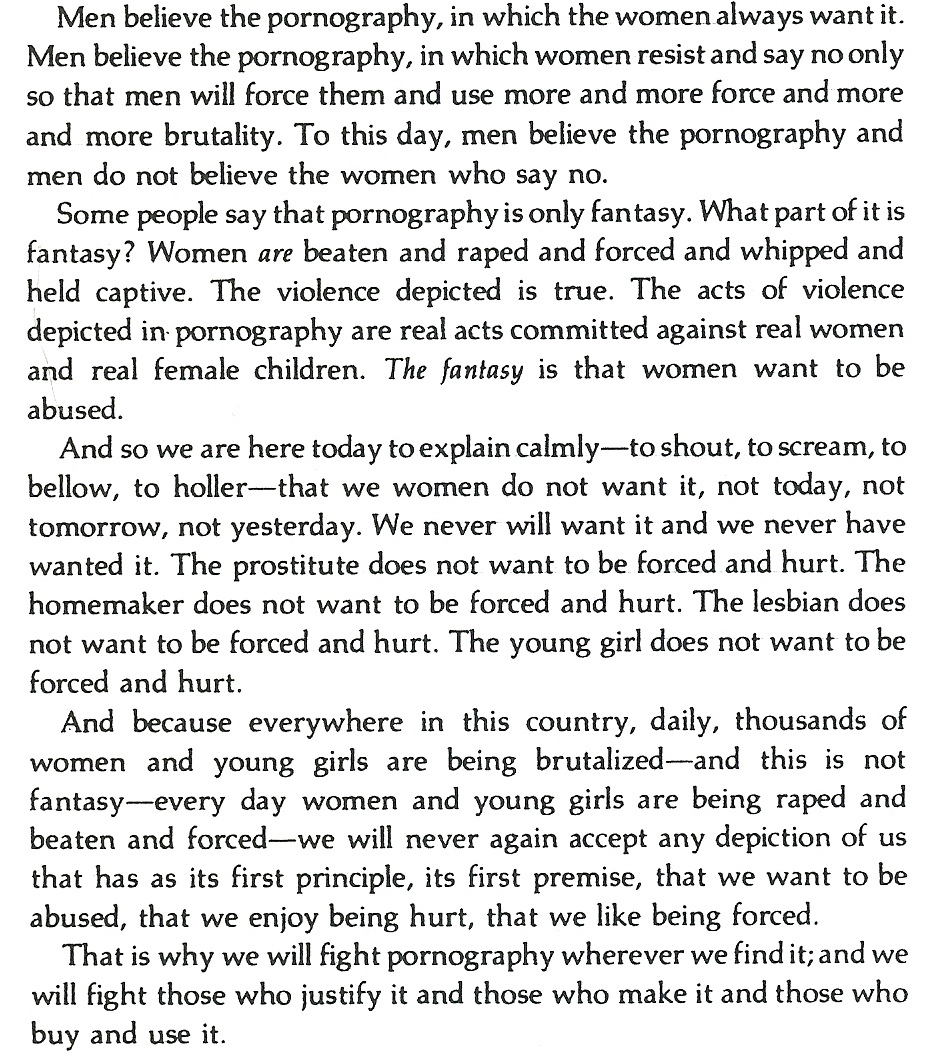
-‘The Lie,’ Andrea Dworkin. 1979. Letters From A War Zone, 1993.











 bleatmop
 Mystro
 The Arbourist


 Dead Wild Roses
Your opinions…