
You are currently browsing the category archive for the ‘Education’ category.
Totalitarianism doesn’t always arrive with jackboots and slogans. Sometimes it comes wrapped in compassion, weaponizing language to divide citizens into moral castes of “the good” and “the guilty.” As James Lindsay warns, every ideology that builds itself on purging an “enemy” eventually devours its own believers. Today’s soft totalitarianism operates not through force, but through narrative warfare—using labels like “Maple MAGA” or “anti-equity” to silence dissent and enforce ideological purity.

The Totalitarian Mindset in Our Midst
The belief in any totalitarian system is that there is some ‘enemy’ that holds back society. Once that enemy is destroyed and purged, society will flourish, or so the cult belief goes.” —James Lindsay
The Endless Enemy
James Lindsay’s observation is not a history lesson it’s a warning. Totalitarian movements always begin with the conviction that society’s ills can be traced to a corrupt class of people who must be identified and eliminated.
The logic is seductively simple: If only the enemy were gone, we could be free. But when the promised harmony never arrives, the search for hidden enemies intensifies. The hunt becomes perpetual, the paranoia self-sustaining. Every failure is blamed on infiltration, every setback on the persistence of the impure.
This cycle of purification is as old as ideology itself, but today it is being revived in softer, subtler ways—through moralized language, social shaming, and bureaucratic enforcement of political conformity.
The New Form: Narrative Warfare
In modern liberal democracies, totalitarianism doesn’t need guns or gulags. It begins with words. The authoritarian project of the 21st century is linguistic—it manufactures enemies through labels, controls discourse through moral accusation, and demands conformity under the banner of compassion.
In Canada and across the West, we see this in the weaponization of language: “Maple MAGA,” “anti-equity,” “white adjacent,” “problematic.” These aren’t analytical categories; they’re *filters of suspicion.* Once the label sticks, a person’s character and arguments no longer matter. They are marked.
This dynamic is a form of narrative warfare—the use of moralized storytelling to delegitimize opponents and consolidate cultural power. It’s the precondition of soft totalitarianism: control the story, and you control reality.
Weaponized Intersectionality: A Framework for Division
One of the key delivery systems for this mentality is **weaponized intersectionality**. Originally coined by legal scholar Kimberlé Crenshaw to describe overlapping forms of discrimination, the concept has been repurposed into a political sorting mechanism—one that divides society into immutable identity classes of “oppressors” and “oppressed.”
|Tactic |How It Works| Effect on Society |
| Labeling & Name-Calling | Terms like “Maple MAGA,” “far-right,” or “white adjacent” pre-empt debate and morally quarantine dissent. | Delegitimizes citizens instead of arguments; silences conversation. |
| Moral Purity Tests | Demands that allies demonstrate constant ideological conformity (“anti-racist,” “affirming,” “decolonized”). | Creates fear of speaking or questioning; enforces orthodoxy. |
| Institutional Capture | Activist vocabulary embedded in policy, HR, and education under “diversity” and “equity” mandates. | Bureaucratizes ideology; punishes dissent within organizations. |
| Perpetual Enemy-Hunting| “Privilege” and “bias” are re-discovered endlessly; the enemy is never gone, only hiding. | Normalizes suspicion; sustains revolutionary fervor without end. |
Each tactic reinforces the other. Together, they recreate the same cycle Lindsay describes: a social order sustained by perpetual purification.
The enemy is not gone; it is merely “in hiding.”
The Moral Mechanics of Control
Modern totalitarianism thrives on moral certainty rather than state terror. It convinces ordinary citizens that they are participating in justice, not oppression. To question the narrative is to expose oneself as suspect, and so the culture of fear spreads horizontally—through HR departments, social media platforms, and educational institutions.
This is how freedom erodes without a coup or revolution: through social coercion disguised as moral progress.
The power lies not in force, but in the internalization of guilt and fear. People censor themselves before anyone else has to.
What We Can Do About It
1. Recenter Universal Principles
Defend equality before the law, free inquiry, and human dignity—not inherited guilt or group virtue. Anchor civic life in the moral universals that totalitarian ideologies deny.
2. Name the Dynamic
When faced with ideological bullying, describe what’s happening: *“This is an attempt to morally disqualify rather than discuss.”* Naming the tactic exposes the manipulation and halts its momentum.
3. Build Parallel Forums for Open Debate
Create independent media, civic associations, and discussion circles where disagreement is respected. The antidote to coercion is community.
4. Refuse the Language of Division
Reject slurs and invented terms designed to fragment society. Language is not neutral—it’s the primary weapon of soft authoritarianism. Don’t wield theirs.
5. Practice Moral Courage
The first act of resistance is speech. Speak calmly, truthfully, and consistently—even when it’s uncomfortable. Silence is the oxygen of control.
Conclusion: The Old Lie in a New Form
Totalitarianism does not march under the same banners it once did. It arrives softly, wrapped in moral rhetoric and bureaucratic language, persuading good people that they are fighting for justice. But as Lindsay warns, every ideology that builds itself on purging an enemy eventually devours its own believers.
The only true defense is to reclaim our shared humanity—to judge one another by deeds, not descent; by actions, not affiliations. Freedom, as it turns out, depends not on the absence of enemies, but on the courage to refuse the hunt.
—
References
Lindsay, J. (2025, October 9). Why totalitarianism always produces mass murders. [Tweet]. X (Twitter). [https://x.com/ConceptualJames/status/1976724498213667156](https://x.com/ConceptualJames/status/1976724498213667156)
Crenshaw, K. (1989). Demarginalizing the Intersection of Race and Sex: A Black Feminist Critique of Antidiscrimination Doctrine, Feminist Theory and Antiracist Politics. University of Chicago Legal Forum.
Orwell, G. (1946). Politics and the English Language.
Arendt, H. (1963). Eichmann in Jerusalem: A Report on the Banality of Evil.
Popper, K. (1945). The Open Society and Its Enemies.
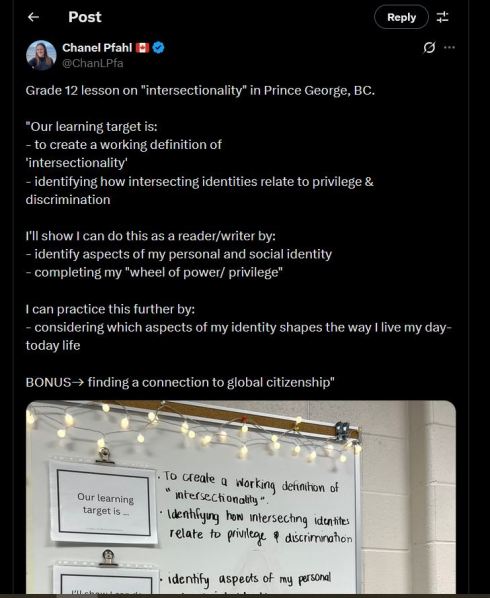
In Prince George, British Columbia, Grade 12 students were recently asked to “map their identities” on a wheel of power and privilege and define how overlapping traits like race, gender, and class shape their lives. The exercise was meant to foster empathy. Instead, it taught students to see themselves—and one another—through a hierarchy of guilt and grievance.
This is intersectionality in action. Coined by legal scholar Kimberlé Crenshaw in 1989, the theory originally sought to highlight how overlapping identities could compound discrimination. But in today’s classrooms, HR seminars, and activist spaces, intersectionality has evolved into something more aggressive: a political sorting tool that assigns moral value based on group identity rather than personal conduct. When used this way, it becomes weaponized intersectionality.
1. Define It Precisely
When arguing against it, start by defining intersectionality clearly. Don’t caricature it. Acknowledge its original intent—understanding overlapping forms of discrimination—but distinguish that from its modern mutation, which treats identity as destiny. This makes your critique credible and inoculates against claims of ignorance or bad faith.
2. Expose the Hidden Premise
Weaponized intersectionality rests on a simple but flawed assumption: that all disparities are the result of oppression and that moral authority flows from victimhood. Challenge that premise. Inequality does not always mean injustice. Lived experience matters, but it does not override evidence or reason.
3. Defend Universalism
Reassert the Enlightenment principle that all individuals possess equal moral worth regardless of group identity. Intersectionality divides by assigning virtue or guilt to immutable traits; universalism unites by judging actions, not ancestry. This is not denial of injustice—it’s the precondition for solving it.
4. Point Out Its Social Effects
Weaponized intersectionality erodes solidarity. It breeds resentment, teaching students and citizens alike to view each other as oppressors or oppressed. Even some leftist thinkers, like Nancy Fraser, have warned that intersectionality replaces economic analysis with “cultural essentialism,” fracturing potential alliances for real reform.
5. Offer a Better Vision
Don’t just oppose—propose. Replace identity grids with human rights frameworks. Discuss shared values such as dignity, equality before the law, and freedom of conscience. These ideas have lifted more people from oppression than any taxonomy of privilege ever could.
The Prince George lesson shows what happens when ideology replaces education: empathy becomes accusation, and learning becomes confession. Weaponized intersectionality promises justice but delivers division. The antidote is not denial of difference but defense of common humanity—an argument every student deserves to hear.
In the context of Alberta’s recent teacher strike, which began on October 6, 2025, following the rejection of a government contract offer, a pertinent question arises. The offer included a 12 percent wage increase for teachers over four years. Rather than applying this raise, what if the equivalent funds were allocated to hire additional educational assistants? Such a reallocation could address classroom support needs directly. This analysis relies on publicly available data to compute the potential impact, prioritizing transparency in figures and assumptions.
Alberta’s education system employs 51,000 teachers under the Alberta Teachers’ Association. Their average annual salary is $85,523. This results in a total annual payroll of approximately $4.36 billion. Implementing a 12 percent increase would add roughly $523 million to this payroll each year, once fully phased in, based on the offer’s structure.
Educational assistants in Alberta earn an average of $33,811 per year. If the $523 million earmarked for the teacher raise were instead used for hiring these support staff, it could fund approximately 15,480 new positions. This figure assumes full-time roles with comparable benefits and no significant overhead variances, focusing on direct salary costs.
This hypothetical redirection highlights trade-offs in education funding. While teachers seek compensation adjustments amid rising class sizes and workloads, bolstering assistant roles could alleviate immediate pressures in classrooms. The calculation underscores the scale of resources involved, inviting scrutiny of priorities in public spending.
Sources and Methodology
To ensure reproducibility, below are the key sources and the step-by-step mathematics used. All data points are drawn from recent, credible reports as of October 2025, with links provided for verification.

Key Data Sources
– Number of teachers: 51,000, from CBC News coverage of the strike (https://www.cbc.ca/news/canada/calgary/calgary-alberta-teacher-labour-strike-monday-1.7650856). Corroborated by Human Capital Magazine (https://www.hcamag.com/ca/specialization/industrial-relations/largest-labour-walkout-ever-51000-alberta-teachers-hold-strike/552206) and Calgary Herald (https://calgaryherald.com/news/politics/potential-teacher-strike-results-vote-tentative-deal-province).
– Average teacher salary: $85,523 annually, from Alberta’s Labour Information Service (ALIS) wage survey (https://alis.alberta.ca/occinfo/wages-and-salaries-in-alberta/elementary-school-and-kindergarten-teachers/41221/). Supported by Statistics Canada data (https://www150.statcan.gc.ca/t1/tbl1/en/tv.action?pid=3710024301).
– Wage increase details: 12 percent over four years (structured as 3 percent annual), from CBC News (https://www.cbc.ca/news/canada/edmonton/alberta-teachers-strike-lockout-questions-9.6934129) and Alberta Teachers’ Association announcement (https://teachers.ab.ca/news/teacher-strike-imminent). Additional context from Canadian Taxpayers Federation (https://www.taxpayer.com/newsroom/alberta-teachers-should-be-ready-for-a-long-strike).
– Average educational assistant salary: $33,811 annually, from ALIS (https://alis.alberta.ca/occinfo/occupations-in-alberta/occupation-profiles/educational-assistant/). Hourly equivalent of $24.53 from the same source (https://alis.alberta.ca/occinfo/wages-and-salaries-in-alberta/elementary-and-secondary-school-teacher-assistants/43100/).
Step-by-Step Calculations
1. Total teacher payroll: Number of teachers × Average salary = 51,000 × $85,523 = $4,361,673,000.
2. Cost of 12 percent increase: 0.12 × $4,361,673,000 = $523,400,760 (annualized, post-phasing).
3. Number of educational assistants fundable: Increase amount ÷ Average EA salary = $523,400,760 ÷ $33,811 ≈ 15,480 (rounded to nearest 10 for practicality).
These steps assume the increase represents a permanent uplift in payroll costs. Variations could occur if considering phased implementation or additional factors like benefits (typically 20-30 percent of salary), but the core estimate holds for illustrative purposes. Readers are encouraged to cross-check with primary sources for any updates.
Found on X here.
Intersectionality in the Classroom: From Empathy to Indoctrination
Intersectionality, a framework coined by legal scholar Kimberlé Crenshaw in 1989, purports to illuminate how overlapping social categories such as race, gender, class, and sexuality compound experiences of discrimination or privilege. Emerging from Crenshaw’s analysis of Black women’s marginalization within both feminist and civil rights discourses, the term has since evolved into a pervasive lens for examining interlocking systems of power.
In a recent Grade 12 lesson plan from Prince George, British Columbia, students are tasked with crafting personal definitions of intersectionality, mapping their identities onto a “wheel of power/privilege,” and connecting these to daily life and global citizenship. This exercise, ostensibly designed to foster empathy, exemplifies how the theory infiltrates education—reducing multifaceted human experience to a grid of predetermined oppressions and advantages. Yet beneath its academic veneer lies a mechanism for sowing division, one that demands scrutiny for its role in perpetuating grievance over growth.
At its core, intersectionality falters by collapsing the rich tapestry of individual lives into rigid identity matrices, sidelining agency, character, and shared humanity in favor of immutable traits assigned at birth. By framing privilege as an unearned inheritance tied to one’s position on the proverbial wheel, the framework risks breeding resentment among students, who learn to view peers not as collaborators but as bearers of systemic guilt. Empirical observations from social movements underscore this fragmentation: alliances crumble when identity eclipses common purpose, as seen in fractured coalitions where tactical solidarity yields to performative purity tests.
Even within leftist traditions, critics decry how intersectionality dilutes rigorous economic analysis into cultural essentialism, obscuring material inequities under a haze of subjective hierarchies. Far from empowering, this lesson in Prince George transforms the classroom into a theater of suspicion—where adolescents dissect their “intersecting identities” not to build resilience but to catalog wounds, fostering a generation primed for perpetual victimhood rather than principled action.
This pedagogical sleight of hand reveals intersectionality’s deeper allegiance to identity politics, a doctrine that elevates collective affiliation above individual merit and moral accountability. In the lesson’s directive to “identify aspects of my personal and social identity” relative to privilege, students are subtly coerced into prioritizing group-based narratives over personal narratives, echoing a broader cultural shift where loyalty to tribe trumps universal ethics. Such politics, by design, atomizes society into silos of grievance, undermining the Enlightenment ideal of judgment by deeds rather than descent.
The result is not enlightenment but alienation: white students branded as inherent oppressors, marginalized peers cast as eternal victims, all while the lesson’s “bonus” nod to global citizenship rings hollow amid the induced tribalism. Verifiable accounts from educators and observers confirm this corrosive effect, with classrooms devolving into echo chambers of accusation rather than forums for frank exchange.
Worse still, intersectionality’s Marxist undercurrents betray its origins in class warfare, merely repackaging economic antagonism as identitarian strife to sustain endless conflict without resolution. Drawing from dialectical materialism’s emphasis on oppositional forces, the theory substitutes proletariat–bourgeois divides with fluid yet perpetually clashing identity classes—oppressors versus oppressed—fueling a zero-sum battle that mirrors historical agitprop but swaps factories for feelings. Critics within the Marxist canon itself lament this dilution, arguing it retreats from revolutionary class consciousness into liberal fragmentation, where cultural skirmishes supplant systemic overhaul.
In the Prince George curriculum, this manifests as students pondering how their “wheel” positions them in global hierarchies, unwittingly internalizing a narrative of inevitable clash that excuses inaction while justifying radicalism. By promoting such identitarian discord, intersectionality does not liberate; it entrenches a spectral class war, audible in its echoes from the Frankfurt School to contemporary campus upheavals.
In place of this divisive doctrine, educators should pivot to a lesson grounded in universal human rights, drawing from the Enlightenment’s timeless assertion of equality before the law irrespective of ascribed identities. Students might begin by studying the Universal Declaration of Human Rights (1948)—articulating core tenets like dignity and non-discrimination—and then apply them to case studies that transcend identity silos. Group debates could explore how these rights galvanize cooperation in pluralistic societies, extending into civic duties such as community service that bridge divides through shared endeavor.
This alternative, far from ignoring inequities, confronts them through aspirational universality, fostering citizens equipped for concord rather than combat. By centering verifiable principles over subjective grids, such a curriculum honors truth’s pursuit, arming youth against narrative warfare with the unyielding shield of human solidarity.
References
- Crenshaw, Kimberlé. “Demarginalizing the Intersection of Race and Sex.” University of Chicago Legal Forum 1989(1): 139–167.
— Foundational essay introducing intersectionality in the context of Black women’s employment discrimination cases. - Crenshaw, Kimberlé. “Mapping the Margins: Intersectionality, Identity Politics, and Violence against Women of Color.” Stanford Law Review 43, no. 6 (1991): 1241–1299.
— Expanded articulation of intersectional theory applied to social and legal contexts. - Bell, Daniel. The Cultural Contradictions of Capitalism. New York: Basic Books, 1976.
— Influential analysis of how ideological movements replace class analysis with cultural moralism. - Fraser, Nancy. “From Redistribution to Recognition? Dilemmas of Justice in a ‘Post-Socialist’ Age.” New Left Review 212 (1995): 68–93.
— A left-wing critique of intersectionality’s turn toward identity over material class structures. - Marcuse, Herbert. One-Dimensional Man. Boston: Beacon Press, 1964.
— Core Frankfurt School text examining how ideology replaces substantive rationality; relevant to intersectionality’s theoretical lineage. - United Nations. Universal Declaration of Human Rights. Adopted December 10, 1948.
— Primary document grounding an alternative civic and moral education in universalism rather than identity determinism. - Lilla, Mark. The Once and Future Liberal: After Identity Politics. New York: Harper, 2017.
— Liberal critique of identity politics and its corrosive impact on civic cohesion.
The Alberta government’s proposed deal to the Alberta Teachers’ Association included a 12% wage increase over four years plus a pledge to hire 3,000 new teachers over three years — a headline framework intended to relieve classroom strain and show fiscal generosity. However, the ATA and its membership balked. In their view, the offer fails to guarantee what matters most: enforceable class-size caps, protections against classroom complexity, and compensation that truly restores lost purchasing power. The tentative agreement was rejected overwhelmingly, with 89.5% voting against it, triggering an imminent strike.
The core of the disagreement lies not only in dollars, but in mechanism versus promise. The government’s hiring numbers are political commitments that can be undermined by retirements, attrition, or enrollment growth — they are not a contractually binding solution to class overload. Meanwhile, teachers argue that compensation must do more than rise nominally; it must reverse years of wage erosion and inflationary decline in real earnings. Without structural reforms baked into the contract, the 12% headline looks insufficient to many in the profession.
Below is a snapshot of key terms and where the parties diverge:
| Item | Government Offer (Reported) | ATA Position / Counter-Priority |
|---|---|---|
| Wage increase | 12% over 4 years | Restoration of lost purchasing power; 12% deemed insufficient |
| Staffing | Hire 3,000 new teachers over 3 years | Enforceable class-size caps / meaningful workload limits |
| Other supports | Strike supports (childcare, tutoring), minor add-ons | Retention incentives, support for complex classrooms, early career retention |
Sources:
- ATA press: Teacher strike imminent; tentative agreement rejected (teachers.ab.ca)
- Global News: analysis of government offer and ATA reaction (globalnews.ca)
- Calgary CityNews: reporting on strike mitigation measures and negotiation context (calgary.citynews.ca)
In a recent post, I criticized Orange Shirt Day as a ritualized form of national self-loathing. That critique stands — but I have to admit I fell into a trap myself: I repeated elements of the story of Phyllis Webstad without checking the details.
Her now-famous account is that, as a six-year-old, she was sent to St. Joseph’s Mission, where her brand-new orange shirt was taken away on her first day. That image — the innocent child stripped of her identity by cruel authority — became the symbolic foundation of Orange Shirt Day and, in turn, the National Day for Truth and Reconciliation. It is powerful. It moves people. It creates policy.
But is it literally true in every detail? The answer is murkier than most Canadians are led to believe. Critics such as Rodney Clifton, a former residential school worker and researcher, have pointed out that Webstad attended St. Joseph’s when it was functioning as a student residence — not a traditional residential school — and that she attended public school in Williams Lake. Others note that staff were often Indigenous lay workers rather than the stereotypical “nuns with scissors.” Even Webstad herself has described that year as one of her “fondest memories,” a detail that vanishes from the public retelling.
In other words: the story has been simplified, polished, and repeated until it no longer represents the whole truth. This is how narratives work. They take a fragment of reality and expand it into myth — and then the myth becomes untouchable. Questioning it, or even pointing out inconsistencies, can make one a “denier” or a “deplorable.”
That is the lesson here. I fell for the narrative too, because it was convenient. It had emotional force. It seemed to explain everything at a glance. But truth — especially historical truth — is rarely that neat.
If Canadians want real reconciliation, it has to be based on facts, not fables. We do Indigenous people no favors by sanctifying selective memories while ignoring the messy, complicated realities of reserve life, family breakdown, and the mixed legacy of institutions like St. Joseph’s. Nor do we honor our own country by allowing symbolic stories to become instruments of guilt rather than prompts for genuine understanding.
References
-
Orange Shirt Society: Phyllis’ Story — orangeshirtday.org
-
Rodney Clifton, They Would Call Me a ‘Denier’ — C2C Journal
- UBC Indian Residential School History and Dialogue Centre, About Orange Shirt Day — irshdc.ubc.ca
- Troy Media, Clifton & Rubenstein, The Truth behind Canada’s Indian Residential Schools — troymedia.com
The Parkland Institute’s report on “parental rights” is heavily ideologically slanted. It repeatedly frames parental involvement as a threat to children’s well-being, assumes bad faith on the part of parents and policymakers, and cherry-picks anecdotes—often from the U.S.—while ignoring Canadian legal frameworks that balance children’s rights with parental guidance. It conflates routine educational transparency with medical care access, overstating risks to vulnerable youth. Below, we break down the report’s claims and set the record straight.
1. Claim: “‘Parental rights’ is being deployed to justify legislative changes that restrict inclusive practices…” (p. 4)
Refutation: Alberta’s amendments require parental notification and opt-in consent only for instruction mainly and explicitly about gender identity, sexual orientation, or human sexuality. Incidental references are not covered, maintaining inclusivity while respecting parental involvement.
2. Claim: “These measures… often override children’s rights and ignore the perspectives of supportive parents…” (p. 5)
Refutation: Canadian law balances children’s rights with parental guidance. Alberta’s policy aligns with this principle, ensuring parental engagement without undermining children’s rights.
3. Claim: “Conservatives generally disagree… that children may have rights independent of what their parents may decide is best for them.” (p. 7)
Refutation: This overgeneralizes. Canadian legal frameworks, including the mature minor doctrine, recognize children’s rights independent of parental decisions.
4. Claim: “Such framing of parental rights… is a clear threat to the rights of vulnerable children.” (p. 6)
Refutation: The policy actually protects children by ensuring parents are informed and involved. Presenting it as a “clear threat” ignores the benefits of parental engagement and legal safeguards.
5. Claim: “Parental opt-in for instruction on gender and sexuality… curtailing access to gender-affirming care for transgender children and youth.” (p. 8)
Refutation: Educational policies do not regulate medical care. Access to gender-affirming care is governed by healthcare policy, not school curricula.
6. Claim: “Conservative governments… moved to enshrine a conservative view of ‘parental rights’ in law.” (p. 9)
Refutation: Alberta’s changes are procedural—requiring notice and opt-in—not ideological. The policy simply formalizes parental involvement in education.
7. Claim: “Parents angered by the government overriding their right to support their children’s access to gender-affirming health care.” (p. 8)
Refutation: This conflates education with healthcare. Alberta’s educational policy does not interfere with parental involvement in medical decisions.
8. Claim: “Complaints [about school library materials] actually came from [advocacy groups]… familiar to anyone who has been following… Moms for Liberty’s attacks on books.” (p. 10)
Refutation: Advocacy group involvement doesn’t negate the legitimacy of parental concerns about content. The policy ensures parents are informed, regardless of who raises issues.
9. Claim: “The law… does not give parents the right to override their children’s rights.” (p. 11)
Refutation: True, but incomplete. Canadian law emphasizes balance. Parents still play a key role in guiding their children, especially regarding sensitive educational content.
10. Claim: “Public education… beset by moral panics and wedge issues.” (p. 12)
Refutation: Labeling legitimate parental concerns as “moral panic” is dismissive. The policy simply promotes transparency and communication between schools and families.
Bottom line: The Parkland report is ideologically driven, cherry-picks anecdotes, and overstates risks while ignoring Canadian law and the benefits of parental engagement. Alberta’s policy seeks balance, transparency, and respect for both parental and children’s rights—exactly what a fair, neutral approach should do.

References
- Parkland Institute Report: Challenging ‘Parental Rights’: A Primer for Parents, Students, Educators, and Advocates
- Alberta Education Act Amendments: Supporting Alberta Students and Families
- Parental Rights in Education: What are the legal rights of parents to be notified and opt-in for instruction?
- Children’s Rights in Canada: Rights of children
- Children’s Participation Rights: Review of Children’s Participatory Rights in Canada











 bleatmop
 Mystro
 The Arbourist


 Dead Wild Roses
Your opinions…