
You are currently browsing the tag archive for the ‘Abortion’ tag.
I think the anti-choicer’s irony meters broke when confronted with the reality of their bloodthirsty sky daddy.
The always controversial religious antagonist is back with another video displaying putrefaction known as religious morality.

Sorry, god mandates a needless death for you, have a nice day...
The story is almost always the same. Worship the christian-sky daddy and women become second class citizens who get to die because ‘abortion is a sin’. In the video the dude from the ‘health department’ mentions the moral and ethical nature of there society. Letting women die because of lack of access to reproductive services is hardly fraking ethical behaviour. I suggest to him that he untwist his head out of Jebus’s asshole and start putting together a health program that respects women and their bodily autonomy as opposed to the heavenly ooga-booga in the sky.
Although abortions are strictly illegal in the Philippines, the medical procedure to terminate pregnancy flourishes in underground clinics.
Given their illegal and unregulated nature, risky procedures are often followed at the clinics, endangering lives.
According to the US-based Centre for Reproductive Rights, more than half a million women risk their lives annually by undergoing backstreet abortions. Out of them, about 1,000 die each year.
Sometimes there is a absence of reasonable discussion when it comes to the topic of abortion. The lack of solid empirical grounding for arguments leads to some rather wild and wooly debates. The Guttmacher institute has a new section called “Are you in the Know?” about women’s health and abortion.
 Safer than childbirth, funny you never hear the anti-choice loons mention this fun little fact.
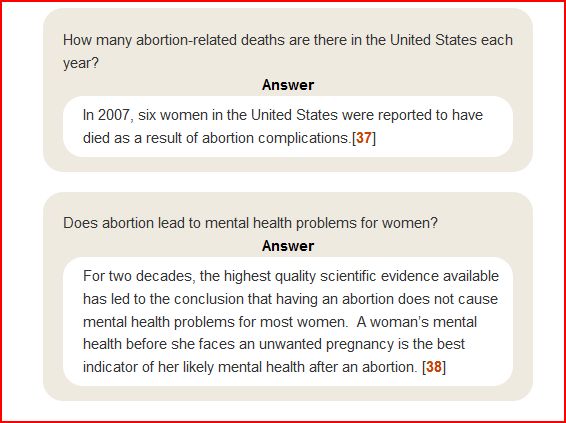 The scare tactics anti-choicer nutters usually resort to include the specious post abortion syndrome and other such nonsense. Cherry picking facts is nothing new for the fetus fetish crowd as their crusade against women has little time for intellectual honesty.

Social Conservatism on Display
The pro-life position is riddled with contradiction –
Republican Rep. Larry Pittman, who was appointed to the District 82 House seat in October, expressed his views in an email sent Wednesday to every member of the General Assembly. […]
“We need to make the death penalty a real deterrent again by actually carrying it out. Every appeal that can be made should have to be made at one time, not in a serial manner,” Pittman wrote in the email. “If murderers (and I would include abortionists, rapists, and kidnappers, as well) are actually executed, it will at least have the deterrent effect upon them. For my money, we should go back to public hangings, which would be more of a deterrent to others, as well.”
Wow, lets stop the taking of life by well… murder by the state which is okay if its adult but not okay if happens to be inside someone’s body at the time. But of course, inconsistency is the hallmark of socially conservative thinking so we should, by now, be unsurprised by little gems shat out by the likes of Larry Pittman.
The pace is accelerating at which a woman’s right to choose is being taken away from her. The US is going crazy, one state at a time, the Guttmacher Institute documents the slide into insanity.
“January 5, 2012
By almost any measure, issues related to reproductive health and rights at the state level received unprecedented attention in 2011. In the 50 states combined, legislators introduced more than 1,100 reproductive health and rights-related provisions, a sharp increase from the 950 introduced in 2010. By year’s end, 135 of these provisions had been enacted in 36 states, an increase from the 89 enacted in 2010 and the 77 enacted in 2009. (Note: This analysis refers to reproductive health and rights-related “provisions,” rather than bills or laws, since bills introduced and eventually enacted in the states contain multiple relevant provisions.)
Fully 68% of these new provisions—92 in 24 states—-restrict access to abortion services, a striking increase from last year, when 26% of new provisions restricted abortion. The 92 new abortion restrictions enacted in 2011 shattered the previous record of 34 adopted in 2005.

- For the complete review of state level actions in 2011 click here.
- For summaries of major state-level actions in 2011, click here.
- For a table showing reproductive health and rights-related provisions enacted in 2011, click here.
- For the status of state law and policy on key reproductive health and rights issues, click here.
Abortion Restrictions Took Many Forms
Bans. The most high-profile state-level abortion debate of 2011 took place in Mississippi, where voters rejected the ballot initiative that would have legally defined a human embryo as a person “from the moment of fertilization,” setting the stage to ban all abortions and, potentially, most hormonal contraceptive methods in the state. Meanwhile, five states (AL, ID, IN, KS and OK) enacted provisions to ban abortion at or beyond 20 weeks’ gestation, based on the spurious assertion that a fetus can feel pain at that point. These five states join Nebraska, which adopted a ban on abortions after 20 weeks in 2010 (see State Policies on Later Abortions). A similar limitation was vetoed by Minnesota Gov. Mark Dayton (D).
Waiting Periods. Three states adopted waiting period requirements for a woman seeking an abortion. In the most egregious of the waiting-period provisions, a new South Dakota law would have required a woman to obtain pre-abortion counseling in person at the abortion facility at least 72 hours prior to the procedure; it would also have required her to visit a state-approved crisis pregnancy center during that 72-hour interval. The law was quickly enjoined in federal district court and is not in effect. A new provision in Texas requires that women who live less than 100 miles from an abortion provider obtain counseling in person at the facility at least 24 hours in advance. Finally, new provisions in North Carolina require counseling at least 24 hours prior to the procedure. With the addition of new requirements in Texas and North Carolina, 26 states mandate that a woman seeking an abortion must wait a prescribed period of time between the counseling and the procedure (see Counseling and Waiting Periods for Abortion).
Ultrasound. Five states adopted provisions mandating that a woman obtain an ultrasound prior to having an abortion. The two most stringent provisions were adopted in North Carolina and Texas and were immediately enjoined by federal district courts. Both of these restrictions would have required the provider to show and describe the image to the woman. The other three new provisions (in AZ, FL and KS), all of which are in effect, require the abortion provider to offer the woman the opportunity to view the image or listen to a verbal description of it. These new restrictions bring to six the number of states that mandate the performance of an ultrasound prior to an abortion (see Requirements for Ultrasound).
Insurance Coverage. Kansas, Nebraska, Oklahoma and Utah adopted provisions prohibiting all insurance policies in the state from covering abortion except in cases of life endangerment; they all permit individuals to purchase additional coverage at their own expense. These new restrictions bring to eight the number of states limiting abortion coverage in all private insurance plans (see Restricting Insurance Coverage of Abortion).
These four provisions also apply to coverage purchased through the insurance exchanges that will be established as part of the implementation of health care reform. Five additional states (FL, ID, IN, OH and VA) adopted requirements that apply only to coverage purchased on the exchange. The addition of these nine states brings to 16 the number of states restricting abortion coverage available through state insurance exchanges.
 Clinic Regulations. Four states enacted provisions directing the state department of health to issue regulations governing facilities and physicians’ offices that provide abortion services. A new provision in Virginia requires a facility providing at least five abortions per month to meet the requirements for a hospital in the state. New requirements in Kansas, Pennsylvania and Utah direct the health agency to develop standards for abortion providers, including requirements for staffing, physical plant, equipment and emergency supplies; supporters of the measures made it clear that the goal was to set standards that would be difficult, if not impossible, for abortion providers to meet. Enforcement of the proposed Kansas regulations has been enjoined by a state court.
Medication Abortion. In 2011, states for the first time moved to limit provision of medication abortion by prohibiting the use of telemedicine. Seven states (AZ, KS, NE, ND, OK, SD and TN) adopted provisions requiring that the physician prescribing the medication be in the same room as the patient (see Medication Abortion).
Family Planning Under Pressure
Family planning services and providers were especially hard-pressed in 2011, facing significant cuts to funding levels, as well as attempts to disqualify some providers for funding because of their association with abortion. Considering the historic fiscal crises facing many states, it is significant that family planning escaped major reductions in nine (CO, CT, DE, IL, KS, MA, ME, NY and PA)of the 18 states where the budget has a specific line-item for family planning. The story, however, was different in the remaining nine states. In six (FL, GA, MI, MN, WA and WI), family planning programs sustained deep cuts, although generally in line with decreases adopted for other health programs. In the other three states, however, the cuts to family planning funding were disproportionate to those to other health programs: Montana eliminated the family planning line item, and New Hampshire and Texas cut funding by 57% and 66%, respectively.
Indiana, Colorado, Ohio, North Carolina Texas and Wisconsin, meanwhile, moved to disqualify or otherwise bar certain types of providers from the receipt of family planning funds. New Hampshire decided not to renew its contract through which the Planned Parenthood affiliate in the state received Title X funds.
Given the difficult fiscal and political climate in states in 2011, it is especially noteworthy that Maryland, Washington and Ohio took steps to expand Medicaid eligibility for family planning. With the approval of these two programs, 24 states have expanded eligibility for family planning under Medicaid based solely on income; seven have utilized the new authority under health care reform (see Medicaid Family Planning Eligibility Expansions).
Abstinence-Only Education Is Back
Unlike in recent years when states had moved to expand access to comprehensive, medically accurate sex education, the only relevant measures enacted in 2011 expanded abstinence education. Mississippi, which had long mandated abstinence education, adopted provisions that make it more difficult for a school district to include other subjects, such as contraception, in order to offer a more comprehensive curriculum. A district will now need to get specific permission to do so from the state department of education. A new requirement enacted in North Dakota mandates that the health education provided in the state include information on the benefits of abstinence “until and within marriage.” Including North Dakota, 37 states now mandate abstinence education (see Sex and HIV Education).
Sexually Transmitted Infections
Over the course of 2011, three states adopted provisions permitting a health care provider to prescribe STI treatment to the partner of a patient, even if he or she has not been seen by the provider. (see Partner Treatment for STIs).”
 Our friends who live on the East coast seem to be clinging to a few anachronistic views about the autonomy of women and the spectrum of choice that should be available to them when it comes to reproductive services.
“Even though it’s a legal medical procedure, P.E.I. remains the only province where abortion services are not offered locally.”
The general notion is that because P.E.I is so darn small some medical procedures necessitate a trip out of province.
Doug Currie the Health Minister says: “There are many services that are currently not available on P.E.I. that Islanders do have to travel off Island for. Unfortunately, due to our limited resources here on P.E.I., being a small province, being a small population, there is just so much money to go around.”
Well Doug, I think it might be time to add one more service to list, call it expanding the economy or increasing your governments commitment to the people but let’s get all of Canada up to speed on its offerings of health and medical services.
Patriarchy offers so many yummy selections of shit sandwich for women. Rape culture, sexism, inequality are hallmarks of the patriarchal construction of our society. The implicit nature of Western patriarchal norms have nothing on what is going on in cultures where said norms are firmly entrenched in the bedrock of society. Modern medical technology coupled with ‘traditional’ societies views on women make female lives even more tenuous.
 “Dr Neelam Singh is on the front line of India’s battle to save its girls.
Modern medical technology – specifically ultrasounds for determining the baby’s sex – coupled with ancient cultural values which give preference to boys, mean that hundreds of thousands of girls are never being born.
There were only 914 girls for every 1,000 boys under the age of six in India, according to the 2011 census, compared with 927 for every 1,000 boys in the 2001 census. Today’s ratio is the highest imbalance since the country won independence in 1947.
“I feel the demand [for abortions] every day,” Singh told Al Jazeera. “Parents say it’s important to have a son in the family. They want to keep their family name. I see this as the most heinous kind of discrimination towards a girl child.”
Outdated customs coupled with new technology = death for women.
“In India, there is a confluence of factors leading to passive infanticide, active infanticide or sex selective abortion,” Valerie Hudson, a professor of political science at Brigham Young University who studies birth rates, told Al Jazeera.
“Probably the most important is the tradition of dowry [payment to a prospective husband]. Having to marry a girl off may be the equivalent of several years of income for a family. A daughter is often seen as a thief who will rob necessary resources.”
Restrictive property rules, where inheritance is passed from father to son rather than to daughters, male dominated funeral rights and parental hopes that male breadwinners will support them through old age also play a part in skewing demographics, Hudson said.
The world’s largest democracy still fares better than China, where the ratio is 121 men per 100 women. Globally, 163 million girls have gone “missing” from the world’s population due to sex selective abortions in the last thirty years, according to the calculations of Mara Hvistendahl, author of Unnatural Selection.
By 2020, an estimated 15 to 20 per cent of men in some regions of northwest India will lack female counterparts. “In Punjab, there are entire villages with no girls under [age] five,” said Rohini Prabha Pande, an independent demographer who works on gender issues in India. “There are some districts with 700 girls per 1,000 boys,” she told Al Jazeera.”
It is an ugly cycle as high sex ratio’s favour a more traditional society which in turn promotes less female children which raises the sex ratio. A destructive positive feedback patriarchal loop in action.
“These massive social imbalances could spark a host of social problems.
“When 15 per cent of young adult males in your population will never become head of household or heirs you will alienate these men in ways that cannot be fixed,” Hudson said. Poor men will be the biggest losers in this equation.
“The historical record shows there can be distinct negative impacts on levels of violent crime, riots and rebellion against the state,” when large groups of single young men are alienated and lack family commitments, according to Hudson.
The lack of women is being felt by bachelors, policy makers and women’s rights activists across Asia. By 2020, China could be home to 40 million bachelors who won’t be able to find mates.
“North Korea’s largest export is women across their northern border with China,” Hudson said, noting that the ruling  communist party is particularly worried about prospects for unrest from angry, unmarried men.”
Nothing like hoards of frustrated young men roaming about to stabilize your society.
“After India’s 1991 census, a prolonged campaign by women’s rights activists over the skewed child sex ratio led to the enactment of the Pre-Natal Diagnostic Techniques Act in 1994.
“Technology allowing families to detect the sex of a foetus at an early stage and plan for an abortion has been banned,” said Mohammed Asif, director of programme implementation with Plan India, an NGO which lobbies to save baby girls.
“The government’s law is stringent, but people have been trying to work around it, going to far away clinics and giving fake addresses. Loopholes have been exploited and a key strategy would be to take action against illegal ultra sound clinics,” Asif told Al Jazeera.
Other researchers don’t think legal changes are the best way to improve the situation. If cultural values discourage against having girls, families can find other ways of getting rid of them without advanced screening techniques.
“Ultra sound technology is just the latest wave to select a son preference,” Pande said. “In rural Uttar Pradesh and Bihar, you see a fairly balanced sex ratio at birth. But when you look at what is happening between birth and age six, they resort to traditional means of neglecting girl children. They are less likely to be immunised, less likely to be taken to a health centre and more likely to be chronically malnourished.”
When women lack autonomy and control of their bodies this sort of discriminate killing can happen as the norms of society trump their reproductive choices.
“Contrary to popular belief, education, status and upward mobility can actually make the problem worse.
“You have a much greater chance of survival as a girl baby if born to a poor family, rather than a rich family,” Hudson said. “Richer families have more assets which could be put in jeopardy by girls due to dowry payments,” she said, adding that wealthy groups worry about having their family name tarnished if their daughter marries from a lower class.
While national trends are cause for concern, the situation is improving in some areas. “Tamil Nadu is one of the few states where we have seen an improvement,” said Sharada Srinivasan, a professor of gender studies at York University in Canada.
In addition to counselling, and the creation of self-help groups for women, the southern state is using the carrot and the stick approach. “The government has created a massive cash transfer programme” to entice parents to keep baby girls, Srinivasan told Al Jazeera. Parents who commit infanticide are increasingly being prosecuted for homicide, she said.
Tamil Nadu also hosts some of India’s new outsourcing and information technology and these post-industrial jobs could improve women’s rights. “Before, women’s work was either at home or on the farm,” Plan India’s Asif said. “With globalisation, girls are now picking up jobs in banking, manufacturing and hi-tech. This is creating a lot of buzz in the family to start considering girls.”
While cash incentives, laws against gender selective ultrasounds, harsh punishments and economic changes all play a role, changing deeply ingrained social values is arguably the most important issue, and the most difficult.
Some communities in Punjab and elsewhere are taking collective pledges not to kill or abort girls, considering the practice a source of shame and an example of backwardness. This is where government policy ends and grassroots action begins.
“There is no way you can tax patriarchy,” Srinivasan said. “Public action has a role to play in changing social norms. History is full of examples of this.”
There are so many factors involved in the commodification of women. The dowry aspect, the class aspect, the inheritance aspect; all contribute toward the strengthening of the patriarchy and the continued abuse of women.
On a similar note, I’ve been down a similar road when discussion abortion with various anti-choice nutters over the years. This seems to be one of their examples they point to when they need example of how “evil” abortion is and all the human life lost. The skewed abortion rates in places like India and China are precisely that way because of the patriarchal rules that make women less than human. Consider that the quest for a male heir to carry on the family name and inheritance trumps any sort of choice/anti-choice discussion because it is not an issue: a male heir is required, end of discussion.
We do not hear about the oppressive nature of the society that perpetuates the sex selected abortions, oh no, it is usually just “They’re killing baaaaaaabies….” with no regard for the normative patriarchal precursors that set the stage for such a sad state of affairs.
(*update* – For a further breakdown on how the anti-choice gambit works, and how absurdly farcical it is, go to The Words on What.)

The only solution, treat women as fully autonomous human beings.











 bleatmop
 Mystro


 Dead Wild Roses
Your opinions…