
You are currently browsing the category archive for the ‘Culture’ category.
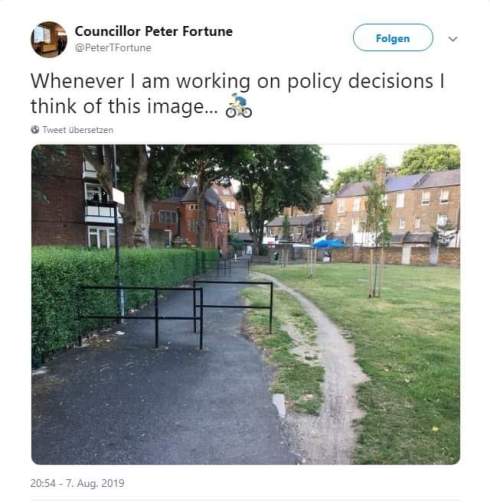
When designers try to overrule human incentives with a barricade, they don’t get obedience. They get a workaround. The meme Councillor Peter Fortune shared shows it in one frame: a paved bike path blocked by metal barriers, and a dirt trail worn smooth beside it where people simply go around. The joke lands because it’s familiar. The system “wins” on paper; the public wins in practice.
The lesson isn’t that people are bad. It’s that people optimize for time, effort, and friction. Put an obstacle in the shortest route and you don’t remove the desire to move—you relocate it. The new path brings second-order costs the designer pretended didn’t exist: erosion, muddier edges, conflicts between walkers and riders, and a steady drift from the “safe” route to the “usable” one. The dirt trail isn’t misbehavior. It’s feedback.
This is why public planning fails in a predictable way. Government systems are often built to defend the plan rather than learn from the result. Once concrete is poured, changing course becomes politically costly, procurement-heavy, and reputation-sensitive. So the incentive is to explain the barrier, not remove it, even when the public has already voted with their feet. You get infrastructure that looks orderly in a report and behaves disorderly in the world.
A competent planner doesn’t start by asking, “How do we force compliance?” They start by asking, “What will people do instead?” Then they design for that answer: align the official route with the desire line, reduce friction where it matters, and treat workarounds as data. Ignore that, and the meme becomes policy. The public routes around you, and you pay twice: once for the plan, and again for the consequences.
Western civilization, in its liberal form, rests on a remarkable set of principles: that religious belief should be voluntary, that individual conscience is sovereign, and that the rights of the person take precedence over both state and religious authority. These ideas are not universal human defaults; they are hard-won cultural and philosophical achievements, shaped by the Enlightenment, the Reformation, and centuries of political struggle. They are not shared equally by all religious or ideological systems.
Classical Islam, in its orthodox jurisprudential tradition, is not solely a private spiritual faith. It is also a comprehensive legal and political system (sharia) that historically integrated religious authority with governance. From its earliest centuries, Islam expanded through a combination of military conquest, trade, persuasion, and migration. While conquest played a significant role in some regions, conversion in others—such as Southeast Asia—was often gradual and voluntary. The fusion of religious and political authority remains influential in many interpretations, though its application varies widely across the Muslim world today.
One area of tension concerns apostasy. In traditional interpretations of several major schools of Islamic law, leaving the faith has been treated as a serious offense, sometimes punishable by death. This stands in contrast to the Western commitment to absolute freedom of belief and conscience. However, enforcement differs greatly: many Muslim-majority countries no longer prescribe capital punishment for apostasy alone, and reformist scholars argue that the Qur’an itself emphasizes no compulsion in religion (2:256) and that punishment should be deferred to the afterlife.Religious pluralism presents another challenge. Historical Islamic polities often extended protected status to Jews, Christians, and sometimes others (“People of the Book”), allowing communal autonomy in exchange for taxation (jizya) and certain restrictions. This system offered more tolerance than many contemporary societies of the time, yet it was hierarchical rather than egalitarian. Full equality before the law—a core Western principle—has not always been realized in states governed by traditional sharia interpretations, though modern reforms in countries such as Tunisia, Morocco, and the United Arab Emirates have moved toward greater legal equality.
The status of women reveals further differences. In some countries applying strict interpretations of sharia, women face legal and social restrictions on dress, travel, marriage, inheritance, and testimony. Recent examples include compulsory veiling enforcement in Iran and severe restrictions under Taliban rule in Afghanistan. These practices draw from certain classical readings of Qur’anic verses and hadith. At the same time, it is worth noting that seventh-century Islamic law granted women rights to inheritance, divorce, and property ownership that were progressive compared to many pre-modern societies. Today, women’s rights vary enormously across the Muslim world—from relatively egalitarian frameworks in Indonesia and Tunisia to highly restrictive ones elsewhere—and Muslim feminist scholars actively work to reinterpret texts in light of contemporary values of equality.These differences are not simply “extremist misinterpretations.” Many stem from longstanding and mainstream interpretations of sacred texts and tradition.
Yet Islam is not monolithic: it encompasses a spectrum of thought, from rigid literalism to progressive reformism, and interpretations evolve over time and place.None of this is an indictment of Muslims as individuals. Millions of Muslims live peacefully and prosperously in Western societies, often embracing liberal values while maintaining their faith. Their successful integration is made possible precisely because Western secular frameworks limit the political reach of any religion—protecting both believers and non-believers alike.Recognizing the genuine tensions between certain traditional interpretations of Islam and core principles of Western liberalism is not intolerance; it is intellectual honesty.
At the same time, acknowledging Islam’s internal diversity, historical context, and capacity for reform prevents sweeping generalizations. A mature conversation requires holding both truths: deep differences exist, yet dialogue, mutual accommodation, and individual freedom remain possible. A civilization that clearly understands its own founding principles—without either naivety or hostility—is best equipped to preserve them while extending hospitality to those who share its public square.

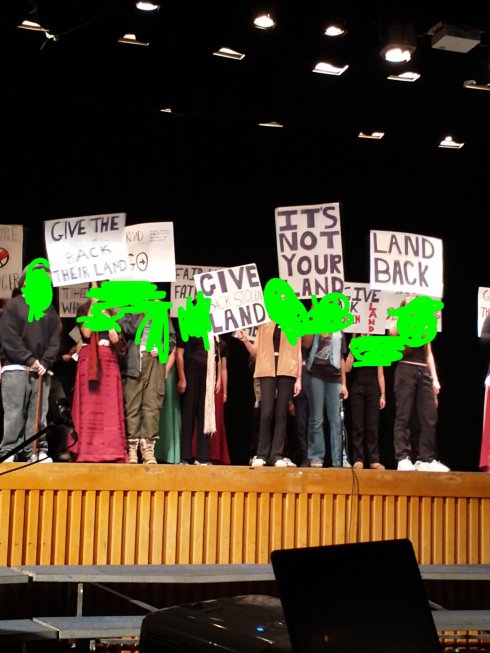
In recent years, Canadian public schools have increasingly incorporated political themes into extracurricular events, including winter concerts. A widely discussed example occurred at Karen Kain School of the Arts in Toronto, where Grade 8 students performed a skit during a December “winter concert” featuring protest‑style signs such as “Give Back Stolen Land” and “Land Back.” The performance replaced traditional seasonal programming with messaging aligned with the contemporary “Land Back” movement. While the intent may have been to highlight Indigenous history, the choice of format and venue raises important questions about the appropriate boundaries between education and activism in publicly funded schools.
To evaluate this incident fairly, it is essential to distinguish between curricular education—which is mandated, necessary, and valuable—and extracurricular political advocacy, which carries different expectations and responsibilities.
Ontario’s curriculum explicitly requires students to learn about Indigenous histories, treaties, residential schools, and the Truth and Reconciliation Commission’s Calls to Action. These topics are not optional; they are embedded in the Social Studies and History curriculum for Grades 1–8. Teaching them is not activism—it is education grounded in historical fact and national responsibility. When taught in the classroom, these subjects can be explored with nuance, context, and opportunities for critical thinking.
The issue at Karen Kain is not the subject matter itself, but the format and framing. A winter concert is traditionally a community‑building event: inclusive, celebratory, and accessible to families of all backgrounds. Parents attend expecting music, dance, or drama that reflects seasonal themes or showcases student creativity. Transforming such an event into a protest‑style performance shifts the purpose from celebration to advocacy. It also removes the pedagogical safeguards—balanced discussion, guided inquiry, and contextual explanation—that exist in the classroom.
The “Land Back” movement, while rooted in legitimate discussions about Indigenous rights and historical treaties, is also a politically contested movement with a wide range of interpretations and significant implications for land ownership, governance, and public policy. Presenting it through slogans and protest imagery, without space for analysis or alternative perspectives, risks conveying a single ideological stance rather than fostering informed understanding. For 13‑ and 14‑year‑old students, who are still developing the ability to evaluate complex political claims, this can blur the line between learning about a movement and being encouraged to endorse it.
This concern is not hypothetical. Surveys consistently show that many Canadian parents prefer schools to avoid pushing students toward political activism, even on causes they personally support. Parents generally want schools to prioritize academic learning, critical thinking, and balanced instruction rather than advocacy. When extracurricular events adopt activist framing, it can erode trust by making families feel blindsided or excluded from decisions about what messages their children are asked to perform publicly.
None of this means schools should avoid difficult topics or silence discussions of Indigenous rights. On the contrary, these subjects deserve thoughtful, rigorous treatment. But context matters. A winter concert is not the venue for dramatizing contested political movements. Doing so risks reducing complex issues to slogans, bypassing critical engagement, and placing students in the role of political actors rather than learners.
A healthier approach would preserve the distinction between education and advocacy. Teach Indigenous history thoroughly in the classroom, as the curriculum requires. Encourage students to analyze movements like Land Back with intellectual seriousness. But keep extracurricular performances focused on inclusive, community‑oriented themes that unite rather than divide.
By maintaining this boundary, schools can honour both their educational mission and their responsibility to provide neutral, welcoming environments for all families—ensuring that learning remains grounded in inquiry, not activism, and that public events remain spaces of shared celebration rather than ideological theatre.
References
Original Incident and Reporting
Pfahl, Chanel (@ChanLPfa). “A parent at the Toronto District School Board sent me these pictures from the ‘Winter Concert’…” X (formerly Twitter), 18 Dec. 2025. https://x.com/ChanLPfa/status/2001719861723173203
“Toronto Grade 8 students stage ‘Land Back’ protest at school ‘winter concert’.” Juno News, 19 Dec. 2025. https://www.junonews.com/p/toronto-grade-8-students-stage-land
Ontario Curriculum Requirements
Ontario Ministry of Education. “Indigenous Education in Ontario.” Government of Ontario, updated 2 Sept. 2025. https://www.ontario.ca/page/indigenous-education-ontario
“Indigenous history, culture now mandatory part of Ontario curriculum.” CBC News, 8 Nov. 2017. https://www.cbc.ca/news/indigenous/indigenous-history-culture-mandatory-ontario-curriculum-1.4393527
Context on the “Land Back” Movement
“The Indigenous ‘Land Back’ Movement: A Land Mine for Canadians.” C2C Journal, 28 Oct. 2024. https://c2cjournal.ca/2024/10/the-indigenous-land-back-movement-a-land-mine-for-canadians/
Parental Attitudes Toward Activism in Schools
Zwaagstra, Michael, and Alex MacPherson. “Canadian parents don’t want schools to push students into political activism.” Fraser Institute, 2024. https://www.fraserinstitute.org/commentary/canadian-parents-dont-want-schools-to-push-students-into-political-activism

On December 3, 2025, Calgary pastor Derek Reimer was arrested for breaching the conditions of his conditional sentence order after refusing to write a court-mandated letter of apology to a public library manager and members of the LGBTQ+ community. The apology stemmed from his earlier conviction for criminal harassment related to protests against Drag Queen Story Hour events at Calgary libraries in 2023, where he had confronted organizers and posted videos online.
Reimer, citing his sincerely held religious beliefs, argued that complying would constitute compelled speech in violation of Canada’s Charter of Rights and Freedoms; however, the court deemed his refusal a breach, leading to his immediate detention.At a bail hearing on December 5-6, 2025, no decision was reached on Reimer’s release, and he remains in custody awaiting a further hearing on Tuesday, December 9. The case highlights the extraordinary nature of the original sentencing requirement: court-ordered apologies are rare in Canadian criminal law and typically reserved for restorative justice or defamation contexts, not as a tool to enforce ideological conformity. By jailing a citizen for refusing to express remorse that contradicts his conscience, the justice system effectively punishes thought and belief rather than solely actions, raising serious concerns about state overreach.
This incident exemplifies growing authoritarian tendencies in Canada’s legal approach to dissent on cultural issues, where protections for freedom of expression and religion appear subordinated to enforcing compliance with progressive orthodoxies. Forcing individuals to voice insincere apologies—or face imprisonment—echoes compelled speech regimes in totalitarian systems, undermining the Charter’s guarantees and signaling that the government views certain religious convictions as incompatible with public order. As of December 6, 2025, Reimer’s continued detention without resolution further illustrates how such measures can be used to silence opposition through prolonged pre-trial incarceration.

Here are some reliable sources for readers seeking more details on Pastor Derek Reimer’s case, including the original protests, the court-ordered apology, his December 3, 2025 arrest for non-compliance, and the ongoing bail proceedings as of December 6, 2025:
- Original X post highlighting the case: https://x.com/RealMattA_/status/1997166177433321898 (Quotes journalist Chris Dacey’s update on the bail hearing delay.)
- Video update from the December 6 bail hearing (posted by
@chrisdacey
): https://x.com/chrisdacey/status/1997152423396204956 (Confirms no bail decision was reached and Reimer remains in custody until December 9.)
- Western Standard – Arrest coverage: https://www.westernstandard.news/news/watch-calgary-pastor-arrested-after-refusing-to-apologize-to-librarian/69520 (Includes details on the breach and compelled speech concerns.)
- Rebel News – Breaking arrest report: https://www.rebelnews.com/derek_reimer_arrested_after_refusing_court_ordered_apology (Features video of the arrest and background on the conditional sentence order.)
- Caldron Pool – Analysis of compelled speech: https://caldronpool.com/compelled-speech-canadian-pastor-arrested-for-refusing-to-issue-court-ordered-apology/ (Discusses Charter violations and Reimer’s religious objections.)
- LifeSiteNews – Recent developments: https://www.lifesitenews.com/news/canadian-pastor-arrested-for-refusing-to-write-apology-to-librarian-who-hosted-drag-queen-story-hour/ (Covers the arrest and broader context of protests against drag events for children.)
In British Columbia, a dangerous woke ideology masquerading as “reconciliation” is being weaponized by Premier David Eby and his inner circle to dismantle the foundations of Canadian society. As Caroline Elliott reveals in her piercing National Post opinion piece, Eby’s advisors—figures like Doug White and Dr. Roshan Danesh—promote a worldview that treats Canada’s formation as an “original sin” demanding atonement through “turbulent transition,” “rupture,” “sacrifice,” and the “utter transformation of human affairs.” This is not benign progressivism; it is extremist zealotry that views Western civilization as inherently oppressive, requiring painful societal upheaval to achieve absolution.
By framing non-Indigenous Canadians as “settlers,” “colonizers,” or “uninvited guests,” these ideologues sow division and guilt, paving the way for the erosion of property rights, economic stability, and democratic norms.
At the heart of this agenda lies the Declaration on the Rights of Indigenous Peoples Act (DRIPA), which mandates aligning B.C. laws with the United Nations Declaration on the Rights of Indigenous Peoples (UNDRIP), including taking “all measures necessary” to enforce it. Elliott highlights how this has led to precedents like the Haida agreement, which recognizes Aboriginal title over private property for the first time, and the B.C. Supreme Court’s Cowichan decision, creating profound uncertainty for landowners. Advisors like Danesh explicitly link this to colonialism’s “domino effect,” where ignoring Indigenous title “knocks down much of the foundation for certainty of fee simple property title.” What woke zealots celebrate as justice is, in reality, a calculated assault on private ownership—the bedrock of a free society—turning secure homes and businesses into contested territories subject to Indigenous jurisdiction.
This radical push extends to land-use and resource development, where officials demand Indigenous consent as the “rightful owners,” effectively halting projects and ceding control over vast public lands. NDP figures like Spencer Chandra Herbert and Christine Boyle openly advocate for the “LandBack” movement, criticizing government ownership and calling for jurisdiction to be handed over to Indigenous groups. Elliott quotes the advisors’ chilling vision of reconciliation as a “coming of age” process that renders “widely accepted practices and conventions, cherished attitudes and habits… one by one being rendered obsolete.” Such language betrays the true intent: not coexistence, but the deliberate obsolescence of Canadian traditions, values, and economic prosperity in favor of a reorganized society built on perpetual atonement.
The consequences of this woke extremism are already manifesting in an “ungovernable province,” where economic devastation looms from blocked development, property values plummet amid title uncertainty, and social cohesion fractures under the weight of imposed guilt. By prioritizing ideological purity over the public interest, Eby’s government treats disagreement as complicity in oppression, dismissing concerns as veiled racism. This is the hallmark of authoritarian zealotry: silencing opposition while pursuing a transformative agenda that benefits a narrow elite of activists and bureaucrats at the expense of ordinary citizens.
Ultimately, British Columbia’s radical reconciliation agenda exemplifies how woke ideology seeks the destruction of society as we know it—replacing merit, individuality, and rule of law with collective guilt, tribalism, and state-enforced rupture. If unchecked, this precedent will spread, undermining Canada’s sovereignty and prosperity nationwide. True reconciliation requires mutual respect and practical solutions, not the painful demolition demanded by these extremists. Citizens must resist this zealotry before the foundations of our civilized order are irrevocably shattered.

Bill C-9, officially titled the Combatting Hate Act and introduced in September 2025, amends the Criminal Code to address rising hate crimes by creating new offences, codifying a definition of “hatred,” and streamlining prosecutions. Key provisions include a new hate-motivated crime offence applicable to any Criminal Code violation (potentially carrying enhanced penalties, including life imprisonment in severe cases), criminalizing the willful promotion of hatred through public display of certain hate or terrorism symbols, and removing the requirement for Attorney General consent in hate propaganda cases. The bill also introduces offences for intimidating or obstructing access to places of worship, schools, or community centres used by identifiable groups. While presented as a response to increased antisemitism, Islamophobia, and other hatreds, critics argue it expands state power over expression in ways that threaten fundamental freedoms.
A particularly alarming development is the proposed amendment—supported by the Liberals in a deal with the Bloc Québécois—to repeal section 319(3)(b) of the Criminal Code. This longstanding defence protects individuals from conviction for wilfully promoting hatred if, in good faith, they express an opinion on a religious subject or based on a religious text. Removing it would expose pastors, priests, imams, and everyday believers to prosecution for faithfully teaching or quoting sacred scriptures on contentious issues like marriage, sexuality, or morality. The Canadian Conference of Catholic Bishops has warned that this risks criminalizing core religious doctrine, disproportionately targeting Christianity’s traditional teachings while undermining freedom of religion under the Charter.
Beyond religious discrimination, Bill C-9 erodes cognitive liberty—the right to hold and express unpopular thoughts without fear of state punishment—and free speech more broadly. By codifying a definition of “hatred” as detestation or vilification (explicitly stating it does not include mere dislike, disdain, or offence), the bill arguably lowers the high bar set by Supreme Court precedents like R. v. Keegstra and Whatcott, potentially chilling debate on public issues. Removing Attorney General oversight for prosecutions invites politically motivated charges, while broad new offences around symbols and obstruction could capture peaceful protest or artistic expression, despite carve-outs for legitimate purposes like education or journalism.
This bill exemplifies a broader authoritarian drift in Canada, where the state increasingly polices thought and belief under the guise of combating hate. Existing laws already prohibit incitement to violence and genuine hate propaganda; expanding them risks turning disagreement into crime and faith into liability. Cognitive liberty demands that Canadians can think, speak, and worship freely, even when offensive to others—yet Bill C-9 subordinates these rights to subjective interpretations of “hatred.”
As Parliament debates this legislation amid reports of a Liberal-Bloc agreement to strip religious protections, citizens must demand its rejection or substantial amendment. True tolerance protects unpopular speech, including religious conviction; suppressing it paves the way for tyranny. Canada’s Charter promises freedom of conscience, religion, thought, and expression—Bill C-9 puts them all at grave risk.

References
- Official text of Bill C-9: https://www.parl.ca/DocumentViewer/en/45-1/bill/C-9/first-reading
- Department of Justice summary: https://www.justice.gc.ca/eng/csj-sjc/pl/c9/index.html
- Charter Statement on Bill C-9: https://www.justice.gc.ca/eng/csj-sjc/pl/charter-charte/c9_2.html
- Canadian Conference of Catholic Bishops on religious exemption removal (December 2025): https://www.cccb.ca/media-release/proposed-restrictions-on-religious-freedom-bill-c-9/
- CBC News on Bloc-Liberal deal to remove religious defence (December 2025): https://www.cbc.ca/news/politics/c9-hate-speech-religion-9.7001891
- National Post on implications for faith (December 2025): https://nationalpost.com/opinion/changes-to-bill-c-9-arent-combating-hate-theyre-criminalizing-faith
- LEGISinfo page for Bill C-9: https://www.parl.ca/legisinfo/en/bill/45-1/c-9
- Canadian Civil Liberties Association concerns: https://ccla.org/press-release/ccla-bill-c-9-risks-criminalizing-peaceful-protest/











 bleatmop
 Mystro


 Dead Wild Roses
Your opinions…