
You are currently browsing the category archive for the ‘Culture’ category.

The X post is doing something familiar: it takes two ugly sentences, assigns one to “conservatives” and one to “leftists,” and then says, See? The rules are different. It’s a compressed morality play about “two-tier” reality—speech treated as violence on one side, actual violence laundered as “peaceful protest” on the other. The point isn’t subtle. The point is that subtlety is for suckers.
And yes: there is a real intellectual touchstone for the logic the meme is gesturing at—Herbert Marcuse and his essay Repressive Tolerance. Marcuse’s argument, in brief, is not “be nice to everyone equally.” It’s that “tolerance” inside an unjust system can function as a stabilizer for the powerful. If the social order is already rigged, then neutral tolerance becomes complicity. So “tolerance” may need to become selective: intolerance toward movements judged oppressive; preferential latitude toward movements judged emancipatory.
That is a mechanism you can recognize in our current atmosphere even if you reject Marcuse’s conclusions. Once you accept that framework—“neutral rules are a mask for power”—you quickly get to the idea that the formal categories we inherited (free speech, due process, viewpoint neutrality, equal enforcement) are not the point. The point is the moral direction of history. If you think the stakes are existential, then anything that slows “liberation” looks like violence, and anything that advances it starts to look excusable.
That’s the lure. It feels like moral seriousness.
It also tends to produce the exact thing the meme is ridiculing: asymmetric permission structures. On paper: “We oppose violence.” In practice: “We oppose violence when it serves the other tribe.” On paper: “Words have consequences.” In practice: “Words are violence when spoken by the wrong person, and merely ‘context’ when spoken by the right one.” If you want to defend selective enforcement as justice, Marcuse gives you a vocabulary. If you want to mock selective enforcement as hypocrisy, this meme gives you an image.
But the meme cheats in two ways.
First, it packages maximal caricatures as if they are the daily policy of real institutions: “people deserve to be shot,” “running over agents is peaceful,” “terrorizing churches is civil rights.” Those aren’t arguments; they’re adrenaline. They’re useful precisely because they let the reader skip the hard work: which specific cases, which authorities, which jurisdictions, which outcomes, which standards? A meme that can’t name a case doesn’t want to inform you. It wants to recruit you.
Second, it collapses three distinct questions into one hot blob:
- What is the law?
- How is it being enforced?
- Should the law be changed?
You can have a serious conversation about two-tier policing and still be allergic to meme logic. Two-tier policing isn’t a vibe; it’s an empirical claim: similar conduct, different outcomes, explained by ideology rather than facts. That’s testable, at least in principle. Pick comparable cases. Compare charging decisions, bail, sentencing, media framing, institutional statements, internal policies, and (crucially) what evidence was available at the time. If the pattern holds, you’ve found something corrosive.
Neutrality is never clean. Discretion and bias are baked into enforcement. That’s why consistency and transparency aren’t niceties; they’re the only way discretion doesn’t become patronage.
And if the pattern doesn’t hold? Then the meme is just a mood board for resentment.
Here’s the deeper issue: equal application of the law is not a decorative liberal slogan. It’s the only thing that keeps politics from becoming a permanent emergency. The moment your faction decides that formal neutrality is merely “repressive tolerance,” you have granted yourself a standing exemption. The moment the other faction learns that lesson, you get escalation, then retaliation, then institutional rot. The system stops being a referee and becomes a weapon. Everyone notices. Nobody trusts verdicts. Everything becomes a street fight conducted through courts, bureaucracies, and HR policies.
Which is, ironically, a recipe for more repression—just not evenly distributed. 🙂
If you want to critique selective enforcement without becoming a partisan mirror image, try this simple discipline:
- Name the standard (what rule should apply?).
- Name the comparator (what similar case was treated differently?).
- Name the decision point (who chose not to enforce, or enforced aggressively?).
- Say what you’d accept if the tribes were swapped.
Sometimes the double standard is real. The remedy is not revenge; it’s comparison—same conduct, same rule, same consequence, even when it’s your side.
That last one is the lie detector. Most people fail it quickly. That’s not because they’re stupid; it’s because the incentive structure is poisonous. If you’re convinced the other side is not merely wrong but illegitimate, “neutral rules” start to feel like self-harm.
Marcuse understood that temptation and tried to turn it into theory. The meme understands the temptation and turns it into a dunk.
My view is more boring and therefore more useful: a society can survive deep disagreement; it cannot survive the public belief that enforcement is a tribal privilege. If you think we have two-tier policing or two-tier moral accounting, don’t answer with a meme that trains your readers to crave revenge. Answer with receipts, standards, comparators, and the willingness to be constrained by the rule you want applied to your enemies.
Otherwise, you’re not defending fairness. You’re just changing who gets to do the repressing.
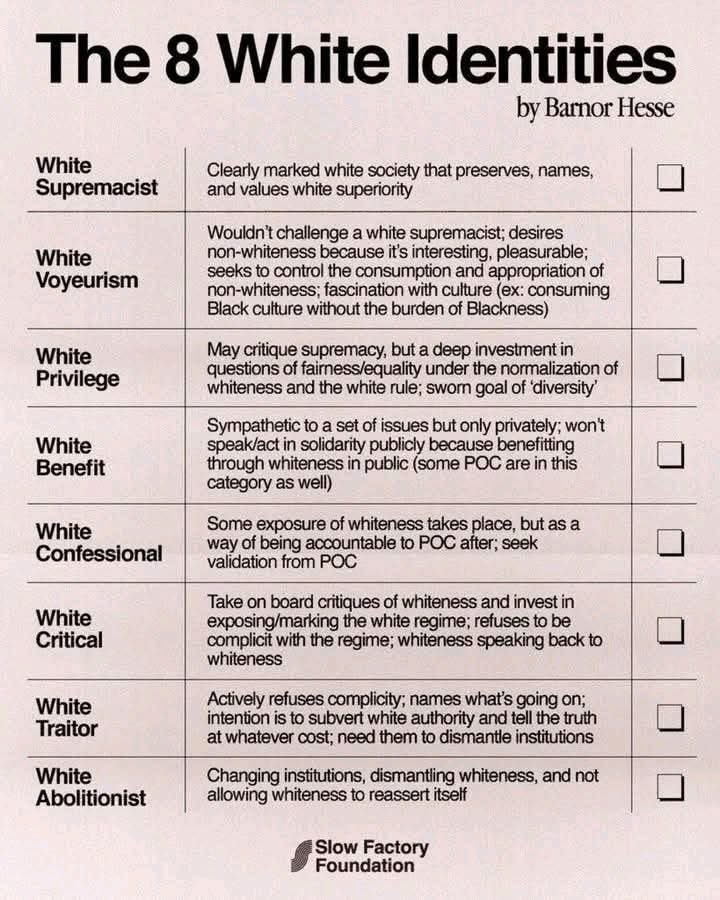
This “8 White Identities” chart (attributed to Barnor Hesse) looks like education, but it functions like a moral sorting machine. It offers eight labels that appear descriptive while quietly guiding you to one approved destination: “traitor/abolitionist,” meaning active participation in dismantling institutions so “whiteness” cannot “reassert itself.” That isn’t neutral analysis; it’s a disciplinary ladder. The key tell is the structure: most categories are not stable identities but staged accusations: if you don’t end at abolition, you’re still “benefiting,” “confessing,” “complicit,” or “voyeur.” It’s less “here are ways people relate to race” and more “here is your moral rank, move upward.”
Where does this method come from? In plain terms, it’s downstream of critical theory which is a family of approaches associated with the Frankfurt School, including Max Horkheimer, which treats social life as saturated with power and aims not merely to interpret society but to critique and transform it. Suspicion becomes the starting posture: norms, institutions, and “common sense” are read as mechanisms that reproduce domination. That posture can be illuminating when it identifies genuine structural incentives or hidden rules. The problem is what happens when the posture hardens into a closed moral cosmology: every institution is presumed guilty, every norm is presumed cover, and disagreement is presumed self-interest.
This particular pop-form is best described as CRT-style reasoning (even when it’s outside law schools): “whiteness” treated as an institutionalized advantage; disparities treated as presumptive evidence of systemic bias; “neutrality” treated as camouflage; and moral legitimacy tied to “anti-racist” alignment rather than truth-tracking. The flaw isn’t “not caring about racism.” The flaw is an a-historical compression: it collapses different eras, actors, and institutions into one continuous regime (“whiteness”) and treats complex tradeoffs as one moral story with one villain. You stop seeing plural motives, competing goods, and reformable failures; you see only complicity versus resistance.
The chart also relies on social coercion, not argument. It invites “accountability,” but what it means in practice is public performance under threat of moral demotion. Ask for evidence and you’re “centering yourself.” Disagree and you’re “invested.” Stay quiet and you’re “benefiting.” Even agreement becomes suspect if it’s the “wrong” kind (confessional, validation-seeking). That’s the unfalsifiable core: the framework is built so that any response can be converted into proof of guilt or complicity. A theory that cannot lose contact with counterevidence doesn’t guide understanding; it guides conformity.
If you actually want a model that helps rather than coerces, start with falsifiable claims and reformable mechanisms: identify specific policies, incentives, or gatekeeping practices; compare outcomes across institutions; test interventions; keep individual dignity intact; and treat moral status as something earned by conduct, not assigned by category. You can still talk about bias and history without turning identity into original sin. The danger of charts like this isn’t that they “teach empathy.” It’s that they train people to swap evidence for ritual, and dialogue for denunciation—and that trade makes every institution worse, not better.
Tyler Cowen once tried to name the biggest “revolutions” he’s lived through—moon landing, collapse of communism, the internet, and now AI. In the middle of that list he drops one that most people still don’t treat like a revolution at all: “Feminization.” (Marginal REVOLUTION)
That word isn’t a complaint. It’s a category. It says: a long-run compositional change is underway, and it matters.
Helen Andrews’ “Great Feminization” thesis—popularized in a talk and elaborated in her Compact essay—takes the next step: as women become a larger share of institutions, institutions don’t merely “include” women; they become substantively feminized, and what we call “wokeness” is basically the cultural exhaust of that process. (Compact)
Here’s my position up front: the demographic shift is real and measurable in Canada; the “feminization = wokeness” equation is an overconfident master key.
It explains too much, too easily, by psychologizing demographics instead of interrogating incentives.
Canadian anchors: the shift is measurable (not vibes)
Start with a handful of Canadian facts you can actually point to.
- Parliament: the House of Commons sits at 104 women out of 343 MPs (30.3%). (IPU Parline)
- Judiciary: the share of federally appointed judges who are women rose from 43.8% (2021) to 46.7% (2023), per Statistics Canada. (Statistics Canada)
- Universities: women are 43.7% of full-time teaching staff in 2024/2025, up from 15.9% in 1984/1985. (Statistics Canada)
- Management: women are 51.9% of public-sector managers but 35.2% of private-sector managers (2023), and hold 42.7% of middle management vs 30.8% of senior management (2021). (Statistics Canada)
- Psychology (Alberta snapshot): Job Bank puts psychologists at 81% women / 19% men in Alberta. (Job Bank)
You don’t need to think any of this is good or bad to recognize the basic point: elite and semi-elite Canadian pipelines have changed composition in living memory. The “Great Feminization,” at minimum, names something real.
Why composition changes institutions (and why noticing this isn’t misogyny)
Here’s the move that poisons discussion: someone observes a demographic shift and asks what it does to norms; the response is to treat the question itself as hatred.
That’s not an argument; it’s a veto.
Institutions aren’t just rulebooks. They are reward systems: what gets you promoted, what gets you ostracized, what gets you hauled into a meeting, what everyone learns not to say out loud. When composition changes, the informal equilibrium can change too—sometimes for the better, sometimes not.
Before anyone reaches for the “misogyny” stamp, three obvious distinctions:
- Descriptive claims aren’t moral verdicts. Saying “X is now 47% female” is not saying “women ruined X.”
- Group averages aren’t destinies. Even if differences exist on average, overlap is huge. Plenty of women are rule-first and combative; plenty of men are harmony-first and censorious.
- The target is incentives, not women. If a system rewards reputational risk-avoidance and punishes open conflict, it will drift toward soft enforcement and speech management—regardless of who staffs it.
Those distinctions don’t sanitize the topic. They make it discussable.
Where Andrews helps—and where her thesis becomes a master key
Steelman Andrews first: she’s right that the shift is large, and she’s right that institutions can be remade through changes in who occupies them. If you pretend otherwise, you’re pretending humans don’t do social enforcement.
Where she overreaches is the claim (often treated as self-evident) that “feminization = wokeness.” (Compact)
Two problems.
1) One variable can’t carry a multi-cause phenomenon
The rise of “woke” managerial dynamics tracks at least four forces that are not reducible to gender composition:
- social media: instant reputational escalation; permanent records of mistakes; a public audience for internal disputes
- liability culture: institutions optimizing to avoid lawsuits, complaints, and scandal
- bureaucratic expansion: more compliance, more policy, more internal language policing
- credential sorting: ideological clustering in certain professional strata
In Canada, you can see the basic direction without naming villains: risk management becomes a career track; “process” becomes protection; disputes become “incidents”; leaders learn to value quiet over truth because quiet is legible as safety.
You can believe feminization is one contributor. But treating it as the engine is an interpretive leap, not an established causal law.
2) It tempts essentialism even when it gestures at nuance
If “wokeness” is “women’s morality,” you’ve turned a complex institutional pathology into a personality profile of half the species. That’s analytically brittle and politically stupid: it hands critics the easiest rebuttal (“you’re essentializing women”) and it blinds you to male-led versions of the same pathologies (purges, conformity spirals, status policing), which history supplies in bulk.
If you want to criticize a norm regime, criticize the regime. Don’t smuggle in contempt.
What the evidence can support—more modestly
A defensible claim, one that doesn’t require you to psychologize women as a class, looks like this:
- Some sex-linked preference gaps show up in some contexts, especially around speech, conflict, and social sanction. For example, a Knight Foundation/College Pulse study reports large gender differences among U.S. college students: 41% of college women prioritized protecting free speech versus 71% of college men, while women were more likely to prioritize promoting an inclusive society.
- Institutions are sensitive to preference distributions because norms are enforced socially, not just formally.
- Incentives decide which preferences become “policy.” Liability, reputation, and managerial bureaucracy amplify harm-avoidance.
And this is the part Andrews gestures at, but doesn’t fully own: if you want to understand modern speech policing, HR creep, and the new professional fearfulness, start with incentives. The incentives turn every controversy into a corporate emergency; then people behave accordingly.
On that view, feminization isn’t the whole story. It’s a relevant input—and its effects depend on the system it enters.
The real Canadian question: can we preserve hard virtues mid-transition?
Canada is useful here because we’re visibly mid-shift rather than at some imagined endpoint. Parliament is at 30% women, not parity. (IPU Parline) The federal judiciary is closing on parity. (Statistics Canada) Universities have moved dramatically since the 1980s, but remain below parity in full-time teaching staff. (Statistics Canada) Management splits sharply by public vs private sector, and senior leadership remains male-skewed. (Statistics Canada)
So the live question isn’t “should women be here?” They are here, and they belong here.
The question is narrower and more urgent:
As composition changes, what norms do we want to protect because they are fragile?
A short list:
- due process and evidence standards (law)
- viewpoint tolerance and intellectual risk-taking (academia)
- candid disagreement and non-performative conflict (organizations)
- the capacity to make decisions that feel “unkind” but are necessary (policy)
If you think those virtues are real and fragile, you don’t need to scapegoat women. You need to design institutions that reward truth-telling and competence more than “harm management” and reputational prophylaxis. That means fewer performative “values” rituals and more procedural backbone: clear standards, clearer speech norms, and leaders who can say “no” without laundering it through therapy language.
Verdict and prediction
The Great Feminization is real in Canada. The numbers are not subtle. (IPU Parline)
But “feminization = wokeness” is a bad master key. It explains too much, too easily, by psychologizing demographics rather than interrogating incentives. (Compact)
My bet is that the next decade won’t be settled by shouting “misogyny” or shouting “women did this.” It will be settled by whether our institutions relearn a difficult skill: distinguishing “this feels harmful” from “this is false,” and building cultures where adults can endure disagreement without turning every conflict into a moral emergency.

Glossary
- Confounders — other factors that could be the real cause, making cause-and-effect hard to prove.
- Essentialism / essentialize — treating a group as if it has one fixed “essence” (“women are X”), ignoring variation.
- Epiphenomenon — a byproduct; something that looks important but is really “exhaust” from a deeper cause.
- Monocausal — blaming one cause for a complex outcome.
- Pathology (institutional pathology) — a recurring dysfunctional pattern inside an institution.
- Prophylaxis — preventative action; here, pre-emptive “avoid scandal” behavior.
- Psychologizing — explaining political/institutional behavior by reducing it to personality traits or “mental makeup.”
A pocket field guide to the tells, the vibes, and the escape hatches 🧭
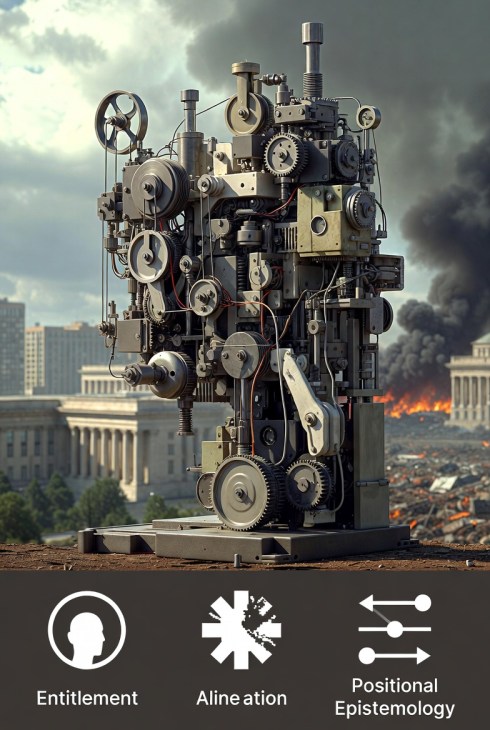
This one is deliberately not an essay. It’s a field guide. If “The Woke Machine” was the engine diagram and “The Woke Machine in the Wild” was the road test, this is the laminated card you keep in your purse/wallet so you can recognize the pattern in real time.
Rule of thumb: you’re not looking for left or right. You’re looking for a script. The woke script, as used in this series, shows up when a conversation shifts from “what’s true?” to “who gets to speak?” to “if you disagree, you’re guilty.”
The three-check test (10 seconds)
If you hear these three moves stacked together, you’ve found it:
- Identity first: “This is about who we are and what’s been done to us.”
- Standing first: “Some people speak; other people defer.”
- Sealed loop: “Disagreement proves the harm.”
One of these is normal politics. All three together is the machine.
The Field Guide Cards 📇
Each card has: vibe → what it’s doing → escape hatch
Card 1: The Credential Swap
Vibe: “It’s not my job to educate you.”
What it’s doing: Turns your question into an offense so the claim never has to be defended.
Escape hatch: “Fair. Point me to the best source you trust. I’ll read it, then we can discuss the claim and the remedy.”
Card 2: The Motive Trap
Vibe: “Intent doesn’t matter. Only impact matters.”
What it’s doing: Makes every mistake equally condemnable. Eliminates proportionality.
Escape hatch: “Impact matters. Intent matters for what response is fair. What change would satisfy you, and what would be excessive?”
Card 3: The Moral Draft Notice
Vibe: “Silence is violence.”
What it’s doing: Forces instant alignment. Neutrality becomes guilt.
Escape hatch: “I’m open to discussion. I don’t do coerced declarations.”
Card 4: The Sacred Testimony Upgrade
Vibe: “Listen to marginalized voices.”
What it’s doing: Sometimes an honest corrective. Sometimes a command to treat testimony as unquestionable.
Escape hatch: “I’m listening. After listening, are we allowed to test general claims with shared evidence standards?”
Card 5: Harm as a Veto
Vibe: “That’s harm.” / “That’s violence.”
What it’s doing: Replaces argument with a stop sign.
Escape hatch: “Let’s specify. What concrete harm, to whom, at what threshold, and what rule follows from it?”
Card 6: The Implementation Shaming
Vibe: “You’re centering yourself.”
What it’s doing: Turns practical questions into moral failure.
Escape hatch: “Implementation questions protect people from unintended damage. Let’s talk tradeoffs.”
Card 7: The Purity Shortcut
Vibe: “If you were a good person, you’d already agree.”
What it’s doing: Makes moral worth depend on agreement.
Escape hatch: “Good people disagree. Let’s talk reasons, evidence, and costs.”
Card 8: The Story-to-System Leap
Vibe: “My lived experience proves the system is X.”
What it’s doing: Jumps from testimony to total causation without the hard middle step.
Escape hatch: “I accept the experience. Now show how we know the cause. What alternative explanations did we check?”
Card 9: The Sealed Loop
Vibe: “Your disagreement is proof.”
What it’s doing: Objections become confirmation. Nothing can be corrected.
Escape hatch: “If disagreement counts as proof, we’ve left reasoning. What would count as disconfirming evidence?”
Card 10: The Reality Sabotage
Vibe: “Objectivity is a tool of oppression.”
What it’s doing: Undermines common standards so the frame can’t lose.
Escape hatch: “If we can’t share standards, we can’t make fair rules. What standards apply to everyone equally?”
Card 11: The Venue Laundering Move
Vibe: “Deplatforming isn’t censorship.”
What it’s doing: Uses technicalities to deny coercion while doing coercion.
Escape hatch: “Maybe it isn’t state censorship. It’s still a power move. What principle makes this consistent?”
Card 12: The Totalizing Story
Vibe: “The whole system is rigged.”
What it’s doing: Converts a hypothesis into a worldview. Every counterexample becomes cover-up.
Escape hatch: “Maybe. What evidence would make you revise that, and what would count as a genuine counterexample?”
The “Woke in the Wild” Bingo Strip 🎯
If you hear three of these in one conversation, slow down:
- “Do the work.”
- “That’s not up for debate.”
- “I don’t feel safe.” (used as policy veto)
- “Platforming equals harm.”
- “Your questions are violence.”
- “You’re asking for emotional labor.”
- “We can’t center comfort.”
- “The data is racist.”
- “That’s tone policing.”
- “You’re on the wrong side of history.”
Some of these are sometimes fair complaints. The tell is when they function as argument substitutes.
Three calm moves that work in almost any room 😌
- Falsifiability: “What would change your mind?”
- Symmetry: “Does this rule apply to your side too?”
- Category check: “Are we discussing evidence, or are we assigning moral status?”
You’re not trying to dunk. You’re trying to keep the conversation inside reality.
Mini-glossary (translation for normal humans) 📘
- Standing: who is treated as allowed to speak and be believed.
- Self-sealing: a belief that treats objections as confirmation.
- Moral sorting: dividing people into good/bad based on frame acceptance.
- Harm (as used here): sometimes real injury; sometimes a rhetorical stop sign.
- Deplatforming: removing access to a venue; not always illegal, often still coercive.
Endnote
This field guide simplifies the framework outlined in “The Woke Machine” and “The Woke Machine in the Wild” prompted by James Lindsay’s New Discourses discussion of “woke” as an identity-and-epistemology posture rather than a simple political label.
[This is second in an expository series on how “Woke” works, see here for the foundational essay on what woke is]
1) The claim
“Woke” is not a single policy or a stable tribe. It is a portable political form: a way of converting friction into identity, and identity into a special way of knowing.
A practical diagnostic:
- Ontological grievance: the dispute becomes about who we are and what is being done to us.
- Positional knowing: standing determines what can be known; dissent becomes suspect.
- Self-sealing loop: objections are reinterpreted as proof of corruption.
When those stack, persuasion decays into control-seeking.
2) The Left, steelmanned (and where the machine bites)
Start with the best version. There are reasonable claims on the Left:
- Institutions can have blind spots that matter in real lives.
- Listening to marginal voices can correct systematic inattention.
- Some norms exclude people unnecessarily, and reform can reduce that.
That’s ordinary liberal reform.
Machine activation begins when “correction” turns into “jurisdiction.” Disagreement becomes “harm,” procedural neutrality becomes “violence in disguise,” and the argument becomes uncorrectable because argument itself is reclassified as aggression.
You can see the pattern in soft-power settings where programming becomes legitimacy warfare. The Adelaide Writers’ Week / Randa Abdel-Fattah controversy escalated into resignations, withdrawals, cancellation, institutional apology, and a promised reinvitation. The conflict stopped being “who should speak” and became “who has moral authority to decide who speaks.” (ABC)
Now the policy-adjacent version (harder, more consequential): Canada’s Bill C-9 (Combatting Hate Act). Steelman: protecting people’s access to religious/cultural spaces from intimidation and addressing hate-motivated conduct are serious public-order aims. (Canada)
But the same machine-shaped risk appears in the surrounding rhetoric: once “speech boundary” disputes are treated as a moral sorting test (good people vs haters), it becomes harder to argue about scope, definitions, and safeguards without being read as suspect. Civil-liberties groups explicitly warn about Charter impacts and overreach risks. (CCLA)
The point is not “hate laws are woke.” The point is: when moral urgency turns into epistemic privilege, the debate stops being corrigible.
3) The Right, steelmanned (and where the machine bites)
Start with the best version. There are reasonable claims on the Right:
- Borders, civic trust, and state capacity matter.
- Institutions sometimes overreach and launder ideology through “neutral” language.
- Recent years have trained people to doubt official narratives too easily.
That is not conspiracism. It’s ordinary suspicion in a messy age.
Bridge sentence (the crucial distinction): distrust becomes machine-shaped when it flips into a total explanatory key, where suppression itself is treated as evidence of truth (“they don’t want you to know”), and disagreement is recoded as complicity.
That’s the turn that makes replacement-style narratives so sticky: anxiety about cohesion gets converted into a unified dispossession story with hidden directors. Watchdogs and explainer sources describe “Great Replacement” ideology as a white nationalist conspiracy frame, often with antisemitic variants, and as a driver for radicalization. (Al Jazeera)
(One more steelman note: people can argue about immigration levels, integration, and public confidence without endorsing any of that. The machine is not “caring about borders.” The machine is the sealed metaphysics move.)
4) Shared outputs (what the form produces on either side)
Once the form locks in, the outputs converge:
Friend–enemy sorting
People are judged less by arguments than by whether they accept the frame. “Ally” becomes an obedience category.
Exception ethics
Rules become “context.” Double standards become “justice.” Coercion becomes “self-defense.”
Platform war
Institutions become terrain: universities, HR offices, granting bodies, publishers, professional colleges.
A Canadian micro-case: the York University Student Centre dispute around MP Garnett Genuis shows how a procedural venue decision can become a symbolic censorship war, with different accounts emphasizing policy requirements versus ideological suppression. The ambiguity itself becomes fuel. (CityNews Edmonton)
5) The discriminator (reform vs machine)
Reform politics says: we can be wrong; show what would change our mind.
Machine politics says: disagreement proves you are contaminated.
That shift is the warning. Not that every Left claim is woke, or every Right claim is woke, but that any movement becomes uncorrigible once it adopts the form.
When that happens, societies stop arguing and start purging. 🧯
Glossary
- Ontological grievance: a complaint treated as core to being, not a fixable dispute.
- Positional knowing / standpoint: the view that social position determines access to truth; some “lived experience” claims function as trump cards.
- Self-sealing loop: a reasoning loop where objections become confirmation.
- Friend–enemy sorting: political classification that treats opponents as existential threats.
- Exception ethics: moral rules are suspended because “we’re under siege.”
- Platform war: institutions become the main battleground for power.
- Corrigible: open to correction by evidence and argument.
Endnotes
- James Lindsay, “What Woke Really Means” (New Discourses podcast, Jan 21, 2026).
- Adelaide Writers’ Week controversy: ABC coverage and Adelaide Festival statement (apology + 2027 reinvitation), plus reporting on cancellation after withdrawals. (ABC)
- Bill C-9 (Combatting Hate Act): Government summary + bill text; civil-liberties critiques and legal-professional analysis. (Canada)
- York University Student Centre / Garnett Genuis dispute (policy vs free-speech framing). (CityNews Edmonton)
- “Great Replacement” explainer coverage describing it as a conspiracy frame and discussing radicalization risk. (Al Jazeera)
Attribution: This essay is a paraphrase-and-critique prompted by James Lindsay’s New Discourses Podcast episode “What Woke Really Means.” Any errors of interpretation are mine. (New Discourses)
“Woke” is a word that now means everything and nothing: insult, badge, shibboleth, brand. That’s why it’s worth defining it narrowly before arguing about it. I’m not using “woke” to mean “progressive,” “civil-rights liberal,” “any activism,” or “anyone who thinks injustice exists.” I mean a specific machine: a moral–political pattern that turns social friction into group-based identity, and then turns group-based identity into a special way of knowing. When that pattern is present, the downstream politics are unusually predictable.
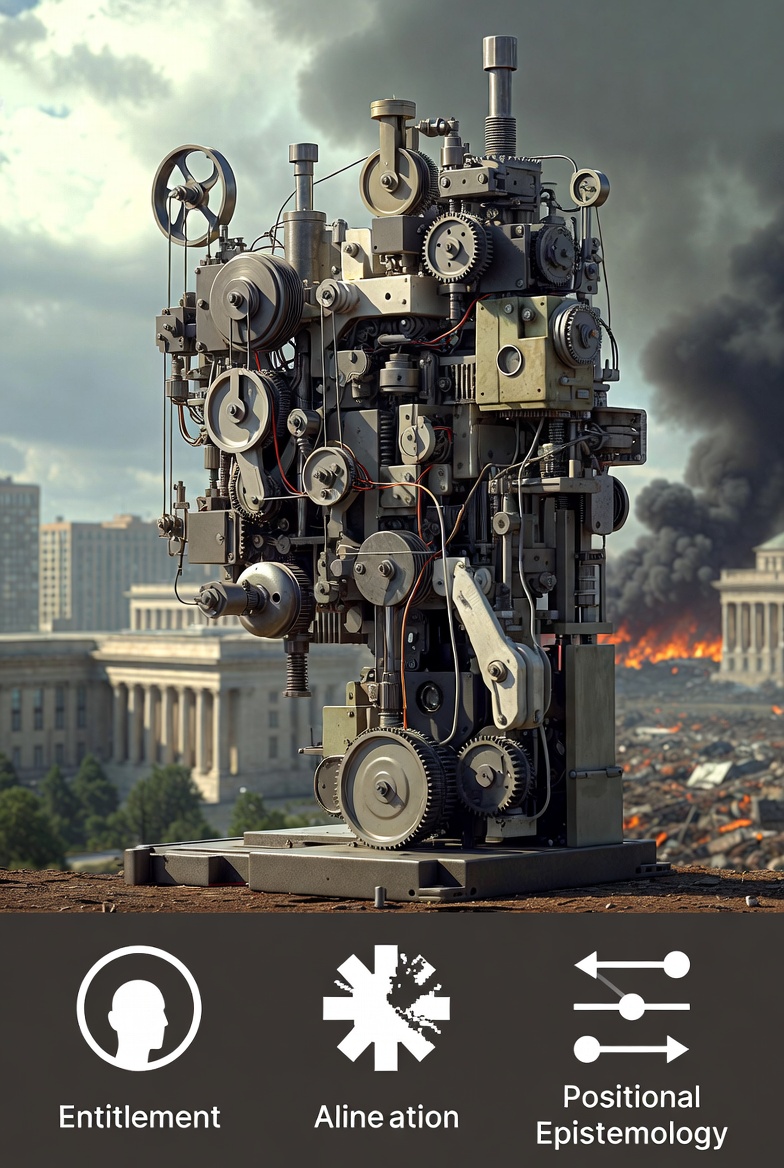
The first engine is entitlement turned into alienation. Start with a felt ought: people like me should be able to live, speak, belong, succeed, and be recognized in a certain way. That ought can be reasonable. Some groups really have been locked out of full participation. Institutions really do gatekeep. Norms really do punish outsiders. The pivot is what you do with the mismatch between “ought” and reality. The woke machine teaches that the mismatch is not mainly a mix of tradeoffs, chance, imperfect policy, individual bad actors, or local failures. It is alienation, a structural condition imposed by an illegitimate power arrangement. Your frustration is not merely about outcomes. It becomes about being denied your proper mode of existence. Once alienation is framed that way, it stops being a problem to solve and becomes an identity to inhabit.
That identity shift is the real move. The self is quietly demoted from “individual with rights and duties” to “representative of a class in conflict.” You begin to think in group nouns first: oppressed/oppressor, marginalized/privileged, normal/deviant, colonized/colonizer. This is why identity politics shows up so reliably. It is a downstream output of a prior decision to interpret the world through group-alienation. It can even masquerade as humility. “I’m just listening to marginalized voices.” But it performs a different operation. Moral standing relocates from argument to position. You don’t merely hold beliefs. You become a bearer of a collective grievance, and that grievance grants a kind of authority in advance.
The second engine is epistemic: knowledge becomes positional. Again, the starting observation can be true enough. Institutions reward certain ways of speaking. Credentialing filters who gets heard. Consensus is sometimes wrong. Lived experience can surface facts that statistics miss. The woke machine turns those observations into a total explanation. The established “knowing field” is not just fallible, but hegemonic. It is treated as a knowledge regime that functions to protect power.
There is an honest version of this impulse. Marginalized people can notice things insiders miss. Testimony can expose local abuses that institutions quietly normalize. Suspicion of official narratives is sometimes warranted. History is full of respectable consensus that later looks like rationalized cruelty. In that sense, privileging marginalized voices can function as a corrective. The problem begins when “corrective” hardens into a standing hierarchy of credibility, and when the moral value of hearing becomes a substitute for the epistemic work of checking. At that point, the method stops being a tool for truth and becomes a tool for power.
Once you accept the hegemonic frame as total, a standing preference follows. “Counter-hegemonic” claims, those said to come from the margins or said to be suppressed, are treated as inherently more trustworthy, or at least more morally protected. The point isn’t always truth. Often it’s leverage. If a claim destabilizes the legitimacy of the system, it gets treated as epistemically special.
You can see how this becomes self-sealing. Consider a common pattern: demographic observation, then a moralized system interpretation, then an appeal to lived experience, then immunity from counterargument. “I notice a space is mostly white.” Fine. “Therefore hiking is racist.” That is not observation but diagnosis. If challenged, the claim can retreat into experience: “I feel unsafe,” “my lived experience says otherwise.” Any dissent is then reclassified as proof of the system’s blindness. The disagreement is not processed as information. It becomes further evidence of hegemony. At that point, you’re no longer arguing about the world. You’re litigating the moral status of who gets to describe it.
Put these two engines together, alienation-as-identity and positional knowing, and the political outputs stop looking like random bad behavior. If your group’s situation is existential, ordinary ethics begin to look like luxuries written by your enemy. Double standards don’t feel like hypocrisy. They feel like “context.” Coercive tactics don’t feel like power-seeking. They feel like self-defense. “Allies” become morally sorted people who accept the frame. “Enemies” become those who refuse it. Because the machine treats knowledge as power, controlling speech and institutions can be rationalized as protecting truth rather than enforcing conformity.
So here’s a clean diagnostic that avoids cheap mind-reading. It’s not “woke” to notice injustice, organize, protest, or advocate. It becomes woke in this sense when three conditions appear together:
- Ontological grievance: your primary identity is a group-based injury story. Who you are is mainly who harmed “your people.”
- Positional epistemology: the status of a claim depends heavily on who says it, not what can be shown. Identity outranks argument.
- Self-sealing reasoning: disagreement is treated as proof of harm or hegemony, making correction impossible.
Any one of these can show up in ordinary politics. “Woke,” in this narrow sense, is when they lock together and become a stable identity system.
That triad is the machine. Once it’s operating, it tends to erode the conditions that let pluralistic societies function: shared standards of evidence, equal moral agency, and the ability to disagree without being treated as morally contaminated. In its best moments, the impulse can push institutions to see what they ignored and to repair what they excused. But a politics that begins as reform can slide into a politics that needs conflict as fuel. Once conflict becomes fuel, the temptation is obvious. Keep the wound open. Keep the epistemic gate locked. Keep the enemy permanent. If the machine ever stops, the identity it built starts to dissolve. 🔥
Glossary 📘
Alienation
A felt separation from what you believe you should rightfully be or have. In this framework: not mere disappointment, but a condition allegedly imposed by an illegitimate system.
Entitlement claim
A “felt ought”: a belief that people like me (or my group) are owed a certain kind of recognition, access, or outcome. Not automatically “spoiled,” just the moral premise that something is due.
Group-based identity
A primary self-concept built around membership in a social category (race/sex/class/nation, etc.), especially when that category is framed as locked in conflict with another.
Identity politics
Politics organized primarily around group membership and group conflict rather than individual rights, shared citizenship, or policy compromise.
Ontology / ontological grievance
Ontology is “what you are.” Ontological grievance is when grievance becomes core to being: the self is primarily defined as an injured member of an alienated group.
Epistemology / positional epistemology
Epistemology is “how we know.” Positional epistemology is when the credibility of claims depends heavily on the speaker’s identity position, rather than evidence and argument.
Hegemony / hegemonic knowledge
The idea that a society’s “common sense” and official knowledge are shaped to preserve existing power. “Hegemonic knowledge” is what the system allegedly allows as legitimate truth.
Counter-hegemonic / marginalized claims
Claims presented as outside the dominant “knowing field,” often treated as morally protected or more trustworthy because they challenge the status quo.
Lived experience
First-person testimony about what life is like. Valuable as evidence of experience; controversial when treated as unquestionable authority on broad causal explanations.
Self-sealing reasoning
A reasoning pattern where counterevidence is reinterpreted as evidence for the claim (for example, “your disagreement proves the system’s bias”), making the claim hard to correct.
Friend–enemy politics
A posture that sorts people into allies and enemies in a moralized way, where dissent feels like threat rather than disagreement.
Exception ethics
A moral logic where ordinary standards like fairness, consistency, and procedural restraint are suspended because the situation is framed as existential.
Endnotes
- James Lindsay, “What Woke Really Means,” New Discourses Podcast (New Discourses, January 21, 2026). (New Discourses)
- “What Woke Really Means,” New Discourses (audio hosting/episode metadata). (SoundCloud)
- Joe L. Kincheloe, Critical Constructivism Primer (Peter Lang, 2005). (Peter Lang)
- Özlem Sensoy and Robin DiAngelo, Is Everyone Really Equal? An Introduction to Key Concepts in Social Justice Education, 2nd ed. (Teachers College Press, 2017). (tcpress.com)
- Helen Pluckrose and James A. Lindsay, Cynical Theories: How Activist Scholarship Made Everything About Race, Gender, and Identity—and Why This Harms Everybody (Pitchstone Publishing, 2020). (ipgbook.com)
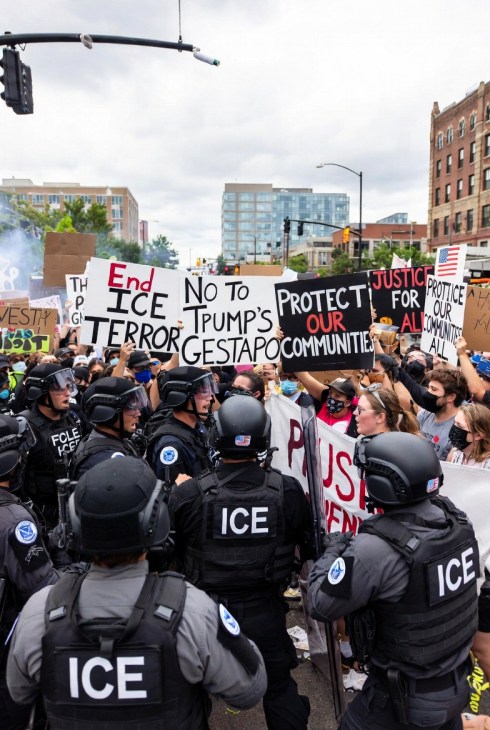
In his January 16, 2026 X post, James Lindsay treats the “ICE is Trump’s Gestapo” line as more than overheated language. He reads it as a political technique: a framing move that aims to provoke escalation, polarize interpretation, and sap legitimacy from federal immigration enforcement by making every subsequent clash look like retroactive confirmation.
Even if you don’t accept the strongest version of his claim (that it is centrally orchestrated), the underlying mechanism is worth taking seriously—because it doesn’t require orchestration to work. It requires an audience that consumes politics in fragments, and a media ecosystem that pays for heat.
The point of media literacy here is not to pick a side. It is to recognize when you are being handed a frame that’s designed to steer your moral conclusion before you are allowed to know what happened.
The loop, reduced to mechanics
The escalation loop has four moves.
1) Load the moral frame early.
“Gestapo” is not an argument. It is a verdict. It tells the audience what they are seeing before they see it. It collapses a contested enforcement dispute into a single image: secret police.
2) Convert observation into resistance.
Once people believe they’re facing secret police, ordinary scrutiny becomes morally charged. Disruption can be reframed as defense. Escalatory behavior becomes easier to justify, especially in crowds, especially on camera.
3) Force a response that looks like the frame.
As tension rises, agents harden posture: more crowd-control readiness, more force protection, more aggressive containment. Some of that may be lawful, and some may be excessive; the loop does not depend on the fine print. It depends on optics.
4) Circulate optics as proof.
Clips win. Captions win. The most provocative 15 seconds becomes “what happened,” for millions who will never read a court filing. The frame spreads because the frame is legible in low context.
Frame → friction → hardened posture → optics → reinforced frame. Repeat.
Notice what’s missing: slow adjudication of facts. The loop thrives on speed. It preys on low-context attention.
Why Minnesota is an instructive case
Minnesota matters here because the escalation loop is visible across multiple lanes at once: street-level conflict, political rhetoric, and rapid legal constraint.
Recent reporting describes the Department of Homeland Security deploying nearly 3,000 immigration agents into the Minneapolis–St. Paul area amid intense protests and public backlash. In that environment, a fatal shooting—Renée Good, shot by an ICE agent on January 7, 2026—became a catalytic event for further demonstrations and scrutiny.
Then the conflict moved into procedural warfare. On January 17, a federal judge issued an injunction restricting immigration agents from detaining or using force (including tear gas or pepper spray) against peaceful protesters and observers absent reasonable suspicion of criminal activity. That order is narrow, but it is not trivial: it codifies a boundary in exactly the arena where optics are most easily weaponized.
The rhetorical layer matters too. DHS has publicly condemned Minnesota Governor Tim Walz for using “modern-day Gestapo” language about ICE (and the White House has amplified that criticism). Whatever you think of the underlying enforcement operation, this is the accelerant: the label that turns complexity into a single moral picture.
If you want a single media-literacy takeaway from Minnesota, it’s this: the escalation loop often ends up constraining policy through courts and procedure, not merely through street confrontation. Once the story becomes “secret police,” legal process itself becomes part of the narrative battlefield—injunctions and motions become content, and content becomes legitimacy.
“Low information public” is the wrong diagnosis
“Low information” is typically used as a sneer. The sharper term is low context.
Most people aren’t stupid; they’re busy. They consume politics the way they consume weather: by glance. They get fragments, and fragments invite frames.
The “Gestapo” label works on low-context audiences because it is:
- Instantly moralized: villain and victim are assigned immediately.
- Highly visual: it primes the brain to interpret normal enforcement cues (gear, urgency, crowd control) as secret-police signals.
- Clip-native: it fits perfectly into captions and short video, where emotional clarity beats evidentiary completeness.
- Correction-resistant: anyone who says “slow down” can be painted as defending tyranny.
This is the real vulnerability narrative warfare exploits: not ignorance, but context starvation.
The key analytical distinction: intent vs incentives
Here’s where writers often lose credibility: they jump from “this pattern exists” to “this was orchestrated.”
Sometimes there is coordination. Often there isn’t. And you typically don’t need it to explain outcomes.
Shared incentives can produce coordinated-looking behavior without a central planner:
- Outrage frames mobilize attention.
- Attention produces fundraising, followers, and headlines.
- Headlines pressure officials and constrain institutions.
- Institutions respond in ways that produce more outrage footage.
That is enough.
The media action depends on showing a self-reinforcing system: rhetoric that increases confrontation risk, confrontation that increases hardened posture, posture that increases “secret police” plausibility to spectators.
That is media literacy: the ability to separate “this felt true on my feed” from “this is true in the world.”
How to defuse the loop
Defusing the escalation loop means starving it of inputs. That requires two fronts: institutional discipline and citizen discipline.
What institutions can do
1) Treat optics as a real constraint (not PR garnish).
In a clip-driven environment, unnecessary spectacle is narrative fuel. If tactics can be lawful and less visually coercive, the second option is often the strategically sane one.
2) Over-communicate rules, thresholds, and remedies.
Explain what triggers stops, detentions, and uses of force; explain complaint pathways; publish policy boundaries. If courts are drawing bright lines around peaceful protest and observation, those lines should become part of the public-facing doctrine, not buried in litigation.
3) Correct fast and publicly when mistakes occur.
Silence functions as permission for the loudest interpretation to win. Delay is a gift to the escalation loop.
4) Avoid “timing that reads like punishment.”
Even lawful actions can look retaliatory if they cluster around protests. In narrative warfare, timing becomes motive in the audience’s mind.
What readers can do
1) Treat moral super-labels as a stop sign.
When you see “Gestapo,” “fascist,” “terrorist,” “insurrection,” assume you’re being pushed into a conclusion. Slow down.
2) Refuse clip capture.
Ask: what happened thirty seconds before this clip starts? If you can’t answer, you’re watching a weaponized excerpt.
3) Use a two-source minimum.
One source gives you mood. A second source often provides the missing constraint—timeline, legal posture, or what is actually being alleged. The injunction’s specific limits, for example, are precisely the kind of detail clips rarely include.
4) Separate event, legality, and morality.
“This happened” is not “this was lawful,” and neither is “this was tyranny.” Narrative warfare succeeds by collapsing those categories into one reflex.
5) Ask what behavior the story is trying to elicit.
Is it trying to make you understand, or to make you react—share, donate, show up, escalate? That question alone breaks many spells.
Where this ends if we don’t learn
If the escalation loop runs unchecked, politics becomes performance for low-context consumption. Enforcement becomes optics. Protest becomes optics. Courts become props. Everyone plays to the camera because legitimacy is increasingly adjudicated there.
The antidote isn’t bland neutrality. It’s refusing to let a frame do your thinking for you—especially one engineered to convert fragments into certainty.
That’s what media literacy looks like now: not knowing everything, but knowing when you’re being steered.
“When a word arrives preloaded with a verdict, your job is to slow the tape.”
References
- James Lindsay, X post (January 16, 2026), “ICE is Trump’s Gestapo” narrative thread. (X (formerly Twitter))
- Reuters (January 17, 2026), report on federal judge’s injunction limiting immigration agents’ tactics toward peaceful protesters/observers in Minneapolis–St. Paul; includes mention of DHS deploying nearly 3,000 agents and context following Renée Good’s death. (Reuters)
- Associated Press (January 17, 2026), coverage of the same injunction and the lawsuit context, including limits on detentions and crowd-control measures against peaceful protesters/observers. (AP News)
- ABC News (January 14, 2026), background reporting confirming Renée Good was fatally shot by an ICE agent on January 7, 2026 and noting an FBI probe. (ABC News)
- U.S. Department of Homeland Security (May 19, 2025), DHS statement criticizing Gov. Tim Walz’s “modern-day Gestapo” language about ICE (useful for documenting the rhetoric’s public circulation). (Department of Homeland Security)
- White House (January 2026), article compiling public statements about ICE and “modern-day Gestapo” language (useful as an example of administration amplification rather than a neutral factual source). (whitehouse.gov)











 bleatmop
 Mystro


 Dead Wild Roses
Your opinions…