
You are currently browsing the category archive for the ‘Culture’ category.
The UK’s immigration argument increasingly sounds like destiny rather than policy. People don’t just disagree about numbers; they disagree about whether the state can still enforce boundaries, integrate newcomers into a shared civic order, and speak plainly about what’s happening. When those basic functions look weak or evasive, the vacuum gets filled with bigger stories—decline, betrayal, “takeover,” inevitability.
A sober view starts with what can be verified quickly.
What the numbers say
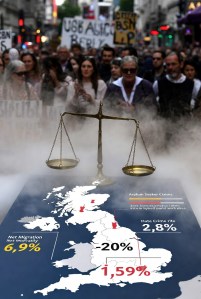
Recent UK migration trends are not a one-way escalator. The Office for National Statistics (ONS) estimates long-term net migration at 204,000 in the year ending June 2025, down from 649,000 the year before. In the same release, ONS estimates long-term immigration at 898,000 and emigration at 693,000.
That decline doesn’t instantly relieve pressure on housing, schools, or services—those systems lag. But it does mean any serious argument has to acknowledge that inflows can change materially under policy and economic conditions.
At the same time, irregular Channel crossings remain the public symbol of “rules don’t work,” regardless of their share of total immigration. Home Office statistics report 46,000 detected arrivals via illegal routes in the year ending December 2025, including 41,000 small-boat arrivals. Politics runs on salience: one visible failure can outweigh many invisible successes.
The asylum system itself is measurable. In the year ending December 2025 the Home Office reports 101,000 asylum claims, 135,000 initial decisions, a 42% grant rate, and 64,000 people awaiting an initial decision at end-December—along with large numbers receiving asylum support, including hotel use. Whatever your values, those are not vibes; they are levers.
Why the argument stays hot even when net migration falls
The debate persists because it is not only about totals. It is about legitimacy: can the state say, credibly, we know who is coming, under what rules, and we can enforce outcomes?
Legitimacy gets harder when estimates change and messaging sounds like PR. The House of Commons Library notes revisions that lowered the estimated net migration figure for the year ending December 2024 (revised to 345,000 from a previously published 431,000). Revisions happen in good faith in statistical work. The political problem is how they land: when people already suspect evasiveness, revisions are read as concealment.
A skeptic will object that “competence” isn’t merely a technical problem; it’s a political one. The worry is not that the state lacks spreadsheets, but that it lacks will: that enforcement is endlessly promised and rarely delivered, and that the system is managed as public relations rather than rule-of-law administration. That objection can’t be waved away. It’s precisely why visible targets, transparent reporting, and demonstrable closure matter: they are the only antidote to the suspicion that the system is performative.
In that atmosphere, administrative failure is quickly translated into moral narrative: the public stops arguing about systems and starts arguing about betrayal.
A necessary constraint: Britain is not a “monolith” story
If you want a steelmanable argument, you have to keep two truths in view.
First, the UK has genuine capacity and integration questions. Second, collective suspicion is both wrong and self-defeating.
A useful demographic anchor: in the 2021 Census for England and Wales, 6.5% of the population (3.9 million) identified as Muslim, up from 4.9% in 2011. That is a significant minority, not a majority—nor a single political bloc. Treating millions of people as a unified will is rhetorical convenience, not analysis.
And the cost of careless rhetoric is not theoretical. A Commons committee report cites 4,478 hate crimes against Muslims in England and Wales in the year ending March 2025. When systems feel out of control, scapegoating rises. Competence is therefore not just technocratic; it’s preventative.
None of this requires pretending integration is automatic. Some communities integrate faster than others; neighbourhood concentration, school pressures, and public-order flashpoints are real issues in parts of the country. The serious question is not whether problems exist, but whether the UK can measure them honestly—language attainment, employment, educational outcomes, and crime (victimization and offending) by clear categories—and then enforce civic norms consistently without collapsing into group blame.
The real lesson: competence drains the market for fate stories
The UK does not need prophecy. It needs closure—visible, lawful closure.
That means:
- Fast, transparent processing of asylum claims and appeals, with published targets and plain reporting. (Throughput has already moved; durability is the test.)
- A credible “no” alongside a humane “yes”—because if failed claims rarely produce timely outcomes, the public stops distinguishing between migration streams and everything becomes one undifferentiated panic.
- Clear public separation of migration categories (work, study, family, humanitarian, irregular entry), so “migration” stops being a fog-word that guarantees misunderstanding. Oxford’s Migration Observatory is a model of that clarity.
- An integration bargain that isn’t embarrassed of itself: language acquisition, equal protection under law, and consistent enforcement against coercive practices—paired with a refusal to treat entire communities as enemies.
When the state can do those things, public debate becomes governable again. When it cannot, the loudest narratives will always be the simplest: destiny, decline, takeover. Not because they are the best explanations, but because they match what people feel.
References
1) Office for National Statistics (ONS) — Long-term international migration, provisional: year ending June 2025
https://www.ons.gov.uk/peoplepopulationandcommunity/populationandmigration/internationalmigration/bulletins/longterminternationalmigrationprovisional/yearendingjune2025
2) UK Home Office — Immigration system statistics, year ending December 2025: Summary of latest statistics
https://www.gov.uk/government/statistics/immigration-system-statistics-year-ending-december-2025/summary-of-latest-statistics
3) UK Home Office — Immigration system statistics, year ending December 2025: Illegal entry routes (detail page)
https://www.gov.uk/government/statistics/immigration-system-statistics-year-ending-december-2025/how-many-people-come-to-the-uk-via-illegal-entry-routes
4) UK Parliament — House of Commons Library: Recent updates to UK migration estimates (CBP-10446)
https://commonslibrary.parliament.uk/research-briefings/cbp-10446/
5) Office for National Statistics (ONS) — Religion, England and Wales: Census 2021
https://www.ons.gov.uk/peoplepopulationandcommunity/culturalidentity/religion/bulletins/religionenglandandwales/census2021
6) UK Parliament — Women and Equalities Committee report (PDF): Discrimination, harassment and abuse against Muslim women
https://committees.parliament.uk/publications/51305/documents/285022/default/
7) Oxford Migration Observatory — Who migrates to the UK and why?
https://migrationobservatory.ox.ac.uk/resources/briefings/who-migrates-to-the-uk-and-why/
Canada still runs a legal category of “Indian” through federal law. Not as history. As operating code. The Indian Act governs registration, band governance, and the reserve framework. Identity becomes partly administered by statute, not only lived in community. (laws-lois.justice.gc.ca) When a state maintains a separate legal lane for a class of people, it does more than recognize difference. It reproduces difference through process and permanence.
Get the timeline right because this is where critics go hunting. The Indian Act was assented to on April 12, 1876, as a consolidation of laws “respecting Indians.” (sac-isc.gc.ca) Consolidation is not an accident. It is a choice to centralize control, define membership, and keep Indigenous life routed through Ottawa’s legal plumbing. Once you do that, you create a stable incentive loop. Governments manage liability and jurisdiction. Communities defend the gateways through which rights, services, and recognition pass. The system is not neutral simply because it is administrative.
Martin Buber’s vocabulary helps name the moral move without turning this into a sermon. An I–It posture treats people as objects. They become cases, stakeholders, units, problems to be managed. An I–Thou posture treats them as subjects with agency and dignity. A system that sorts people into different legal kinds makes I–It governance easier. Bureaucratic proxies replace encounter. Resentment follows because the relationship becomes instrumental even when the language stays compassionate.
You can watch the machine work in Alberta right now. Elections Alberta issued a Notice of Initiative Petition in late January 2026 for a citizen initiative proposing an Alberta independence referendum question. (elections.ab.ca) First Nations responded with litigation arguing the province had constitutional duties to consult on the impacts of such a referendum and failed to do so. (globalnews.ca) Alberta’s population reached 5.0 million in Q4 2025. (economicdashboard.alberta.ca) That is a large public, a loud politics, and a long list of grievances looking for a target. In that environment, it becomes easy to blame “Indians” as a block instead of blaming the architecture that turns every dispute into a status-mediated struggle over courts, duties, and jurisdiction.
The safest conclusion is also the strongest. Treat this as structure, not as villains. There are Indigenous voices, including William Wuttunee, who argued decades ago that the reserve-dependency model traps people and that integration on Indigenous terms was a path out. (uofmpress.ca) You do not need to adopt his full program to accept the warning. As long as legal status remains the main conduit for dignity, power, and money, Canada will keep reproducing otherness by design. Too many institutions cannot cash their cheques any other way.

References
Source Speech (YouTube)
Indian Act (R.S.C., 1985, c. I-5) — Justice Laws (official text)
https://laws-lois.justice.gc.ca/eng/acts/i-5/
Indian Act, 1876 (“amend and consolidate…”) — SAC-ISC archival text
https://www.sac-isc.gc.ca/eng/1100100010252/1618940680392
Martin Buber (I–It / I–Thou) — Stanford Encyclopedia of Philosophy
https://plato.stanford.edu/entries/buber/
Elections Alberta — Notice of Initiative Petition issued (Jan 27, 2026)
New Citizen Initiative Application Approved, Notice of Initiative Petition Issued
Alberta separation petition legal challenge context — Global News (Jan 23, 2026)
3 Alberta First Nations say separation petition is unconstitutional
Alberta population (5.0M in Q4 2025) — Government of Alberta Economic Dashboard
https://economicdashboard.alberta.ca/dashboard/population-quarterly/
William Wuttunee / Ruffled Feathers — University of Manitoba Press
https://uofmpress.ca/books/still-ruffling-feathers
Social media is not a neutral information pipeline. It is a distribution system for identity scripts, status incentives, and institutional messaging aimed at children and adolescents.
The internet matters, but the internet is not the first mover. The first mover is often the institution. Child-facing media packages contested identity-adjacent material in a glowing register—creativity, confidence, self-expression, empowerment—then platforms do what platforms do: amplify, repeat, and reward.
That sequence matters. Parents know the internet is porous and chaotic. Institutional children’s programming arrives pre-approved. It signals safety. It signals legitimacy. By the time a clip hits the feed, it is not just content. It is content stamped with adult authority.
Criticism of this pattern is routinely framed as hostility to “queer youth.” That framing is too convenient. The stronger criticism is about frameworks.
Some strands of queer activism are not simply asking for tolerance or protection from abuse. They are explicitly suspicious of norms as such, and in some cases treat norm disruption as a political good. Adults can debate that project in adult spaces. The problem begins when a norm-disruptive framework is repackaged as child guidance and presented as developmental common sense.
Developmental psychology matters here as a guardrail. Piaget’s core point still stands: children do not think like adults; reasoning develops in stages. Erikson likewise treats identity formation as developmental, social, and staged. Children and early adolescents are especially sensitive to imitation, belonging, prestige, and adult cues. That does not mean they lack an inner life. It means adults should not hand them high-status identity templates and call it pure self-discovery.
The question is not whether vulnerable youth exist. They do. The question is whether activist frameworks built to challenge adult social norms should be translated into child-facing institutional messaging as if they were straightforwardly age-appropriate. On that question, skepticism is not cruelty. It is adult judgment.
Public argument usually collapses here. One side calls it moral panic. The other calls it recruitment. Both are lazy.
Children are impressionable. Social learning is real. Status-seeking is real. Identity experimentation is real. None of that requires conspiracy thinking. It also does not justify a cartoon model of causation where one video produces one outcome. The serious concern is cumulative: repeated exposure, emotional framing, peer reinforcement, institutional endorsement, and algorithmic repetition shape what children perceive as admirable, normal, and socially rewarded.
That concern becomes more serious when the surrounding issue can become clinical. Once clinical pathways enter the picture, the adult burden of care rises. “Let kids explore” is not a sufficient standard when the surrounding culture is supplying scripts, rewards, and institutional validation at scale.
The evidence conversation has to stay honest. Research on social media and transgender or gender-diverse youth supports a mixed picture: online spaces can correlate with distress, discrimination, and problematic use, while also providing support, connection, and relief from offline isolation. Used carelessly, that literature gets abused in both directions—either as proof of “brainwashing” or as proof that social influence is irrelevant.
The more useful point is simpler: institutions increasingly present contested identity material to children in the language of celebration before they provide any framework for developmental caution. The sequencing is wrong. The tone is wrong. The confidence is often ahead of the evidence.
A sane standard is still available. Some online spaces help marginalized youth. Some online dynamics intensify confusion, distress, and imitation. Institutions should not present complex identity performance to children as if there are no downstream risks, tradeoffs, or developmental questions.
That is not cruelty. It is adult supervision.
The deeper problem is cultural, not merely digital. We outsource moral formation to feeds, then act surprised when children absorb what the feed rewards. Social media amplifies. Schools legitimize. Media narrates. Government ratifies. Then the shift is described as organic.
It is not fully organic. It is curated.
That does not mean every child in these spaces is inauthentic. It means authenticity itself is now being shaped inside an environment saturated with scripts, incentives, and prestige signals children are poorly equipped to evaluate critically.
If standards do not return, institutions will keep mistaking early exposure for compassion, and children will keep paying for adult vanity dressed up as progress.
References
-
Piaget, Jean, and Bärbel Inhelder. The Psychology of the Child.
-
Erikson, Erik H. Identity: Youth and Crisis.
-
Halperin, David M. Saint Foucault: Towards a Gay Hagiography. Oxford University Press, 1995.
-
Keenan, H., and Lil Miss Hot Mess. “Drag Pedagogy: The Playful Practice of Queer Imagination in Early Childhood.” Curriculum Inquiry (2021). DOI: 10.1080/03626784.2020.1864621.
-
CBC Kids News / Drag Kids segment (2017, resurfaced clip).
This essay is not an argument against transgender adults living freely and being treated decently. It is an argument about a specific set of claims—metaphysical, political, and clinical—that tends to generate persistent institutional conflict because it lacks a shared stopping rule. By “stopping rule,” I mean a principled boundary that both sides can recognize as legitimate: a line where accommodation ends and coercion begins, or where uncertainty requires caution. When subjective identity claims are treated as authoritative and dissent is treated as harm, disputes recur across domains—speech norms, public policy, and pediatric medicine—because there is no common adjudicator capable of resolving the underlying disagreement.
1) Thesis and scope: what is being argued, and what is not
The claim here is procedural. Whatever one’s moral intuitions, systems built to enforce contested metaphysics predictably produce friction that neither side can permanently “win.” A pluralist society can enforce civility and prohibit harassment. It cannot, without escalating conflict, require citizens and institutions to treat an internally felt identity as the final authority over publicly legible categories—especially when those categories structure law, safety, and fairness.
2) Metaphysical claim: identity as authoritative reality
The metaphysical claim, stated minimally, is: when sex and self-declared gender conflict, identity is treated as the authoritative reality for how others must speak and for how institutions must categorize. In a liberal society, people routinely request courtesy; the tension begins when courtesy becomes a duty enforced by institutional sanctions, because that converts disagreements about contested concepts into compliance problems.
The mechanism is structural rather than psychological. If a proposition is treated as morally obligatory yet largely unverifiable, enforcement shifts from evidence to norms, and from norms to penalties. This does not require attributing motives; it is a predictable consequence of asking public systems to operationalize contested metaphysics. The cost is an expansion of “speech governance,” where ordinary interpersonal mistakes or dissenting beliefs are treated as policy violations rather than social disputes. The verdict: making subjective identity authoritative at the level of public rulemaking tends to destabilize shared norms, because the principle contains no internal boundary that can settle recurring disputes.
3) Political claim: institutions forced to referee contested categories
The political claim extends the metaphysical one: public institutions must treat identity as authoritative in classification and access. The “no stopping rule” problem becomes concrete when policy must decide eligibility, categories, and competing rights. Sport is not the whole controversy, but it is a clear case study because sex-segregated categories exist to preserve fairness under stable biological differences.
World Athletics’ 2023 regulations excluding transgender women who have experienced male puberty from elite female competition were an explicit attempt to draw a boundary grounded in performance-relevant biology rather than identity.(worldathletics.org) This example does not “prove” the broader thesis; it illustrates the governing dilemma: once identity is treated as determinative, any sex-based boundary becomes contestable on the same logic, and institutions are pulled into continuous adjudication. The cost is not only policy churn but legitimacy loss, as significant segments of the public come to see institutions as enforcing contested beliefs rather than administering neutral rules. The verdict: when institutions are made to referee contested metaphysical claims, policy disputes harden into identity conflicts and become difficult to resolve through ordinary pluralist compromise.
4) Clinical claim: minors, uncertainty, and the need for evidentiary brakes
The clinical claim is narrower and higher-stakes: affirmation-first protocols are often presented as the evidence-based default for minors, despite ongoing disputes about evidence quality, long-term outcomes, and appropriate thresholds for irreversible interventions.
The mechanism is again about stopping rules. In pediatrics, where patients may have limited capacity to grasp lifelong tradeoffs and where interventions can be difficult to reverse, uncertainty normally triggers caution: structured assessment, conservative pathways, and high evidentiary standards. In England, the Cass Review’s recommendations prompted major service redesign, and NHS England’s implementation document outlines steps already taken and planned in response to those recommendations.(england.nhs.uk) The UK government also announced that emergency restrictions on the private sale and supply of puberty blockers would be made indefinite following advice from the Commission on Human Medicines, citing safety concerns; the DHSC explainer situates this within a broader shift toward research frameworks.(gov.uk)
The point is not that UK policy settles the science. The point is procedural: a major public health system treated evidentiary uncertainty as a reason to tighten pathways and emphasize research structures. The cost of overstating certainty is predictable—trust erosion among families, clinicians, and the public when policy appears to run ahead of evidence. The verdict: for minors, uncertainty should operate as a brake; when it does not, clinical decision-making becomes vulnerable to political and ideological pressure.
5) Steelman, with a credibility caveat: what proponents argue, and why WPATH cannot be treated as neutral authority
A fair steelman starts with the humane premise: some young people experience profound distress; social rejection correlates with worse mental health; supportive environments may reduce suffering; and for adults, liberal societies generally presume wide autonomy over body and presentation. Observational research has reported short-term associations between receiving puberty blockers or hormones and lower reported depression or suicidality among transgender and nonbinary youth, while still facing the usual limitations of nonrandomized designs (selection effects, confounding, short follow-up).(jamanetwork.com)
Advocates often cite WPATH’s Standards of Care (SOC8) as a professional consensus reference point. A publishable essay, however, has to include a procedural caveat: SOC8 is now contested as an uncontested authority, particularly for minors, due to public disputes about guideline-development process and evidentiary representation. The “WPATH Files” publication by Environmental Progress alleges internal discussions inconsistent with the public posture of evidentiary confidence.(environmentalprogress.org) Separately, an HHS report alleged that during SOC8 development, WPATH suppressed certain systematic reviews considered potentially undermining to preferred protocols.(opa.hhs.gov) WPATH and USPATH responded by disputing key characterizations and criticizing the HHS report, framing it as misrepresenting evidence, and noting constraints around ongoing litigation and related processes.(wpath.org)
The responsible conclusion is limited but important: SOC8 may still be used to describe the best-case articulation of the pro-affirmation position, but it cannot function as a neutral “settled science” stamp—especially in a pediatric domain where evidentiary confidence must be demonstrable rather than asserted. The verdict: steelman the humane intent and the reported short-term associations; do not outsource epistemic certainty to a guideline whose development and representation are under active public dispute.
6) Synthesis: stopping rules as the governance solution
The practical question is governance, not moral panic: can a pluralistic society accommodate people without compelling metaphysical assent, and can pediatric medicine proceed without overstating certainty? The answer is unglamorous: stopping rules.
In institutions, stopping rules mean enforcing civil treatment and anti-harassment norms while refusing to treat metaphysical agreement as a condition of participation in public life. In medicine, stopping rules mean evidence thresholds, transparent review, and heightened caution for minors where long-term outcomes remain contested. If stopping rules are refused, conflict tends to migrate: from clinics to courts, from policy to punishment, from persuasion to compulsion. The cost is durable polarization and degraded trust in institutions. The verdict: if the goal is social peace and clinical integrity, the burden is on advocates and opponents alike to articulate boundaries that are evidence-responsive, rights-consistent, and enforceable without demanding ideological conformity.

Glossary
Affirmation-first: A clinical approach that treats a person’s stated gender identity as true and prioritizes support for it; critics argue it may reduce exploratory assessment, especially for minors.
Cass Review: Independent review commissioned by NHS England into child and adolescent gender services; its recommendations prompted service redesign and tighter evidence standards.(england.nhs.uk)
Observational study: Research that observes outcomes without random assignment; can show association but generally cannot prove causation.(pubmed.ncbi.nlm.nih.gov)
Puberty blockers (GnRHa): Medications that suppress pubertal development; debated in youth gender medicine due to evidence-quality and risk/benefit uncertainty.(gov.uk)
SOC8: WPATH Standards of Care, version 8 (2022), widely cited in gender medicine; currently disputed as neutral authority in some public controversies.(environmentalprogress.org)
Stopping rule: A principled boundary that can settle recurring disputes (e.g., evidence thresholds for minors; category rules in sport).
WPATH Files: A publication of alleged internal WPATH materials by Environmental Progress; relevant here because it is part of an ongoing credibility dispute about guideline development.(environmentalprogress.org)
References
- NHS England, Implementing the Cass Review recommendations (PDF). https://www.england.nhs.uk/wp-content/uploads/2024/08/PRN01451-implementing-the-cass-review-recommendations.pdf
- NHS England, Children and young people’s gender services: implementing the Cass Review recommendations (long read). https://www.england.nhs.uk/long-read/children-and-young-peoples-gender-services-implementing-the-cass-review-recommendations/
- UK Department of Health and Social Care, “Ban on puberty blockers to be made indefinite on experts’ advice” (11 Dec 2024). https://www.gov.uk/government/news/ban-on-puberty-blockers-to-be-made-indefinite-on-experts-advice
- DHSC Media Blog, “Puberty blockers: what you need to know.” https://healthmedia.blog.gov.uk/2024/12/11/puberty-blockers-what-you-need-to-know/
- World Athletics press release (Mar 2023) on female eligibility. https://worldathletics.org/news/press-releases/council-meeting-march-2023-russia-belarus-female-eligibility
- World Athletics eligibility regulations PDF. https://worldathletics.org/download/download?filename=c50f2178-3759-4d1c-8fbc-370f6aef4370.pdf&urlslug=C3.5A%20%E2%80%93%20Eligibility%20Regulations%20Transgender%20Athletes%20%E2%80%93%20effective%2031%20March%202023
- Tordoff et al., JAMA Network Open (2022). https://jamanetwork.com/journals/jamanetworkopen/fullarticle/2789423
- Environmental Progress, “The WPATH Files.” https://environmentalprogress.org/big-news/wpath-files
- HHS, Treatment for Pediatric Gender Dysphoria (Nov 2025). https://opa.hhs.gov/sites/default/files/2025-11/gender-dysphoria-report.pdf
- WPATH/USPATH response (May 2025). https://wpath.org/wp-content/uploads/2025/05/WPATH-USPATH-Response-to-HHS-Report-02May2025-3.pdf
“Trans kids didn’t exist until we created them” is blunt phrasing, but the mechanism underneath it is real: kids don’t merely reveal identities; they adopt the identity-models a culture supplies and rewards. Adolescence is a meaning-factory. Pain looks for an explanation. Alienation looks for a tribe. If adults and institutions elevate one interpretive story for distress and then attach moral prestige, protection-from-questioning, and instant community to that story we should expect more kids to step into it. Not because every child is “lying,” but because this is how social scripts spread: they simplify suffering, convert it into status, and offer belonging on demand.
Proponents will tell a cleaner story. They claim “trans kids have always existed” and we’re simply seeing higher visibility in a less stigmatizing age. They claim affirmation is harm reduction. They claim the clinical pathway is cautious, selective, and evidence-informed. And they claim the “social contagion” frame is just a pretext to dismiss real dysphoria. That’s the best version of their public narrative: visibility + safety + compassion + careful medicine. The problem is that this narrative asks society to treat disputed assumptions as settled truth and then to treat moral confidence as a substitute for evidence – precisely in the domain where evidence must be strongest: irreversible interventions for minors.
That’s where the ideology runs aground. The evidence base for pediatric medical transition—especially puberty suppression—has repeatedly been assessed as weak and low-certainty. The York-led systematic review published in Archives of Disease in Childhood concluded there is a lack of high-quality research on puberty suppression in adolescents with gender dysphoria/incongruence, and that no firm conclusions can be drawn about impacts on dysphoria or mental/psychosocial outcomes. A 2025 systematic review in the same journal similarly characterized the best available evidence on puberty blockers’ effects as mostly very low certainty. This isn’t a minor academic quibble. It’s the difference between “we have strong reasons to believe this helps, on balance” and “we cannot be confident what this does to developing bodies and minds.” When the confidence level is that low, the ethical default is not acceleration; it’s restraint.
And restraint is exactly what some public health systems have moved toward—because the claims didn’t cash out in robust evidence. In the UK, the NHS stopped routine prescribing of puberty blockers for under-18s and restricted them to research context, and the government moved to make restrictions indefinite after expert advice citing insufficient evidence of safety. NHS England’s Cass implementation materials also frame puberty blockers as part of a research program with long-term follow-up, alongside evaluation of psychosocial interventions. That is not what “settled science” looks like. That is what a field looks like when it is finally admitting—late—that it has been making high-stakes moves on thin ice.
Now zoom out from the clinic to the culture, because this is the part people keep refusing to say out loud: the social environment is not neutral. Once schools, media, and professional bodies moralize one framework (“affirmation is care”) and stigmatize alternatives (“questioning is harm”), you get a one-way ratchet. A child declares an identity; the adults are trained that the declaration must be treated as authoritative; “exploration” becomes suspect if it doesn’t begin with affirmation; and any friction is rebranded as abuse. That moral framing isn’t compassion—it’s epistemic closure. And epistemic closure is exactly how you end up routing heterogeneous adolescent distress into a single explanatory funnel.
Because the presenting population isn’t one thing. It’s a mix: anxiety, depression, trauma, obsessive traits, social contagion dynamics, autism-spectrum features, sexual discomfort, body dysmorphia, internalized homophobia, loneliness, and the general misery of puberty in a screen-soaked status economy. Give that mix one glamorous story with institutional backing, and you will pull more children into it. You will also make it harder for them to exit, because the identity becomes socially defended and medically reinforced. Once irreversible steps begin, doubt becomes expensive. Regret becomes unspeakable. The “care model” becomes self-protecting: the deeper you go, the harder it is to admit the initial certainty was misplaced.
This is why I don’t treat “gender-affirming care” as a neutral phrase. It’s marketing language for a clinical posture that—too often—front-loads conclusion and back-loads caution. Real care for minors under uncertainty looks boring: slow assessment, serious differential diagnosis, treatment of comorbidities, family stability, and time. Real care doesn’t require anyone to be cruel. It requires adults to resist the temptation to turn a child’s distress into an adult moral performance. It requires institutions to stop rewarding certainty and punishing skepticism. It requires the basic humility to say: “We might not know what’s going on yet, and that means we don’t get to make irreversible bets with children.”
If we don’t change course, the end state is predictable. More kids will be swept into an identity pipeline that confers instant meaning but demands escalating commitment. More parents will be coerced by policy and stigma rather than persuaded by evidence. More clinicians will practice defensively in a moralized climate. And the backlash won’t stay polite or surgical; it will arrive as a blunt instrument, because careful critics were dismissed as hateful for too long. That’s the social damage: not merely the trend itself, but the institutional refusal to admit uncertainty until the human costs become impossible to ignore.

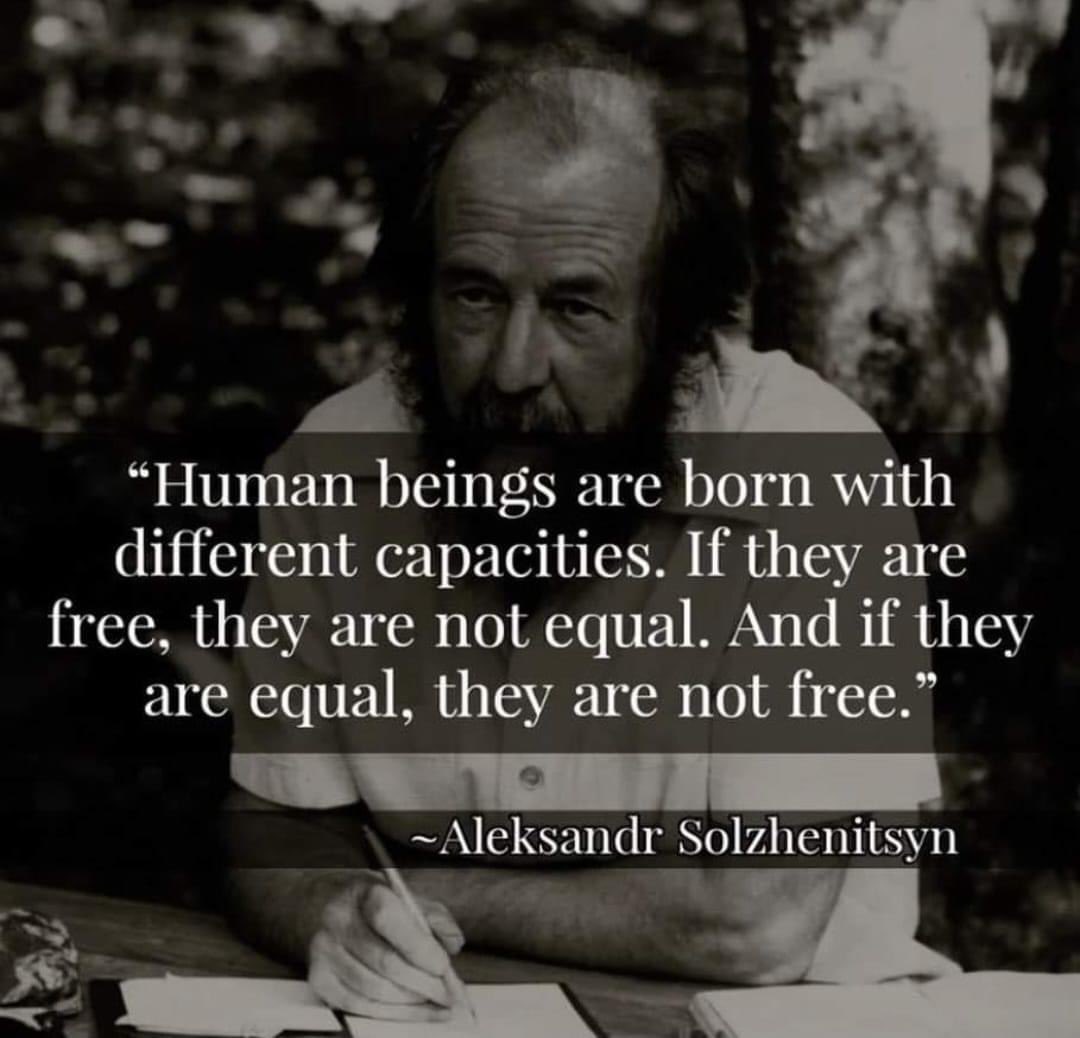
This meme only “works” if you stop letting equality smuggle itself in as a moral trump card.
Humans are born uneven. Not in worth—in capacity. Strength, IQ, impulse control, charm, health, family stability, appetite for risk, luck. You can pretend those differences don’t matter, but the moment people are allowed to act freely, they cash out into unequal outcomes. Some people build, some coast, some burn it all down. Freedom is a sorting machine.
So the first half is basically a description: if people are free, they will not end up equal. Not because someone rigged the game. Because the inputs aren’t equal and choices compound.
The second half is the warning: if you demand equality of outcomes, you don’t get it for free. You get it by force. There’s no other mechanism. Outcomes only converge when you stop people from doing the things that produce divergence: earning more, choosing differently, hiring freely, saying what they think, competing hard, associating with who they want, opting out. Equality-as-leveling needs an enforcer. And enforcers don’t show up with a gentle “please.” They show up with rules, penalties, and permission structures—what you’re allowed to do, to say, to keep.
That’s the core trade: freedom produces inequality; outcome equality requires coercion.
Now for the part people always dodge: there are different “equalities.” And conflating them is the whole scam.
- Equal dignity: every person counts as a person. That’s a moral claim. Compatible with freedom.
- Equality before the law: same rules, same due process, no caste exemptions. Also compatible with freedom—arguably required for it.
- Equality of outcomes: everyone ends up in roughly the same place. That’s the one that fights liberty, because it needs constant correction.
Most modern arguments cheat by pointing at the first two and then demanding the third. “If you deny outcome parity, you deny human worth.” No—what you’re denying is the claim that the state (or HR, or the university, or the tribunal) should get to manage adult lives until the spreadsheet looks morally satisfying.
You can have compassion without pretending outcomes should match. You can want upward mobility without confiscating difference. You can care about the bottom without pretending the top is illegitimate.
And yes: sometimes liberty creates ugly inequality. The honest response is to name the costs and argue about which constraints are justified—fraud laws, safety nets, antitrust, disability supports, basic education—without turning “equality” into a magic word that dissolves the question of coercion.
The meme’s point is simple and harsh: if you want equal outcomes, you’re volunteering everyone for supervision. And the people doing the supervising never start by supervising themselves.

A meme slid past my feed this week that’s basically a whole comment section compressed into one sentence:
“If you’re real quiet about Renée Good and Alex Pretti, but were really loud about Charlie Kirk—I see you. We all see you.”
You can feel what it’s trying to do. It’s not asking a question. It’s issuing a verdict — and inviting the crowd to clap. 👀
Before we get moral about it (or defensive about it), it helps to name what’s happening. This kind of meme is a conversational device. It’s a way of sorting people into “clean” and “suspect” without having to do the slow work of inquiry.
This post isn’t about denying hypocrisy exists. Selective empathy is real. It’s ugly. It’s also common — across every tribe that’s ever existed. The point here is narrower:
When we treat silence as proof of motive, we stop talking about what’s true and start talking about who’s safe.
And once the conversation becomes “who’s safe,” facts arrive late and leave early.
What the meme is actually doing
That one sentence performs four moves:
- An observable claim: “Some people were loud about X and quiet about Y.”
- A measurement dodge: “Loud” and “quiet” are undefined (posts? news coverage? your feed? my feed?).
- A motive leap: The difference is taken as evidence of moral defect.
- A social threat: “I see you. We all see you.” = reputational enforcement.
In other words: it skips the checkable part (#1) and jumps straight to the morally satisfying part (#3), backed by a crowd (#4).
If you want conversation instead of sorting, you reverse the order: connect → define → test → then (carefully) infer.
The best one-sentence reply is not a rebuttal
Before you ask any questions, you lower the temperature:
“All political violence and unjust killing is wrong. If selective empathy is happening, I agree it’s worth confronting.”
That sentence does two things: it refuses the tribal frame, and it makes your questions sound like inquiry rather than evasion.
Make the meme’s claim testable
Here are the three questions that turn heat into light:
- “When you say loud vs quiet, what counts as loud/quiet?”
- “Do you mean the same individuals, or the general vibe of your feed?”
- “On a 0–10, how sure are you it’s the same people — and what gets you to that number?”
If the conversation can’t answer those, it isn’t actually about truth. It’s about loyalty.
“Real conversations” in action (composites)
What follows are composites — not quotes — written to sound like the kinds of exchanges that reliably show up under posts like this. The point is not to win. The point is to keep two minds in the same room long enough to examine certainty.
Conversation A: The public comment (low bandwidth, high heat)
Them: “If you were loud about Kirk but quiet now, you’re telling on yourself.”
You: “I hear the frustration. Selective empathy is real, and it’s corrosive.”
Them: “Exactly. People only care about their team.”
You: “Can I ask one clarifying question — when you say ‘quiet’ and ‘loud,’ do you mean the same individuals, or the general vibe of your feed?”
Them: “Same individuals.”
You: “On a 0–10, how sure are you it’s the same individuals?”
Them: “Nine.”
You: “What gets you to 9?”
Them: “I saw them post about Kirk immediately.”
You: “Okay. What would move you to an 8? Would it matter if some of them simply never saw the other story, or didn’t know enough yet to comment?”
Them: “Maybe, but come on.”
You: “Fair. I’m not denying hypocrisy exists. I’m trying to separate ‘didn’t see / didn’t know’ from ‘doesn’t care.’ If we’re going to accuse motives, I want it to land on something we can actually verify.”
Notice the move: you don’t “defend the quiet.” You ask whether the accusation is evidence-based or feed-based.
Conversation B: The DM (relationship context)
Friend: “I’m sick of fake empathy.”
You: “I get that. Can I ask what you want to happen with a post like this — reflection, apology, pressure, unfriending?”
Friend: “I want people to admit they’re biased.”
You: “Okay. On a 0–10, how sure are you it’s bias rather than attention/algorithm/people being afraid to say the wrong thing?”
Friend: “Nine.”
You: “What’s the strongest thing that puts it at 9?”
Friend: “They posted about Kirk instantly.”
You: “That’s a real data point. Would you be willing to test one person you mean? If they genuinely didn’t see the other story, would you want to know that before concluding motive?”
Friend: “…Yeah.”
You: “That’s all I’m guarding: one small door for ‘maybe there’s another explanation’ before we turn silence into a moral indictment.”
This is the “impossible conversations” pivot: from verdict to conditions for revising certainty.
Conversation C: The trap (“You were loud about Kirk”)
Them: “Funny you’re talking now. You were loud about Kirk.”
You: “Fair question. What are you inferring from that?”
Them: “That your empathy is tribal.”
You: “I don’t want that to be true. My honest answer is: the Kirk story saturated my feed, so I reacted fast. I saw the other story later.”
Them: “Convenient.”
You: “Maybe. So let’s test it. If you saw me condemn violence consistently across cases, would that move your certainty down even one point?”
Them: “Possibly.”
You: “Then we’re not stuck. And I’ll take the lesson too: I should be slower to mind-read others, because I don’t want it done to me.”
You decline the moral cage match and offer a falsifiable check: consistency over time.
The hidden leap: silence equals motive
The meme’s real power comes from a hidden assumption: silence proves character.
Sometimes silence is cowardice. Sometimes it’s indifference. Sometimes it’s ignorance. Sometimes it’s grief in private. Sometimes it’s uncertainty. Sometimes it’s algorithmic — people genuinely did not see what you saw.
If you want to accuse motives, you can. But if you want to persuade people who don’t already agree with you, you need to do the hard part first: define what you’re measuring, and test whether your inference survives alternative explanations.
A few clarifications before the comments do what comments do
- “So you’re saying hypocrisy isn’t real?” No. I’m saying hypocrisy accusations land harder when they’re grounded rather than assumed.
- “So you’re saying violence isn’t political?” No. I’m saying political interpretation isn’t a substitute for checking claims.
- “So you’re tone-policing?” No. I’m trying to keep inquiry alive when the conversation is about to be sealed shut.
- “So this is manipulation?” Only if you use it to stall forever. The point is mutual standards and one testable claim. If we can’t do that, we exit.
Suggested reading
- How to Have Impossible Conversations — the toolkit behind the “connection → certainty → one claim” pattern
- The Righteous Mind — why moral intuitions lead and reasoning follows
- Mistakes Were Made (But Not by Me) — why doubling down feels like integrity
- Never Split the Difference — practical emotional-safety tactics
- How Minds Change — what actually shifts belief over time











 bleatmop
 Mystro
 The Arbourist


 Dead Wild Roses
Your opinions…