
You are currently browsing the tag archive for the ‘Censorship’ tag.
Collin May has published a long, ambitious essay in the C2C journal (Hearts of Darkness: How the Left Uses Hate to Fuel its 21st Century Universal Imperium) on cancel culture, “hate” rhetoric, and the modern left’s moral posture. It is broader than I would write, more philosophical than most readers will tolerate, and occasionally overbuilt. But it names a pattern that matters, and one I return to often here: once “hate” becomes a universal accusation, institutions stop persuading and start policing.
May’s most useful contribution is not just the complaint (“cancel culture exists”) but the mechanism: “hate” stops being a moral description and becomes a category that pre-sorts who may be argued with and who may simply be managed.
That is the issue.
Not whether hatred exists. It does. Not whether some speech is vicious. It is. The issue is what happens when “hate” becomes the default label for disagreement, skepticism, refusal, dissent, or plain moral and factual judgments that cut against elite narratives.
At that point, the term stops describing and starts doing administrative work.
You can watch this happen across the institutions that shape public life: media, HR departments, professional bodies, universities, bureaucracies, and the expanding quasi-legal space around speech regulation. The sequence is familiar. Someone raises a concern about policy, ideology, language rules, school programming, medical ethics, public safety, immigration, religion, or sex-based rights. Instead of answering the argument, the institution reframes the speaker. Not wrong—harmful. Not questioning—spreading hate. Not participating in democratic friction—a threat to social order.
That move changes the rules of engagement. A wrong claim can be debated. A “hateful” claim can be quarantined. Once a claim is reclassified as harm rather than argument, the institutional response changes with it: less rebuttal, more restriction.
This language matters because it is not only moral language. It is managerial language. It justifies deplatforming, censorship, professional discipline, reputational destruction, and exclusion from ordinary civic legitimacy. It creates a class of people whose arguments no longer need to be answered on the merits. It also trains bystanders to confuse moral panic with moral seriousness.
May explains this through a large historical and philosophical genealogy. Fair enough. I am less interested in the full genealogy than in the practical result in front of us. In plain terms: the rhetoric of “hate” is often used to centralize authority in institutions that no longer trust the public and no longer feel obliged to reason with them.
That is one reason trust keeps collapsing.
People can live with disagreement. They can even live with policies they dislike. What they do not tolerate for long is being handled—being told their questions are illegitimate before they are heard. Once citizens conclude that institutions are using moral language as a shield against scrutiny, every future statement gets discounted. Even true statements are heard as spin.
And then the damage compounds. If “hate” is defined so broadly that it includes dissent, genuinely hateful speech becomes harder to identify and confront. The category gets inflated, politicized, and cheapened. Meanwhile, ordinary democratic disagreement becomes harder to conduct without professional or social risk.
That is not a confident free society. It is a managerial one.
Canada is not exempt. We have our own versions of this habit: speech debates reframed as safety debates, policy criticism recoded as identity harm, and public disputes (including over schools, sex-based rights, and even routine civic rituals like land acknowledgements) routed through tribunals, regulators, HR offices, and media scripts instead of open argument. The details vary by case. The mechanism does not. This tactic is not unique to one political tribe, but it is now especially entrenched in progressive-managerial institutions, which is precisely why it has so much reach.
The answer is not to deny hatred exists, or to become casual about cruelty. The answer is to recover civic discipline.
Name actual incitement when it occurs. Enforce existing laws where there are real threats, harassment, or violence. But stop using “hate” as a catch-all for disfavoured views. Stop treating condemnation as a substitute for evidence. Stop teaching institutions that the way to win an argument is to disqualify the speaker.
May quotes Pope Francis on cancel culture as something that “leaves no room.” Whether or not one follows his full historical argument, that phrase captures the operational problem.
A liberal society cannot function if citizens are only permitted to disagree inside moral boundaries drawn in advance by bureaucrats, activists, and legacy media.
The test is simple: can a claim be examined without first being moralized into silence?
If the answer is no, that is not moral confidence. It is institutional insecurity backed by power.
That is the pattern worth naming. And that is why essays like May’s, even when they overshoot, remain worth reading.

References
Collin May, “Hearts of Darkness: How the Left Uses Hate to Fuel its 21st Century Universal Imperium,” C2C Journal (February 16, 2026), https://c2cjournal.ca/2026/02/hearts-of-darkness-how-the-left-uses-hate-to-fuel-its-21st-century-universal-imperium/. (C2C Journal)

Children grow in stages in terms of physical, intellectual, and social development. They are able to properly comprehend ideas and concepts at different points of the maturation cycle.
Thus, keeping age sensitive materials availability in tune with the developmental processes is a rational way to proceed. Activists try to blend this age appropriate filter as ‘censorship’ when in fact it just a notion tied to the very real idea of stages of child development.
Why would the activist Left want to expose children to age inappropriate and destabilizing literature?

This interview is so good!
Do think that the gender-magic might be a problem now? This corrosive religion demands absolute conformity to its strictures or you will be punished. Women who have *CORRECTLY* pointed out that this is a man have been suspended from twitter for doing so.
Truth matters. Freedom of Speech Matters. Female boundaries and safety matter. If you do not speak out against the hurt feelings/I’m offended crowd, you tacitly endorse this sort of unacceptable behaviour. Defend your rights.
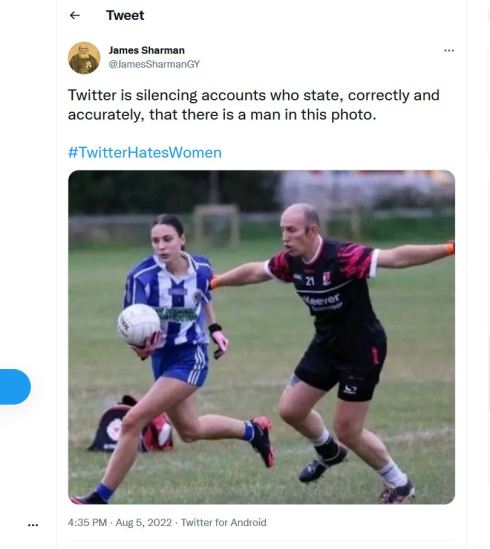
We won’t back down in defending Women’s rights here at DWR. If commenting on Sasha White’s thread is enough to get one in hotwater, so be it. There is too much at stake to sit down and shut up over this issue. Women (adult human females) are currently being unfairly ostracized, doxxed, and harassed for defending their rights, boundaries, and safety in society. We will not bend the knee to TRA demands here. Not ever.
This from 4w.pub describing the situation.
“An assistant literary agent made international headlines this week when she was fired from her job at Tobias Literary Agency in New York. Sasha White, a feminist who had started her career at Tobias as an intern, announced that she had been fired from the agency on Monday for expressing her “feminist stance” on Twitter.
White maintained two Twitter accounts—one professional, and one personal. Her professional account, @SashaSemyonovna, stated her role at Tobias while her personal account, @iamGrushenka, was largely anonymous until recently and states no connection to her former employer. In a statement to reporter Jesse Singal, President of Tobias Literary Agency, Lane Heymont, claimed that White was fired because she “did not specify her views were her own in her Twitter bio, thus suggesting and it was perceived she was speaking on behalf of the agency and those views are not in line with our beliefs. Therefore we had to part ways.”
When asked by Singal specifically what tweet violated their policies, Heymont pointed to a retweet White had made on her personal account of a post explaining the difference between how women and trans-women experience male violence.
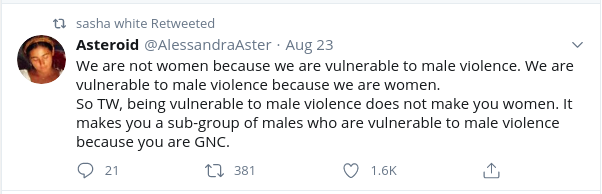
In an official statement, Tobias Literacy Agency claimed, “We do not have any room for anti-trans sentiments at TLA. Period. Thus, we have parted ways with Sasha.” TLA did not clarify what part of Sasha’s violating tweets, specifically, included anti-trans sentiment.
In response, feminists began tweeting in support of White, trending #IStandWithSashaWhite, a riff on a previous hashtag in support of another fired feminist, Maya Forstater. Forstater was fired in 2019 from her job at a UK think tank, The Center for Global Development, for similar tweets in support of a feminist analysis of gender. Forstater’s case gained global attention in December of 2019 when Harry Potter author J. K. Rowling tweeted in her defense.”











 bleatmop
 Mystro


 Dead Wild Roses
Your opinions…