
You are currently browsing The Arbourist’s articles.
When people say “trans rights,” they often smuggle in the conclusion before the argument has even begun. The phrase suggests a class of basic liberties being withheld from a minority population. In most liberal democracies, that is not the real dispute. Trans-identifying people already possess the same ordinary civil rights as everyone else: to vote, work, speak, worship, associate, and live free from assault or arbitrary exclusion. The real conflict begins when contested demands are framed as rights claims in order to place them beyond criticism.
That distinction matters. A right is not the same thing as a demand for access, validation, or institutional compliance. Female sports were not created out of prejudice, but out of recognition that sex differences matter in strength, speed, endurance, and physical risk. Female shelters, prisons, and changing rooms were built on the same logic. They exist because privacy, safety, fairness, and dignity are not imaginary goods. They are concrete protections, won through long struggle, and they do not cease to matter because a new vocabulary has been imposed on the debate.
Once this is seen clearly, much of the rhetoric falls apart. If a male-bodied person demands entry into a female space, the objection is not that he lacks human worth. It is that women have sex-based boundaries, and those boundaries exist for reasons. If a parent objects to gender ideology in schools, that is not the denial of anyone’s basic rights. It is the defense of parental authority in an area of profound moral and developmental consequence. If a citizen resists compelled pronouns or refuses to treat metaphysical claims about sex as binding fact, that is not violence. It is a refusal to surrender conscience and language to activist pressure.
“When one group’s ‘rights’ require another group to surrender privacy, fairness, or conscience, the conflict is no longer about equality. It is about power.”
This is where the phrase “trans rights” does its real work. It pre-loads the moral verdict. It makes disagreement sound like oppression before the argument has even begun. Once that framing is accepted, women’s boundaries become cruelty, parental caution becomes hatred, and democratic disagreement becomes abuse. But this is not a serious use of rights language. It is a way of insulating contested claims from scrutiny by wrapping them in the prestige of civil rights.
None of this means every accommodation is unreasonable, or that every dispute is zero-sum. Ordinary civility and equal treatment in public life are not difficult standards to defend. But when one group’s claimed “rights” require another group to surrender privacy, fairness, language, or the right to maintain sex-based boundaries, the conflict has moved beyond equal citizenship. It has become a struggle over whose moral framework will rule, and whose objections will be permitted to count.
That is why the language matters. “Trans rights” sounds like a plea for equal liberty. In many of the most contentious cases, it is something else: a demand that others yield, affirm, and rearrange long-standing social boundaries on command. When women refuse that erasure, or parents refuse that indoctrination, or citizens refuse that compelled speech, they are not violating rights. They are defending their own.

One of the stupider habits in media criticism is the claim that one bubble tells the truth and the other tells fairy tales. In Canada, the usual version is that mainstream media give the public a softened, reassuring picture of Liberal rule, while X is where people go for the hard reality.
That flatters both sides.
The problem is not usually fabrication. It is calibration. Different media environments distort reality by different mechanisms. Mainstream outlets tend to smooth, normalize, and translate failure into managerial language. X tends to sharpen, inflame, and convert every pressure into proof of regime decay. One teaches underreaction. The other teaches overreaction.
The early Carney era makes the pattern easy to see. The Liberal rebound is real. 338Canada’s March 8 polling snapshot had the Liberals at 45%, with several late-February and early-March polls putting them in the mid-to-high 40s. Carney projects competence, institutional fluency, and stability at a moment when many voters are tired of noise. A media system does not need to invent momentum when momentum exists.
But that does not mean the picture is balanced. Institutional media often frame persistent problems in the language of management rather than consequence. Housing becomes a supply challenge. Immigration strain becomes recalibration. Cost-of-living pain becomes a headwind. Even when the facts are there, they are often cushioned by tone. A government cutting immigration targets after years of visible strain can be framed less as an admission of damage than as prudent adjustment. Ottawa’s own immigration levels plan uses the language of “restoring balance and control” while reducing temporary-resident arrivals and stabilizing permanent-resident admissions. A chronic failure described in the voice of process sounds less like failure.
“One side launders stress through institutional language. The other turns every strain into apocalypse.”
That is the mainstream distortion. It is not usually lie-by-falsehood. It is lie-by-emphasis. What is softened, what is normalized, what is treated as regrettable but basically under control.
X distorts in the opposite direction. It takes real pressures and narrates them at maximum intensity. Every shortage becomes collapse. Every compromise becomes betrayal. Every omission in legacy media becomes proof of protection or conspiracy. A grim housing forecast or weak affordability number can move through the platform in hours as evidence that Canada is finished. X sometimes performs a real service by surfacing data, reports, and institutional failures that legacy outlets underplay. Its weakness is not attention, but proportion.
That is why both bubbles feel persuasive from the inside. Each one is attached to something real. The mainstream press is right that public opinion can shift and governments can recover. X is right that the country’s underlying pressures did not disappear because the branding changed. Housing is still broken. CMHC’s latest supply-gap estimate says housing starts would need to rise to roughly 430,000 to 480,000 units a year through 2035 to restore affordability, far above the current pace. A better suit and calmer tone do not cancel that.
So the real divide is not truth versus lies. It is polished optimism versus permanent indictment. One side launders stress through institutional language. The other turns every strain into apocalypse. Neither gives citizens a good sense of scale.
That is the danger of media bubbles. They do not just tell people what to think. They teach people how hard to feel. Mainstream media often teach Canadians to underreact to chronic deterioration. X teaches them to experience every deterioration as final proof that the whole order is rotten.
Reality is uglier and less satisfying than either story. Canada is not collapsing. Canada is not well. Carney may have political momentum. The country may still be carrying pressures that no narrative reset can solve. Both things can be true at once.
The sane response is not to trust one bubble against the other. It is to distrust the emotional calibration of both. Read institutional media for reporting. Read adversarial media for pressure points. Believe neither atmosphere.
That is less exciting than choosing a tribe. It is also closer to reality.

One of the most destructive temptations in politics is the urge to turn disagreement into moralized tribal war. Not argument. Not persuasion. Not the hard, frustrating work of governing a society full of competing interests and imperfect people. War. Friends and enemies. Allies and traitors. The pure and the contaminated. Once that frame takes hold, politics stops being about order, restraint, and judgment. It becomes a loyalty machine. Carl Schmitt gave this instinct its most famous formulation in The Concept of the Political, where he argued that the essence of politics lies in the distinction between public friend and public enemy. He was right to see that real political life can descend to existential conflict. He was wrong to treat that descent as the essence of politics rather than one of the permanent dangers civilized politics is supposed to contain. The friend-enemy distinction is not the foundation of healthy politics. It is the logic of political decay.
The danger is not only that the framework is harsh. Politics can be harsh. The danger is that it installs enmity at the center of public life and pushes everything else to the margins. Institutions, laws, debate, compromise, constitutional limits, due process, even ordinary factual disagreement all become secondary. What matters is identifying the enemy, consolidating the team, and punishing hesitation. That is why this logic travels so easily across ideologies. It can appear in revolutionary Marxism, in Maoist “enemies of the people,” in Islamist loyalty-and-disavowal frameworks, in activist binaries like ally versus bigot or oppressor versus oppressed, and in right-wing scripts about traitors, regime collaborators, and weak conservatives who supposedly enable the left. The vocabulary changes. The mechanism does not. A public enemy is named, and then a moral test is imposed: how fully will you align against him?
“The ratchet always turns one way: toward greater fanaticism, greater purification, greater moral ugliness. Truth is subordinated to solidarity. Principle is subordinated to faction.”
What makes this logic totalitarian is that it abolishes the space for dissent. Once the enemy has been declared, neutrality is no longer allowed. You either join the mobilization or you are suspected of serving the enemy’s cause. Hesitation becomes complicity. Refusal becomes betrayal. Moderation becomes guilt. That is how political movements become purge machines. You can either be anti-racist or you are helping racism. You can either be a trans ally or you are enabling bigotry. You can either fight the deep state, resist the regime, and oppose the left without reservation, or you are a RINO, a coward, a collaborator. This is the structure that matters. Not the tribe wearing it. Once politics is moralized into friend and enemy, the pressure falls hardest not only on official opponents, but on the insufficiently zealous within one’s own camp.
That is why factions organized around “no enemies to the left” or “no enemies to the right” almost always radicalize inward. The outer edge of the movement becomes untouchable because criticizing it risks helping the enemy. So the only safe targets are moderates, doubters, and fellow travelers who fail the loyalty test. The left protects its most extreme activists and attacks liberals who cannot keep up. The right protects its own hardliners and attacks conservatives who still think prudence, constitutional restraint, or factual discipline matter. In both cases, the center is hollowed out first. The ratchet always turns one way: toward greater fanaticism, greater purification, greater moral ugliness. Truth is subordinated to solidarity. Principle is subordinated to faction. Politics ceases to be the art of living together under conditions of disagreement and becomes a permanent sorting mechanism for friends, enemies, and suspects.
A civilized society cannot survive on those terms. That does not mean pretending enemies never exist. They do. Free societies are not obliged to indulge movements openly hostile to liberty, law, and peaceful coexistence. But the achievement of constitutional civilization is precisely that it refuses to make enmity the organizing principle of normal public life. It channels conflict through law, opposition, procedure, restraint, and rights. It leaves room for disagreement without turning every disagreement into proof of treason. That is the line Schmitt blurred and totalitarian movements erase completely. The mistake is not in noticing that politics can become existential. The mistake is in treating that possibility as the deepest truth of politics and then building public life around it. Once you do that, purges are no longer an accident. They are the destination. Friend-enemy politics is not realism. It is the operating system of political decay.

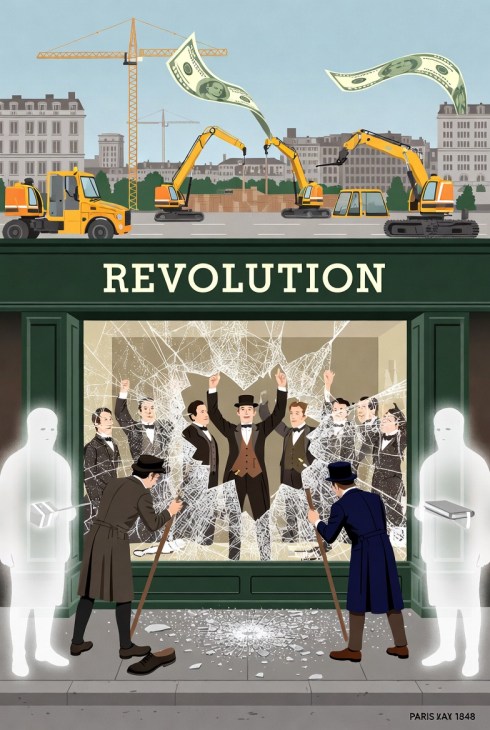
The ‘Broken Window’ parable has lasted because the mistake it identifies is permanent. People keep confusing motion with wealth.
A shop window gets smashed. The glazier benefits. He is paid to replace it. Money changes hands. Work is created. Onlookers reassure themselves that the damage at least “helped somebody.” Bastiat’s point is that this is where bad economic reasoning begins. The shopkeeper must now spend money restoring what he already had instead of buying something new, improving his business, saving, or investing. The glazier gains work. The shopkeeper loses options. Society ends up with a replaced window instead of a replaced window plus whatever else might have been created. That is not growth. It is recovery from loss.
In That Which Is Seen, and That Which Is Not Seen, published in 1850, Bastiat gave this simple error its enduring form. The visible effect is easy to grasp: the glazier gets income, then spends it elsewhere, and activity ripples outward. But the visible beneficiary is only half the story. What disappears from view are the unrealized alternatives: the suit never bought, the tool never purchased, the apprentice never hired, the expansion never attempted. The fallacy survives because the gain is concrete and public while the loss is dispersed and hypothetical. One can be pointed to. The other must be reasoned out.
“People keep confusing motion with wealth. Visible activity is easy to celebrate. The wealth that never came into being is harder to see, and easier to ignore.”
That is why the broken window is not really about vandalism. It is about how easily public argument stops at the first visible effect and calls the matter settled. Once you see that, a great deal of modern economic rhetoric starts to look less like analysis than stagecraft.
The pattern is familiar in debates over stimulus spending. Governments announce major spending packages. The public is shown crews on worksites, contracts being signed, jobs being counted, funds “flowing into the economy.” The imagery is always immediate and flattering. Something is happening. Therefore something good must be happening.
But visible activity is not the same thing as net wealth creation. Government does not create resources from nothing. It taxes them away, borrows them away, or inflates them away. In each case, resources are redirected from other possible uses. The serious question is not whether public spending produces measurable effects. Of course it does. The serious question is whether those resources would have created more value had they remained in private hands, guided by price signals, local knowledge, and voluntary choice rather than political allocation.
That is where the unseen side of the ledger matters. We see the bridge. We do not see the private investment that never happened because capital was drawn elsewhere. We see the subsidized payroll. We do not see the household purchasing power weakened by inflation. We see the grant recipient. We do not see the startup that never secured financing, or the consumer demand that was blunted by higher taxes or debt service. Public spending can make its beneficiaries highly visible while leaving its displaced alternatives diffuse and mostly invisible. That is politically useful, but analytically weak.
The usual reply is that recessions change the equation. When labour is idle, capital is underused, and private demand collapses, government spending may mobilize resources that would otherwise sit dormant. That is the strongest counterargument, and it should be taken seriously. A deep recession is not the same as a fully employed economy. Slack matters. Timing matters. Liquidity panics matter. A blanket denial of all countercyclical policy is cruder than Bastiat’s actual insight deserves.
But this does not rescue the broken window logic from criticism because it does not actually answer it. Even in a downturn, the central question remains comparative: compared to what? If the claim is that temporary public spending can stabilize demand under exceptional conditions, that is at least a serious argument. But it is not the same argument as saying that destruction creates prosperity, or that politically directed spending is wealth in itself. It still matters what is being funded, how efficiently it is administered, what incentives it creates, and whether the spending is genuinely using idle resources or merely displacing better uses that are harder to measure in real time.
“Replacement is not creation. Redirection is not prosperity. A society does not become richer by repairing destruction and calling the bustle growth.”
That distinction matters because bad arguments often smuggle themselves in under good intentions. A narrow case for emergency stabilization can turn into a permanent political habit of treating state spending as inherently productive. Once that shift happens, Bastiat’s warning reasserts itself in full. Replacement is still not creation. Redirection is still not spontaneous enrichment. Measured output can rise while underlying wealth formation weakens.
The same mistake appears after natural disasters and during wartime booms. After a hurricane, people say rebuilding will “boost the economy.” During war, people point to full factories and rising production figures. But rebuilding what was destroyed is not the same as becoming richer. Producing goods for destruction is not the same as expanding civilian prosperity. These events may generate employment, contracts, and output. They do not erase the prior loss. The relevant comparison is not between disaster and inactivity. It is between the world after destruction and the world in which the destruction never occurred.
That is what makes Bastiat’s lesson both obvious and routinely ignored. Visible motion is emotionally persuasive. A ribbon-cutting is easier to celebrate than an opportunity cost. A government announcement is easier to narrate than a private investment that never happened. Political systems are structurally biased toward what can be displayed, counted, branded, and claimed. The unseen has no ceremony attached to it. It leaves no plaque.
So the broken window fallacy endures not because the logic is hard, but because the discipline is hard. It requires people to keep asking the next question after the applause line. Jobs doing what? Spending on what? At whose expense? Relative to which forgone alternative? In a free economy, resources are scarce and choices are real. To pretend otherwise because spending is visible is to confuse accounting entries with prosperity.
Bastiat’s point remains devastating because it cuts through so much noise. Destruction does not enrich. Replacement does not add net wealth. Spending is not identical with prosperity. A society becomes richer when it creates new value, lowers costs, improves production, expands choice, and allows people to direct resources toward ends they actually value. It becomes poorer when it burns wealth, redirects capital by force, and congratulates itself for the bustle that follows.
That was true in Bastiat’s time. It is true now. The forms get larger, the numbers get bigger, and the rhetoric gets smoother, but the underlying mistake does not change. The glazier is still real. So is the window. So is everything we never got because we mistook repair, diversion, and visible activity for growth.
References
Bastiat, Frédéric. “What Is Seen and What Is Not Seen.” Online Library of Liberty.
https://oll.libertyfund.org/pages/wswns
Bastiat, Frédéric. “That Which Is Seen, and That Which Is Not Seen.”
https://bastiat.org/en/twisatwins.html
Bastiat, Frédéric. “Chapter 1: What Is Seen and What Is Not Seen.” Econlib.
Encyclopaedia Britannica. “Frédéric Bastiat.”
https://www.britannica.com/money/Frederic-Bastiat
Cullen, Joseph A., and Roger H. Gordon. “Taxes and Wartime Mobilization in the U.S. Economy: World War II as a Natural Experiment.” NBER Working Paper 12801.
Garin, Andy. “The Wartime Origins of Industry Location and Economic Mobility in the United States.” NBER Working Paper 33418.
Europe has spent years congratulating itself on becoming too enlightened for its old demons. The old hatreds, we were told, belonged to a darker age: church prejudice, blood-and-soil nationalism, crude ethnic chauvinism, all safely archived in museums and memorial culture. Modern Europe would be different. Liberal. Secular. Therapeutic. Post-tribal. Above all, tolerant.
And yet here we are again, with Jews across Europe reporting that open Jewish life feels risky, visibility feels costly, and public confidence in their safety has eroded badly. The European Union Agency for Fundamental Rights found in its 2024 survey that antisemitism remains a reality for many Jewish people in the EU and that most feel unable to live openly Jewish lives. The agency’s 2026 follow-up stated it even more starkly: Jewish people in the EU face antisemitism on a “nearly constant basis.”
That is the irony. Europe built an entire moral identity around remembering the Jewish catastrophe, and yet in large parts of Europe it has become normal again for Jews to calculate where to wear a kippah, whether to hide a Star of David, and which neighbourhoods are best avoided. The continent has mastered the liturgy of remembrance while struggling with the elementary duty of protection.
The preferred story, of course, is that the danger must still come from the approved villains of European memory: the nationalist brute, the Christian reactionary, the provincial right-wing throwback with too much history and not enough sociology. Sometimes it does. The far right remains real, and in Germany, for example, Reuters reported in June 2025 that the watchdog RIAS recorded 8,627 antisemitic incidents in 2024, nearly double the 4,886 recorded in 2023, and that far-right offenders were responsible for around three times as many incidents as Islamists. That fact matters, and serious people should not airbrush it away for narrative convenience.
But that is not the whole story, and everyone knows it is not the whole story.
“Europe still loves Jews in theory, in memory, in curriculum, in the high-church ceremony of remembrance days. It is the living, visible, inconvenient Jew who keeps committing the unforgivable sin of existing in public.”
What liberal Europe finds harder to admit is that some of the antisemitism now making Jewish life more precarious arrives under the cover of other sacred commitments: multicultural innocence, asylum romanticism, anti-colonial theatre, imported sectarian fury, and elite cowardice dressed up as nuance. The old hatred has not vanished. It has diversified. It now marches under more than one banner. It can wear a bomber jacket, a keffiyeh, or a university lanyard. It can quote medieval slanders or postcolonial jargon. It can shout in the street or whisper in institutional euphemism.
That is what makes the present moment so revealing. Europe did not abolish prejudice. It changed the etiquette around which prejudices could be named plainly. It became exquisitely skilled at denouncing the safe forms of antisemitism, especially the dead ones, while growing clumsy, evasive, or selectively blind toward the live ones.
So the spectacle becomes almost comic in its hypocrisy. Politicians attend Holocaust memorials by day and govern societies by night in which Jews are advised to be discreet. Institutions publish statements about inclusion while Jewish students need security. Commentators deliver lectures on democratic values while treating Jewish fear as awkward, politically inconvenient, or in need of contextualization. Europe still loves Jews in theory, in memory, in curriculum, in the high-church ceremony of remembrance days. It is the living, visible, inconvenient Jew who keeps committing the unforgivable sin of existing in public.
The deepest irony may be this: a civilization that prides itself on tolerance has become so attached to its self-image that it cannot honestly describe the forms of intolerance now flourishing inside its own borders. And when a society cannot name a problem because naming it would embarrass its governing myths, the problem does not disappear. It metastasizes.
A decent society does not prove its virtue by hosting remembrance days, curating moral vocabulary, or posting the correct slogans after each outrage. It proves its virtue when Jews can walk its streets without calculation. Europe remembers what happened. Good. It should. But remembrance that does not cash out in ordinary public safety is beginning to look less like moral seriousness than civilizational vanity.

References
European Union Agency for Fundamental Rights, Jewish People’s Experiences and Perceptions of Antisemitism (11 July 2024). Survey overview and key findings page.
European Union Agency for Fundamental Rights, Monitoring and recording antisemitism in the EU – State of play and ways forward (27 January 2026). Overview and introduction page.
Reuters, “Antisemitic incidents in Germany almost double in 2024, report says” (4 June 2025).
Raymond Ibrahim, “The Irony of Europe’s Antisemitism Problem — Jewish Safety, Migration, and a Failed Narrative,” Hungarian Conservative (21 January 2026). Used here as thematic inspiration rather than as a primary evidentiary source.
One of the more unsettling ideas in political history is that civilization may depend not only on teaching people virtue, but on steadily removing the people least capable of civilized life.
That is the thesis Peter Frost and Henry Harpending explore in Western Europe, State Formation, and Genetic Pacification. It cuts against the modern habit of explaining violent disorder almost entirely through environment, incentives, poverty, trauma, and weak institutions. Those things matter. But Frost and Harpending press a harder possibility: what if the long pacification of Western Europe was driven not only by stronger states and changing norms, but also by selection against the men most prone to chronic violence? (PubMed)
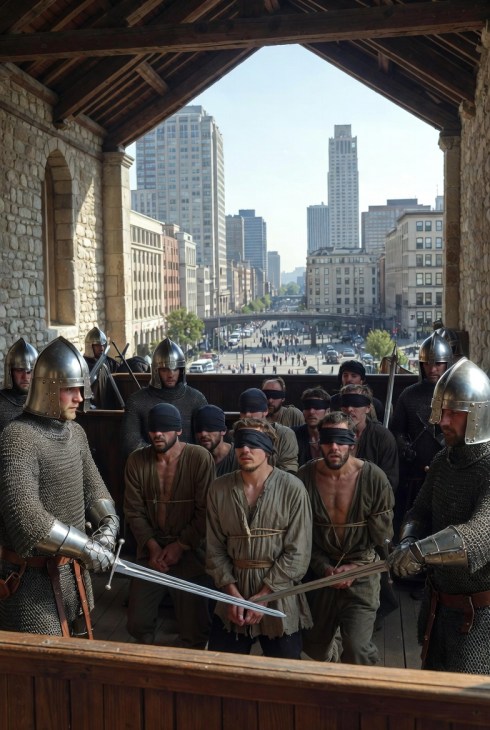
The historical pattern they point to is clear. In medieval Europe, homicide rates were vastly higher than in the modern West. Over time, as states consolidated their monopoly on violence and private vengeance receded, courts imposed the death penalty more systematically. Frost and Harpending argue that by the late Middle Ages, courts were condemning between 0.5 and 1.0 percent of all men of each generation to death, with perhaps as many more violent offenders dying at the scene of crimes or in prison while awaiting trial. Meanwhile, long-run homicide rates in Western Europe fell dramatically across the centuries. That broader decline is visible not only in their paper but in later summaries built from Manuel Eisner’s historical homicide datasets. (PubMed; Our World in Data)
That much already matters. Peace is not the natural resting state of a society. It is achieved. It is enforced. It is built through institutions capable of suppressing predation. The state does not merely administer order after the fact. It creates the conditions under which ordinary trust can exist. Without that floor, commerce, family stability, education, beauty, and freedom remain fragile.
But Frost and Harpending are interested in more than deterrence. Their stronger claim is that repeated removal of violent men from the breeding population may have altered the population itself over many generations. In plain language: if men most disposed to impulsive violence, predation, and chronic criminality are disproportionately executed, killed while offending, or otherwise prevented from reproducing, then over centuries one should expect some reduction in the prevalence of those tendencies. The state, in that account, does not just restrain violence from the outside. It may slowly reshape the human material with which the society reproduces itself. (PubMed)
That is the interesting part of the thesis, and the part that needs the cleanest handling. Frost and Harpending present it not as a settled master key to European history, but as a plausible co-factor alongside state formation, punishment, and cultural conditioning. Direct genomic confirmation remains absent. Other explanations place more weight on the state’s monopoly on violence, changing norms of self-control, declining honor culture, economic development, and improved policing. So the strongest honest claim is not that the paper has solved the history of European pacification. It is that it raises a serious possibility modern readers are strongly conditioned not to consider. (PubMed)
“Civilization is not sustained by kindness alone. It rests on a prior achievement: order strong enough to protect the peaceable from the predatory.”
Even with that caution in place, the paper still does useful work. It moves the discussion beyond the sterile split between “bad systems” and “bad individuals.” It suggests a layered civilizing process: institutions suppress violent conduct, norms change under the shelter of that order, and then, possibly, population traits shift over time as the most antisocial men are less likely to survive and reproduce. Culture and coercion do not sit in separate boxes here. They interact.
You do not have to buy every part of that model to see why it has force. A society does not begin from zero every generation. It inherits habits, expectations, institutions, and distributions of temperament formed over long stretches of time. If Western Europe became unusually low in interpersonal violence by world-historical standards, that happened through a civilizing process measured in centuries, not slogans. It was produced by a long narrowing of the space in which violent men could operate, flourish, and reproduce themselves socially.
That last phrase matters because reproduction here is not only biological. Violent men reproduce disorder culturally as well. They shape neighborhoods, train younger males, normalize intimidation, degrade family life, and turn predation into a viable strategy. Once that ecology is established, disorder becomes self-reinforcing. The reverse is also true. When a state reliably incapacitates the worst predators, peace can become self-reinforcing too.
That is part of why modern examples like El Salvador draw so much attention. The cases are not equivalent, and they do not prove Frost and Harpending’s genetic hypothesis. What they do show is older and simpler: when a state decisively removes a violent criminal stratum from daily circulation, social peace can return with surprising speed. The IMF reported in 2025 that El Salvador’s homicide rate fell from 54 per 100,000 in 2018 to 1.8 in 2024, and tied the improvement in security to stronger growth, tourism, remittances, and investor confidence. Human Rights Watch, from the opposite moral angle, also reports a significant decline in gang violence while warning that restricted data access and changes in homicide counting complicate full independent verification. (IMF; HRW; AP)
That is where a serious reader has to keep both truths in view at once. El Salvador does not demonstrate multi-generational selection. It demonstrates the older principle that predators must be removed from circulation if ordinary life is to recover. At the same time, Human Rights Watch documents arbitrary detention, torture, ill-treatment, and deaths in custody under the state of exception. The rights costs are real. The case does not prove that every harsh regime is wise. It proves that liberal societies often flatter themselves about how peace is maintained. (HRW)
This is not an argument for population engineering or collective guilt. It is an argument for recognizing that a small fraction of high-rate violent offenders can do outsized damage, and that civilization depends on their incapacitation. Modern liberal societies are comfortable discussing prevention, rehabilitation, and root causes. They are much less comfortable discussing the incorrigible. But any serious civilization needs a theory of that minority and the will to act on it long enough for the peaceable majority to live normally.
That, in the end, is the value of Frost and Harpending’s paper. Not that it offers a final key to history. Not that every part of its model has been settled beyond dispute. It matters because it reopens a forbidden question: how much of social peace depends not merely on teaching better values, but on the long-term suppression of the people least fit for peaceful life? Even readers who reject the paper’s stronger selection claim should still feel the pressure of that deeper point. Order is not self-generating. It has to be maintained against people who would dissolve it if allowed.
Modern states, at their best, answer that problem more humanely than medieval ones did. They use prisons rather than gallows. They rely on due process rather than spectacle. Good. They should. But the softer method does not abolish the harder principle. Social peace depends on removing certain people from the field, sometimes for a very long time.
That is the truth buried beneath the discomfort here. Civilization is not sustained by kindness alone. It rests on a prior achievement: order strong enough to protect the peaceable from the predatory. Everything higher comes after that.
References
Peter Frost and Henry C. Harpending, “Western Europe, State Formation, and Genetic Pacification,” Evolutionary Psychology 13, no. 1 (2015). PubMed: https://pubmed.ncbi.nlm.nih.gov/25748943/ ; journal page: https://journals.sagepub.com/doi/10.1177/147470491501300114
International Monetary Fund, El Salvador: Request for Extended Arrangement Under the Extended Fund Facility (2025). IMF page: https://www.elibrary.imf.org/view/journals/002/2025/058/article-A001-en.xml ; PDF: https://www.imf.org/-/media/files/publications/cr/2025/english/1slvea2025001-print-pdf.pdf
Human Rights Watch, “World Report 2026: El Salvador.” https://www.hrw.org/world-report/2026/country-chapters/el-salvador
Our World in Data, historical homicide materials drawing on Manuel Eisner’s data: https://ourworldindata.org/data-insights/homicide-rates-have-declined-dramatically-over-the-centuries and https://ourworldindata.org/grapher/homicide-rates-across-western-europe
Associated Press, “El Salvador closes 2024 with a record low number of homicides.” https://apnews.com/article/69384a8705267eaddd18dcd28a53465b
“Someone You Loved” is built on a kind of beautiful restraint. The piano moves in a steady, unadorned pattern, and everything else seems to gather around it with care rather than force. That sparseness is the song’s great strength. It leaves room for the ache. Lewis Capaldi does not bury heartbreak under cleverness or overproduction. He sings it plainly, with a voice that frays at the edges just when it should, turning private grief into something large enough for strangers to recognize in themselves.
What makes the song linger is not complexity but exposure. Its language is simple, almost naked, and that is why it cuts. This is not heartbreak dressed up as poetry. It is heartbreak admitted. By the time the chorus returns, it does not feel like repetition so much as the mind circling the same wound, unable to leave it alone. “Someone You Loved” understands that loss is rarely dramatic in the way films imagine it. More often it is a sudden coldness where warmth used to be, a hand reaching for what is no longer there. That is the space this song inhabits, and it does so with uncommon grace.











 bleatmop
 Mystro


 Dead Wild Roses
Your opinions…