
You are currently browsing The Arbourist’s articles.
“You typed it. Someone lived it.”
That is the ominous opening of an Edmonton Police Service campaign encouraging residents to report “online hate.” Perhaps this means threats, criminal harassment, incitement to violence or the wilful promotion of hatred—all matters in which the police may have a legitimate role.
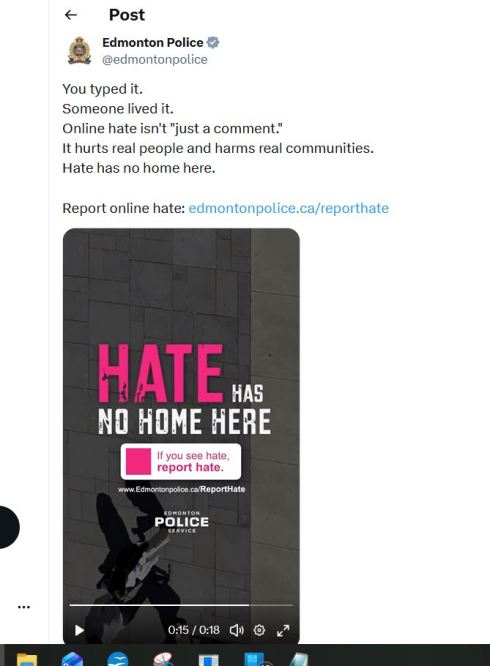
Follow the link, however, and the mandate becomes considerably broader.
EPS defines a “hate-motivated incident” as a non-criminal action motivated by bias, prejudice or hate. Its examples include insults, offensive jokes, slurs and racial comments. Reports receive a police file number, are reviewed by Hate Crime investigators and may result in contact from an investigator.
In other words, Edmonton police are inviting citizens to report one another for speech that the police themselves acknowledge may be entirely lawful.
There is a reasonable argument for recording certain non-criminal incidents. A slur painted on someone’s fence may precede vandalism or violence. A pattern of escalating behaviour may help police assess a later threat. Victims may also need information about services even when no charge is possible.
But those limited purposes do not justify a public campaign that deliberately blurs the boundary between crime and offence.
Canadian law sets a demanding threshold for criminal hate speech. Public incitement must be likely to cause a breach of the peace, while wilful promotion requires more than an ugly opinion or an offensive joke. The Supreme Court has described the legal definition of hatred as an “onerous and objective standard.” That high threshold exists because freedom of expression means very little if it protects only speech that authorities consider kind, constructive or socially beneficial.
“Hate has no home here” may be a civic aspiration, but it is not a legal standard. Hurt is real, yet hurt alone does not confer police jurisdiction.
When police encourage reports of lawful expression, they place the weight of the state behind ordinary social and political disputes. The resulting file may never produce a charge, but the knowledge that a joke, argument or unpopular opinion can reach a Hate Crime investigator is itself capable of chilling speech.
EPS should vigorously investigate threats, harassment, vandalism and criminal hate propaganda. It should also tell citizens clearly when reported conduct is not a police matter.
A free society must leave room for speech that is stupid, cruel and offensive. Such speech can be answered, condemned or ignored. It should not automatically become an entry in a police database.
The police exist to enforce the law—not to supervise Edmonton’s emotional climate.
References
- Edmonton Police Service, “Report a Hate Motivated Incident Online”:
https://www.edmontonpolice.ca/ContactEPS/ReportAHateMotivatedIncidentOnline - Edmonton Police Service, “Hate and Bias Crime”:
https://www.edmontonpolice.ca/CommunityPolicing/OrganizedCrime/HateBiasCrime - Criminal Code, section 319:
https://laws-lois.justice.gc.ca/eng/acts/c-46/section-319.html - Supreme Court of Canada, Hansman v. Neufeld, 2023 SCC 14:
https://decisions.scc-csc.ca/scc-csc/scc-csc/en/item/19911/index.do

The accompanying meme asks why women are increasingly described as “menstruators,” “pregnant people” and “cervix-havers,” while men appear less frequently as “ejaculators” or “penis people.”
The absolute comparison is imperfect. Some medical organizations now use expressions such as “people with prostates.” That does not answer the objection; it merely demonstrates that the same ideology can make language equally absurd in both directions.
Sex is a biological reality, not an identity. The Canadian Institutes of Health Research defines sex through biological attributes including chromosomes, hormones and reproductive anatomy.[1] Personal feelings may affect how someone wishes to dress, live or be addressed, but they cannot transform a male body into a female one or vice versa.
No male requires a Pap test, becomes pregnant or menstruates. No female develops prostate or testicular cancer. A female who identifies as a man may still require cervical screening, but that is because she remains female. Her identity does not make cervical cancer a male health issue.
Nor does saying that women menstruate imply that every woman currently menstruates. Children, post-menopausal women, women with certain medical conditions and women who have undergone surgery remain female. Ordinary category language has never required every member of a class to display every characteristic associated with it.
The linguistic transformation therefore serves another purpose. Once woman is redefined as an internal identity available to males, it can no longer reliably name the female sex. Yet medicine, law and politics still require a way to discuss female bodies. Women are consequently reassembled as lists of organs and functions: uterus-havers, menstruators and birthing bodies.
That is the anti-woman streak within transgender ideology. It does not merely ask that a small number of people be treated courteously. It demands that women surrender the language required to describe themselves as a sex class—and then presents their disappearance as inclusion.
This matters beyond wounded sensibilities. Women’s health research depends upon recognizing sex differences; Health Canada explicitly warns that failing to study women as a distinct sex can obscure clinically important differences in treatment and outcomes.[2] The same clarity is necessary when discussing pregnancy, sexual violence, sport and sex discrimination.
Courtesy toward individuals does not require institutions to falsify material reality. Medical professionals can treat every patient with dignity while recording sex accurately and speaking plainly about which sex is affected by a condition.
Women are not menstruators, cervix-havers or birthing bodies. They are women. Language that cannot say so is not inclusive; it has simply made women harder to name.
References
- Canadian Institutes of Health Research, “What is gender? What is sex?”
https://cihr-irsc.gc.ca/e/48642.html - Health Canada, “Considerations for Inclusion of Women in Clinical Trials and Analysis of Data by Sex.”
https://www.canada.ca/en/health-canada/services/drugs-health-products/drug-products/applications-submissions/guidance-documents/clinical-trials/considerations-inclusion-women-clinical-trials-analysis-data-sex-differences.html - Trans Care BC, “Gender-Inclusive Language: Clinical Settings.”
https://www.transcarebc.ca/sites/default/files/2024-03/Gender_Inclusive_Language_Clinical.pdf
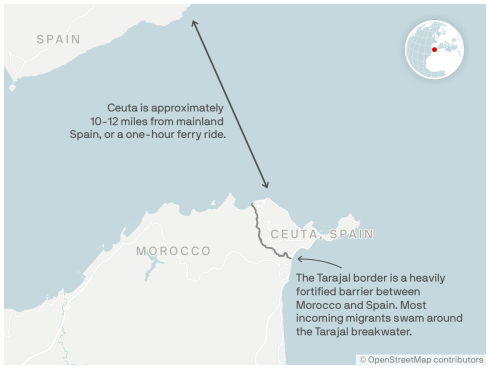
About 50,000 people crossed illegally from Morocco into the Spanish territory of Ceuta within two days. Most were young Moroccan men, although women, children and other nationalities were also present. At least 67 people died, while more than 48,000 returned after discovering that Ceuta did not provide an open route into mainland Europe.[1]
Whether one calls this an invasion, a migration crisis or a mass border breach, the underlying principle should not be controversial: a sovereign country must be able to decide who enters, in what numbers and under what conditions.
Immigration can be enormously beneficial. Canada’s traditional system was built around that recognition. It was not perfect, nor was every immigrant selected solely for economic potential, but it generally combined skilled immigration, family reunification and humanitarian obligations within controlled annual limits. Canada admitted approximately 260,000 permanent immigrants in 2014.[2]
By 2024, permanent admissions had risen to nearly 484,000. More consequentially, temporary residents had grown from 3.3 per cent of Canada’s population in 2018 to 7.5 per cent in 2024. Even the federal government eventually acknowledged that this unprecedented increase was placing pressure on housing, health care and schools.[3]
Most of these newcomers did not enter Canada illegally. That distinction matters. Canada’s failure was largely self-inflicted: governments expanded legal and temporary pathways without ensuring that housing, infrastructure and public services could absorb the resulting population growth. The Bank of Canada observed that vacancy rates began falling shortly after immigration increased in 2015 because housing construction failed to keep pace.[4]
That is not the fault of immigrants who accepted Canada’s invitation. It is the fault of governments that treated intake targets as statements of virtue rather than practical commitments requiring homes, doctors, classrooms and public consent.
A just immigration system must account for three parties: those hoping to immigrate, those who followed the rules and were admitted, and the citizens whose country is receiving them. Uncontrolled illegal entry cheats lawful applicants. Excessive legal intake strains communities and leaves newcomers competing for scarce housing and services. Refusing to discuss either problem eventually destroys public confidence in immigration itself.
Strong borders are therefore not contrary to compassion. Clear rules, enforceable limits and admissions kept within a country’s plausible capacity are what allow immigration to remain fair, beneficial and politically sustainable. Capacity can never be calculated perfectly, but uncertainty is not an excuse to ignore obvious strain.
A country that cannot—or will not—decide who may enter is not practising generosity. It is surrendering the conditions that make generosity possible.
References
- Reuters, “Spain installs floating barrier in Ceuta after calm night following border rush,” August 1, 2026.
https://www.reuters.com/world/europe/spain-installs-floating-barrier-ceuta-after-calm-night-following-border-rush-2026-08-01/ - Statistics Canada, “Permanent and temporary immigration to Canada from 2012 to 2014.”
https://www150.statcan.gc.ca/n1/pub/91-209-x/2016001/article/14615-eng.htm - Immigration, Refugees and Citizenship Canada, “2025 Annual Report to Parliament on Immigration.”
https://www.canada.ca/en/immigration-refugees-citizenship/corporate/publications-manuals/annual-report-parliament-immigration-2025.html - Bank of Canada, “Immigration, housing and the outlook for inflation,” December 7, 2023.
https://www.bankofcanada.ca/2023/12/economic-progress-report-immigration-housing-outlook-inflation/
The distinction between Islam and Islamism is useful. Islam is a diverse religion; Islamism is the political project of ordering society and the state according to an assertedly Islamic system. Confusing the two turns every Muslim into a political suspect. Pretending they have nothing important to do with one another, however, requires a different kind of dishonesty.
Islamism also covers more than terrorism or armed jihad. Its adherents may pursue power through political parties, welfare and religious institutions, demands for parallel jurisdiction, pressure for censorship and blasphemy laws, or violence. Those methods are not morally equivalent, but they share the conviction that Islam supplies not merely private belief or moral guidance, but the authoritative framework by which public life should be governed.
A recent New Discourses podcast approaches the issue through Sayyid Qutb’s Milestones, one of the formative texts of modern revolutionary Islamism. In its chapter on jihad, Qutb argues that establishing God’s sovereignty means enforcing divine law and abolishing laws made by human beings. Preaching alone cannot accomplish this because the institutions exercising political and social power will not voluntarily surrender it. Religious proclamation must therefore operate alongside “the movement,” which confronts the material obstacles standing between belief and Islamic rule.
Qutb’s formulation exposes something that polite Western discussion often obscures. Islamism is not merely ordinary authoritarianism wearing an Islamic costume, nor is it an alien ideology arbitrarily grafted onto an otherwise private faith. Its concepts—divine sovereignty, sharia, jihad, the ummah and the exemplary authority of Muhammad and the early Muslim community—are drawn from Islam itself. Islamists may interpret those sources selectively or radically, but they are not citing them by accident.
The argument becomes weaker, however, if Qutb is allowed to speak for Islam as a whole. He was a twentieth-century revolutionary who assembled older Islamic concepts into a modern political program, not the neutral curator of an uncontested tradition. Muslims have produced rival interpretations across centuries, and many today accept religious pluralism and democratic government. Their existence cannot be dismissed as counterfeit belief merely because Qutb would have dismissed it that way.
Nor does recognizing Islamism’s Islamic roots assign collective guilt to Muslims. Ideas have genealogies; people have agency. A Muslim who rejects the coercive political project is not responsible for it simply because an Islamist invokes the same scripture. By the same measure, Islamists cannot be insulated from scrutiny by insisting that any examination of their religious claims constitutes hatred of Muslims.
Both errors serve the extremists. Collapsing Islam into Islamism grants Islamists the status they covet as the authentic representatives of every Muslim. Severing the two protects Islamist doctrine from the criticism applied to every other political ideology.
The classical liberal answer is equal liberty under neutral rules. Muslims possess the same freedom of conscience, worship, speech and political participation as everyone else. What they do not possess—and what no religious or political constituency should possess—is an exemption from laws governing intimidation, obstruction or the use of public space.
Mass public prayer is protected religious expression. If a gathering blocks roads, occupies civic space without authorization or prevents others from exercising their rights, however, the relevant rules should be enforced exactly as they would be against Christians, environmentalists or striking workers. When authorities relax enforcement because they fear communal tension or accusations of prejudice, tolerance has curdled into unequal treatment.
The language surrounding “Islamophobia” presents a related danger. Anti-Muslim hatred and discrimination are real and should be opposed. Islam, however, is a body of religious claims, not a person possessing civil rights. When “Islamophobia” is used to collapse criticism of Islamic doctrine into hostility toward Muslims, it becomes an ideological shield against examination. People are entitled to equal protection; religions are not entitled to protection from criticism.
Militant Islamism is not a hypothetical challenge. Through terrorism, intimidation, blasphemy enforcement and campaigns to subordinate civil law, it has demonstrated its hostility to liberal society. Western nations must confront that threat openly—in policing, security policy and the public square.
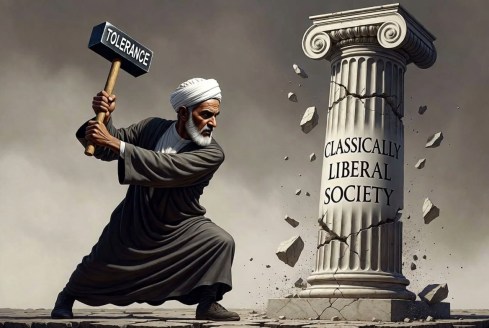
The paradox of tolerance is not a licence to suppress Muslims or peaceful belief. It is a warning that tolerance cannot survive if it grants coercive movements the freedom to destroy the conditions that make tolerance possible. Islamism grows from within Islam; it is neither the whole tree nor a foreign vine. Opposing it without collective guilt requires candour, equal enforcement and the confidence to defend our liberal inheritance.
One of the stranger features of the debate over gender identity is that women are still expected to apologize for noticing when policies affect them.
When male bodies enter female prisons, shelters, changing rooms or athletic categories, sex matters. When children are placed on a medical pathway with lifelong consequences, sex matters. When crime statistics, scholarships or political representation are organized by sex, definitions matter. Refusing to pretend otherwise is not hatred; it is the beginning of an honest discussion.
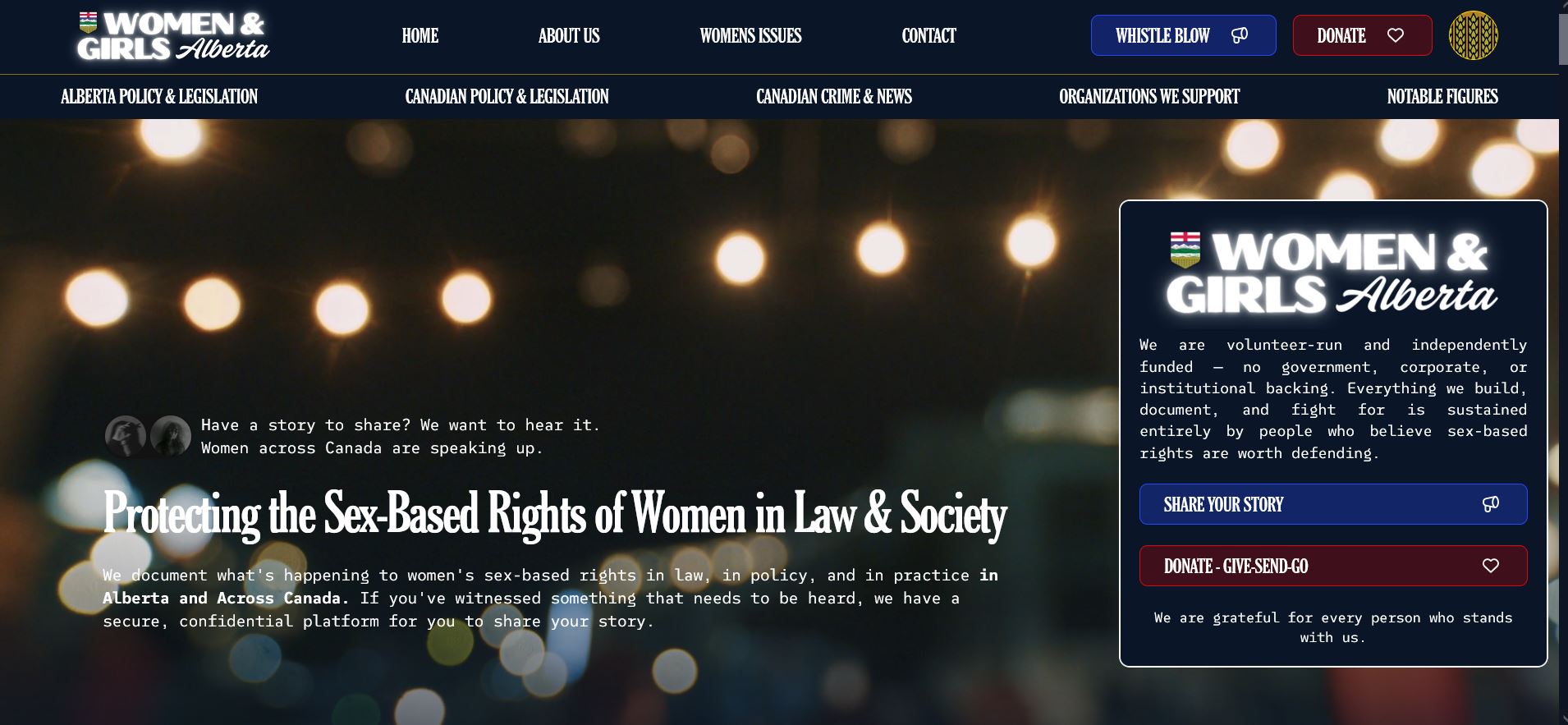
Women & Girls Alberta is an Alberta-based, women-led organization working to restore sex-based rights and protections in law, public policy and everyday life. Its platform reflects something I have argued repeatedly on this site: individual dignity does not require society to abandon material reality.
The organization focuses on the practical conflicts created when self-declared gender identity is allowed to override sex. These include women’s sports, prison safety, rape-crisis services, bodily privacy, lesbian boundaries, women’s scholarships, accurate crime statistics and single-sex spaces. Its issues section brings these concerns together rather than treating each controversy as an isolated incident.
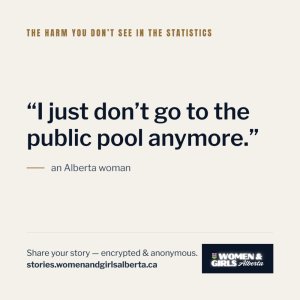 That matters because institutional change often occurs quietly. A definition changes inside a policy manual. A reporting category becomes unreliable. A woman raises a privacy or safeguarding concern and discovers that the institution has already decided which questions may be asked. By the time the public notices, the new rule is presented as settled practice rather than a political choice that should have been debated.
Women & Girls Alberta is doing more than issuing statements. The organization collects legislation, policy developments, documented cases and Canadian news concerning the erosion of sex-based protections. Its stated mandate includes providing sex-based policy analysis, supporting legislative clarity and creating opportunities for public discussion. Readers can examine its sources and arguments for themselves rather than being asked to accept a slogan.
Especially valuable is its confidential reporting platform, through which women can document experiences involving prisons, hospitals, shelters, schools, workplaces, sports and government programs. The organization says submissions can be made without an account or a name through a system built on the open-source GlobaLeaks platform, and it provides additional precautions for people concerned about professional retaliation or identification.
The point is not to declare every allegation true merely because it has been submitted. The point is to gather accounts, documents and recurring patterns that institutions may otherwise ignore. Evidence cannot be examined until people are permitted to report it.
The strongest argument from the other side should be acknowledged: transgender people are entitled to safety, civil treatment and protection from genuine discrimination. Nothing about defending women’s sex-based rights requires cruelty toward anyone. But compassion cannot mean that every competing interest disappears. Nor can one group’s desire for recognition automatically override another group’s privacy, safety, freedom of association or right to fair competition.
A pluralistic society must be capable of protecting individuals without demanding that women surrender the language needed to describe their bodies, their boundaries and their rights.
That is why I support the work of Women & Girls Alberta. It is giving women a place to speak, documenting policies that deserve public scrutiny and insisting that biological sex remains a legitimate and sometimes indispensable legal category.
Visit the Women & Girls Alberta website, read its platform, examine the evidence and share its work. Those who agree with its mission can also subscribe, contribute or help ensure that women who have something important to report know where they can be heard.
Women should not need permission to defend rights that exist because they are women.


In 2020, the Smithsonian’s National Museum of African American History and Culture published the two graphics above as part of its “Talking About Race” portal.
A necessary disclaimer: the museum removed the chart after criticism and acknowledged, “We erred in including it.” It is not current Smithsonian policy. That correction deserves recognition.
The point of revisiting it is not to pretend otherwise, but to examine the ideas circulating within an institution when someone created this material, others approved it, and the museum decided it was fit for public education.
Look at what the chart assigns to “whiteness”: objective and rational thinking, the scientific method, cause-and-effect reasoning, hard work, delayed gratification, planning for the future, self-reliance, decision-making, written communication, politeness and the protection of property.
If a white supremacist had claimed these were distinctively white characteristics, everyone would recognize the racism immediately. Placed inside an anti-racist framework, however, the same racial essentialism was briefly presented as enlightenment.
What does the chart imply about people who are not white? That rationality, foresight, scientific thinking and self-discipline are foreign norms imposed upon them? The creators may not have intended that conclusion, but they constructed the racial division that produces it.
There are a few legitimate observations buried inside the mess. American holidays have been shaped by Christianity, its legal system descends substantially from English common law, and its history was often taught through European settlement and male political leaders. “Win at all costs,” female subordination and treating wealth as personal worth are also reasonable targets for criticism.
The chart destroys those distinctions by dumping historical inheritance, social conventions, genuine vices and universal human capacities into one container marked whiteness. English common law, Barbie, scientific reasoning, bland food and delayed gratification are all made expressions of the same racialized system.
Objectivity is not white. It is a method for correcting the biases found in every human population. Written traditions developed across civilizations. Parents of every race sacrifice for their children, workers labour toward future goals, and societies everywhere use observation and causal reasoning to survive.
To produce something this ridiculous requires more than an editorial mistake. It requires an institutional culture that has spent so long treating Western inheritance as presumptively oppressive that civilizational self-criticism has curdled into self-repudiation. Once “whiteness” became the organizing category, apparently nobody stopped to ask what assigning rationality and hard work to white people implied about everyone else.
The museum eventually did stop, listen and withdraw the chart. Good.
But the artifact remains instructive. When anti-racism teaches that reason, discipline and foresight are white characteristics, it has not defeated racism. It has reproduced racism, reversed the approved moral direction and called the result education.











 bleatmop
 Mystro
 The Arbourist


 Dead Wild Roses
Your opinions…