
You are currently browsing the monthly archive for March 2026.
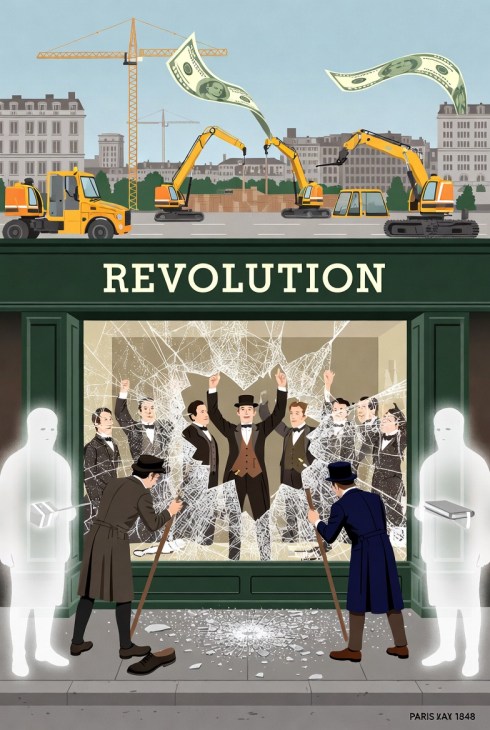
The ‘Broken Window’ parable has lasted because the mistake it identifies is permanent. People keep confusing motion with wealth.
A shop window gets smashed. The glazier benefits. He is paid to replace it. Money changes hands. Work is created. Onlookers reassure themselves that the damage at least “helped somebody.” Bastiat’s point is that this is where bad economic reasoning begins. The shopkeeper must now spend money restoring what he already had instead of buying something new, improving his business, saving, or investing. The glazier gains work. The shopkeeper loses options. Society ends up with a replaced window instead of a replaced window plus whatever else might have been created. That is not growth. It is recovery from loss.
In That Which Is Seen, and That Which Is Not Seen, published in 1850, Bastiat gave this simple error its enduring form. The visible effect is easy to grasp: the glazier gets income, then spends it elsewhere, and activity ripples outward. But the visible beneficiary is only half the story. What disappears from view are the unrealized alternatives: the suit never bought, the tool never purchased, the apprentice never hired, the expansion never attempted. The fallacy survives because the gain is concrete and public while the loss is dispersed and hypothetical. One can be pointed to. The other must be reasoned out.
“People keep confusing motion with wealth. Visible activity is easy to celebrate. The wealth that never came into being is harder to see, and easier to ignore.”
That is why the broken window is not really about vandalism. It is about how easily public argument stops at the first visible effect and calls the matter settled. Once you see that, a great deal of modern economic rhetoric starts to look less like analysis than stagecraft.
The pattern is familiar in debates over stimulus spending. Governments announce major spending packages. The public is shown crews on worksites, contracts being signed, jobs being counted, funds “flowing into the economy.” The imagery is always immediate and flattering. Something is happening. Therefore something good must be happening.
But visible activity is not the same thing as net wealth creation. Government does not create resources from nothing. It taxes them away, borrows them away, or inflates them away. In each case, resources are redirected from other possible uses. The serious question is not whether public spending produces measurable effects. Of course it does. The serious question is whether those resources would have created more value had they remained in private hands, guided by price signals, local knowledge, and voluntary choice rather than political allocation.
That is where the unseen side of the ledger matters. We see the bridge. We do not see the private investment that never happened because capital was drawn elsewhere. We see the subsidized payroll. We do not see the household purchasing power weakened by inflation. We see the grant recipient. We do not see the startup that never secured financing, or the consumer demand that was blunted by higher taxes or debt service. Public spending can make its beneficiaries highly visible while leaving its displaced alternatives diffuse and mostly invisible. That is politically useful, but analytically weak.
The usual reply is that recessions change the equation. When labour is idle, capital is underused, and private demand collapses, government spending may mobilize resources that would otherwise sit dormant. That is the strongest counterargument, and it should be taken seriously. A deep recession is not the same as a fully employed economy. Slack matters. Timing matters. Liquidity panics matter. A blanket denial of all countercyclical policy is cruder than Bastiat’s actual insight deserves.
But this does not rescue the broken window logic from criticism because it does not actually answer it. Even in a downturn, the central question remains comparative: compared to what? If the claim is that temporary public spending can stabilize demand under exceptional conditions, that is at least a serious argument. But it is not the same argument as saying that destruction creates prosperity, or that politically directed spending is wealth in itself. It still matters what is being funded, how efficiently it is administered, what incentives it creates, and whether the spending is genuinely using idle resources or merely displacing better uses that are harder to measure in real time.
“Replacement is not creation. Redirection is not prosperity. A society does not become richer by repairing destruction and calling the bustle growth.”
That distinction matters because bad arguments often smuggle themselves in under good intentions. A narrow case for emergency stabilization can turn into a permanent political habit of treating state spending as inherently productive. Once that shift happens, Bastiat’s warning reasserts itself in full. Replacement is still not creation. Redirection is still not spontaneous enrichment. Measured output can rise while underlying wealth formation weakens.
The same mistake appears after natural disasters and during wartime booms. After a hurricane, people say rebuilding will “boost the economy.” During war, people point to full factories and rising production figures. But rebuilding what was destroyed is not the same as becoming richer. Producing goods for destruction is not the same as expanding civilian prosperity. These events may generate employment, contracts, and output. They do not erase the prior loss. The relevant comparison is not between disaster and inactivity. It is between the world after destruction and the world in which the destruction never occurred.
That is what makes Bastiat’s lesson both obvious and routinely ignored. Visible motion is emotionally persuasive. A ribbon-cutting is easier to celebrate than an opportunity cost. A government announcement is easier to narrate than a private investment that never happened. Political systems are structurally biased toward what can be displayed, counted, branded, and claimed. The unseen has no ceremony attached to it. It leaves no plaque.
So the broken window fallacy endures not because the logic is hard, but because the discipline is hard. It requires people to keep asking the next question after the applause line. Jobs doing what? Spending on what? At whose expense? Relative to which forgone alternative? In a free economy, resources are scarce and choices are real. To pretend otherwise because spending is visible is to confuse accounting entries with prosperity.
Bastiat’s point remains devastating because it cuts through so much noise. Destruction does not enrich. Replacement does not add net wealth. Spending is not identical with prosperity. A society becomes richer when it creates new value, lowers costs, improves production, expands choice, and allows people to direct resources toward ends they actually value. It becomes poorer when it burns wealth, redirects capital by force, and congratulates itself for the bustle that follows.
That was true in Bastiat’s time. It is true now. The forms get larger, the numbers get bigger, and the rhetoric gets smoother, but the underlying mistake does not change. The glazier is still real. So is the window. So is everything we never got because we mistook repair, diversion, and visible activity for growth.
References
Bastiat, Frédéric. “What Is Seen and What Is Not Seen.” Online Library of Liberty.
https://oll.libertyfund.org/pages/wswns
Bastiat, Frédéric. “That Which Is Seen, and That Which Is Not Seen.”
https://bastiat.org/en/twisatwins.html
Bastiat, Frédéric. “Chapter 1: What Is Seen and What Is Not Seen.” Econlib.
Encyclopaedia Britannica. “Frédéric Bastiat.”
https://www.britannica.com/money/Frederic-Bastiat
Cullen, Joseph A., and Roger H. Gordon. “Taxes and Wartime Mobilization in the U.S. Economy: World War II as a Natural Experiment.” NBER Working Paper 12801.
Garin, Andy. “The Wartime Origins of Industry Location and Economic Mobility in the United States.” NBER Working Paper 33418.
Europe has spent years congratulating itself on becoming too enlightened for its old demons. The old hatreds, we were told, belonged to a darker age: church prejudice, blood-and-soil nationalism, crude ethnic chauvinism, all safely archived in museums and memorial culture. Modern Europe would be different. Liberal. Secular. Therapeutic. Post-tribal. Above all, tolerant.
And yet here we are again, with Jews across Europe reporting that open Jewish life feels risky, visibility feels costly, and public confidence in their safety has eroded badly. The European Union Agency for Fundamental Rights found in its 2024 survey that antisemitism remains a reality for many Jewish people in the EU and that most feel unable to live openly Jewish lives. The agency’s 2026 follow-up stated it even more starkly: Jewish people in the EU face antisemitism on a “nearly constant basis.”
That is the irony. Europe built an entire moral identity around remembering the Jewish catastrophe, and yet in large parts of Europe it has become normal again for Jews to calculate where to wear a kippah, whether to hide a Star of David, and which neighbourhoods are best avoided. The continent has mastered the liturgy of remembrance while struggling with the elementary duty of protection.
The preferred story, of course, is that the danger must still come from the approved villains of European memory: the nationalist brute, the Christian reactionary, the provincial right-wing throwback with too much history and not enough sociology. Sometimes it does. The far right remains real, and in Germany, for example, Reuters reported in June 2025 that the watchdog RIAS recorded 8,627 antisemitic incidents in 2024, nearly double the 4,886 recorded in 2023, and that far-right offenders were responsible for around three times as many incidents as Islamists. That fact matters, and serious people should not airbrush it away for narrative convenience.
But that is not the whole story, and everyone knows it is not the whole story.
“Europe still loves Jews in theory, in memory, in curriculum, in the high-church ceremony of remembrance days. It is the living, visible, inconvenient Jew who keeps committing the unforgivable sin of existing in public.”
What liberal Europe finds harder to admit is that some of the antisemitism now making Jewish life more precarious arrives under the cover of other sacred commitments: multicultural innocence, asylum romanticism, anti-colonial theatre, imported sectarian fury, and elite cowardice dressed up as nuance. The old hatred has not vanished. It has diversified. It now marches under more than one banner. It can wear a bomber jacket, a keffiyeh, or a university lanyard. It can quote medieval slanders or postcolonial jargon. It can shout in the street or whisper in institutional euphemism.
That is what makes the present moment so revealing. Europe did not abolish prejudice. It changed the etiquette around which prejudices could be named plainly. It became exquisitely skilled at denouncing the safe forms of antisemitism, especially the dead ones, while growing clumsy, evasive, or selectively blind toward the live ones.
So the spectacle becomes almost comic in its hypocrisy. Politicians attend Holocaust memorials by day and govern societies by night in which Jews are advised to be discreet. Institutions publish statements about inclusion while Jewish students need security. Commentators deliver lectures on democratic values while treating Jewish fear as awkward, politically inconvenient, or in need of contextualization. Europe still loves Jews in theory, in memory, in curriculum, in the high-church ceremony of remembrance days. It is the living, visible, inconvenient Jew who keeps committing the unforgivable sin of existing in public.
The deepest irony may be this: a civilization that prides itself on tolerance has become so attached to its self-image that it cannot honestly describe the forms of intolerance now flourishing inside its own borders. And when a society cannot name a problem because naming it would embarrass its governing myths, the problem does not disappear. It metastasizes.
A decent society does not prove its virtue by hosting remembrance days, curating moral vocabulary, or posting the correct slogans after each outrage. It proves its virtue when Jews can walk its streets without calculation. Europe remembers what happened. Good. It should. But remembrance that does not cash out in ordinary public safety is beginning to look less like moral seriousness than civilizational vanity.

References
European Union Agency for Fundamental Rights, Jewish People’s Experiences and Perceptions of Antisemitism (11 July 2024). Survey overview and key findings page.
European Union Agency for Fundamental Rights, Monitoring and recording antisemitism in the EU – State of play and ways forward (27 January 2026). Overview and introduction page.
Reuters, “Antisemitic incidents in Germany almost double in 2024, report says” (4 June 2025).
Raymond Ibrahim, “The Irony of Europe’s Antisemitism Problem — Jewish Safety, Migration, and a Failed Narrative,” Hungarian Conservative (21 January 2026). Used here as thematic inspiration rather than as a primary evidentiary source.
One of the more unsettling ideas in political history is that civilization may depend not only on teaching people virtue, but on steadily removing the people least capable of civilized life.
That is the thesis Peter Frost and Henry Harpending explore in Western Europe, State Formation, and Genetic Pacification. It cuts against the modern habit of explaining violent disorder almost entirely through environment, incentives, poverty, trauma, and weak institutions. Those things matter. But Frost and Harpending press a harder possibility: what if the long pacification of Western Europe was driven not only by stronger states and changing norms, but also by selection against the men most prone to chronic violence? (PubMed)
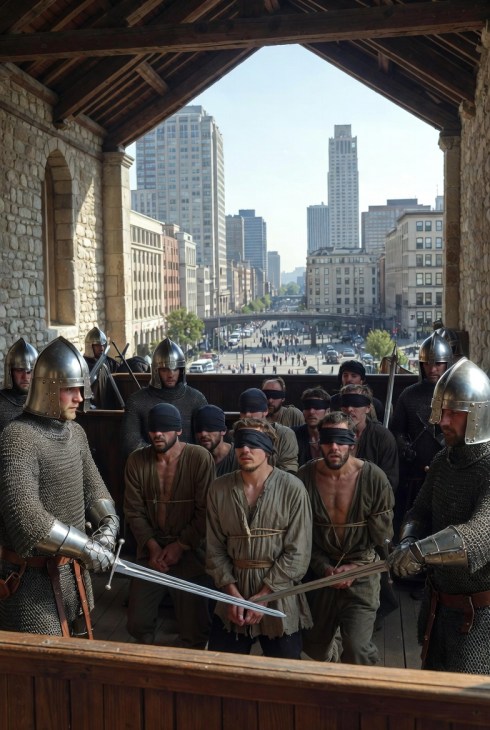
The historical pattern they point to is clear. In medieval Europe, homicide rates were vastly higher than in the modern West. Over time, as states consolidated their monopoly on violence and private vengeance receded, courts imposed the death penalty more systematically. Frost and Harpending argue that by the late Middle Ages, courts were condemning between 0.5 and 1.0 percent of all men of each generation to death, with perhaps as many more violent offenders dying at the scene of crimes or in prison while awaiting trial. Meanwhile, long-run homicide rates in Western Europe fell dramatically across the centuries. That broader decline is visible not only in their paper but in later summaries built from Manuel Eisner’s historical homicide datasets. (PubMed; Our World in Data)
That much already matters. Peace is not the natural resting state of a society. It is achieved. It is enforced. It is built through institutions capable of suppressing predation. The state does not merely administer order after the fact. It creates the conditions under which ordinary trust can exist. Without that floor, commerce, family stability, education, beauty, and freedom remain fragile.
But Frost and Harpending are interested in more than deterrence. Their stronger claim is that repeated removal of violent men from the breeding population may have altered the population itself over many generations. In plain language: if men most disposed to impulsive violence, predation, and chronic criminality are disproportionately executed, killed while offending, or otherwise prevented from reproducing, then over centuries one should expect some reduction in the prevalence of those tendencies. The state, in that account, does not just restrain violence from the outside. It may slowly reshape the human material with which the society reproduces itself. (PubMed)
That is the interesting part of the thesis, and the part that needs the cleanest handling. Frost and Harpending present it not as a settled master key to European history, but as a plausible co-factor alongside state formation, punishment, and cultural conditioning. Direct genomic confirmation remains absent. Other explanations place more weight on the state’s monopoly on violence, changing norms of self-control, declining honor culture, economic development, and improved policing. So the strongest honest claim is not that the paper has solved the history of European pacification. It is that it raises a serious possibility modern readers are strongly conditioned not to consider. (PubMed)
“Civilization is not sustained by kindness alone. It rests on a prior achievement: order strong enough to protect the peaceable from the predatory.”
Even with that caution in place, the paper still does useful work. It moves the discussion beyond the sterile split between “bad systems” and “bad individuals.” It suggests a layered civilizing process: institutions suppress violent conduct, norms change under the shelter of that order, and then, possibly, population traits shift over time as the most antisocial men are less likely to survive and reproduce. Culture and coercion do not sit in separate boxes here. They interact.
You do not have to buy every part of that model to see why it has force. A society does not begin from zero every generation. It inherits habits, expectations, institutions, and distributions of temperament formed over long stretches of time. If Western Europe became unusually low in interpersonal violence by world-historical standards, that happened through a civilizing process measured in centuries, not slogans. It was produced by a long narrowing of the space in which violent men could operate, flourish, and reproduce themselves socially.
That last phrase matters because reproduction here is not only biological. Violent men reproduce disorder culturally as well. They shape neighborhoods, train younger males, normalize intimidation, degrade family life, and turn predation into a viable strategy. Once that ecology is established, disorder becomes self-reinforcing. The reverse is also true. When a state reliably incapacitates the worst predators, peace can become self-reinforcing too.
That is part of why modern examples like El Salvador draw so much attention. The cases are not equivalent, and they do not prove Frost and Harpending’s genetic hypothesis. What they do show is older and simpler: when a state decisively removes a violent criminal stratum from daily circulation, social peace can return with surprising speed. The IMF reported in 2025 that El Salvador’s homicide rate fell from 54 per 100,000 in 2018 to 1.8 in 2024, and tied the improvement in security to stronger growth, tourism, remittances, and investor confidence. Human Rights Watch, from the opposite moral angle, also reports a significant decline in gang violence while warning that restricted data access and changes in homicide counting complicate full independent verification. (IMF; HRW; AP)
That is where a serious reader has to keep both truths in view at once. El Salvador does not demonstrate multi-generational selection. It demonstrates the older principle that predators must be removed from circulation if ordinary life is to recover. At the same time, Human Rights Watch documents arbitrary detention, torture, ill-treatment, and deaths in custody under the state of exception. The rights costs are real. The case does not prove that every harsh regime is wise. It proves that liberal societies often flatter themselves about how peace is maintained. (HRW)
This is not an argument for population engineering or collective guilt. It is an argument for recognizing that a small fraction of high-rate violent offenders can do outsized damage, and that civilization depends on their incapacitation. Modern liberal societies are comfortable discussing prevention, rehabilitation, and root causes. They are much less comfortable discussing the incorrigible. But any serious civilization needs a theory of that minority and the will to act on it long enough for the peaceable majority to live normally.
That, in the end, is the value of Frost and Harpending’s paper. Not that it offers a final key to history. Not that every part of its model has been settled beyond dispute. It matters because it reopens a forbidden question: how much of social peace depends not merely on teaching better values, but on the long-term suppression of the people least fit for peaceful life? Even readers who reject the paper’s stronger selection claim should still feel the pressure of that deeper point. Order is not self-generating. It has to be maintained against people who would dissolve it if allowed.
Modern states, at their best, answer that problem more humanely than medieval ones did. They use prisons rather than gallows. They rely on due process rather than spectacle. Good. They should. But the softer method does not abolish the harder principle. Social peace depends on removing certain people from the field, sometimes for a very long time.
That is the truth buried beneath the discomfort here. Civilization is not sustained by kindness alone. It rests on a prior achievement: order strong enough to protect the peaceable from the predatory. Everything higher comes after that.
References
Peter Frost and Henry C. Harpending, “Western Europe, State Formation, and Genetic Pacification,” Evolutionary Psychology 13, no. 1 (2015). PubMed: https://pubmed.ncbi.nlm.nih.gov/25748943/ ; journal page: https://journals.sagepub.com/doi/10.1177/147470491501300114
International Monetary Fund, El Salvador: Request for Extended Arrangement Under the Extended Fund Facility (2025). IMF page: https://www.elibrary.imf.org/view/journals/002/2025/058/article-A001-en.xml ; PDF: https://www.imf.org/-/media/files/publications/cr/2025/english/1slvea2025001-print-pdf.pdf
Human Rights Watch, “World Report 2026: El Salvador.” https://www.hrw.org/world-report/2026/country-chapters/el-salvador
Our World in Data, historical homicide materials drawing on Manuel Eisner’s data: https://ourworldindata.org/data-insights/homicide-rates-have-declined-dramatically-over-the-centuries and https://ourworldindata.org/grapher/homicide-rates-across-western-europe
Associated Press, “El Salvador closes 2024 with a record low number of homicides.” https://apnews.com/article/69384a8705267eaddd18dcd28a53465b
“Someone You Loved” is built on a kind of beautiful restraint. The piano moves in a steady, unadorned pattern, and everything else seems to gather around it with care rather than force. That sparseness is the song’s great strength. It leaves room for the ache. Lewis Capaldi does not bury heartbreak under cleverness or overproduction. He sings it plainly, with a voice that frays at the edges just when it should, turning private grief into something large enough for strangers to recognize in themselves.
What makes the song linger is not complexity but exposure. Its language is simple, almost naked, and that is why it cuts. This is not heartbreak dressed up as poetry. It is heartbreak admitted. By the time the chorus returns, it does not feel like repetition so much as the mind circling the same wound, unable to leave it alone. “Someone You Loved” understands that loss is rarely dramatic in the way films imagine it. More often it is a sudden coldness where warmth used to be, a hand reaching for what is no longer there. That is the space this song inhabits, and it does so with uncommon grace.
The lesson of 1970s stagflation was not that governments can do nothing. It was that the people running policy understood less than they claimed, and that the tools they trusted were much cruder than advertised. The “Great Inflation” from roughly 1965 to 1982 forced economists and central banks to rethink how inflation, unemployment, and monetary policy actually interact. (Federal Reserve History)
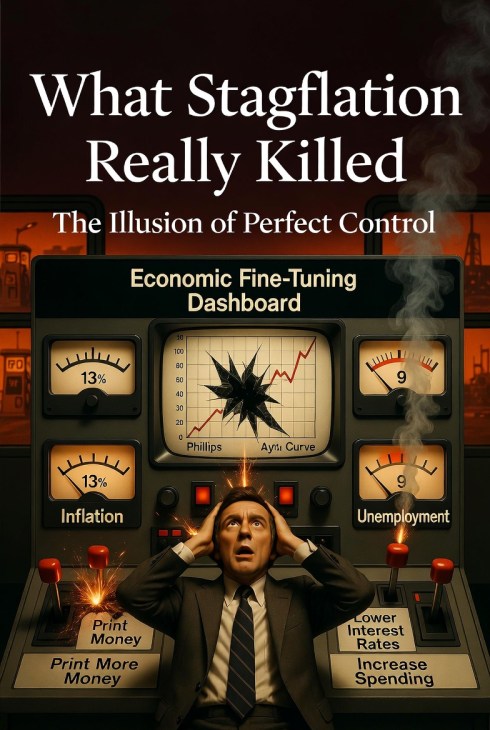
For a time, the postwar consensus rested on a flattering idea. Inflation and unemployment were treated as a manageable trade-off. The Phillips Curve was not just read as a pattern in the data. In practice, it became a governing intuition: if unemployment rose, policymakers could push demand higher and accept somewhat more inflation as the cost. That was the real temptation. A relationship observed under one set of conditions was quietly promoted into an instrument of control. The curve stopped being a caution and became a dashboard. That is where the error entered. As later critiques made clear, any apparent trade-off could break down once expectations adjusted. (Federal Reserve History)
Then the 1970s arrived and the trade-off stopped behaving.
Inflation rose sharply while unemployment also remained painfully high. BLS historical CPI data show annual U.S. inflation at 11.0 percent in 1974, 11.3 percent in 1979, and 13.5 percent in 1980. Federal Reserve History identifies this whole era as the defining macroeconomic crisis of the late twentieth century precisely because it combined persistent inflation with serious economic weakness and forced a rethink of earlier policy assumptions. The old promise had implied that these pressures could be balanced against each other. Instead they arrived together. (Bureau of Labor Statistics)
It is tempting to tell that story too neatly. Some people reduce stagflation to one cause, usually Nixon’s August 1971 suspension of dollar convertibility into gold. That was a major monetary break, and it helped bring the Bretton Woods system to an end. But it was not the whole story. Nixon’s package also included wage and price controls, and the wider period was shaped by multiple interacting forces, including oil shocks and broader inflation dynamics. The point of that complexity is not to rescue the old confidence. It is to bury it. An economy shaped by that many moving parts was never going to be managed with the precision implied by mid-century technocratic rhetoric. (Federal Reserve History)
This is where some critics of monetary manipulation look stronger in retrospect than they did at the time. Austrian economists such as Mises and Hayek had long warned that money and credit are not harmless policy tools. Cheap credit can distort investment. Monetary expansion can scramble price signals. Artificial booms can end in painful correction. There is no need to pretend they possessed a complete script for every feature of 1970s macroeconomics. They did not. But they were directionally right about something central: when policymakers treat money as an instrument of short-run management rather than a framework for stable coordination, they increase the odds of disorder. That warning aged better than the promise of fine-tuning. This is an interpretive judgment, but it is supported by how badly the simpler policy reading of the Phillips Curve fared during the Great Inflation. (Federal Reserve History)
Paul Volcker’s anti-inflation campaign in the early 1980s drove the point home in brutal form. The Federal Reserve’s October 1979 shift to tighter anti-inflation policy helped bring inflation down, but the price of restoring credibility was severe. Federal Reserve History notes that inflation fell sharply after its 1980 peak, while unemployment reached 10.8 percent in late 1982 during the deep 1981–82 recession. That was not the triumph of elegant expert control. It was the bill arriving. Once inflationary disorder hardens, the correction is rarely gentle. (Federal Reserve History)
So what did stagflation actually kill?
Not economics. Not all state action. Not even every Keynesian insight. What it killed was a style of elite confidence. It killed the belief that national economies can be fine-tuned with enough intelligence, enough models, and enough institutional nerve. It killed the conceit that the dashboard is the machine. The language has changed since then. The models are more sophisticated. The temptation is still with us. Every generation of managers wants to believe that this time the controls are better and the uncertainties smaller. The 1970s remain useful because they remind us that policy operates under limits, trade-offs turn ugly, and reality does not care how elegant the model looked on paper. (Federal Reserve History)
Glossary
Phillips Curve
A model associated with a short-run relationship between inflation and unemployment. In practice, many policymakers treated it as if lower unemployment could be purchased with somewhat higher inflation. The 1970s badly damaged confidence in that simple reading. (Federal Reserve History)
Stagflation
A period of high inflation combined with weak growth and high unemployment. The 1970s made the term famous because that combination was supposed to be difficult to sustain under older policy assumptions. (Federal Reserve History)
Fiat money
Money that is not redeemable for a commodity such as gold and instead depends on legal and institutional backing. Nixon’s 1971 decision ended dollar convertibility into gold for foreign governments and central banks. (Federal Reserve History)
Bretton Woods system
The postwar international monetary order in which other currencies were pegged to the U.S. dollar, and the dollar was convertible into gold under the system’s rules. It unraveled in the early 1970s. (Federal Reserve History)
Disinflation
A slowing in the rate of inflation. Prices may still be rising, but less quickly than before. Volcker’s early-1980s policy is a classic U.S. example. (Federal Reserve History)
References / URLs
Federal Reserve History, “The Great Inflation”
https://www.federalreservehistory.org/essays/great-inflation
Federal Reserve History, “Nixon Ends Convertibility of U.S. Dollars to Gold and Announces Wage/Price Controls”
https://www.federalreservehistory.org/essays/gold-convertibility-ends
Federal Reserve History, “Volcker’s Announcement of Anti-Inflation Measures”
https://www.federalreservehistory.org/essays/anti-inflation-measures
Federal Reserve History, “Recession of 1981–82”
https://www.federalreservehistory.org/essays/recession-of-1981-82
Federal Reserve History, “Creation of the Bretton Woods System”
https://www.federalreservehistory.org/essays/bretton-woods-created
U.S. Bureau of Labor Statistics, Historical CPI-U, 1913–2023
https://www.bls.gov/cpi/tables/supplemental-files/historical-cpi-u-202312.pdf
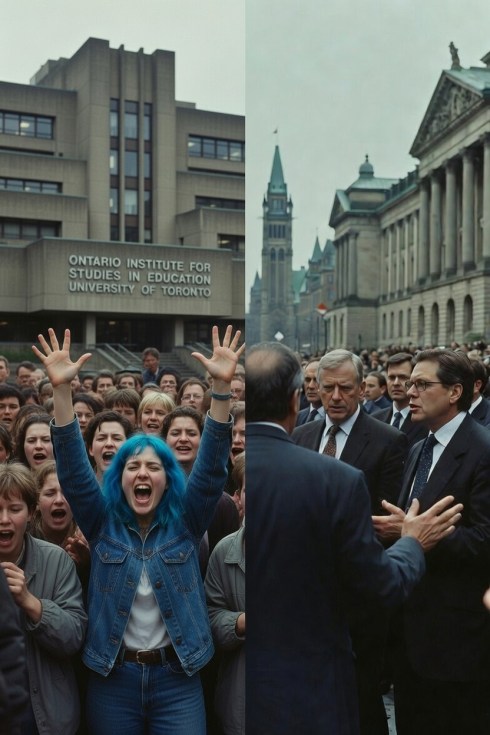
The Ontario Institute for Studies in Education at the University of Toronto is hosting its 13th annual decolonizing conference from March 12 to 14, 2026. The title tells you plenty: Colonial Ruptures: Unmasking Ongoing Coloniality and Fostering Counter Insurgency, Resistance and Liberatory Possibilities. The event materials describe a gathering of scholars, activists, educators, artists, Elders, and community leaders committed to critical reflection, collective action, and “decolonial futures.” They speak of resisting “global capital extractivism and supremacist thinking,” rejecting “colonial binaries,” and advancing liberatory possibilities. This is not an outside caricature. It is the institution describing itself.
That matters because OISE is not a fringe collective borrowing university space for a weekend. It is one of the country’s most influential faculties of education, and CIARS is one of its public-facing centres. A conference like this does not define every part of OISE, but it does reveal a real moral and intellectual current inside one of Canada’s most important teacher-forming institutions. When an institution like that adopts the language of rupture, insurgency, resistance, and decolonial struggle, critics are entitled to ask a basic question: is this education in the ordinary civic sense, or ideological formation dressed in educational language?
To be fair, proponents would say the purpose is not social fragmentation but repair. They would say decolonizing education means confronting historical blind spots, taking Indigenous and anti-racist perspectives seriously, and widening the moral vocabulary of the classroom. Fine. That case should be acknowledged. But public language still matters. When a flagship faculty of education foregrounds coloniality, rupture, counter-insurgency, and resistance, it signals something more than curricular broadening. It signals an adversarial posture, even when softened by the language of care, solidarity, and reimagined futures.
That is the real concern. The problem is not that Canada’s injustices are being taught. A serious country should teach its history honestly. The problem is that teacher formation may be drifting toward a framework in which critique stops being a tool of civic improvement and becomes the default grammar through which the society itself is read. In theory, decolonial approaches and core educational goals can coexist. In practice, the public-facing language here suggests a hierarchy of concerns in which ideological critique increasingly outranks institutional competence, shared citizenship, and academic pluralism.
“What the public sees is not repair but drift: a professional class fluent in rupture and resistance while the country struggles to do ordinary things well.”
People notice that shift because they are already living inside a country under strain. Canada has struggled with weak productivity for years. The OECD’s 2025 survey says the outlook was worsened by trade uncertainty and tariffs, projects a decline in GDP from the second quarter of 2025 because of falling exports to the United States, and devotes sustained attention to the problem of raising business-sector productivity. Housing is worse. CMHC said in 2025 that restoring affordability to 2019 levels would require roughly 430,000 to 480,000 new housing units per year until 2035, about double the recent pace. That is not ideological spin. It is the national housing agency saying the country is not building nearly enough homes.
So people look around and see weak productivity, punishing housing costs, trade pressure, strained public capacity, and thinning civic confidence. Then they watch elite educational institutions pour moral energy into conferences on colonial rupture and liberatory counter-insurgency. The disconnect is hard to miss. Citizens who want functional schools, affordable homes, competent government, and some residue of common national identity are told, again and again, that the deeper task is deconstruction. Not reform. Not competence. Deconstruction.
That is one reason disillusionment has grown. The problem is not honest history. It is not the inclusion of neglected perspectives. The problem is that “decolonizing” has become, in practice, a legitimating language for ideological sorting. It shifts attention away from what institutions are for and toward the moral drama of permanent critique. In education, that is a serious danger. A teacher should be equipped to help students read, write, reason, deliberate, and live with others in a shared society. If the training environment increasingly teaches that the shared society itself is morally suspect at the root, the civic consequences are unlikely to be good.
Canada does not need amnesia. It does not need self-flattery either. But it also does not need a professional class trained to interpret the country chiefly through the grammar of oppression, rupture, and resistance. A society held together by trust, inheritance, and common rules cannot sustain indefinite elite suspicion toward its own foundations. If public institutions want to recover legitimacy, they will have to rediscover a language of citizenship, competence, pluralism, and shared belonging. Until then, more Canadians will keep feeling that the country they were told to love is being taught to despise itself.
References
OISE / CIARS conference page
https://www.oise.utoronto.ca/ciars/ciars-2026-xiii-decolonizing-conference-1
OISE / SJE newsletter page on the conference
https://www.oise.utoronto.ca/sje/newsletter/march-2026/CIARS-newsletter-conference
OISE February 2026 conference notice
https://www.oise.utoronto.ca/home/sje/newsletter/february-2026/CIARS-conference
CIARS centre page
https://www.oise.utoronto.ca/ciars
CMHC housing supply report page
https://www.cmhc-schl.gc.ca/professionals/housing-markets-data-and-research/housing-research/research-reports/accelerate-supply/canadas-housing-supply-shortages-a-new-framework
CMHC housing supply gap explainer
https://www.cmhc-schl.gc.ca/observer/2025/updating-canada-housing-supply-shortages-new-housing-supply-gap-estimates
CMHC news release on housing supply gaps
https://www.cmhc-schl.gc.ca/media-newsroom/news-releases/2025/cmhc-releases-latest-housing-supply-gaps-report
OECD Economic Survey of Canada 2025
https://www.oecd.org/en/publications/2025/05/oecd-economic-surveys-canada-2025_ee18a269.html
OECD full report
https://www.oecd.org/en/publications/2025/05/oecd-economic-surveys-canada-2025_ee18a269/full-report.html
OECD chapter on raising business-sector productivity
https://www.oecd.org/en/publications/2025/05/oecd-economic-surveys-canada-2025_ee18a269/full-report/raising-business-sector-productivity_443bcd88.html
Glossary
Decolonizing
A broad academic and political term for efforts to challenge ideas, institutions, and practices seen as shaped by colonial power.
Coloniality
The claim that power structures formed under colonial rule can persist long after formal colonial administration ends.
Counter-insurgency
Traditionally, efforts to resist or suppress insurgent movements. In academic settings it is often used metaphorically, which is part of why it sounds so militant.
Colonial binaries
Simple oppositions said to come out of colonial thinking, such as colonizer/colonized or civilized/uncivilized.
Liberatory
A term used to describe ideas or practices aimed at freeing people from oppression or domination.
Extractivism
An economic model focused on intensive resource extraction, usually criticized for environmental damage or unequal power.
Academic pluralism
The principle that higher education should make room for genuine intellectual diversity rather than one dominant ideological framework.
Civic order
The shared rules, institutions, and habits that allow people with real differences to live together in one political community.
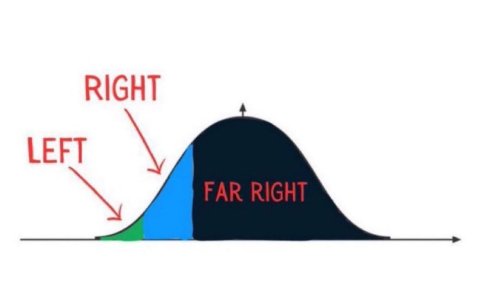
One of the most corrosive habits in current political discourse is the way plain factual claims get assigned a partisan label. Not arguments. Not policies. Facts. Or, more precisely, statements that point back to material reality, institutional limits, or ordinary human constraints. In theory, facts are supposed to discipline ideology. In practice, they are often treated as ideological aggression when they obstruct a preferred moral script.
That is what people are reaching for when they say facts are now treated as right-wing. The phrase is blunt, but it points to something real. In a growing number of disputes, especially around sex, gender, speech, and institutional policy, a person can say something materially true and be treated not as a participant in debate but as a moral suspect. The point is not answered on its merits. It is recoded as a signal of contamination. The speaker is no longer heard as describing reality. He is heard as choosing a tribe.
That shift matters because it changes the structure of argument. Once a factual claim is socially coded as “right-wing,” the burden quietly moves. The question is no longer whether the claim is true. The question becomes why you said it, what kind of person says such things, and who might feel endangered by hearing it. Motive replaces mechanism. Stigma replaces rebuttal. The claim is not refuted so much as quarantined.
You can see this clearly in disputes over sex and pronouns. For many people, saying that sex is real, binary in the ordinary human sense, and not altered by self-declaration is not an act of hostility. It is a claim about reality and a claim about language. “He” and “she” historically track male and female persons. Refusing to detach those words from sex is not, on its face, a partisan performance. It is an attempt to keep public language tethered to the material world rather than to inward identity claims.
“The disagreement is not mainly about politeness. It is about which reality gets public authority.”
That is exactly why the issue generates so much heat. The disagreement is not mainly about politeness. It is about which reality gets public authority. Does language track bodies, or does it track self-declared identity? Does a school treat sex as a stable feature of the world, or does it treat identity assertion as the governing fact? Those are not small etiquette disputes inflated by the internet. They are conflicts about ontology, law, and institutional power.
Canada now offers several live examples. Alberta’s Education Amendment Act requires parental notification when a student requests a gender identity-related preferred name or pronouns, and parental consent for students under 16 before staff may use them. The province says these changes are part of supporting families and setting clear school rules, with the remaining education amendments anticipated to take effect on September 1, 2025. Then, in late 2025, Alberta escalated further. Bill 9 invoked the notwithstanding clause to shield not only this school policy but other contested sex-and-gender measures from being struck down by the courts. That bundling matters. It shows this is no longer being treated as a narrow administrative disagreement, but as a foundational conflict over parental authority, child development, and the public meaning of sex.
Quebec presents the same fracture from the opposite direction, and it is ongoing now. Current reporting says a Montreal teacher is challenging the provincial policy that allows students 14 and older to change the name and pronouns used at school without parental consent. The teacher alleges she was required to use male pronouns at school while using female pronouns with the student’s parents. A preliminary hearing on anonymity and confidentiality was held on March 6, 2026, with the broader merits challenge still to come. Strip away the activist packaging and the conflict becomes plain: can institutional professionals be required to maintain two vocabularies of reality depending on the audience, and if they object, are they making an ethical argument or committing a moral offense?
The Barry Neufeld case in British Columbia shows the institutional end point of this logic. On February 18, 2026, the B.C. Human Rights Tribunal issued its decision and ordered substantial damages after finding that multiple publications were discriminatory, while some crossed the threshold into hate speech. That does not prove that every factual objection to gender ideology is punishable. It does show how readily dissent can be processed through systems that move from moral condemnation to formal classification. Once that line is crossed, everyone watching understands the lesson. The risk is no longer simply that you will be called wrong. The risk is that you will be treated as a public contaminant.
This is why the familiar “both sides are just choosing different facts” formula goes soft in exactly the wrong place. The conflict is not symmetrical. One side is generally making claims about bodies, language, legal authority, and institutional procedure. The other is often demanding that those things yield to identity-based recognition norms. Dignity is real and relevant. But dignity does not erase biological category, dissolve observable sex, or transmute factual disagreement into literal violence.
So when people say facts are treated as right-wing, the point is not that truth literally belongs to one side of the spectrum. The point is that in a culture saturated with moral performance, inconvenient facts are often recoded as partisan because it is easier to stigmatize them than to answer them. A factual claim that disrupts the script is no longer processed as description. It is processed as dissent. And dissent, under current conditions, is increasingly treated as a character defect.
Facts do not have a party. But when facts obstruct an ideological narrative, that narrative will often brand them right-wing and move straight to motive-policing. That is not a sign that the facts have changed. It is a sign that too much of public discourse has become allergic to reality when reality refuses to flatter the creed.
References
Government of Alberta. “Supporting Alberta students and families.”
https://www.alberta.ca/supporting-alberta-students-and-families
Government of Alberta. “Protecting youth, supporting parents, and safeguarding female sport.”
https://www.alberta.ca/protecting-youth-supporting-parents-and-safeguarding-female-sport
Global News. “Montreal teacher challenges policy for trans students to hide identity from parents.” March 6, 2026.
https://globalnews.ca/news/11719392/montreal-teacher-trans-students-challenge/
British Columbia Human Rights Tribunal. Chilliwack Teachers’ Association v. Neufeld (No. 10), 2026 BCHRT 49. February 18, 2026.
https://www.bctf.ca/docs/default-source/for-news-and-stories/49_chilliwack_teachers-_association_v_neufeld_no_10_2026_bchrt_49.pdf?sfvrsn=2d847803_1











 bleatmop
 Mystro


 Dead Wild Roses
Your opinions…