
You are currently browsing the tag archive for the ‘Gender Ideology’ tag.
The recent Tickle v Giggle ruling exposes a widening gap between legal language and ordinary reality.
The court held that a female-only app unlawfully discriminated against a ‘transgender woman’ by excluding him from the platform. The legal mechanism matters: this was framed through gender-identity discrimination protections. But the practical result is hard to miss. A space created for women was told it could not draw its boundary around being female.
That has consequences beyond one app.
Women’s sex-based protections exist because sex is real. Pregnancy is real. Male-pattern violence is real. Privacy concerns in shelters, prisons, changing rooms, sports, and intimate female spaces are not imaginary. They are not bigotry dressed up as discomfort. They arise from material differences that law once had enough common sense to recognize.
A humane society can treat transgender people with dignity and still preserve female-only spaces. Those two duties are not enemies unless ideology makes them so.
The problem with this ruling is that it pushes women into the old subordinate role again: accommodate first, object later, and expect punishment if the objection sounds too firm. Female boundaries become negotiable. Female discomfort becomes suspect. Meanwhile, identity claims are treated as moral imperatives that everyone else must organize around.
That is not equality. It is a new hierarchy with better manners.
Ordinary people notice the coercion. They notice the pressure to say things publicly that they do not believe privately. They notice that everyone still understands what sex is when the issue is medical care, crime statistics, pregnancy, or athletics, but suddenly becomes confused when women try to maintain a boundary.
This is why the issue refuses to disappear. Reality keeps returning through the side door.
The law should protect every citizen from harassment and mistreatment. But it should not compel society to pretend that sex is meaningless. If women cannot define female-only spaces around biological sex, then “woman” has lost the legal coherence that made women’s rights possible in the first place.
This decision should be overturned, and the law should be clarified: sex means biological sex where single-sex spaces, services, sports, and protections are concerned.
Without that correction, women are being told to move aside in the name of inclusion.
They have heard that instruction before.
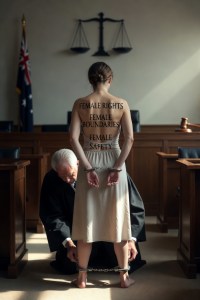
Gender ideology did not arise because women demanded equality. That charge is lazy, and more importantly, false.
Women wanting legal equality, bodily safety, political representation, equal pay, and freedom from male coercion did not cause male people to be admitted into women’s sports, prisons, shelters, changing rooms, or lesbian dating spaces. Ordinary feminism is not responsible for male opportunism. Men who exploit weak boundaries do not need a seminar in feminist theory before trying the door.
But institutions are different. They often need language, policy frameworks, and moral justifications before they surrender boundaries they once understood perfectly well.
That is where the harder question begins.
Some ideas developed inside feminist theory helped create vulnerabilities that gender ideology later exploited. This is not the same as saying feminism “caused” the problem. It is saying that ideas have consequences, including unintended ones. A concept built for one purpose can be repurposed for another; a tool designed to loosen an unjust constraint can also be used to dissolve a necessary distinction.
That is the part many people would rather not examine.
One side wants to say feminism caused the whole mess. Too crude. The other wants to say feminism had nothing whatsoever to do with it. Too convenient. The truth is less satisfying, and probably closer because of it.
Feminist credentials are not the issue here. Truth is.
Feminism makes public claims about sex, power, language, law, institutions, rights, and the body. Those claims do not become immune to scrutiny because they are made in the name of women, and criticisms do not become invalid because of who makes them. A serious movement should want its ideas tested. If an argument is wrong, answer it: show the missing evidence, the bad inference, the false premise.
Dismissing criticism through identity-checking is not analysis. It is a way of avoiding analysis.
Oddly enough, that should be a feminist point. If feminism rejects reducing people’s minds to their sex, then sex cannot become a veto when the argument becomes inconvenient.
The first mechanism was the separation of sex from gender.
At its best, this distinction did useful work. Being female does not require liking pink, wanting babies, wearing dresses, being passive, or arranging your personality around male approval. Feminists were right to attack those scripts. Biology is real, but sex roles are not destiny.
The danger was not the distinction itself. The danger came when gender stopped meaning “social expectations imposed on sex” and started meaning an inner truth separable from sex. Once that shift happened, the old feminist critique became available for a very different project. What began as an attack on stereotypes could now be used as a theory of identity overriding the body.
The second mechanism was social constructionism.
There was a legitimate insight here too. “Womanhood” has always carried social meanings layered on top of female biology. Societies attach expectations to women’s bodies, labour, sexuality, motherhood, modesty, obedience, beauty, and public authority. Feminism needed language for that. It needed to be able to say: these rules are not nature. They are social arrangements, and they can be challenged.
Fair enough.
The problem came when the analysis slid from “many meanings attached to sex are constructed” into “sexed categories themselves are political constructs.” That is a very different claim. If womanhood is primarily a social role, discourse, or identity, then why can’t a male person enter it by declaration?
That question did not appear from nowhere. The ground had been softened.
The third mechanism was suspicion of biology.
Feminists had good historical reasons to distrust biological arguments. “Nature” has been used to deny women education, property rights, professional status, sexual autonomy, and political authority. Biology was often weaponized as destiny, so the suspicion was not irrational.
But rejecting biological determinism is not the same thing as rejecting biological reality.
Women are not oppressed because they like dolls, fail to “lean in” properly, or possess some mystical feminine essence. Women are vulnerable as a class because female bodies matter materially. Pregnancy, birth, lactation, menstruation, physical vulnerability, reproductive control, and male sexual access are not floating social metaphors; they are part of the material reality around which women’s oppression has historically been organized.
A feminism that cannot say “female” without flinching cannot defend women.
The fourth mechanism was standpoint hardening.
“Listen to women” is good advice. Women know things about harassment, fear, pregnancy, exclusion, motherhood, male violence, and sex-based vulnerability that cannot be captured from a distance. Lived experience matters because it can reveal what abstract theory misses.
But experience is evidence, not sovereignty.
A useful corrective hardens into a veto when “listen to women” becomes “you cannot question this because you are not one of us.” At that point, the claim is no longer being tested. The speaker’s credentials are checked, the conclusion is presumed, and the disagreement is treated as a social violation.
This is also where the overlap with gender activism becomes hard to miss.
Gender activists often do not answer objections; they rename them. “Bigotry,” “erasure,” “literal violence,” “no debate,” and “trans women are women” can all describe real things in some contexts. The issue is not whether the words are always false. The issue is what happens when they are used as substitutes for argument.
Then they do not test a claim. They quarantine it. The person raising the objection is not answered; they are placed outside the moral community.
The same habit appears whenever feminist criticism is rejected because of who made it rather than what was said. Maybe the argument is wrong. Then show where. But identity does not settle the question. Evidence does.
The fifth mechanism was coalition loyalty.
Many feminist institutions embedded themselves inside broader progressive coalitions. That brought energy, money, institutional access, and moral prestige, but it also created a loyalty problem. Once gender identity became a sacred progressive cause, dissent became dangerous.
Women who objected were not answered. They were branded as bigots, fascists, transphobes, unsafe women, right-wing collaborators, or whatever label was most useful that week.
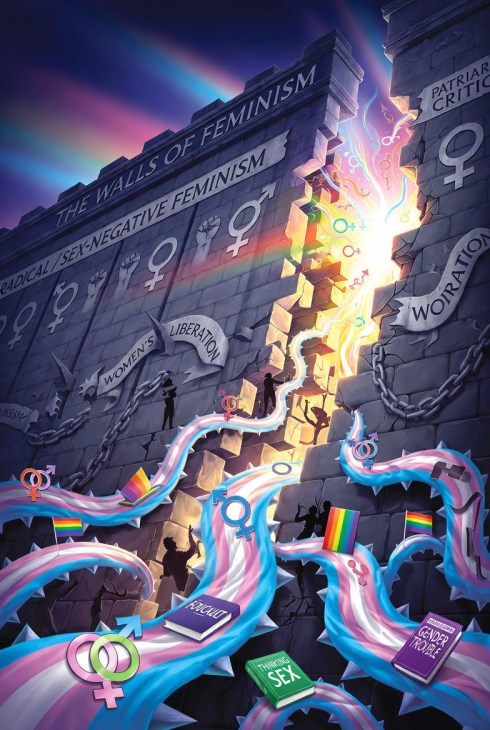
That is how organizations founded to defend women ended up defending males in women’s spaces while calling it liberation. They had trained themselves to treat coalition belonging as moral proof, so when the coalition turned against sex-based rights, too many lacked either the nerve or the language to resist.
This matters because gender ideology did not win by argument alone. It won through institutions. HR departments, schools, medical bodies, activist organizations, media outlets, professional regulators, and law all played their parts. Queer theory supplied much of the more radical conceptual machinery. Bureaucracy turned it into policy. Social media turned dissent into reputational danger.
But some feminist concepts weakened the walls before the push came.
That is the uncomfortable part.
The tragedy is that many women saw the danger early and were told to shut up by institutions claiming to speak for them. They were not confused, hysterical, or hateful for noticing that sex-based rights require sex-based categories. They were pointing at the load-bearing wall while the renovation crew was already swinging hammers.
The repair begins with honesty.
Women are female humans. Sex is real. Sex roles are not destiny. Biology is not oppression. Lived experience matters, but it does not outrank evidence. Coalitions are useful only while they remain answerable to reality.
This is not an argument against women’s rights. It is an argument against refusing to audit the theories that claimed to speak for women.
Feminism does not have to accept hostile caricatures of itself. But it does have to face the places where its own language, assumptions, and institutional loyalties were turned against its central subject.
Test the claim. Follow the mechanism. Face the consequences.
Alberta Premier Danielle Smith used her address at the Canada Strong and Free Network conference to frame her government’s recent legislative agenda as a direct challenge to what she called the “era of wokeism.”
The speech was not about one bill. It was a political inventory: professional regulation, classroom neutrality, parental rights, gender medicine for minors, female sport, and sexually explicit material in libraries. The through-line was institutional restraint. Schools, regulators, medical systems, and libraries should not become vehicles for ideological enforcement.
Smith pointed first to what supporters have called the “Jordan Peterson Law,” Alberta’s legislation aimed at professional regulators. The basic idea is that professional bodies should regulate competence and misconduct, not punish members for off-duty political or personal views unless those views clearly bear on professional conduct. Whatever one thinks of Peterson himself, the principle is larger than one man: licensing bodies are not supposed to become political conformity boards.
Education took up much of the speech. Alberta’s Bill 25, introduced March 31, 2026, is formally titled An Act to Remove Politics and Ideology from Classrooms and Amend the Education Act. The province says the bill is meant to keep classrooms neutral, impartial, and respectful of diverse viewpoints. It would require school authorities to avoid taking official positions on political, social, or ideological matters outside their education mandate, and would direct teachers to remain objective and present balanced perspectives.
That is the political nerve centre of the speech. For years, progressive activists have argued that schools cannot be neutral and must instead be actively “inclusive,” “anti-oppressive,” or “affirming.” Smith’s answer is that this logic has turned too many classrooms into ideological delivery systems. Her government’s position is that schools should teach students how to think, not quietly steer them toward approved political conclusions.
Smith also returned to Alberta’s laws on gender-related interventions for minors. The province’s Protecting Alberta’s Children Statutes Amendment Act invokes the notwithstanding clause to shield several measures from being struck down by courts. These include prohibitions on gender reassignment surgery for children under 18, restrictions on puberty blockers and hormone treatments for gender reassignment for children under 16, parental notice and consent rules around gender-related name and pronoun changes in schools, opt-in consent for teaching on gender identity, sexual orientation, or human sexuality, and rules limiting women’s and girls’ amateur competitive sports to those born female.
Supporters will call this child protection, parental rights, and fairness in female sport. Critics will call it state interference in the lives of transgender youth. That fight will not be settled by changing labels. It turns on deeper questions: what children can consent to, what parents are entitled to know, how strong the medical evidence is, and whether schools may keep consequential identity-related information from families.
Smith also addressed sexually explicit material in libraries. Alberta has proposed public-library measures aimed at limiting minors’ access to materials containing explicit visual depictions of sexual acts, while saying adults would retain access and that materials would not be removed from libraries. The government describes this as age-appropriate access control, not a book ban. Critics see it as censorship, especially given previous fights over school-library materials and LGBTQ-themed books.
The speech’s political purpose was obvious. Smith was not merely listing policies. She was tying them into a governing thesis: Alberta’s public institutions have drifted from their proper roles, and her government intends to pull them back.

That is the real argument underneath the “wokeism” language. Are schools, professional regulators, medical bodies, and libraries limited institutions with defined purposes? Or are they now expected to act as engines of progressive moral instruction?
Smith’s answer is blunt: no.
The word “wokeism” is not especially precise. It is a bucket term, and bucket terms can get sloppy fast. But in this case, it is pointing at something real: the steady conversion of public institutions into ideological enforcement systems, usually under softer language about safety, inclusion, equity, care, or professional standards.
Alberta’s new posture is simple: public institutions should serve the public under defined rules, not quietly reshape the public under activist supervision. That is the line Smith is trying to draw. The coming fight will be over whether Alberta is allowed to draw it.
Much of the current conflict around gender identity is framed as a debate about compassion, recognition, and inclusion. At a more basic level, it is also a conflict about language—specifically, whether individuals can be expected to adopt terms that do not align with their understanding of reality.
Pronouns seem like a small thing. In practice, they are not.
They are not simply polite conventions. They function as statements about a person. To use a pronoun is to make a claim, and when that claim is contested, the disagreement is not about tone but about what is being asserted.
For a time, the direction of that disagreement appeared settled. In many settings, declining to use requested pronouns was treated not as a difference of view, but as a form of harm. Social and professional consequences followed—sometimes quickly, sometimes quietly, but with enough consistency to shape behaviour.
That shift matters because it changes the role language plays. It moves from something negotiated between individuals to something that, in certain contexts, is expected and enforced.
There is a difference between courtesy and agreement.
Courtesy is voluntary. It allows for discretion, context, and mutual recognition. Agreement operates differently. It narrows the range of acceptable responses and attaches consequences to deviation. The two can overlap, but they are not the same thing, and treating them as interchangeable obscures the boundary where disagreement becomes difficult to express.
The argument for using preferred pronouns is often framed as a matter of basic dignity—a small concession that reduces friction in everyday life. At that level, it has real force. Most people are willing to extend minor courtesies to make social interactions smoother, especially when the cost appears low.
The difficulty is that this framing does not remain stable.
“Once language is tied to required affirmation, refusal is no longer treated as disagreement, but as harm.”
What begins as a request for courtesy has, in many contexts, become an expectation of agreement. The distinction matters. Courtesy allows for discretion; agreement does not. Once language is tied to a required affirmation, refusal is no longer interpreted as indifference or disagreement, but as harm.
That shift changes the nature of the interaction. It moves from a voluntary accommodation between individuals to a norm that carries social or professional consequences. At that point, the question is no longer whether one is willing to be polite. It is whether one can be required to make a claim one does not believe to be true.
This is why pronouns became a point of pressure.
They are easy to enforce, highly visible, and symbolically loaded. Agreeing to their use is often treated as a minimal concession. Refusing them is treated as a line crossed. That asymmetry is not accidental. It makes pronouns an effective entry point for broader expectations about how language should function.
There is also a boundary question that is harder to avoid than it first appears.
Individuals are free to describe themselves as they choose. That freedom, however, does not automatically extend to requiring others to adopt the same description. At some point, a shared language is still needed, and that language cannot function if its basic terms are entirely detached from common reference points.
For many people, this is where the conflict becomes unavoidable.
Refusing to adopt certain pronouns is not always an act of hostility. In some cases, it is an attempt to preserve a distinction between what one believes to be true and what one is being asked to say. Whether that distinction is respected or overridden has implications that extend beyond the immediate interaction.
Once language becomes a site of compelled agreement, the scope of that agreement rarely remains fixed.
That is why this feels, to some, like an early point of decision. Not because the issue is small, but because it establishes what can be asked—and what must be said.

This is how activists frame their lies and misdirection.

Here is their bullshittery in full:
The introduction of new rules restricting participation in women’s sport categories to “biological females”, determined through mandatory genetic screening and testing, imposes exclusionary criteria. These measures not only bar transgender women from competition, but target and disqualify cisgender women with differences in sex development.
This policy will apply to the Los Angeles 2028 Olympic Games and beyond, despite the absence of clear evidence that any transgender women were poised to participate in those Games. The IOC’s approach aligns itself with the U.S. government’s 2025 executive order “Keeping Men Out of Women’s Sports” which threatened to withdraw funding from organizations that permit transgender athletes to compete and to deny visas to certain athletes seeking to participate in the Los Angeles Olympics. The convergence of international sport governance with exclusionary state policy raises serious concerns about the politicization of athletic participation and the erosion of independent, rights-respecting governance.
“While framed as a measure to ensure fairness, this policy imposes exclusionary criteria that will disproportionately harm transgender women and also place cisgender women at risk, particularly those with natural biological variations,” says Aaden Pearson, Trans Rights Legal Fellow at the Canadian Civil Liberties Association. “The policy authorizes intrusive scrutiny of women’s bodies and asserts authority over who gets to participate as a ‘real’ woman under the guise of regulation.”
This policy will have detrimental impact on Canadian athletes that may be barred from participating in the Olympics because of this policy who otherwise would qualify to represent Canada.
A rights-respecting approach to sport must be grounded in inclusion, evidence, and proportionality. Fairness and human dignity are not mutually exclusive. The legitimacy of sport depends on ensuring that all athletes are able to participate without discrimination.
The CCLA calls on the IOC and national sporting bodies to:
- Immediately reconsider the implementation of these eligibility rules;
- Ensure that any policies governing participation in sport are evidence-based, proportionate, and consistent with international human rights obligations; and
- Uphold the principle that sport must be accessible to all, without discrimination.
The legitimacy of sport depends not only on fairness in competition, but on fairness in access. Policies that exclude, surveil, and stigmatize athletes have no place in a rights-respecting sporting system.”
————————
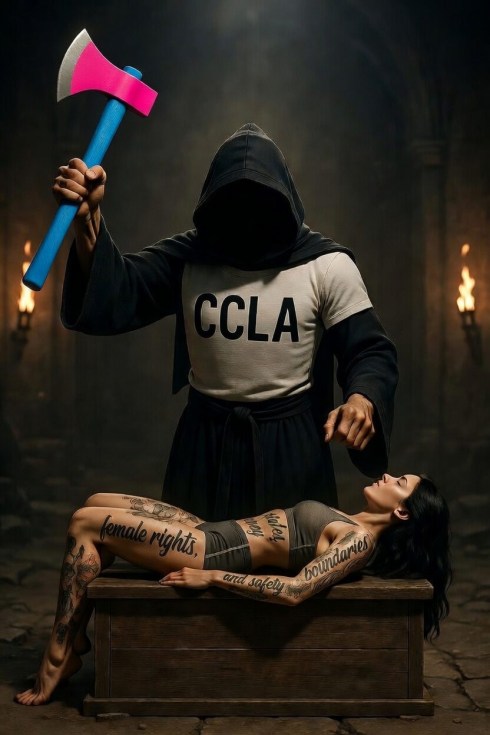
When a civil liberties organization cannot define a category, it cannot defend a right.
That is the move.
The IOC’s policy does not abolish sport as a “human right.” It sets an eligibility rule for the female category: from LA 2028 onward, athletes in that category must pass a one-time SRY gene screen, using saliva, a cheek swab, or blood. Athletes who do not qualify are still eligible for male, mixed, or open categories. This is not exclusion from sport. It is boundary enforcement within sport.
That distinction is the entire argument, and the CCLA refuses to engage it.
Instead, it leans on the language of “inclusion” as though inclusion means entitlement to every category. But sport has never worked that way. Weight classes exclude. Age divisions exclude. Paralympic classifications exclude. Women’s sport exists because sex matters. Calling sex-based eligibility “exclusionary” does not answer that reality. It simply renames the boundary and hopes no one notices.
The claim that the policy “targets cisgender women with differences in sex development” is similarly evasive. The IOC framework uses SRY screening because it is strong evidence of male development. World Boxing’s policy is explicit: eligibility for the women’s category excludes athletes with Y-chromosome material or male androgenization. The relevant question is not whether someone identifies as a woman, but whether they have undergone male development. The CCLA substitutes sympathetic language for that question rather than answering it.
The argument about there being no “clear evidence” of transgender women poised to compete in LA 2028 is weaker still. Rules are not written only after a problem becomes numerically large. They are written to clarify the category before competition begins. “There aren’t many” is not an argument against having a rule. It is an admission that the rhetoric is disproportionate to the scale of the issue.
“It treats female sport as though it were an access program rather than a sex-based category.”
The claim of “intrusive scrutiny” is also inflated. The IOC’s first-line test is a one-time genetic screen using saliva, cheek swab, or blood. That is not the same thing as the mid-20th century abuses activists like to invoke. A serious civil-liberties analysis would distinguish between limited modern verification and historical excess. This statement deliberately blurs them.
And then there is the core contradiction. The CCLA says fairness and dignity are not mutually exclusive. That is true. But it follows that female athletes can be treated with dignity and retain a protected category that excludes males. The CCLA resolves this tension by dissolving the category instead. In practice, its position requires female athletes to absorb the cost: compromised fairness, weakened boundaries, and—in contact sports—elevated risk.
That is not a neutral rights framework.
It is a redefinition of rights in which access to the female category is prioritized, and the integrity of that category is treated as negotiable.
A civil liberties organization should be able to state the purpose of a category before it critiques its rules. The CCLA does not. It treats the female category as a site for validating identity claims rather than as a sporting class organized around sex.
Once that happens, the conclusion is pre-determined.
Female boundaries become suspect.
Enforcement becomes cruelty.
And reality becomes something to be managed with language.
The woke left speaks endlessly about colonization, erasure, and the violence of imposing alien categories onto other peoples. Then, on gender, it does exactly that. “Two-spirit” is not a generic synonym for nonbinary or trans. It was coined in a specific Indigenous context, for Indigenous people, to describe realities bound up with particular nations, ceremonial roles, and community obligations. The same is true of hijra, fa’afafine, bissu, and similar roles elsewhere. These are not free-floating proof texts for Western activists. They are culturally embedded forms of life. To strip them out of their own cosmologies and social structures, then redeploy them as evidence for a universal modern gender framework, is not solidarity. It is appropriation with moral vanity attached.
“The people most fluent in the language of decolonization cannot stop subordinating Indigenous meaning to Western identity fashion.”
The same pattern appears in history. Joan of Arc, Chevalier d’Eon, Herculine Barbin, and other ambiguous or unusual figures are routinely conscripted into a modern trans genealogy, as if the past existed chiefly to validate present slogans. But this is not historical recovery. It is retrospective annexation. These people lived inside worlds structured by religion, law, custom, sex, status, and necessity in ways that do not map cleanly onto 21st-century identity language. To force modern labels onto them is not to “see” them at last. It is to erase the terms on which they actually understood themselves. The activist flatters himself that he is rescuing the past from ignorance. In reality he is recolonizing it.
That is the real irony. The people most eager to denounce Western universalism cannot stop universalizing their own categories. The people most fluent in the language of decolonization cannot stop subordinating Indigenous meaning to Western identity fashion. The people most obsessed with “listening to lived experience” routinely ignore living communities when those communities resist being folded into the approved script. This is not liberation. It is a familiar imperial habit in progressive costume: take what is particular, local, sacred, and historically bounded, flatten it into an abstract category, and then call the theft inclusion.
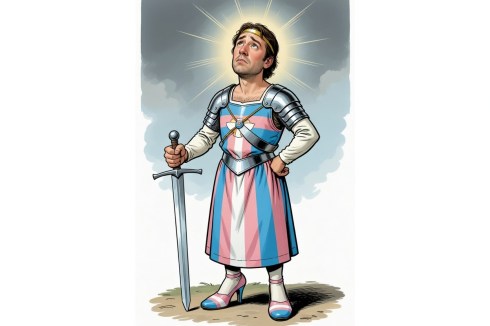
John of Arc
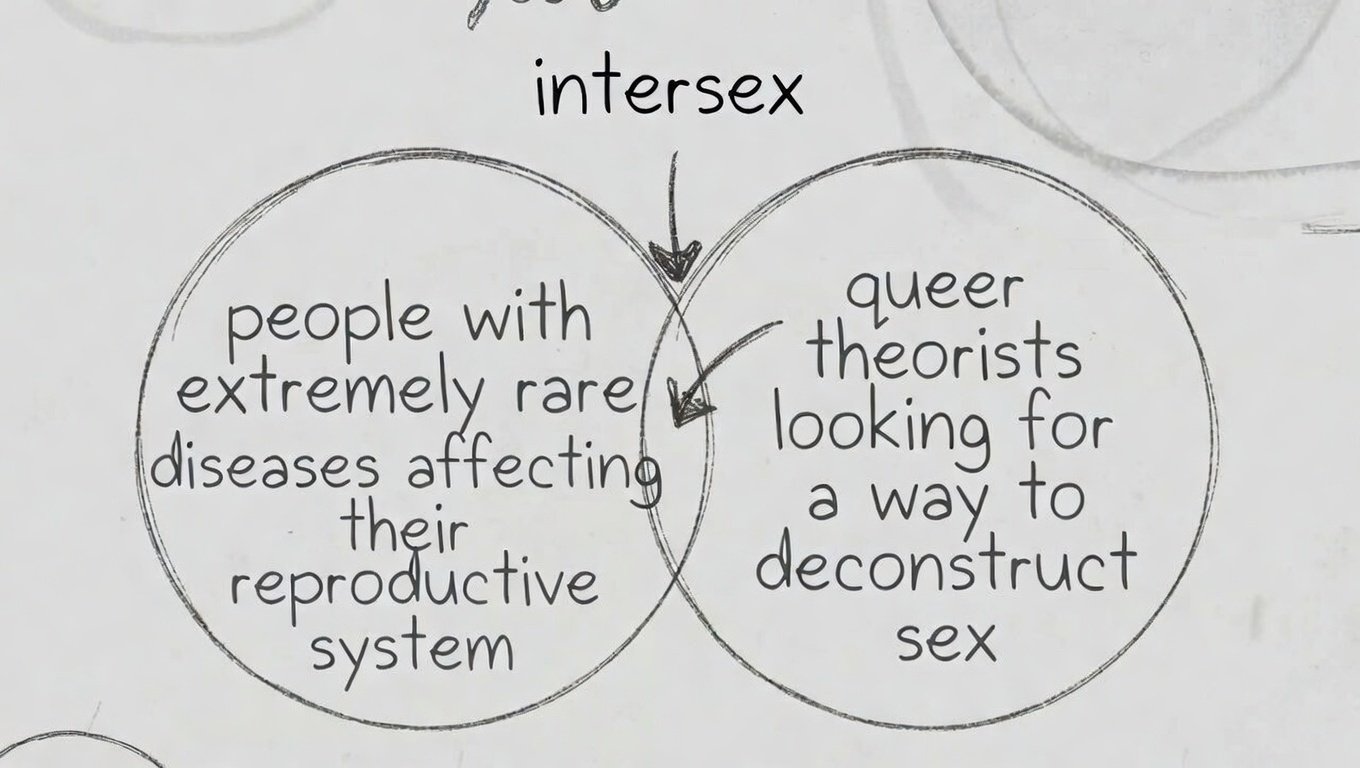
This image makes a simple point: “intersex” does not mean a third sex. It refers to rare medical disorders affecting sexual development. The criticism here is that queer theorists often use those rare exceptions rhetorically to blur or deconstruct the basic reality that sex is male or female.











 bleatmop
 Mystro


 Dead Wild Roses
Your opinions…