
You are currently browsing the tag archive for the ‘Women’s Rights’ tag.
 Parastoo Ahmadi sang without a hijab. For that, an Iranian court has reportedly sentenced her to seventy-four lashes, along with a two-year travel ban and a ban on artistic work.
Eight members of her musical and production team reportedly face the same punishment.
The ruling may still be appealed. That matters legally. It does not rescue the moral situation. A state has looked at a woman singing in an online performance and answered with the threat of the lash.
The official language is familiar: public decency, immoral content, religious propriety, social order. There is always a phrase ready when power wants to punish disobedience. But the facts remain plain enough. Ahmadi performed without submitting to Iran’s compulsory hijab laws, accompanied by male musicians, in a concert released online. The court treated the performance not as art, but as contamination.
That is what theocratic rule does. It turns a woman’s hair, voice, clothing, movement, and public presence into political territory.
A hijab freely chosen may be an act of faith, modesty, identity, or personal conviction. A hijab enforced by courts and police is something else. It becomes a sign of state power. Once punishment enters the picture, the language of choice disappears.
Western societies often become nervous when speaking about this. Ordinary Muslims in Canada, Britain, France, or the United States are not responsible for the crimes of the Islamic Republic. Many Muslims reject this kind of rule entirely. Many Iranian women resisting the regime come from Muslim families and communities themselves.
But that distinction cannot become an excuse for silence.
Islam as private belief is one thing. Islam as state power is another. When religious law governs women’s dress, restricts women’s voices, polices women’s bodies, and punishes public disobedience, it stands in direct conflict with the liberal inheritance the West should still be willing to defend: freedom of conscience, freedom of expression, equality before the law, and the right of the individual to live without clerical supervision.
Those values are not always honoured here. The West fails them often enough. But their failures do not make them false. Their absence is visible in places where a woman can be dragged through courts for singing.
Ahmadi’s alleged offence was not violence. It was not theft. It was not corruption. It was a performance. The regime’s response reveals the insecurity beneath the theology. A system confident in its moral authority would not need to threaten artists with flogging. A faith secure in itself would not require police, courts, and punishment to preserve public obedience.
“A hijab freely chosen belongs to the woman. A hijab enforced by courts and police belongs to the state.”
This is where polite multicultural language often fails. Respect for persons does not require respect for the laws that crush them. We can defend the dignity of peaceful Muslims while saying plainly that theocratic rule in Iran is oppressive, anti-liberal, and especially brutal toward women.
Sweeping that conflict under the multicultural rug does nothing for women like Ahmadi. It only protects the comfort of people far away from the consequences. The women living under these laws do not get the luxury of abstraction. They live with patrols, summonses, bans, fear, and the knowledge that a song can become evidence.
The phrase “Women, Life, Freedom” became powerful because it named what the regime fears most: women living as full human beings rather than managed subjects. Ahmadi’s performance belongs to that same moral territory. Under a regime like Iran’s, a woman singing uncovered is not merely performing. She is refusing.
And for that refusal, the state reaches for the lash.
Parastoo Ahmadi should be free to sing. Iranian women should be free to uncover their hair, make art, criticize their rulers, choose their faith, reject faith, and live without being disciplined by men who mistake control for morality.
A society that must threaten to whip women into obedience has already lost the argument.
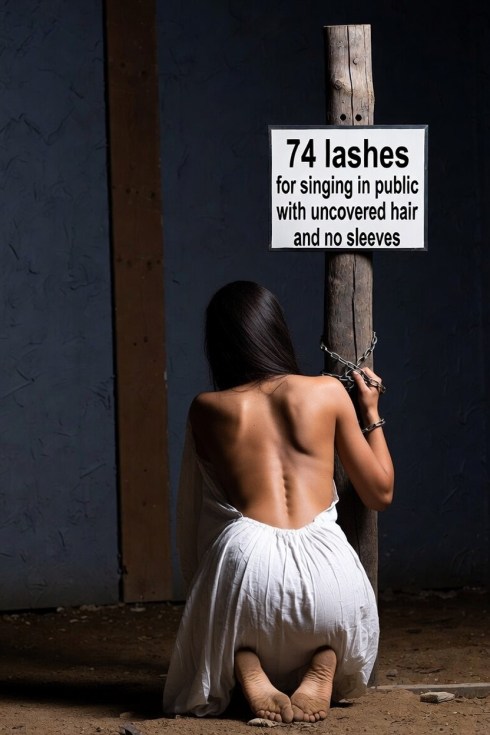
Seventy-four lashes for a song — the price of a woman’s uncovered voice in Iran.”
References
The Guardian. “Iranian star Parastoo Ahmadi reportedly sentenced to 74 lashes for singing without hijab.” June 18, 2026.
https://www.theguardian.com/world/2026/jun/18/iran-parastoo-ahmadi-74-lashes-singing-without-hijab
Radio Free Europe/Radio Liberty. “74 Lashes For A Song: Iranian Artist Sentenced For Virtual Concert.” June 2026.
https://www.rferl.org/a/iran-singer-sentence-flogging-morality-police-ban-women-life-freedom-hijab-concert-youtube/33783873.html
IranWire. “Caravanserai Concert Staff Sentenced to Flogging and Artistic Bans.” June 2026.
https://iranwire.com/en/news/153871-caravanserai-concert-staff-sentenced-to-flogging-and-artistic-bans/
Amnesty International. “Iran: New compulsory veiling law intensifies oppression of women and girls.” December 10, 2024.
https://www.amnesty.org/en/latest/news/2024/12/iran-new-compulsory-veiling-law-intensifies-oppression-of-women-and-girls/
I have been called “Maple MAGA.”
It is a silly phrase, but not an innocent one. Imported American static with a Canadian toque pulled over it, the label works less as description than as sorting device: once attached, it tells the room what to do with the person before anyone has to answer what he said. That is its usefulness.
The charge, as far as I can tell, is not that I am secretly American, or that I want Donald Trump to annex the Prairies, or that I am pining for red hats on Parliament Hill. It is not that I support theocracy, oppose women’s education, or want priests running the courts.
The charge is simpler. I keep saying things that no longer sit comfortably inside the approved progressive frame.
 I defend freedom of expression, especially when the expression is rude, inconvenient, unfashionable, or badly timed. I think women and girls have sex-based rights that cannot be wished away by therapeutic language. I think female prisons should be for female prisoners. I think children should not be hurried into irreversible medical pathways to satisfy adult ideology. I think citizens should be free to read, think, doubt, argue, dissent, and change their minds without the state, the school board, the professional college, or the HR department treating their inner life as a compliance problem.
Apparently, this is enough now: not enough to make one wrong, which would require an argument; not enough to make one dangerous, which would require evidence; but enough to make one “far right,” “MAGA,” “reactionary,” “unsafe,” or whatever label is currently doing the work reasons used to do.
The insult is the visible part. Underneath it sits the relocation of the acceptable centre.
Cultures move. Language changes. Laws change. Public taste changes. Some changes are good and overdue; some are foolish; some begin as compassion and harden into coercion. There is nothing sacred about yesterday’s vocabulary merely because it is yesterday’s vocabulary, but cultural movement does not move reality.
That distinction is now being blurred. It is one thing for a society to change how it talks about sex, gender, identity, offence, harm, safety, and inclusion. It is another thing to pretend the underlying truths have changed because the approved language has changed.
A male body in a female prison does not become a female body because a policy manual has been updated. A teenage girl’s distress about her body does not become simple proof of a medical destiny because a professional association has learned a new script. A citizen’s refusal to repeat an ideological formula does not become hatred because an HR department calls the formula kindness.
The culture can change what is rewarded, what is punished, who gets invited to speak, who gets reported, who gets promoted, who gets quietly avoided, and who gets labelled a problem; it cannot change the truth.
Female prisons make the point concrete because, for most of living memory, saying that female prisons should be for female prisoners was not a right-wing position. It was barely a position at all. It sat in the background with other obvious assumptions: women’s shelters are for women, women’s sports are for women, and sex matters most in the places where privacy, vulnerability, male violence, and bodily difference are not abstractions.
“There is nothing sacred about yesterday’s vocabulary merely because it is yesterday’s vocabulary, but cultural movement does not move reality.”
Prisons are coercive institutions. Women inside them cannot simply leave, choose their neighbours, or opt out of policy experiments designed by people outside the walls. The state therefore has a heightened duty of care. Sex matters there; it matters when privacy is stripped away, when physical power is uneven, when trauma is common, and when the people affected have no meaningful escape route.
Yet once the vocabulary changes, the old safeguarding claim can be redescribed as extremism. Not because women became less vulnerable in prison, male-pattern violence disappeared, or sex stopped mattering in confined spaces; the argument is recoded because the permitted moral language changed around it.
This is the trick: move the official language, then treat unchanged reality as if it has been morally superseded.
The same pattern appears elsewhere. Free expression becomes “harm.” Privacy becomes “suspicion.” Doubt becomes “denial.” Genuine distress in young people is real, and compassion for it is necessary; but caution in youth medicine is not cruelty, and weak evidence does not become strong because the approved language insists it must. Refusing compelled belief becomes bigotry. The old liberal question — “Is this true, and may I say so?” — is replaced by a managerial one: “Does this comply with the approved moral vocabulary?”
There is a Gramscian flavour here. Gramsci understood something real about modern power: it does not operate only through police, courts, elections, and parliaments. It operates through culture; through schools, media, churches, universities, publishers, artists, professional bodies, and the people who teach society what respectable people are supposed to think.
Durable victory requires more than capturing the state; it requires shaping common sense. That is the part that feels familiar now: a workshop here, a policy update there, a glossary, a training module, a revised professional standard, a grant condition, a reputational warning. No jackboots required. Just enough pressure to teach ordinary people which sentences now come with consequences.
Most people understand the lesson. They have jobs, families, colleagues, reputations, mortgages, volunteer roles, and professional obligations. They do not want to be called hateful, unsafe, extremist, bigoted, MAGA, or far right; they do not want to become the example everyone else is warned about. So they move, or they fall silent.
Then comes the strange inversion. People who have not changed their minds are told they have moved to the far right. The old centre is renamed after the fact; positions that were once liberal, feminist, or civil-libertarian are reclassified as dangerous because the institutions around them have adopted a new script. The people did not move so much as find the centre moved around them.
That is why “Maple MAGA” is such a convenient little insult. It imports the emotional charge of American polarization and drops it onto Canadian disagreement. It lets the speaker skip the local argument: no need to examine the claim, no need to ask whether an older feminist concern might still be true, no need to wonder whether a civil-libertarian objection might have merit. The label supplies the answer before the question is allowed to form.
“Once that habit takes hold, precision disappears. These words become atmospheric; they create suspicion, not understanding, and suspicion is often all that is needed.”
This is especially poisonous in Canada, where we already borrow too many American reflexes. We take American slogans, American moral panics, American partisan categories, American racial scripts, American activist vocabulary, and American media obsessions, then pretend they map cleanly onto Canadian life. Usually they do not; but they are emotionally efficient, and that is often enough.
Once that habit takes hold, precision disappears. “MAGA” no longer means a specific American political movement. “Far right” no longer means a coherent political position. “Unsafe” no longer means a demonstrated danger. These words become atmospheric; they create suspicion, not understanding, and suspicion is often all that is needed.
A person does not have to be refuted if he has already been made socially radioactive. His argument does not have to be answered if the room has been taught to flinch before hearing it. That is the quiet power of these labels: they replace disagreement with contamination.
A free society cannot keep doing that and remain free in any serious sense. It cannot function if disagreement is treated as pollution, cannot remain liberal if every objection is recoded as harm, and cannot reason together if words are used to end thought rather than sharpen it.
Some people really are extremists. Some movements really are dangerous. Some ideas really do deserve fierce opposition; there is no virtue in pretending otherwise. But when the label comes before the argument, the argument never happens. Civic life begins to rot not when people disagree, but when they lose the habit of believing disagreement deserves an answer.
So no, I am not especially interested in proving that I am not “Maple MAGA.” The phrase is too silly to deserve that much respect. I am interested in why so many people now reach for labels instead of reasons: how free expression became suspect, how female rights became reactionary, how cognitive liberty became dangerous, and how ordinary citizens were told that standing still meant they had somehow moved to the far right.
The institutions moved the language, then pretended they had moved reality.
That is the lie at the centre of the whole exercise.

References / Further Reading
Correctional Service Canada — Commissioner’s Directive 100: Gender Diverse Offenders
Canada’s federal correctional policy on gender-diverse offenders, including placement according to gender identity or expression.
UK Ministry of Justice — New Transgender Prisoner Policy Comes Into Force
The 2023 England and Wales policy restricting placement of some transgender-identifying males in women’s prisons.
The Cass Review — Final Report
The 2024 independent review of gender identity services for children and young people in England, especially useful for the essay’s caution-in-youth-medicine point.
Ipsos Canada — Strong Majority of Canadians Continue to Support 2SLGBT+ Rights and Visibility
Useful public-opinion context showing broad support for LGBT rights alongside lower support for gender-identity-based rules in women’s sport.

The Taliban understand something too many Western progressives pretend not to: the education of women is civilization-level power.
That is why they ban it. That is why they silence girls. That is why they bury half the country alive and call it virtue.
A society that fears educated women is not protecting tradition. It is confessing its own cowardice.
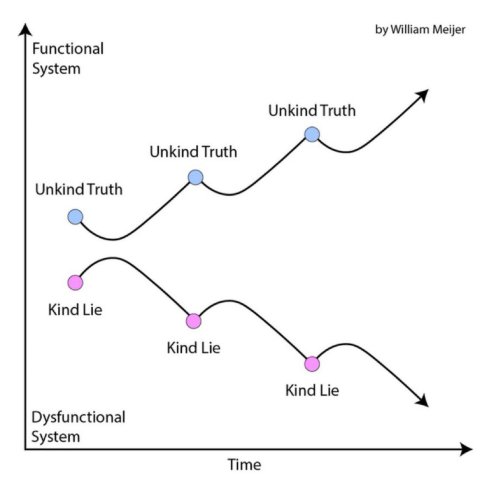
Most social lies do not begin as lies. They begin as little acts of politeness.
You laugh at a joke that was not funny. You say “no problem” when there was, in fact, a problem. You sit through a meeting where everyone knows the plan makes no sense, but nobody wants to be the person who slows the room down. Ordinary life requires tact. Not every uncomfortable truth needs to be hurled across the table the moment it appears.
But there is a difference between tact and required unreality.
Tact says we should not be needlessly cruel. Required unreality says we must say the false thing, affirm the false thing, organize institutions around the false thing, and treat anyone who refuses as morally suspect.
That difference matters because societies rarely drift away from truth in one dramatic leap. They drift through small accommodations. A phrase changes here. A courtesy becomes expected there. A workplace norm hardens into policy. A school form gets rewritten. A professional guideline quietly changes the question everyone is allowed to ask.
Then, one day, ordinary people look around and realize they are being asked to deny things they can see with their own eyes.
The debate over sex and gender is one of the clearest examples.
The first move was linguistic. “Sex observed at birth” became “sex assigned at birth.” Many people shrugged. It sounded harmless, maybe even compassionate. Why fight over wording? But the change was not neutral. “Observed” describes the recognition of a biological fact. “Assigned” suggests an administrative decision, something imposed, possibly mistaken, perhaps unjust.
No parent waits for a committee to assign sex. They see the baby. They know. The doctor observes. The parents understand. The paperwork follows reality; it does not create it.
But once “assigned” becomes normal, the ground has shifted. The old reality has not disappeared, but the language around it has been loosened. A fact starts to sound like an opinion. An observation starts to sound like an imposition. What was once obvious becomes something polite people are encouraged not to say too firmly.
Pronouns came next for many ordinary people. “What is the harm?” they were told. “It is just politeness.”
And in private life, adults can choose whatever courtesies they want. People use nicknames. People avoid sore spots. People soften language to keep peace with neighbours, coworkers, students, friends, and family. That is normal human life.
The difficulty begins when courtesy becomes compulsory and everyone is expected to speak as though sex has disappeared from the room.
A teacher pauses before saying “she.” A coworker catches himself mid-sentence. A parent sits through a school meeting and says nothing because every adult in the room knows what is being asked, and nobody wants to be first to break the spell. So people go along. They use words they do not quite believe. They tell themselves it is only a small thing.
“Those arguments matter. But before any of them can be had honestly, people must be allowed to say what they know is true.”
Small things train larger habits. Once people become accustomed to saying what they do not believe, the person who says, “wait, this is not accurate,” becomes the problem. Not the falsehood. Not the policy built on it. The person who interrupts the shared performance.
That is how a real slippery slope works. It is not that one concession magically causes the next. It is that each concession changes the moral conditions under which the next demand is judged.
If sex is “assigned,” and pronouns are only kindness, and refusing preferred language is cruelty, then female-only spaces start to look morally suspicious. The sign on the changing room may stay the same, but the rule underneath it changes. The word “women” remains on the door. What it means has been quietly edited.
That edit does not stay abstract. It reaches the sports team someone’s daughter trains with. It reaches shelters, prisons, changing rooms, rape-crisis services, and lesbian boundaries. All can be reframed as sites of exclusion. The question quietly changes from “Do women and girls have sex-based rights?” to “Why are you being unkind to this vulnerable person?”
None of this denies that some people experience genuine distress about their bodies. They do. The question is whether compassion requires everyone else to rewrite reality around that distress.
By then, the argument has already moved. Women are no longer asking to preserve boundaries rooted in sex. They are being asked to justify why those boundaries should exist at all.
That is not an abstract problem. It changes institutions. It changes policies. It changes what children are taught. It changes what professionals are allowed to say. It changes whether parents, teachers, doctors, athletes, and ordinary citizens are permitted to name reality without being accused of hatred.
The kind lie does not remain kind once people are punished for refusing it.
We can debate the details of medicine, sports, schools, safeguarding, and law. Those arguments matter. But before any of them can be had honestly, people must be allowed to say what they know is true.
Reality has a way of waiting. Bodies still exist. Sex still matters in medicine, sport, privacy, reproduction, vulnerability, and patterns of violence. Institutions can change their language, but language does not abolish the facts underneath it. Step away from truth for long enough and eventually reality supplies the correction.
Reality always bats last.
The point is not that every hard truth should be spoken harshly. Decency matters. So does compassion. But compassion detached from truth becomes something else. It becomes a demand that some people absorb real costs so everyone else can feel morally clean.
That is the part ordinary people need to notice. Every time they play along with a claim they know is not true, they are not merely being polite. They may be helping build the next rule, the next policy, the next institutional punishment for the person who finally says no.
A recent post from a Women’s Liberation Front activist should be read less as a complaint than as a warning about how institutions train dissenters to accept contempt as normal.
She describes years of opposing gender-identity legislation in California: travelling to Sacramento, meeting legislative offices, testifying at hearings, and trying to explain to ordinary people what the policies actually mean. Female locker rooms become mixed-sex spaces by administrative decree. Girls’ sports and girls’ boundaries become conditional. Distressed young women are placed on medical pathways that can permanently alter healthy bodies.
The remarkable part is not merely that lawmakers disagree with her. Disagreement is expected in politics. What stands out is the air of pre-judgment around the process. She writes that legislators’ offices treat these women with “barely contained disdain.” Public hearings fill with activists who regard any defence of female boundaries as proof of bigotry. The women objecting are not received as citizens raising serious concerns about privacy, safeguarding, fairness, or medical ethics. They are treated as a nuisance class: managed, endured, and socially disqualified before the argument begins.
A functioning democracy does not require lawmakers to agree with every citizen. It does require them to hear citizens as citizens. When women raise concerns about intimate spaces, parental knowledge, fair competition, or irreversible interventions on minors, the answer cannot simply be a sneer and a label. “Bigot” is not an argument. “Hate” is not a policy analysis. “Inclusion” does not magically settle every conflict between competing rights.
Institutional capture often works this way. It does not begin by winning every argument in public. It begins by deciding which arguments are permitted to count. After that, the ordinary political process becomes strangely theatrical. Hearings still happen. Citizens still line up to speak. Legislators still nod along with the solemn expressions of people performing democratic patience. But the conclusion has already been filed away. These women are not constituents with claims on representation. They are obstacles to be routed around.
“A functioning democracy does not require lawmakers to agree with every citizen. It does require them to hear citizens as citizens.”
California is an especially sharp example because its political culture is so one-sided on this issue. The institutions are not neutral referees; they have chosen a side, and women who object are expected to absorb that fact politely. Over time, this wears people down. The WoLF activist’s most revealing line is not the one about crazy legislation. It is the moment of recognition: going to Washington, D.C. reminded her how badly she had become accustomed to being treated in California.
That is what contempt does over time. It lowers your expectations. It trains you to think basic respect is a luxury. It teaches you that being ignored is normal, that being caricatured is normal, that being called hateful for stating sex-based concerns is the price of admission.
This is especially perverse when the dissenters are women defending women’s boundaries. Feminism once insisted that female privacy, bodily integrity, and protection from male entitlement mattered. Now women who make those arguments are often treated as embarrassing relics, reactionaries, or moral contaminants. The old feminist vocabulary survives, but the sex class it was built to defend has been quietly replaced by a more fashionable abstraction.
The inversion should be obvious by now. Women are told they must be compassionate while their own concerns are dismissed. Girls are told inclusion matters while fairness and privacy are negotiated away on their behalf. Parents are told to trust institutions that increasingly treat hesitation as a threat. Citizens are told democracy is sacred while lawmakers learn to ignore the public on issues where the public is far less progressive than the activist class.
“The hearings still happen. Citizens still line up to speak. But the conclusion has already been filed away.”
This is why the fight matters even when a particular bill is lost. Public opposition creates a record. It denies consensus. It tells other women they are not alone. It forces legislators to own what they are doing rather than hiding behind bureaucratic language and moral fog.
Eventually, legislators need to pay a political price for treating women this way. Not because disagreement is forbidden. Not because every feminist objection should automatically prevail. But because a political class that can dismiss women’s sex-based concerns with contempt has learned something dangerous about power: the right moral vocabulary can make ordinary citizens disappear.
Women cannot win a fight they are shamed out of entering. They cannot defend boundaries they are not allowed to name. They cannot rely on institutions that have already decided their objections are evidence of guilt.
The point is not that every battle will be won in Sacramento. Some will be lost. Maybe many. But silence is how capture becomes permanent. Visibility is how it starts to crack.

Institutional capture rarely arrives breathing fire. More often, it brings a binder, a microphone, and a schedule.
Women do not need permission to define themselves.
The word woman already has a meaning. It is not hateful to say so, and it is not extremist to defend female boundaries, female privacy, female sports, or female-only spaces. Women are adult human females. That definition is not a slur. It is the basis on which women’s rights were built.
The public silence around this issue is starting to crack because too many people can now see where the trajectory leads. A society that cannot define women cannot reliably protect them. Rights tied to sex become fragile once sex itself is treated as optional language.
Enough of the intimidation. Enough of the compelled speech. Enough of the social blackmail that brands ordinary women as bigots for wanting boundaries previous generations understood as normal, necessary, and humane.
The next step is not private agreement. It is public resistance, steady enough that institutions can no longer pretend the objection belongs only to cranks and extremists.
Write to elected officials and demand that sex-based protections be clarified in law as applying to biological sex. Support groups defending women’s sports, shelters, prisons, and female-only services. Push back in schools, workplaces, unions, professional associations, and public consultations when policies dissolve female boundaries into identity claims. Refuse the language games that make reality harder to discuss. Speak plainly, calmly, and repeatedly.
Support the journalists, writers, academics, whistleblowers, parents, athletes, and ordinary women who are absorbing the punishment for saying what millions still believe. Do not leave them standing alone while quietly agreeing with them afterward in private.
That private agreement is one of the main things keeping this machine alive. Institutions interpret silence as consent. Bureaucracies advance until they meet resistance, and too many citizens have been trained to mistake politeness for surrender.
This resistance does not require rage or cruelty. It requires steadiness, numbers, and the willingness to stop pretending obvious things are unsayable.
The backlash already underway across the Western world is not driven by hatred. It is driven by exhaustion with the claim that female boundaries are negotiable, that biology is taboo, and that dissent itself is immoral.
Women have the right to their own spaces, language, associations, and political interests. No court ruling or policy document can erase that reality.

The recent Tickle v Giggle ruling exposes a widening gap between legal language and ordinary reality.
The court held that a female-only app unlawfully discriminated against a ‘transgender woman’ by excluding him from the platform. The legal mechanism matters: this was framed through gender-identity discrimination protections. But the practical result is hard to miss. A space created for women was told it could not draw its boundary around being female.
That has consequences beyond one app.
Women’s sex-based protections exist because sex is real. Pregnancy is real. Male-pattern violence is real. Privacy concerns in shelters, prisons, changing rooms, sports, and intimate female spaces are not imaginary. They are not bigotry dressed up as discomfort. They arise from material differences that law once had enough common sense to recognize.
A humane society can treat transgender people with dignity and still preserve female-only spaces. Those two duties are not enemies unless ideology makes them so.
The problem with this ruling is that it pushes women into the old subordinate role again: accommodate first, object later, and expect punishment if the objection sounds too firm. Female boundaries become negotiable. Female discomfort becomes suspect. Meanwhile, identity claims are treated as moral imperatives that everyone else must organize around.
That is not equality. It is a new hierarchy with better manners.
Ordinary people notice the coercion. They notice the pressure to say things publicly that they do not believe privately. They notice that everyone still understands what sex is when the issue is medical care, crime statistics, pregnancy, or athletics, but suddenly becomes confused when women try to maintain a boundary.
This is why the issue refuses to disappear. Reality keeps returning through the side door.
The law should protect every citizen from harassment and mistreatment. But it should not compel society to pretend that sex is meaningless. If women cannot define female-only spaces around biological sex, then “woman” has lost the legal coherence that made women’s rights possible in the first place.
This decision should be overturned, and the law should be clarified: sex means biological sex where single-sex spaces, services, sports, and protections are concerned.
Without that correction, women are being told to move aside in the name of inclusion.
They have heard that instruction before.











 bleatmop
 Mystro
 The Arbourist


 Dead Wild Roses
Your opinions…