
You are currently browsing the category archive for the ‘Gender Issues’ category.
This is how activists frame their lies and misdirection.

Here is their bullshittery in full:
The introduction of new rules restricting participation in women’s sport categories to “biological females”, determined through mandatory genetic screening and testing, imposes exclusionary criteria. These measures not only bar transgender women from competition, but target and disqualify cisgender women with differences in sex development.
This policy will apply to the Los Angeles 2028 Olympic Games and beyond, despite the absence of clear evidence that any transgender women were poised to participate in those Games. The IOC’s approach aligns itself with the U.S. government’s 2025 executive order “Keeping Men Out of Women’s Sports” which threatened to withdraw funding from organizations that permit transgender athletes to compete and to deny visas to certain athletes seeking to participate in the Los Angeles Olympics. The convergence of international sport governance with exclusionary state policy raises serious concerns about the politicization of athletic participation and the erosion of independent, rights-respecting governance.
“While framed as a measure to ensure fairness, this policy imposes exclusionary criteria that will disproportionately harm transgender women and also place cisgender women at risk, particularly those with natural biological variations,” says Aaden Pearson, Trans Rights Legal Fellow at the Canadian Civil Liberties Association. “The policy authorizes intrusive scrutiny of women’s bodies and asserts authority over who gets to participate as a ‘real’ woman under the guise of regulation.”
This policy will have detrimental impact on Canadian athletes that may be barred from participating in the Olympics because of this policy who otherwise would qualify to represent Canada.
A rights-respecting approach to sport must be grounded in inclusion, evidence, and proportionality. Fairness and human dignity are not mutually exclusive. The legitimacy of sport depends on ensuring that all athletes are able to participate without discrimination.
The CCLA calls on the IOC and national sporting bodies to:
- Immediately reconsider the implementation of these eligibility rules;
- Ensure that any policies governing participation in sport are evidence-based, proportionate, and consistent with international human rights obligations; and
- Uphold the principle that sport must be accessible to all, without discrimination.
The legitimacy of sport depends not only on fairness in competition, but on fairness in access. Policies that exclude, surveil, and stigmatize athletes have no place in a rights-respecting sporting system.”
————————
When a civil liberties organization cannot define a category, it cannot defend a right.
That is the move.
The IOC’s policy does not abolish sport as a “human right.” It sets an eligibility rule for the female category: from LA 2028 onward, athletes in that category must pass a one-time SRY gene screen, using saliva, a cheek swab, or blood. Athletes who do not qualify are still eligible for male, mixed, or open categories. This is not exclusion from sport. It is boundary enforcement within sport.
That distinction is the entire argument, and the CCLA refuses to engage it.
Instead, it leans on the language of “inclusion” as though inclusion means entitlement to every category. But sport has never worked that way. Weight classes exclude. Age divisions exclude. Paralympic classifications exclude. Women’s sport exists because sex matters. Calling sex-based eligibility “exclusionary” does not answer that reality. It simply renames the boundary and hopes no one notices.
The claim that the policy “targets cisgender women with differences in sex development” is similarly evasive. The IOC framework uses SRY screening because it is strong evidence of male development. World Boxing’s policy is explicit: eligibility for the women’s category excludes athletes with Y-chromosome material or male androgenization. The relevant question is not whether someone identifies as a woman, but whether they have undergone male development. The CCLA substitutes sympathetic language for that question rather than answering it.
The argument about there being no “clear evidence” of transgender women poised to compete in LA 2028 is weaker still. Rules are not written only after a problem becomes numerically large. They are written to clarify the category before competition begins. “There aren’t many” is not an argument against having a rule. It is an admission that the rhetoric is disproportionate to the scale of the issue.
“It treats female sport as though it were an access program rather than a sex-based category.”
The claim of “intrusive scrutiny” is also inflated. The IOC’s first-line test is a one-time genetic screen using saliva, cheek swab, or blood. That is not the same thing as the mid-20th century abuses activists like to invoke. A serious civil-liberties analysis would distinguish between limited modern verification and historical excess. This statement deliberately blurs them.
And then there is the core contradiction. The CCLA says fairness and dignity are not mutually exclusive. That is true. But it follows that female athletes can be treated with dignity and retain a protected category that excludes males. The CCLA resolves this tension by dissolving the category instead. In practice, its position requires female athletes to absorb the cost: compromised fairness, weakened boundaries, and—in contact sports—elevated risk.
That is not a neutral rights framework.
It is a redefinition of rights in which access to the female category is prioritized, and the integrity of that category is treated as negotiable.
A civil liberties organization should be able to state the purpose of a category before it critiques its rules. The CCLA does not. It treats the female category as a site for validating identity claims rather than as a sporting class organized around sex.
Once that happens, the conclusion is pre-determined.
Female boundaries become suspect.
Enforcement becomes cruelty.
And reality becomes something to be managed with language.

The public case for pediatric gender medicine is simple enough. Medical intervention is supposed to reduce distress and improve mental-health outcomes.
That claim matters because the interventions are not minor. Puberty blockers, cross-sex hormones, and related medical pathways are presented to parents, policymakers, and the public as serious treatments for serious suffering. Their case does not rest on compassion alone. It rests on the claim that they work.
The trouble is that the strongest population-level data now available does not show that happening.
A new Finnish nationwide register study reports severe psychiatric morbidity before referral, continued severe psychiatric morbidity after referral, and no sign that psychiatric need subsides after medical gender reassignment. The study does not prove that treatment caused worsening. It does, however, cut directly against confident claims that these interventions reliably resolve the underlying distress in young people.
Terms fixed in advance
This subject is saturated with semantic drift, so a few terms need fixing at the outset.
By pediatric gender medicine, I mean the medical management of gender-distressed minors and young people through interventions such as puberty blockers, cross-sex hormones, and, where applicable, surgical pathways. By psychiatric morbidity, I mean the study’s outcome measure: need for specialist psychiatric treatment, whether inpatient or outpatient. By improvement, I mean a measurable reduction in psychiatric morbidity relative to baseline or to relevant controls.
That is a demanding definition. It is also the clinically serious one. If an intervention is being justified as a mental-health measure, then some observable improvement in hard psychiatric outcomes is the least one should expect.
What the Finnish study is
The Finnish paper is not a survey, and it is not a self-report exercise. It is a nationwide register study of all 2,083 individuals under age 23 who contacted Finland’s centralized gender identity services between 1996 and 2019, compared with 16,643 matched controls. Follow-up extended to June 2022. The outcome was specialist-level psychiatric treatment recorded in national health registers.
That matters. Register data has limits, but it is still harder than the small, uncontrolled, self-reported studies so often used to manufacture confidence in this field.
What it found
Before referral, 45.7% of the gender-referred cohort had already received specialist psychiatric treatment, compared with 15.0% of controls. Two years or more after referral, 61.7% of the gender-referred cohort required specialist psychiatric care, compared with 14.6% of controls. The first fact that has to be faced squarely is that psychiatric burden in this population is not only high at baseline. It remains very high afterward.
The post-2010 cohort matters as well, because defenders of the current model often imply that older data says little about the newer referral population. In this study, referrals after 2010 were in markedly worse psychiatric shape before referral than the earlier cohort. Among referrals before 2010, pre-referral psychiatric morbidity was 23.7%, versus 11.8% among controls. Among referrals after 2010, it was 47.9%, versus 15.3% among controls. So the recent referral surge did not simply bring in more of the same patients. It brought in a population with substantially heavier psychiatric burden.
The most striking figures concern the medically treated subgroups. Among those proceeding down the feminizing pathway, pre-referral psychiatric treatment was 9.8%; at least two years after referral it was 60.7%. Among those proceeding down the masculinizing pathway, the figures were 21.6% before referral and 54.5% after. Those are not small fluctuations. They are large increases in specialist psychiatric treatment after entry into the care pathway.
The adjusted-risk figures are no less serious. After adjustment for prior psychiatric treatment, hazard ratios remained approximately 3.0 to 3.7 times higher than female controls and 4.7 to 6.1 times higher than male controls. In plain English, the excess psychiatric burden did not wash away once prior history was accounted for.
The authors’ own conclusion is worth quoting in fuller form than the clipped line now circulating online: “Severe psychiatric morbidity is common among gender-referred adolescents and appears to be more prevalent in those referred after the recent surge in referrals. Psychiatric needs do not subside after medical gender reassignment.” That is not activist spin. It is the paper’s conclusion.
“Psychiatric needs do not subside after medical gender reassignment.”
What this study does not claim
This part matters because opponents will often try to smuggle in a claim you did not make and then congratulate themselves for refuting it.
This study does not prove that medical transition caused worsening in every case. It does not isolate a single causal mechanism. It does not show that no individual patient experienced subjective relief. It does not establish that specialist psychiatric treatment is a perfect one-to-one proxy for every dimension of psychological distress.
Those are real limits. They should be stated plainly.
But none of them rescues the stronger public claim that pediatric medical transition is clearly supported by solid evidence showing reliable mental-health benefit.
The strongest counterargument
The strongest counterargument is easy enough to state. Patients who go on to medical treatment may differ in important ways from those who do not. There may be unmeasured confounding. Some young people selected for treatment may have had more severe, more persistent, or more complex underlying psychiatric problems than the registers fully capture.
This is plausible.
Even if granted in full, however, it concedes the central problem.
If these interventions are working as claimed at the population level, then some clear signal of mental-health improvement should appear in the aggregate outcomes. Instead, psychiatric burden remains extremely high, does not converge toward control levels, and in key medically treated subgroups rises sharply. Increased specialist psychiatric treatment does not by itself prove worsening in every individual. What it does show is substantial psychiatric need persisting at levels incompatible with confident claims of broad psychiatric resolution.
That is the point critics keep trying to dodge. The question is not whether every confounder has been abolished. The question is whether the real-world outcome pattern supports the certainty with which these treatments have been promoted. This study says no.
Absence of demonstrated benefit is not a trivial problem
A common dodge here is to pretend that unless one has a perfect randomized trial proving direct harm, no serious concern exists. That is not how responsible pediatric medicine works.
Lack of demonstrated benefit is not identical to proof of harm. But weak evidence plus invasive intervention is not a neutral combination, especially in minors. When the evidence base is low quality and the strongest real-world data still fails to show the promised mental-health improvement, caution is not reactionary. It is simply what evidence-based medicine looks like once ideology is removed from the room.
“If an intervention works, population data should eventually show it. This does not.”
The larger evidence context
The Finnish register study matters on its own, but it lands in a broader evidentiary landscape that has already shifted under activists’ feet.
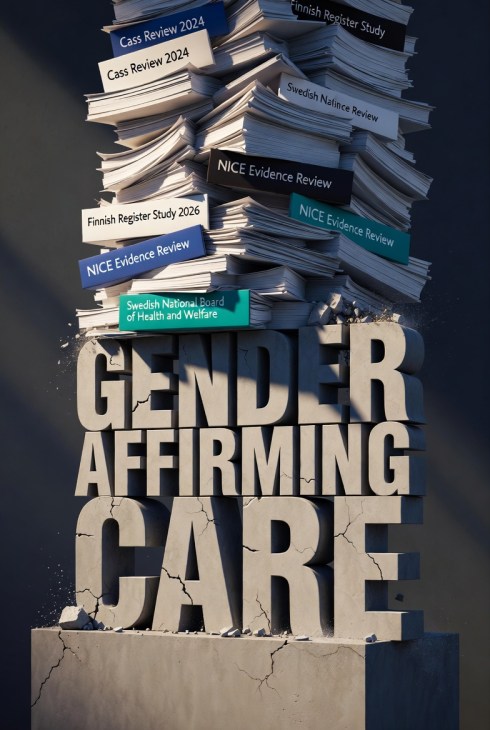
The independent Cass Review in England concluded that the evidence base for medical intervention in children and young people with gender-related distress is weak, that studies are generally small and uncontrolled, and that the field has been marked by overconfidence unsupported by good evidence. The review also incorporated earlier evidence reviews commissioned from NICE on puberty blockers and hormones.
Those NICE evidence reviews found the evidence for both puberty blockers and cross-sex hormones in this population to be of very low certainty. They remain among the most cited formal evaluations of the literature in this area.
Sweden’s National Board of Health and Welfare likewise revised its national guidance, concluding that for minors the risks of puberty blockers and hormone treatment currently outweigh the expected benefits, and that such treatment should be offered only in exceptional cases within structured specialist settings.
That pattern is not accidental. It reflects a broader recognition across evidence reviews and national reassessments: the confidence of the clinical rhetoric has run ahead of the quality of the evidence.
What can actually be concluded
Several conclusions can be made safely.
First, the psychiatric burden in this population is real and often severe. Nothing in this argument denies that.
Second, the new Finnish register data does not show psychiatric need subsiding after medical gender reassignment. On the contrary, the burden remains high, and in some medically treated subgroups the observed specialist psychiatric treatment rates rise sharply.
Third, the broader review literature and policy reassessments from major health authorities do not justify the level of certainty with which pediatric medical transition has often been promoted. The evidence is not robust enough for that.
Fourth, this study does not by itself prove a simple causal story of treatment-induced worsening in every case. Anyone claiming that from this paper alone is saying more than the evidence can bear. But anyone claiming that the strongest available population-level data clearly supports a confident mental-health benefit is also saying more than the evidence can bear.
The policy problem
That mismatch is the real issue.
This is not a case in which critics are denying a clearly established medical benefit. It is a case in which weak evidence, ambiguous long-term outcomes, and very serious interventions have too often been wrapped in the language of settled science.
They are not settled.
The evidence base is weak. The psychiatric burden remains high. The strongest register data now available does not show the promised relief in hard mental-health outcomes. That should force a lower-confidence, higher-caution clinical posture than the activist narrative has allowed.
Verdict
No honest reading of this literature permits the triumphant line that pediatric gender medicine is clearly evidence-based and reliably improves youth mental health.
The better reading is harsher and simpler.
The evidence is weak. The certainty has been inflated. And the strongest real-world data now available does not show psychiatric needs subsiding after medical gender reassignment.
When the evidence does not show improvement, escalation is not caution.
It is risk.
References
Ruuska, S.-M., Tuisku, K., Holttinen, T., & Kaltiala, R. (2026). Psychiatric morbidity among adolescents and young adults who contacted specialised gender identity services in Finland in 1996–2019: A register study. Acta Paediatrica. Advance online publication. https://doi.org/10.1111/apa.70533
Cass, H. (2024). Independent review of gender identity services for children and young people: Final report. https://cass.independent-review.uk/home/publications/final-report/
NICE / NHS England. (2020). Evidence review: Gonadotrophin releasing hormone analogues for children and adolescents with gender dysphoria. https://www.engage.england.nhs.uk/consultation/puberty-suppressing-hormones/user_uploads/nice-evidence-review-gnrh-analogues-for-children-and-adolescents-with-gender-dysphoria-october-2020.pdf
NICE / Cass Review. (2020). Evidence review: Gender-affirming hormones for children and adolescents with gender dysphoria. https://cass.independent-review.uk/wp-content/uploads/2022/09/20220726_Evidence-review_Gender-affirming-hormones_For-upload_Final.pdf
Socialstyrelsen. (2022). Care of children and adolescents with gender dysphoria – Summary of national guidelines – December 2022. https://www.socialstyrelsen.se/publikationer/care-of-children-and-adolescents-with-gender-dysphoria–summary-of-national-guidelines–december-2022-2023-1-8330/
Socialstyrelsen. (2022, December 16). Updated knowledge support for care in gender dysphoria among young people. https://www.socialstyrelsen.se/om-socialstyrelsen/pressrum/press/uppdaterat-kunskapsstod-for-vard-vid-konsdysfori-hos-unga/
Hostile Reader FAQ
“You’re claiming gender-affirming care causes harm.”
No. This piece does not claim causation. It shows that the strongest population-level data does not demonstrate the expected mental-health improvement. Absence of demonstrated benefit is not the same as proof of harm—but it is not neutral either.
“Psychiatric service use isn’t the same as worse mental health.”
Correct. It is not a perfect proxy for subjective distress. It is, however, a hard clinical outcome and a strong indicator of ongoing psychiatric need. Persistent high rates of specialist care are not consistent with claims of broad resolution.
“These patients were already more distressed.”
Yes. The study shows elevated psychiatric burden before referral. The question is whether that burden improves. At the population level, it does not converge toward control levels, and in some subgroups increases substantially.
“This is just one study.”
It is one of the largest and longest nationwide register studies to date. More importantly, its findings align with multiple systematic reviews and policy reassessments that rate the evidence base as low quality and uncertain.
“Other studies show benefits.”
Some smaller or short-term studies report improvements, often based on self-report and without strong controls. Systematic reviews consistently find these studies to be low certainty and at high risk of bias. That is why several national health authorities have revised their guidance.
“You’re ignoring patient experiences.”
Individual experiences vary, and some patients report relief. Clinical policy, however, is not built on anecdote. It is built on aggregate outcomes and evidence quality. Those are the focus here.
Solomon Asch’s conformity experiments were brutally simple. One person sits with a unanimous group. Two lines of obviously different lengths appear. The group confidently gives the wrong answer. Around 75% of participants conformed at least once. On the critical trials, they went along with the false answer roughly one-third of the time. In the control condition, with no group pressure, errors were almost nonexistent.
That experiment did not stay in the lab.
We now run it as social policy.
A plainly male person enters a female space or female category, and everyone nearby is expected to override what their eyes and judgment are reporting. Not because the evidence is subtle. Because the penalty for stating the obvious has been made artificially high: bigot, transphobe, career risk, social isolation, institutional discipline.
That is the test.
The point is not that everyone believes the lie. The point is that enough people comply in public to make it feel socially mandatory. That is how conformity works: not by proving a falsehood, but by punishing dissent until visible reality becomes something people are afraid to name.
“He knew better. He gave the group answer anyway.”
And the clearer the mismatch, the harsher the demand for submission. Non-passing males are not an embarrassment to this ideology. They are its purest form. They force the conformity trial into the open. The more obvious the contradiction, the more intensely the crowd must insist that you deny it.
Malcolm Gladwell recently handed the game away. Reflecting on his 2022 MIT panel on trans athletes, he admitted he was “ashamed” because he shared Ross Tucker’s position “100%” and was “cowed.” He knew better. He gave the group answer anyway.
That is the real Asch lesson of our time. Social coercion does not need universal belief. It only needs enough fearful public compliance to make reality itself feel socially dangerous.
Call male female, or pay the price.
That is not compassion. It is organized conformity.

Sources:
- Solomon E. Asch, “Opinions and Social Pressure,” Scientific American 193, no. 5 (1955). Classic summary of the line-judgment conformity experiments. Asch reports that in the critical condition, about one-third of judgments shifted toward the erroneous majority, while control-group errors were virtually absent.
- OpenLearn (The Open University), “Starting with psychology: 5.3 Groups and conformity.” Useful summary of Asch’s original findings, including that 75 percent of participants conformed to an obviously wrong answer at least once.
- Encyclopaedia Britannica, “Conformity” and “Normative influence.” Helpful for the distinction your piece relies on: conformity can involve public compliance without private acceptance, which fits your argument that the mechanism is outward submission under pressure rather than sincere belief.
- For the Gladwell reference: The Real Science of Sport podcast follow-up notes confirm that Gladwell apologized for how he handled the 2022 MIT Sloan panel, and contemporaneous reporting quotes him saying he shared Ross Tucker’s position “100%” and was “cowed.”
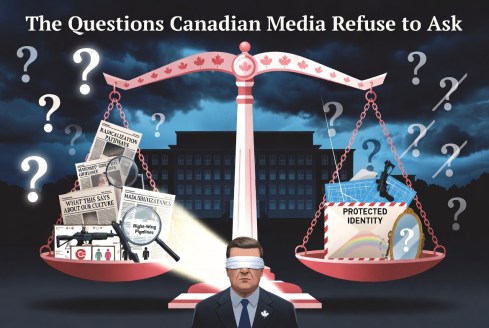
Canadian media know how to do pattern recognition when they want to.
Give them the right suspect, the right ideology, or the right grievance story, and they will produce instant analysis about pathways, warning signs, radicalization, social meaning, and what the event “says” about the culture. But let violence intersect with a politically protected identity category, and the appetite for explanation suddenly disappears.
That is the real story here.
A youth in Nova Scotia is accused in a foiled school attack plot involving online coordination, handwritten plans, imitation weapons, hate symbols, and threats. Weeks earlier, Canada saw the Tumbler Ridge massacre, one of the country’s rare school-linked mass shootings, carried out by a trans-identified male with prior mental-health-related police contacts. Two cases do not prove some grand law. They do, however, justify a question. When identity disturbance, grievance, alienation, and violence begin to cluster, are we allowed to notice, or does the conversation get shut down the moment the demographic becomes inconvenient?
That question is treated as indecent when it should be treated as basic public seriousness.
The point is not that trans identification causes violence. That would be a stupid claim, and an unserious one. The point is that severe identity instability, grievance, social isolation, and moral insulation from scrutiny can form a combustible mix, and our institutions become evasive when gender ideology is somewhere in the picture. They know how to be curious. They simply become selective about when curiosity is allowed.
That selectivity matters because schools are not seminar rooms. They are places where adults are supposed to notice risk before bodies hit the floor.
Instead, the public gets the usual flattening language. Troubled youth. Mental health struggle. Isolated incident. Complex circumstances. All of that may be true as far as it goes. What is missing is any willingness to ask whether a culture that treats identity claims as sacred, untouchable, and morally beyond scrutiny might also be making honest risk assessment harder than it should be. If a young person’s entire psychic life is being organized around grievance, estrangement, fantasy, and a demand that reality ratify the self at all costs, that is not automatically a violence pathway. But it is certainly not nothing.
And yet the moment this territory appears, Canadian media go soft in the head.
“When violence intersects with a protected identity category, Canadian media suddenly lose their appetite for explanation.”
They will interrogate masculinity, whiteness, right-wing pipelines, online extremism, misogyny, colonial resentment, and institutional failure when those frames are available. But when gender ideology may be part of the unstable mix, the analysis collapses into vagueness. Suddenly nobody wants to generalize. Nobody wants to connect dots. Nobody wants to risk saying the wrong thing. The protected category gets narrative shelter that other categories do not receive.
That is not neutrality. It is selective curiosity.
None of this means most gender-distressed youth are violent. Of course they are not. But public safety is not served by pretending that every cluster of instability must be discussed in the most generic terms possible just because one part of the profile has become politically delicate. Schools, parents, and the public deserve better than ritual euphemism after every near miss or body count.
The issue is not a proven demographic pattern. The issue is that when violence and identity pathology appear together inside a protected narrative, Canadian media suddenly lose their nerve. They stop asking explanatory questions not because the questions are irrational, but because the answers might offend the wrong people.
And that is how taboo makes serious societies stupider than they can afford to be.
This is not argument. It is selective framing used to shut the argument down before it begins.
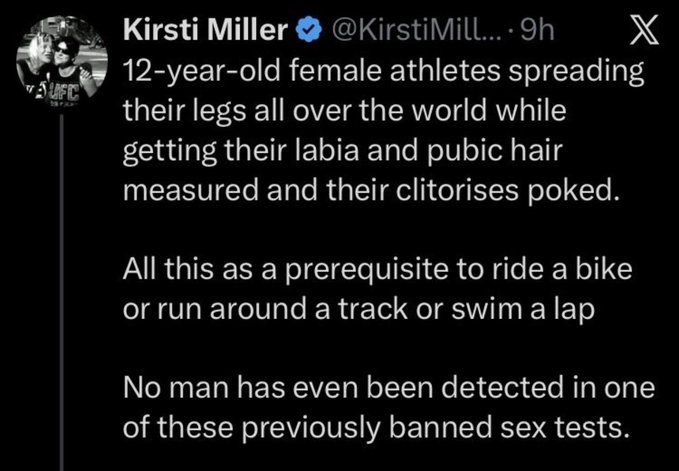
Yes, sport once used degrading sex tests. The old “nude parade” era was real. Women were subjected to visual and even anatomical examination in the 1960s, and those practices deserved to die. But that is not the current rule. The current activist trick is to drag the ugliest abuses of the past into the frame, staple them to a modern eligibility rule, and hope the reader is too disgusted to notice the switch.
The IOC’s new Olympic rule is not genital inspection of random girls. Reuters reports it is a one-time SRY-gene screen for elite female-category eligibility, using saliva, a cheek swab, or blood, and that it applies from LA 2028 onward to the Olympic pathway, not to amateur sport. Athletes who test positive can still compete in male, mixed, or open categories. That is not barbarism. It is category enforcement.
World Boxing is also not what the tweet implies. Its published policy applies to athletes over 18 in World Boxing-owned or sanctioned events, using a once-in-a-lifetime PCR or equivalent genetic test. Again, this is not “little girls can’t ride a bike without a genital exam.” It is a rule for elite competition in a combat sport where fairness and safety are not decorative concerns.
That is why this rhetoric is dishonest. It does not answer the real question, because the real question is hard: if female sport is a protected sex category, how is that category enforced when eligibility is disputed? Instead of answering that, activists change the subject. They substitute panic imagery, selective history, and moral blackmail. They want “naked parade” and “cheek swab” to feel like the same thing. They are not the same thing.
“A category that cannot be enforced is not protected. It is ornamental.”
The old methods were degrading and scientifically crude. Fine. Then make the process narrower, cleaner, and more private. But do not pretend that the female category can exist on the condition that no one is ever allowed to verify it. A category that cannot be enforced is not protected. It is ornamental. And that is the actual goal of this rhetoric: not to protect women from cruelty, but to make fairness, boundaries, and safety in female sport impossible to defend without first apologizing for something nobody is proposing.
Some political movements seek to reform institutions. Gender ideology asks for something larger and stranger. It asks society to treat subjective identity as more authoritative than sexed embodiment, and then to reorganize language, law, education, medicine, and intimate social norms around that priority. The promise is liberation from constraint. The reality is collision. When the self is treated as sovereign over the body, every boundary that still reflects sex begins to look like an injustice in need of correction.
That point has to be stated carefully. This essay is not a denial that some people experience genuine dysphoria, distress, or alienation from their bodies. Nor is it a claim that every trans-identifying person arrives at that identity through the same motives, pathways, or degree of ideological commitment. The target here is narrower and more political: an activist doctrine that turns subjective identification into a public demand, treats resistance as harm, and insists that the rest of society ratify its claims even where doing so dissolves clarity, boundaries, and truth.
At its most ambitious, gender ideology offers a redemptive promise. The conflict between self and body can be resolved. Alienation can be overcome. The old constraints of sex can be socially, medically, and linguistically superseded. The person need not reconcile himself to reality. Reality can be revised until it reflects the inner claim. But that promise carries a built-in instability. The body does not cease to be sexed because the surrounding vocabulary changes. Social reality does not become infinitely plastic because institutions adopt new rules. Other people continue to perceive bodies as they are, not merely as they are declared to be. Where the doctrine expects resolution, it encounters friction.
“Women are told to absorb the contradiction and treat it as progress.”
That friction matters because it does not remain abstract for long. Women’s boundaries are among the first places where sex remains socially visible and morally non-negotiable. Changing rooms, shelters, prisons, sports, hospital wards, quotas, maternity language, and the ordinary right to name male bodies as male all become targets once identity is treated as sovereign. The demand is not merely for courtesy. It is for override. Women are told to absorb the contradiction and treat it as progress. If they object, their objection is rarely treated as a competing rights claim grounded in privacy, vulnerability, fairness, dignity, or safety. It is moralized as exclusion, cruelty, or hatred.
This is where the negative-idealist mechanism, already traced in earlier essays, sharpens into focus. In a visible subset of male transition pathways, the conflict is intensified by a contested but persistent pattern: autogynephilia, the eroticization of the self as female. The concept is disputed and does not explain every case. Even so, it accounts for observable features in some trajectories: fantasy-driven identification, idealized femininity, online reinforcement, and a demand that others ratify the internal image as socially real. Where that pattern is present, sexed reality appears not as a limit to be reckoned with, but as an insult to be overcome. What cannot be secured inwardly is demanded outwardly through language, ritual affirmation, institutional policy, and the erosion of boundaries once thought too basic to require defense.
Institutions then inherit the contradiction. They are asked to affirm that sex is real enough to matter in medicine, reproduction, and anatomy, but unreal or irrelevant wherever women seek exclusion, protection, or clear naming. They are asked to treat words as both descriptive and compulsory, as if language were a branch of ethics rather than a tool for tracking reality. They are asked to uphold fairness while denying the relevance of the sex differences that made female categories necessary in the first place. The result is not ordinary accommodation. It is organized unreality, maintained by euphemism, fear, and social pressure.
Once the doctrine reaches this stage, dissent can no longer be treated as ordinary disagreement. Neutral refusal leaves sex standing. Clear language leaves the body visible. Female boundaries leave the claim of total override incomplete. So resistance must be moralized. Women defending sex-based spaces become aggressors. Parents asking for caution become extremists. Professionals who refuse to lie become threats. The contradiction is externalized so the doctrine can remain innocent. What it cannot resolve, it accuses.
“The result is not ordinary accommodation. It is organized unreality, maintained by euphemism, fear, and social pressure.”
At that point the familiar mechanism returns. The promised reconciliation between self and world fails to arrive in full. The body remains sexed. Other people keep noticing. Boundaries persist. Tradeoffs refuse to disappear. Rather than treating this as evidence that the doctrine asks too much of reality, the movement interprets the friction as proof that enemies remain active. A purified horizon is announced. Reality fails to comply. The gap is moralized. The search for the guilty begins.
The cost is now visible everywhere. Women lose the confidence to defend boundaries without being cast as moral offenders. Institutions lose the ability to speak plainly about sex without fear of sanction. Children are taught contested metaphysical claims as though they were settled truths. And a doctrine too unstable to secure assent through evidence alone increasingly relies on compulsion, euphemism, intimidation, and institutional pressure. What begins as a politics of identity becomes a politics of override.
The problem, then, is not simply that gender ideology is confused, though it often is. It is that confusion has been translated into policy, pedagogy, and compulsion. A doctrine built on unstable metaphysics now presses against some of the most basic social distinctions human beings have long relied on: male and female, mother and father, privacy and exposure, fairness and force, truth and courtesy. Because the doctrine cannot secure its claims through evidence or peaceful coexistence alone, it increasingly seeks protection through euphemism, intimidation, and institutional pressure. That is why the breakdown of female boundaries is not a side issue. It is one of the clearest signs that the ideology has moved from private belief to coercive social power.
When a movement cannot make reality yield, it begins by demanding silence and ends by punishing those who still name what they can see.

When an ideology cannot make reality yield, women are often told to bear the cost in silence.
When people say “trans rights,” they often smuggle in the conclusion before the argument has even begun. The phrase suggests a class of basic liberties being withheld from a minority population. In most liberal democracies, that is not the real dispute. Trans-identifying people already possess the same ordinary civil rights as everyone else: to vote, work, speak, worship, associate, and live free from assault or arbitrary exclusion. The real conflict begins when contested demands are framed as rights claims in order to place them beyond criticism.
That distinction matters. A right is not the same thing as a demand for access, validation, or institutional compliance. Female sports were not created out of prejudice, but out of recognition that sex differences matter in strength, speed, endurance, and physical risk. Female shelters, prisons, and changing rooms were built on the same logic. They exist because privacy, safety, fairness, and dignity are not imaginary goods. They are concrete protections, won through long struggle, and they do not cease to matter because a new vocabulary has been imposed on the debate.
Once this is seen clearly, much of the rhetoric falls apart. If a male-bodied person demands entry into a female space, the objection is not that he lacks human worth. It is that women have sex-based boundaries, and those boundaries exist for reasons. If a parent objects to gender ideology in schools, that is not the denial of anyone’s basic rights. It is the defense of parental authority in an area of profound moral and developmental consequence. If a citizen resists compelled pronouns or refuses to treat metaphysical claims about sex as binding fact, that is not violence. It is a refusal to surrender conscience and language to activist pressure.
“When one group’s ‘rights’ require another group to surrender privacy, fairness, or conscience, the conflict is no longer about equality. It is about power.”
This is where the phrase “trans rights” does its real work. It pre-loads the moral verdict. It makes disagreement sound like oppression before the argument has even begun. Once that framing is accepted, women’s boundaries become cruelty, parental caution becomes hatred, and democratic disagreement becomes abuse. But this is not a serious use of rights language. It is a way of insulating contested claims from scrutiny by wrapping them in the prestige of civil rights.
None of this means every accommodation is unreasonable, or that every dispute is zero-sum. Ordinary civility and equal treatment in public life are not difficult standards to defend. But when one group’s claimed “rights” require another group to surrender privacy, fairness, language, or the right to maintain sex-based boundaries, the conflict has moved beyond equal citizenship. It has become a struggle over whose moral framework will rule, and whose objections will be permitted to count.
That is why the language matters. “Trans rights” sounds like a plea for equal liberty. In many of the most contentious cases, it is something else: a demand that others yield, affirm, and rearrange long-standing social boundaries on command. When women refuse that erasure, or parents refuse that indoctrination, or citizens refuse that compelled speech, they are not violating rights. They are defending their own.












 bleatmop
 Mystro


 Dead Wild Roses
Your opinions…