
You are currently browsing the category archive for the ‘Public Policy’ category.
“Diversity is our strength” is one of those phrases that now passes for settled truth. It appears in policy documents, school mandates, and corporate statements, rarely argued and almost never examined. Though it presents itself as an empirical observation, most of the time it functions as moral reassurance.
Since I am not a sociologist, I am not pretending to offer original research here. What I am doing is more modest: reading the best-known work in this area, noting the later reviews, and asking whether the slogan is actually supported by the evidence usually invoked in its defence.
On those terms, the answer is less flattering than the slogan suggests.
When people reach for the empirical case, the best-known starting point is Robert Putnam. In 2007, he published a major study on social capital in American communities built on the Social Capital Community Benchmark Survey, drawing on roughly 30,000 respondents through a national sample and smaller samples from 41 communities across the United States. In the pooled 41-site sample, the estimated effect of diversity on trust was negative in 39 of the 41 communities.
For present purposes, two things matter: the scale was serious, and the pattern was not some one-off local oddity.
Although Putnam is often invoked as if he were a critic of diversity as such, that is not what he was doing. In the same paper, he argued that increased diversity may, in the long run, bring important cultural, economic, fiscal, and developmental benefits, and that successful immigrant societies can build broader identities that overcome fragmentation. Even so, he also concluded that, in the short to medium run, immigration and ethnic diversity “tend to reduce social solidarity and social capital.”
That is the part the slogan politely steps around.
What Putnam found, moreover, was not a simple story of ethnic conflict. His summary remains the clearest: in ethnically diverse neighborhoods, residents of all races tend to “hunker down”; trust, including trust in one’s own race, is lower; altruism and community cooperation are rarer; and people have fewer friends. Contemporary reporting on the study described the pattern less as intergroup hostility than as a general civic malaise.
“The effect isn’t conflict. It’s withdrawal.”
While Putnam’s study is not the last word, neither is it some isolated embarrassment later research quietly buried. A 2020 narrative and meta-analytical review by Peter Thisted Dinesen, Merlin Schaeffer, and Kim Mannemar Sønderskov examined 1,001 estimates from 87 studies and found a statistically significant negative relationship between ethnic diversity and social trust across the literature as a whole. The association was stronger for trust in neighbours and stronger when diversity was measured locally. Adding covariates changed the relationship only slightly.
None of this means every study says the same thing, or that every context behaves the same way. It does mean the slogan cannot honestly be treated as a simple social-scientific fact. At best, the literature points to a more conditional and less comforting conclusion: diversity may bring benefits in some domains while also imposing real costs in trust, cohesion, and civic reciprocity, especially in the short to medium term.
Had public argument stopped there, the conversation would be easier. It does not. One reason progressive arguments on diversity can be so maddening to answer cleanly is that the problem is not just the evidence. It is the rhetorical structure built around it.
What you often get is a classic motte-and-bailey.
In its bailey form, the claim is large and ambitious: diversity makes societies stronger. It enriches institutions, strengthens communities, and should be treated as an obvious good. That is the version used in slogans, public messaging, and moral posturing.
The motte, by contrast, is smaller and safer: people from different backgrounds have equal dignity; plural societies can function; exposure to different people can be valuable; racism is wrong. All true. All defensible. All much easier to protect.
The trick, of course, is that these are not the same argument.
One is a broad empirical claim about what diversity does to trust, cohesion, and institutional life. The other is a narrow moral claim about how people ought to be treated. But when the broader claim comes under pressure, when someone points to evidence of lower trust, weaker civic engagement, or social withdrawal, the argument retreats into the motte. Suddenly the response is not “let’s examine the evidence.” It is “What, are you against diversity? Are you some kind of racist?”
That is the coercive move.
“The harder claim retreats. The safer claim takes its place.”
Once that happens, the moral core is used as a shield for a much larger empirical claim that has not earned that protection.
To say this is not to deny the moral core. It is to point out that it is being made to do dishonest work.
Equal dignity under the law is not the same claim as “diversity strengthens communities.” Opposition to racism is not the same claim as “more heterogeneity reliably produces more trust.” The first set of claims may be moral bedrock. The second set are empirical propositions, and empirical propositions do not become true because disagreement with them is made socially costly.
Nor is the underlying mechanism difficult to imagine. Social trust depends on shared expectations: language, norms, behaviour, obligation. As those expectations become less predictable, the cost of ordinary interaction rises. People become more cautious. Fewer interactions clear the threshold of “worth it.” The result is often not hostility, but distance. That basic picture fits both Putnam’s “hunkering down” formulation and the later finding that the negative association is strongest in neighbour trust and local contexts.
Less talking. Less joining. Less trusting.
None of that requires malice. It requires friction.
“The long run is not the short run.”
As Putnam himself argued, successful immigrant societies can, over time, construct broader identities and new forms of solidarity. Fine. Maybe. But that long-run possibility does not erase the short-run trade-off he reported, and the later review literature does not erase it either.
Here, “may” is doing a lot of work.
That outcome is conditional. It depends on institutions, norms, shared language, and successful integration over time. It is not an automatic by-product of demographic change, still less a magic formula that turns heterogeneity into cohesion by moral declaration. Putnam’s own formulation was that the central challenge for diversifying societies is to create a new, broader sense of “we.”
Possibility is not inevitability.
What raises the stakes is that the costs of lower trust do not fall evenly. They hit hardest where social capital is already thin: poorer neighborhoods, fragile communities, institutions with less slack, places where informal cooperation matters most. When trust declines there, the result is weaker networks, less mutual aid, and more pressure on systems already under strain. Social capital is not a decorative extra. It is part of what makes communities safer, healthier, and more governable.
Ignoring that does not make a society humane. It makes it less prepared.
“A slogan that cannot admit costs cannot guide policy.”
A serious discussion of diversity would start there. It would admit trade-offs. It would separate moral claims from empirical ones. It would stop pretending every objection is a moral stain and start asking the harder question: under what conditions can diversity be made compatible with trust, reciprocity, and shared civic life?
That is the real task. Not chanting the slogan more loudly. Not treating doubt as heresy. Not hiding a contested empirical claim inside a morally untouchable one.
In the end, societies that do that are not being honest. They are buying social peace on credit and hoping the bill never comes due.

References
- Robert D. Putnam, “E Pluribus Unum: Diversity and Community in the Twenty-first Century,” Scandinavian Political Studies 30, no. 2 (2007).
- Peter Thisted Dinesen, Merlin Schaeffer, and Kim Mannemar Sønderskov, “Ethnic Diversity and Social Trust: A Narrative and Meta-Analytical Review,” Annual Review of Political Science 23 (2020).
- Michael Jonas, “The Downside of Diversity,” Boston Globe, August 5, 2007.
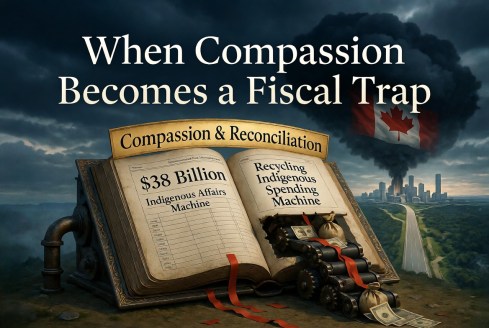
Canada’s Indigenous spending model has a problem it can no longer hide behind good intentions.
We are spending roughly $38 billion a year through core departments alone, after a decade of rapid expansion. The question is not whether that money is justified in principle. The question is whether it works.
On the outcomes that matter most—housing, child welfare, clean water reliability, and long-term economic independence—the answer is uneven at best and stagnant at worst. Progress exists. It is real. But it is not proportional to the scale of the spending. That gap between money spent and results achieved is the whole argument.
A system that cannot convert large, sustained spending into durable independence is not compassionate. It is failing.
The current model does not primarily produce independence. It manages dependency.
Spending has risen sharply, yet the Auditor General still found unsatisfactory progress on 53% of prior recommendations across core areas such as water, health access, emergency management, and socio-economic gaps. That is the mechanism in plain terms: more money flows, the system expands, compliance and administration thicken, and outcomes move slowly.
This is not just a funding shortage. It is a delivery failure.
And a delivery system that cannot convert major, repeated spending increases into reliable improvement is not neutral. It is misallocating resources at scale.
Canada is not bankrupt. But it is not insulated from fiscal reality either.
Federal spending is approaching half a trillion dollars. Debt-service costs are rising. Demographics are tightening the margin for error. You do not need a full sovereign-debt crisis for political choices to narrow. You just need pressure. A serious downturn, rising interest costs, or prolonged fiscal strain can force governments into reprioritization very quickly.
And when that happens, governments do not trim politely. They cut where they can.
That is where the current model becomes morally and fiscally dangerous at the same time. A system built on permanent federal transfers is stable only while those transfers keep flowing at politically tolerable levels. The moment that assumption weakens, those most dependent on the state become the most exposed to its limits.
That is the point too many sentimental arguments glide past. Dependency is not merely expensive. It is fragile.
A support model that only works while fiscal capacity keeps expanding is not a support model. It is a fair-weather dependency machine.
The present structure also rewards the wrong things. It rewards program expansion over completion, compliance over outcomes, announcements over maintenance, and federal management over local accountability. Money moves. Reports get written. Conditions improve, if they improve, far too slowly.
Look at drinking water. Ottawa rightly points to advisories lifted over the past decade. That progress matters. But Ottawa’s own figures also show that long-term advisories remain, and that many systems still require operational improvements before advisories can be lifted. That is not mainly a ribbon-cutting problem. It is a maintenance and systems problem. Building is politically photogenic. Sustaining is harder. The current model has often been better at funding capital headlines than at securing competent long-run operation.
The same broader pattern appears elsewhere. Indigenous children remain dramatically overrepresented in foster care. In 2021, Indigenous children made up 7.7% of children under 15, but 53.8% of children in foster care. A system that absorbs this much money and still leaves such ratios in place does not get to call itself successful because it can point to process, intent, or moral vocabulary.
If a model is expensive, underperforming, and fragile, it does not get preserved untouched. It gets triaged.
That means being willing to contemplate deep reductions—on the order of half to two-thirds over time—not as punishment, but as forced prioritization. The case is not for abandoning Indigenous communities. The case is for abandoning the fantasy that every current layer of spending is equally necessary, equally effective, or equally defensible.
Not everything should survive.
What should be protected is what is plainly essential: clean water systems with funded long-term maintenance, core health and emergency services, schooling, literacy, child protection, housing tied to credible upkeep plans, and communities that demonstrate effective local governance capacity.
What should be cut, compressed, or eliminated is the non-essential layer that accumulates in every morally protected spending regime: duplicative federal administration, consultant-driven program layers, pilot projects that never scale, compliance regimes that consume resources without clearly improving lives, and symbolic reconciliation spending detached from measurable outcomes.
If a program cannot show serious, durable improvement, it does not get to exist because it sounds compassionate in a press release.
This is where critics will predictably panic and moralize. They will say that Indigenous communities cost more to support because of historical injustice, geographic isolation, damaged infrastructure baselines, and the enduring effects of state misconduct. That is the strongest version of the opposing case, and parts of it are obviously true.
Historical injustice matters. Geographic isolation matters. Remote delivery costs are real. Weak starting conditions are real.
But that argument does not rescue the current model.
Historical injustice explains the starting line. It does not excuse a decade of rapidly expanding budgets with only partial and uneven progress. A moral claim to support is not the same thing as a proof that the delivery structure works. And after this much spending, defenders of the status quo still cannot point to outcome improvement proportionate to the scale of expenditure.
That matters because dependency wrapped in the language of reconciliation is still dependency. A model that leaves communities structurally tied to Ottawa’s fiscal condition is not empowering them. It is exposing them.
The answer, then, is not cuts for their own sake. It is reallocation.
Savings from the non-essential layer should be redirected in two directions. First, toward fiscal stabilization, because a state that loses control of its finances loses control of its choices. Second, toward connective infrastructure: roads, bridges, utilities, and other corridors that physically integrate isolated communities into provincial economies and reduce the permanent cost of remoteness.
Isolation is not an identity. It is, in significant part, an engineering and governance problem.
If you do not solve that problem, you will subsidize its consequences forever.
Historical injustice explains the starting line. It does not excuse ten years of bigger budgets with only marginal gap closure.
This is the part polite politics hates to say aloud. A country that refuses to discipline failing systems during periods of relative control increases the odds that future discipline will arrive under pressure instead. Markets impose limits. Debt-service costs impose limits. Fiscal stress imposes limits. In more extreme scenarios, countries lose the luxury of setting their own reform timetable and their own reform terms.
Better a hard reallocation now than a panicked contraction later.
Better to choose triage than to have it chosen for you.
The question is not whether Canada should support Indigenous communities. It should.
The question is whether Canada is willing to admit that the current model is not delivering enough, not fast enough, and not durably enough to justify its scale. Because the worst outcome is not reform. The worst outcome is drift: a system that consumes, reassures, and congratulates itself right up until the moment it cannot continue.
And then fails all at once.
References
- Indigenous Services Canada and Crown-Indigenous Relations and Northern Affairs Canada planned spending totals for 2025–26, approximately $38 billion combined.
- Office of the Auditor General of Canada follow-up finding that 53% of prior recommendations showed unsatisfactory progress.
- Indigenous Services Canada figures on long-term drinking water advisories, including advisories lifted and those still active.
- Statistics Canada figures showing Indigenous children as 7.7% of children under 15 but 53.8% of children in foster care in 2021.
- Federal spending and debt-pressure context from the budget and main estimates material summarized in the source text.
This is how activists frame their lies and misdirection.

Here is their bullshittery in full:
The introduction of new rules restricting participation in women’s sport categories to “biological females”, determined through mandatory genetic screening and testing, imposes exclusionary criteria. These measures not only bar transgender women from competition, but target and disqualify cisgender women with differences in sex development.
This policy will apply to the Los Angeles 2028 Olympic Games and beyond, despite the absence of clear evidence that any transgender women were poised to participate in those Games. The IOC’s approach aligns itself with the U.S. government’s 2025 executive order “Keeping Men Out of Women’s Sports” which threatened to withdraw funding from organizations that permit transgender athletes to compete and to deny visas to certain athletes seeking to participate in the Los Angeles Olympics. The convergence of international sport governance with exclusionary state policy raises serious concerns about the politicization of athletic participation and the erosion of independent, rights-respecting governance.
“While framed as a measure to ensure fairness, this policy imposes exclusionary criteria that will disproportionately harm transgender women and also place cisgender women at risk, particularly those with natural biological variations,” says Aaden Pearson, Trans Rights Legal Fellow at the Canadian Civil Liberties Association. “The policy authorizes intrusive scrutiny of women’s bodies and asserts authority over who gets to participate as a ‘real’ woman under the guise of regulation.”
This policy will have detrimental impact on Canadian athletes that may be barred from participating in the Olympics because of this policy who otherwise would qualify to represent Canada.
A rights-respecting approach to sport must be grounded in inclusion, evidence, and proportionality. Fairness and human dignity are not mutually exclusive. The legitimacy of sport depends on ensuring that all athletes are able to participate without discrimination.
The CCLA calls on the IOC and national sporting bodies to:
- Immediately reconsider the implementation of these eligibility rules;
- Ensure that any policies governing participation in sport are evidence-based, proportionate, and consistent with international human rights obligations; and
- Uphold the principle that sport must be accessible to all, without discrimination.
The legitimacy of sport depends not only on fairness in competition, but on fairness in access. Policies that exclude, surveil, and stigmatize athletes have no place in a rights-respecting sporting system.”
————————
When a civil liberties organization cannot define a category, it cannot defend a right.
That is the move.
The IOC’s policy does not abolish sport as a “human right.” It sets an eligibility rule for the female category: from LA 2028 onward, athletes in that category must pass a one-time SRY gene screen, using saliva, a cheek swab, or blood. Athletes who do not qualify are still eligible for male, mixed, or open categories. This is not exclusion from sport. It is boundary enforcement within sport.
That distinction is the entire argument, and the CCLA refuses to engage it.
Instead, it leans on the language of “inclusion” as though inclusion means entitlement to every category. But sport has never worked that way. Weight classes exclude. Age divisions exclude. Paralympic classifications exclude. Women’s sport exists because sex matters. Calling sex-based eligibility “exclusionary” does not answer that reality. It simply renames the boundary and hopes no one notices.
The claim that the policy “targets cisgender women with differences in sex development” is similarly evasive. The IOC framework uses SRY screening because it is strong evidence of male development. World Boxing’s policy is explicit: eligibility for the women’s category excludes athletes with Y-chromosome material or male androgenization. The relevant question is not whether someone identifies as a woman, but whether they have undergone male development. The CCLA substitutes sympathetic language for that question rather than answering it.
The argument about there being no “clear evidence” of transgender women poised to compete in LA 2028 is weaker still. Rules are not written only after a problem becomes numerically large. They are written to clarify the category before competition begins. “There aren’t many” is not an argument against having a rule. It is an admission that the rhetoric is disproportionate to the scale of the issue.
“It treats female sport as though it were an access program rather than a sex-based category.”
The claim of “intrusive scrutiny” is also inflated. The IOC’s first-line test is a one-time genetic screen using saliva, cheek swab, or blood. That is not the same thing as the mid-20th century abuses activists like to invoke. A serious civil-liberties analysis would distinguish between limited modern verification and historical excess. This statement deliberately blurs them.
And then there is the core contradiction. The CCLA says fairness and dignity are not mutually exclusive. That is true. But it follows that female athletes can be treated with dignity and retain a protected category that excludes males. The CCLA resolves this tension by dissolving the category instead. In practice, its position requires female athletes to absorb the cost: compromised fairness, weakened boundaries, and—in contact sports—elevated risk.
That is not a neutral rights framework.
It is a redefinition of rights in which access to the female category is prioritized, and the integrity of that category is treated as negotiable.
A civil liberties organization should be able to state the purpose of a category before it critiques its rules. The CCLA does not. It treats the female category as a site for validating identity claims rather than as a sporting class organized around sex.
Once that happens, the conclusion is pre-determined.
Female boundaries become suspect.
Enforcement becomes cruelty.
And reality becomes something to be managed with language.

The public case for pediatric gender medicine is simple enough. Medical intervention is supposed to reduce distress and improve mental-health outcomes.
That claim matters because the interventions are not minor. Puberty blockers, cross-sex hormones, and related medical pathways are presented to parents, policymakers, and the public as serious treatments for serious suffering. Their case does not rest on compassion alone. It rests on the claim that they work.
The trouble is that the strongest population-level data now available does not show that happening.
A new Finnish nationwide register study reports severe psychiatric morbidity before referral, continued severe psychiatric morbidity after referral, and no sign that psychiatric need subsides after medical gender reassignment. The study does not prove that treatment caused worsening. It does, however, cut directly against confident claims that these interventions reliably resolve the underlying distress in young people.
Terms fixed in advance
This subject is saturated with semantic drift, so a few terms need fixing at the outset.
By pediatric gender medicine, I mean the medical management of gender-distressed minors and young people through interventions such as puberty blockers, cross-sex hormones, and, where applicable, surgical pathways. By psychiatric morbidity, I mean the study’s outcome measure: need for specialist psychiatric treatment, whether inpatient or outpatient. By improvement, I mean a measurable reduction in psychiatric morbidity relative to baseline or to relevant controls.
That is a demanding definition. It is also the clinically serious one. If an intervention is being justified as a mental-health measure, then some observable improvement in hard psychiatric outcomes is the least one should expect.
What the Finnish study is
The Finnish paper is not a survey, and it is not a self-report exercise. It is a nationwide register study of all 2,083 individuals under age 23 who contacted Finland’s centralized gender identity services between 1996 and 2019, compared with 16,643 matched controls. Follow-up extended to June 2022. The outcome was specialist-level psychiatric treatment recorded in national health registers.
That matters. Register data has limits, but it is still harder than the small, uncontrolled, self-reported studies so often used to manufacture confidence in this field.
What it found
Before referral, 45.7% of the gender-referred cohort had already received specialist psychiatric treatment, compared with 15.0% of controls. Two years or more after referral, 61.7% of the gender-referred cohort required specialist psychiatric care, compared with 14.6% of controls. The first fact that has to be faced squarely is that psychiatric burden in this population is not only high at baseline. It remains very high afterward.
The post-2010 cohort matters as well, because defenders of the current model often imply that older data says little about the newer referral population. In this study, referrals after 2010 were in markedly worse psychiatric shape before referral than the earlier cohort. Among referrals before 2010, pre-referral psychiatric morbidity was 23.7%, versus 11.8% among controls. Among referrals after 2010, it was 47.9%, versus 15.3% among controls. So the recent referral surge did not simply bring in more of the same patients. It brought in a population with substantially heavier psychiatric burden.
The most striking figures concern the medically treated subgroups. Among those proceeding down the feminizing pathway, pre-referral psychiatric treatment was 9.8%; at least two years after referral it was 60.7%. Among those proceeding down the masculinizing pathway, the figures were 21.6% before referral and 54.5% after. Those are not small fluctuations. They are large increases in specialist psychiatric treatment after entry into the care pathway.
The adjusted-risk figures are no less serious. After adjustment for prior psychiatric treatment, hazard ratios remained approximately 3.0 to 3.7 times higher than female controls and 4.7 to 6.1 times higher than male controls. In plain English, the excess psychiatric burden did not wash away once prior history was accounted for.
The authors’ own conclusion is worth quoting in fuller form than the clipped line now circulating online: “Severe psychiatric morbidity is common among gender-referred adolescents and appears to be more prevalent in those referred after the recent surge in referrals. Psychiatric needs do not subside after medical gender reassignment.” That is not activist spin. It is the paper’s conclusion.
“Psychiatric needs do not subside after medical gender reassignment.”
What this study does not claim
This part matters because opponents will often try to smuggle in a claim you did not make and then congratulate themselves for refuting it.
This study does not prove that medical transition caused worsening in every case. It does not isolate a single causal mechanism. It does not show that no individual patient experienced subjective relief. It does not establish that specialist psychiatric treatment is a perfect one-to-one proxy for every dimension of psychological distress.
Those are real limits. They should be stated plainly.
But none of them rescues the stronger public claim that pediatric medical transition is clearly supported by solid evidence showing reliable mental-health benefit.
The strongest counterargument
The strongest counterargument is easy enough to state. Patients who go on to medical treatment may differ in important ways from those who do not. There may be unmeasured confounding. Some young people selected for treatment may have had more severe, more persistent, or more complex underlying psychiatric problems than the registers fully capture.
This is plausible.
Even if granted in full, however, it concedes the central problem.
If these interventions are working as claimed at the population level, then some clear signal of mental-health improvement should appear in the aggregate outcomes. Instead, psychiatric burden remains extremely high, does not converge toward control levels, and in key medically treated subgroups rises sharply. Increased specialist psychiatric treatment does not by itself prove worsening in every individual. What it does show is substantial psychiatric need persisting at levels incompatible with confident claims of broad psychiatric resolution.
That is the point critics keep trying to dodge. The question is not whether every confounder has been abolished. The question is whether the real-world outcome pattern supports the certainty with which these treatments have been promoted. This study says no.
Absence of demonstrated benefit is not a trivial problem
A common dodge here is to pretend that unless one has a perfect randomized trial proving direct harm, no serious concern exists. That is not how responsible pediatric medicine works.
Lack of demonstrated benefit is not identical to proof of harm. But weak evidence plus invasive intervention is not a neutral combination, especially in minors. When the evidence base is low quality and the strongest real-world data still fails to show the promised mental-health improvement, caution is not reactionary. It is simply what evidence-based medicine looks like once ideology is removed from the room.
“If an intervention works, population data should eventually show it. This does not.”
The larger evidence context
The Finnish register study matters on its own, but it lands in a broader evidentiary landscape that has already shifted under activists’ feet.
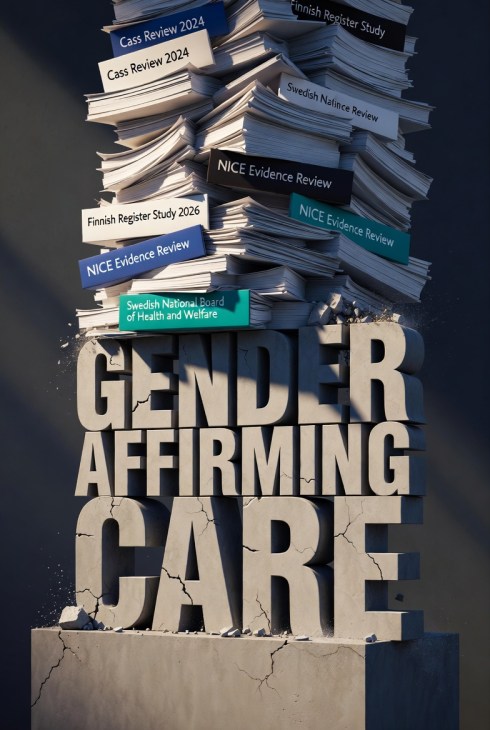
The independent Cass Review in England concluded that the evidence base for medical intervention in children and young people with gender-related distress is weak, that studies are generally small and uncontrolled, and that the field has been marked by overconfidence unsupported by good evidence. The review also incorporated earlier evidence reviews commissioned from NICE on puberty blockers and hormones.
Those NICE evidence reviews found the evidence for both puberty blockers and cross-sex hormones in this population to be of very low certainty. They remain among the most cited formal evaluations of the literature in this area.
Sweden’s National Board of Health and Welfare likewise revised its national guidance, concluding that for minors the risks of puberty blockers and hormone treatment currently outweigh the expected benefits, and that such treatment should be offered only in exceptional cases within structured specialist settings.
That pattern is not accidental. It reflects a broader recognition across evidence reviews and national reassessments: the confidence of the clinical rhetoric has run ahead of the quality of the evidence.
What can actually be concluded
Several conclusions can be made safely.
First, the psychiatric burden in this population is real and often severe. Nothing in this argument denies that.
Second, the new Finnish register data does not show psychiatric need subsiding after medical gender reassignment. On the contrary, the burden remains high, and in some medically treated subgroups the observed specialist psychiatric treatment rates rise sharply.
Third, the broader review literature and policy reassessments from major health authorities do not justify the level of certainty with which pediatric medical transition has often been promoted. The evidence is not robust enough for that.
Fourth, this study does not by itself prove a simple causal story of treatment-induced worsening in every case. Anyone claiming that from this paper alone is saying more than the evidence can bear. But anyone claiming that the strongest available population-level data clearly supports a confident mental-health benefit is also saying more than the evidence can bear.
The policy problem
That mismatch is the real issue.
This is not a case in which critics are denying a clearly established medical benefit. It is a case in which weak evidence, ambiguous long-term outcomes, and very serious interventions have too often been wrapped in the language of settled science.
They are not settled.
The evidence base is weak. The psychiatric burden remains high. The strongest register data now available does not show the promised relief in hard mental-health outcomes. That should force a lower-confidence, higher-caution clinical posture than the activist narrative has allowed.
Verdict
No honest reading of this literature permits the triumphant line that pediatric gender medicine is clearly evidence-based and reliably improves youth mental health.
The better reading is harsher and simpler.
The evidence is weak. The certainty has been inflated. And the strongest real-world data now available does not show psychiatric needs subsiding after medical gender reassignment.
When the evidence does not show improvement, escalation is not caution.
It is risk.
References
Ruuska, S.-M., Tuisku, K., Holttinen, T., & Kaltiala, R. (2026). Psychiatric morbidity among adolescents and young adults who contacted specialised gender identity services in Finland in 1996–2019: A register study. Acta Paediatrica. Advance online publication. https://doi.org/10.1111/apa.70533
Cass, H. (2024). Independent review of gender identity services for children and young people: Final report. https://cass.independent-review.uk/home/publications/final-report/
NICE / NHS England. (2020). Evidence review: Gonadotrophin releasing hormone analogues for children and adolescents with gender dysphoria. https://www.engage.england.nhs.uk/consultation/puberty-suppressing-hormones/user_uploads/nice-evidence-review-gnrh-analogues-for-children-and-adolescents-with-gender-dysphoria-october-2020.pdf
NICE / Cass Review. (2020). Evidence review: Gender-affirming hormones for children and adolescents with gender dysphoria. https://cass.independent-review.uk/wp-content/uploads/2022/09/20220726_Evidence-review_Gender-affirming-hormones_For-upload_Final.pdf
Socialstyrelsen. (2022). Care of children and adolescents with gender dysphoria – Summary of national guidelines – December 2022. https://www.socialstyrelsen.se/publikationer/care-of-children-and-adolescents-with-gender-dysphoria–summary-of-national-guidelines–december-2022-2023-1-8330/
Socialstyrelsen. (2022, December 16). Updated knowledge support for care in gender dysphoria among young people. https://www.socialstyrelsen.se/om-socialstyrelsen/pressrum/press/uppdaterat-kunskapsstod-for-vard-vid-konsdysfori-hos-unga/
Hostile Reader FAQ
“You’re claiming gender-affirming care causes harm.”
No. This piece does not claim causation. It shows that the strongest population-level data does not demonstrate the expected mental-health improvement. Absence of demonstrated benefit is not the same as proof of harm—but it is not neutral either.
“Psychiatric service use isn’t the same as worse mental health.”
Correct. It is not a perfect proxy for subjective distress. It is, however, a hard clinical outcome and a strong indicator of ongoing psychiatric need. Persistent high rates of specialist care are not consistent with claims of broad resolution.
“These patients were already more distressed.”
Yes. The study shows elevated psychiatric burden before referral. The question is whether that burden improves. At the population level, it does not converge toward control levels, and in some subgroups increases substantially.
“This is just one study.”
It is one of the largest and longest nationwide register studies to date. More importantly, its findings align with multiple systematic reviews and policy reassessments that rate the evidence base as low quality and uncertain.
“Other studies show benefits.”
Some smaller or short-term studies report improvements, often based on self-report and without strong controls. Systematic reviews consistently find these studies to be low certainty and at high risk of bias. That is why several national health authorities have revised their guidance.
“You’re ignoring patient experiences.”
Individual experiences vary, and some patients report relief. Clinical policy, however, is not built on anecdote. It is built on aggregate outcomes and evidence quality. Those are the focus here.
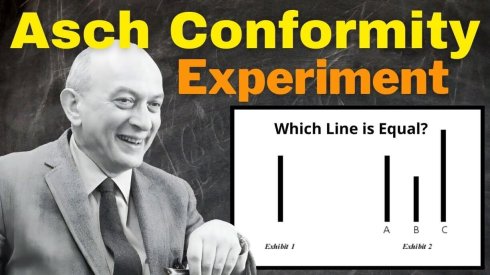
Solomon Asch’s conformity experiments were brutally simple. One person sits with a unanimous group. Two lines of obviously different lengths appear. The group confidently gives the wrong answer. Around 75% of participants conformed at least once. On the critical trials, they went along with the false answer roughly one-third of the time. In the control condition, with no group pressure, errors were almost nonexistent.
That experiment did not stay in the lab.
We now run it as social policy.
A plainly male person enters a female space or female category, and everyone nearby is expected to override what their eyes and judgment are reporting. Not because the evidence is subtle. Because the penalty for stating the obvious has been made artificially high: bigot, transphobe, career risk, social isolation, institutional discipline.
That is the test.
The point is not that everyone believes the lie. The point is that enough people comply in public to make it feel socially mandatory. That is how conformity works: not by proving a falsehood, but by punishing dissent until visible reality becomes something people are afraid to name.
“He knew better. He gave the group answer anyway.”
And the clearer the mismatch, the harsher the demand for submission. Non-passing males are not an embarrassment to this ideology. They are its purest form. They force the conformity trial into the open. The more obvious the contradiction, the more intensely the crowd must insist that you deny it.
Malcolm Gladwell recently handed the game away. Reflecting on his 2022 MIT panel on trans athletes, he admitted he was “ashamed” because he shared Ross Tucker’s position “100%” and was “cowed.” He knew better. He gave the group answer anyway.
That is the real Asch lesson of our time. Social coercion does not need universal belief. It only needs enough fearful public compliance to make reality itself feel socially dangerous.
Call male female, or pay the price.
That is not compassion. It is organized conformity.
Sources:
- Solomon E. Asch, “Opinions and Social Pressure,” Scientific American 193, no. 5 (1955). Classic summary of the line-judgment conformity experiments. Asch reports that in the critical condition, about one-third of judgments shifted toward the erroneous majority, while control-group errors were virtually absent.
- OpenLearn (The Open University), “Starting with psychology: 5.3 Groups and conformity.” Useful summary of Asch’s original findings, including that 75 percent of participants conformed to an obviously wrong answer at least once.
- Encyclopaedia Britannica, “Conformity” and “Normative influence.” Helpful for the distinction your piece relies on: conformity can involve public compliance without private acceptance, which fits your argument that the mechanism is outward submission under pressure rather than sincere belief.
- For the Gladwell reference: The Real Science of Sport podcast follow-up notes confirm that Gladwell apologized for how he handled the 2022 MIT Sloan panel, and contemporaneous reporting quotes him saying he shared Ross Tucker’s position “100%” and was “cowed.”
I woke this morning to the sort of silence one usually associates with miracles or the CBC losing funding. It was not the usual Canadian silence of people muttering “well, that’s concerning” while being mugged by ideology in a Lululemon hoodie. No. It was the silence that comes after a fever breaks.
By breakfast, the first signs were impossible to miss. Gender ideology had finally been moved to its proper shelf: comparative religion. It now sat comfortably beside crystal healing, Gnostic sects, and the more enthusiastic forms of astrology. Canadians, with characteristic politeness, agreed that adults were free to believe in innate gender spirits if they wished. They were simply no longer allowed to drag those beliefs into schools, prisons, women’s shelters, human rights tribunals, or sports governing bodies and demand that everybody else call it science.
Female spaces reverted, almost overnight, to the radical old principle that women are female. Women’s prisons once again housed women. Women’s shelters once again served women. Women’s hospital wards, changing rooms, crisis centres, rape relief services, and athletic categories all quietly recovered their original function. The country did not collapse. No one burst into flames. The sun rose, the buses ran late, and Canadian women experienced the deeply unfamiliar sensation of not having to explain why privacy, fairness, and physical safety were not hate crimes.
“They were replaced by the revolutionary practice of getting on with things.”
Even the sports pages improved. Men were removed from women’s competitions with so little fuss one wondered why the insanity had been allowed to continue so long. Records began to mean something again. Girls stopped being told that getting flattened by male bodies was a teachable moment in inclusion.
Meanwhile, Canada seemed to have recovered from a long and embarrassing binge. DEI offices vanished like travelling carnivals after a municipal scandal. Land acknowledgements were quietly retired from every meeting and kindergarten graduation after the public noticed they had not, in fact, altered land title or improved anyone’s life. They were replaced by the revolutionary practice of getting on with things.
Freedom of speech also made an unexpected return. Not the decorative kind. The real kind. The kind where one could say true or unpopular things without being marched through a moral struggle session by people whose entire personality is a lanyard.
For several glorious hours, the country seemed almost curable.
Then I remembered the date.

Happy April Fool’s Day.
Most political reform begins from a defect that can be named and a remedy that can be argued over. A law is unjust. A policy fails. An institution overreaches. The aim is improvement, not redemption. The point is to correct a problem within the permanent constraints of social life.
A different kind of politics begins elsewhere. It is driven less by a concrete vision of what a good society can actually sustain than by an intense certainty about what must be abolished: domination, exclusion, stigma, hierarchy, impurity. The ideal appears first not as a positive order with defined institutions, costs, limits, and tradeoffs, but as a purified horizon from which every visible moral stain has been removed.
That structure matters. A politics organized around what must disappear often possesses enormous critical energy but weak constructive discipline. It can identify contamination faster than it can describe settlement. It can mobilize outrage faster than it can specify completion. Because its standard is defined chiefly by negation, it struggles to say when the work is done. The result is a politics of permanent dissatisfaction: a style of moral and political life in which every remaining imperfection is read not as evidence of human limits, conflicting goods, or institutional friction, but as proof that the world is still guilty.
I will call this negative idealism. By that I mean a way of thinking in which the desired social order is known mainly by its absences rather than by its positive form. No oppression. No exclusion. No domination. No harm. No taint. Those aspirations can contain real moral insight. But as political endpoints they are unstable unless they are joined to harder questions. What institutions will carry this vision? What tradeoffs does it permit? What tensions are permanent? What counts as enough? When those questions go unanswered, negation begins to do more than criticize the present. It becomes a self-renewing engine of dissatisfaction.
The attraction is not mysterious. Negation is easier than construction. It is emotionally cleaner to denounce a stain than to design a settlement. Critique flatters the conscience. Construction burdens it. One allows people to inhabit moral clarity. The other forces them to reckon with scarcity, conflict, enforcement, and cost. It is easier to unite people around what they reject than around the terms on which they are prepared to live together.
“The structure is often recognizable: a purified horizon is announced, reality fails to comply, the gap is moralized, and the search for the guilty begins.”
That asymmetry gives this style of politics much of its force. It does not need to answer many hard questions in order to condemn domination, exclusion, or stigma. It can gather energy long before it can govern. It can speak in the language of moral emergency without yet saying what institutions would embody its ideal, what competing goods would have to be balanced, or what losses would remain even after reform. In that sense, it is potent precisely because it defers the moment when aspiration must submit to architecture.
Politics becomes serious at exactly that moment. It becomes serious when a moral vision is forced to move from diagnosis to design. What laws would reflect its principles? What institutional powers would be needed to enforce them? What rights would be protected when goods conflict? What exclusions would still remain, and on what grounds? What counts as enough? These are not secondary questions. They are the point at which aspiration is tested by the world it proposes to inhabit.
Here the negatively defined ideal often begins to wobble. The problem is not that it identifies nothing real. Many such projects do identify real injustices, real cruelties, and real failures of social order. The problem is that the ideal itself remains underdescribed. A society can reduce particular evils. It can mitigate harms. It can discipline abuses. But it cannot become a place with no stigma, no hierarchy, no domination, no friction, no exclusion, and no conflict unless words have ceased to mean what they usually mean. Human beings are finite. Goods compete. Institutions are blunt. Boundaries protect some things by restricting others. Social life is not clean.
Once that reality is faced, the burden of politics changes. The question is no longer how to abolish every trace of moral injury, but how to order a society under conditions where some tensions are permanent and some tradeoffs are unavoidable. That is the work negative idealism resists. It prefers purification to settlement. It treats compromise as contamination. It treats incompleteness not as a condition of human life, but as evidence that the moral task has been betrayed.
That is why dissatisfaction becomes self-renewing. An ideal that cannot be positively specified also cannot be clearly achieved. There is always another residue to expose, another hidden structure to name, another dissenter to classify as complicit, another demand that must now be treated as morally urgent because prior concessions have already established the principle. Partial victories do not calm the impulse. They often intensify it. Each gain becomes evidence that the horizon can be pressed farther still, and each remaining imperfection becomes proof that justice has been delayed by someone’s refusal, cowardice, or bad faith.
What this pattern often lacks is a serious category of tragedy. Not every persistent social imperfection survives because wicked people protect it. Some survive because resources are finite, institutions are crude, and goods that matter can come into conflict without any clean resolution. Freedom and equality can pull against each other. Inclusion and standards can pull against each other. Compassion and truth can pull against each other. Order has costs, but disorder has costs too. A politics that cannot admit such tensions will misread the world it is trying to govern.
The refusal to acknowledge limits distorts judgment. What should have been recognized as friction, tradeoff, or permanence is recoded as obstruction. What should have been understood as an unintended cost is treated as evidence of hidden malice. What should have been accepted as the unfinished character of social life is interpreted instead as proof that the work has been sabotaged. A movement that cannot say, “this good is real, but incomplete,” will be tempted to say, “this good has been denied because guilty people still stand in the way.”
This does not belong to one ideology alone. Variations of the pattern have appeared in revolutionary class politics, racial purification movements, and newer forms of moralized identity activism. The content differs. The vocabulary differs. The designated enemies differ. But the structure is often recognizable: a purified horizon is announced, reality fails to comply, the gap is moralized, and the search for the guilty begins.
That is the deeper political danger in negative idealism. It does not merely produce endless critique. It creates pressure to personalize failure. If the ideal is pure, and the ideal remains unrealized, then the fault must lie not in the ambition itself, nor in the constraints of reality, but in the people said to be resisting redemption. At that point dissatisfaction ceases to be diagnostic and becomes accusatory. The inability to perfect the world is no longer treated as a human condition. It is treated as evidence that enemies remain.
“A politics that knows the good chiefly as the removal of taint will have difficulty describing completion, accepting limits, or recognizing partial success.”
Ordinary politics depends on a harder and more chastened wisdom. It depends on the recognition that some injustices can be reduced without being abolished, that some conflicts must be managed rather than solved, and that settlement is often the proper goal where purification is impossible. A society that loses that wisdom becomes vulnerable to movements that know how to denounce every stain but do not know how to live with human limits. Such movements can speak with immense conviction. What they struggle to do is stop.
None of this means moral criticism is misplaced, or that reform should be timid, or that injustice is merely the name we give to unavoidable discomfort. It means something narrower and harder. A politics that knows the good chiefly as the removal of taint will have difficulty describing completion, accepting limits, or recognizing partial success. It will remain permanently dissatisfied because the horizon it serves is permanently receding. And once that condition sets in, the search for a better order can all too easily become a search for the guilty.
This is where the next question begins. If a movement cannot explain the gap between its ideal and reality through limits, tradeoffs, or tragedy, how will it explain that gap instead? Usually by finding someone to blame.

Glossary
Negative idealism: A way of thinking in which the desired social order is known mainly by what it seeks to abolish rather than by a clear positive account of what it can sustain.
Purified horizon: An imagined social condition from which moral stain has been removed, even though its institutions, limits, and tradeoffs remain vague.
Permanent dissatisfaction: The condition that arises when a movement cannot clearly define completion and so treats every remaining imperfection as proof that the work is unfinished.
Tragedy: The fact that some social tensions persist not because of sabotage or malice, but because goods conflict, resources are finite, and human beings are limited.
Settlement: A workable political order that manages conflict and tradeoffs without pretending to abolish them entirely.











 bleatmop
 Mystro


 Dead Wild Roses
Your opinions…