
You are currently browsing the monthly archive for May 2026.
One of the stranger features of modern public life is watching people who can spot religious dogma at fifty paces lose the gift the moment the dogma arrives in institutional clothing.
Put the claim in a pulpit and they reach for their Voltaire.
Put it in a workshop binder with equity on the cover and suddenly everyone is very concerned about tone.
That is not an argument against every claim made under DEI. Some discrimination is real. Some institutions have treated people badly while congratulating themselves for being fair. There is nothing strange about wanting hiring, schooling, policing, or public services to be less arbitrary and less cruel. A serious society should be able to hear those claims without flinching.
But hearing is not kneeling.
There is a difference between ordinary anti-discrimination work and the more ambitious creed that often travels under the same acronym. Widening a hiring pool is not the same thing as treating every statistical gap as proof of moral corruption. Removing needless barriers is not the same thing as teaching employees to confess inherited guilt in approved vocabulary. One belongs to public argument. The other starts looking for candles.
Religion, at least, usually admits when it is dealing with sacred things. It has altars, prayers, prohibitions, confessions, authorized interpreters, and a long memory for people who ask the wrong questions. The newer version arrives with less incense and more paperwork: forms, trainings, hiring rubrics, grant language, land acknowledgements, and small ceremonial statements read into microphones before everyone gets on with the actual event.
The room knows what is happening.

You may ask questions, technically. You may even be praised for your “curiosity,” provided your curiosity walks on a leash. Ask what equity means in practice. Ask who measures it. Ask what evidence would count against the program. Ask whether disagreement is permitted or merely pathologized. The temperature changes. Chairs shift. Someone smiles too carefully.
The comparison here is not that DEI managers are burning heretics in the town square. Scale matters. A missed promotion, HR complaint, grant denial, public scolding, or quiet reputational warning is not the Spanish Inquisition, and pretending otherwise only makes the critic sound unserious.
But mechanisms matter too. Church authorities once treated doubt as spiritual failure. Modern DEI culture often treats dissent as fragility, privilege, bigotry, or harm. The accusation has moved from the soul to the psychology, but the social lesson is familiar enough: you are not merely wrong; your question has exposed something unclean in you.
People notice. They adjust their faces. They save the real conversation for the parking lot.
That is how sacred subjects survive in public institutions. Not because everyone believes. Not even because the doctrine is especially persuasive. They survive because enough people learn the price of candour. A teacher nods through the training module. A board member lets the phrase pass. A musician reads the little ritual line because this is supposed to be a concert, not a committee war. An employee keeps the objection in his throat because rent is due and reputational damage compounds quickly.
And if DEI wants to remain in the world of policy rather than piety, it has to answer ordinary policy questions. Does the training work? Compared with what? At what cost? Does it reduce discrimination, or merely produce better-trained public language? Does it improve decisions, or teach people to repeat approved formulas while moving their actual thoughts elsewhere? Mandatory unconscious-bias training, in particular, has hardly earned the right to be treated as revealed truth. Some interventions may help in some contexts. Fine. Then test them, measure them, revise them, and stop treating skepticism as contamination.
Power has always enjoyed borrowing moral language. Traditional religion needed scrutiny for that reason. So does DEI. So does nationalism. So does environmentalism. So does any movement that claims authority over public life while placing its own premises behind velvet rope.
The question is not whether a belief is religious or secular. The question is whether it can be challenged without punishment.
What do you mean?
How do you know?
Who benefits?
Who pays?
What happens to the person who says no?
Those are not hostile questions. They are the minimum price of entering public argument. A doctrine that cannot tolerate them is not being protected from cruelty. It is being protected from accountability.
The old religions taught us what happens when moral certainty gets institutional shelter. The new secular religions are generous enough to provide a refresher course, complete with handouts, acronyms, and a sign-in sheet.
No belief gets immunity because it flatters itself as compassion.
And when ordinary people start moving their honest conversations out of the room, the institution has already chosen the sermon over the argument.
Manitoba Premier Wab Kinew wants children under 16 kept off social media and AI chatbots.
Good.
Not because the policy is automatically workable. Kids are talented little smugglers, and the internet has more holes than any government net. But the premise is sound enough: children are not miniature adults. Their judgment is still forming. Their resilience is still forming. Their sense of self is still being built under pressure from machines designed to harvest attention, anxiety, loneliness, status hunger, and imitation.
Anyone who has spent time in a school already knows this. The phone does not stay in the phone. It follows children into classrooms, friendships, sleep, family life, and self-understanding, dragging the emotional weather of the internet behind it.
So Kinew is not wrong to worry about the infinite scroll.
But now comes the circle no one should be asked to square.
If children under 16 are too developmentally immature to responsibly use TikTok, Instagram, Snapchat, or AI chatbots, how are they mature enough to consent to medical interventions that can alter puberty, sexual development, fertility, and future bodily integrity?
That is not a cheap gotcha. It is the question.
The same adult world cannot say a 15-year-old is too vulnerable for algorithmic identity machines, then turn around and treat that same 15-year-old as a sovereign authority on an identity framework often first encountered, rehearsed, and socially reinforced online. The developmental premise cannot change just because the political subject changes.
This is where the phrase “gender-affirming care” does too much work.
It bundles together counselling, social transition, names, pronouns, puberty blockers, cross-sex hormones, surgeries, legal changes, and an institutional framework that treats affirmation as the default moral response. Once the label is accepted, scrutiny begins to sound cruel. Caution becomes “denial of care.” Questions become “hate.”
That is how a medical culture loses discipline.
None of this requires pretending that gender dysphoria is fake. It is not. Some young people are genuinely distressed, and they deserve compassion, seriousness, and protection from bullying or humiliation.
But compassion is not the same thing as medical acceleration.
The evidence base for pediatric gender medicine is not as settled as activists and professional bodies spent years pretending. The Cass Review in England found serious weaknesses in the evidence behind youth gender services and pushed the NHS toward a more cautious model. NHS England stopped routine prescribing of puberty blockers for minors in 2024, and the U.K. government later made restrictions on puberty blockers indefinite, citing expert advice about safety risks. (NHS England)
That was not an American culture-war panic. It was a major health system responding to an evidentiary rupture.
NHS England has also moved toward greater caution around masculinising and feminising hormones for minors, including a 2026 consultation on whether those treatments should remain a routine option for under-18s. (The Guardian)
Meanwhile, Manitoba’s own Gender Diversity and Affirming Action for Youth program says hormone blockers may be discussed for some youth early in puberty, while gender-affirming hormones may be discussed for youth who have completed puberty. Shared Health Manitoba has also described puberty blockers as delaying physical and sexual maturity for youth who have not yet entered or completed puberty. (Shared Health)
So the contradiction is not imaginary.
Kinew’s child-safety argument depends on one claim: children under 16 are developmentally vulnerable. They are susceptible to manipulation, emotional contagion, social pressure, adult incentives, and systems they do not fully understand.
Exactly.
Now apply that consistently.
Protect children from addictive apps. Protect them from algorithmic sexualization. Protect them from online mobs and chatbot intimacy. But also protect them from adults who treat adolescent distress as proof of an inner essence that must be medically affirmed before the child has finished becoming herself.
A sane society can hold two thoughts at once.
First, distressed children deserve care.
Second, because they are children, adults owe them caution.
Patience is not cruelty. Hesitation is not hatred. Preserving a child’s future options is not oppression.
Kinew has stumbled into the right premise. Children are not miniature adults. If that is true when the subject is social media, it does not magically become false when the subject changes to puberty blockers, cross-sex hormones, fertility, and future sexual development.
The standard cannot be: fragile when scrolling, sovereign when affirming.
That is not child protection. That is politics choosing which vulnerabilities count.
Kinew has been hoisted by his own petard. The only question is whether anyone in his political world is willing to notice.

References
Wab Kinew / Manitoba youth social media and AI chatbot ban coverage: (650 CKOM)
NHS England, Clinical policy: puberty suppressing hormones: (NHS England)
U.K. government, Ban on puberty blockers to be made indefinite on experts’ advice: (GOV.UK)
U.K. government explainer, Puberty blockers: what you need to know: (healthmedia.blog.gov.uk)
NHS England / U.K. parliamentary briefing on hormone treatment policy for children and young people: (House of Commons Library)
Shared Health Manitoba, GDAAY program description: (Shared Health)
Shared Health Manitoba, Supporting Trans Youth to “Live Their Best Life”: (Shared Health)
Arvo Pärt – Spiegel im Spiegel
The title translates as “Mirror in the Mirror.” It is a simple phrase, but a strange one. Not a mirror reflecting an object, but a mirror reflecting another mirror: an image repeating inward, becoming quieter and more infinite the longer you look.
Arvo Pärt is an Estonian composer, born in 1935, and one of the most performed living composers in the world. His early work moved through modernist and serialist techniques, but after a long creative crisis he turned toward something much more austere: sacred music, chant, silence, and what he called tintinnabuli, from the Latin word for little bells.
That matters here.
Spiegel im Spiegel, written in 1978 shortly before Pärt left Soviet Estonia, is almost absurdly simple on paper. A piano plays steady broken chords. A solo instrument — often violin or cello — moves step by step through a slow, rising and falling melody. There is no dramatic eruption. No technical fireworks. No grand Romantic struggle. The piece just breathes.
And somehow it devastates.
Part of its power comes from restraint. The music refuses to manipulate you in the usual ways. It does not chase emotion. It waits. The piano gives you a pulse, almost like a clock or a heartbeat, while the melody moves with the patience of someone carrying grief carefully because dropping it would make too much noise.
That is why the piece hits so hard. It creates space around feeling instead of explaining it. The repetitions are not boring; they are devotional. Each return feels slightly changed because we are slightly changed. The music is minimal, yes, but not empty. It is sparse in the way a winter field is sparse: nothing wasted, nothing hidden, and somehow more present because of what has been removed.
Spiegel im Spiegel is often used in films, memorials, and moments of quiet reckoning, which makes sense. It sounds like stillness after language has failed.
Or, more simply: a mirror facing a mirror, and somewhere in that infinite corridor, a human heart trying to steady itself.
Gender ideology did not arise because women demanded equality. That charge is lazy, and more importantly, false.
Women wanting legal equality, bodily safety, political representation, equal pay, and freedom from male coercion did not cause male people to be admitted into women’s sports, prisons, shelters, changing rooms, or lesbian dating spaces. Ordinary feminism is not responsible for male opportunism. Men who exploit weak boundaries do not need a seminar in feminist theory before trying the door.
But institutions are different. They often need language, policy frameworks, and moral justifications before they surrender boundaries they once understood perfectly well.
That is where the harder question begins.
Some ideas developed inside feminist theory helped create vulnerabilities that gender ideology later exploited. This is not the same as saying feminism “caused” the problem. It is saying that ideas have consequences, including unintended ones. A concept built for one purpose can be repurposed for another; a tool designed to loosen an unjust constraint can also be used to dissolve a necessary distinction.
That is the part many people would rather not examine.
One side wants to say feminism caused the whole mess. Too crude. The other wants to say feminism had nothing whatsoever to do with it. Too convenient. The truth is less satisfying, and probably closer because of it.
Feminist credentials are not the issue here. Truth is.
Feminism makes public claims about sex, power, language, law, institutions, rights, and the body. Those claims do not become immune to scrutiny because they are made in the name of women, and criticisms do not become invalid because of who makes them. A serious movement should want its ideas tested. If an argument is wrong, answer it: show the missing evidence, the bad inference, the false premise.
Dismissing criticism through identity-checking is not analysis. It is a way of avoiding analysis.
Oddly enough, that should be a feminist point. If feminism rejects reducing people’s minds to their sex, then sex cannot become a veto when the argument becomes inconvenient.
The first mechanism was the separation of sex from gender.
At its best, this distinction did useful work. Being female does not require liking pink, wanting babies, wearing dresses, being passive, or arranging your personality around male approval. Feminists were right to attack those scripts. Biology is real, but sex roles are not destiny.
The danger was not the distinction itself. The danger came when gender stopped meaning “social expectations imposed on sex” and started meaning an inner truth separable from sex. Once that shift happened, the old feminist critique became available for a very different project. What began as an attack on stereotypes could now be used as a theory of identity overriding the body.
The second mechanism was social constructionism.
There was a legitimate insight here too. “Womanhood” has always carried social meanings layered on top of female biology. Societies attach expectations to women’s bodies, labour, sexuality, motherhood, modesty, obedience, beauty, and public authority. Feminism needed language for that. It needed to be able to say: these rules are not nature. They are social arrangements, and they can be challenged.
Fair enough.
The problem came when the analysis slid from “many meanings attached to sex are constructed” into “sexed categories themselves are political constructs.” That is a very different claim. If womanhood is primarily a social role, discourse, or identity, then why can’t a male person enter it by declaration?
That question did not appear from nowhere. The ground had been softened.
The third mechanism was suspicion of biology.
Feminists had good historical reasons to distrust biological arguments. “Nature” has been used to deny women education, property rights, professional status, sexual autonomy, and political authority. Biology was often weaponized as destiny, so the suspicion was not irrational.
But rejecting biological determinism is not the same thing as rejecting biological reality.
Women are not oppressed because they like dolls, fail to “lean in” properly, or possess some mystical feminine essence. Women are vulnerable as a class because female bodies matter materially. Pregnancy, birth, lactation, menstruation, physical vulnerability, reproductive control, and male sexual access are not floating social metaphors; they are part of the material reality around which women’s oppression has historically been organized.
A feminism that cannot say “female” without flinching cannot defend women.
The fourth mechanism was standpoint hardening.
“Listen to women” is good advice. Women know things about harassment, fear, pregnancy, exclusion, motherhood, male violence, and sex-based vulnerability that cannot be captured from a distance. Lived experience matters because it can reveal what abstract theory misses.
But experience is evidence, not sovereignty.
A useful corrective hardens into a veto when “listen to women” becomes “you cannot question this because you are not one of us.” At that point, the claim is no longer being tested. The speaker’s credentials are checked, the conclusion is presumed, and the disagreement is treated as a social violation.
This is also where the overlap with gender activism becomes hard to miss.
Gender activists often do not answer objections; they rename them. “Bigotry,” “erasure,” “literal violence,” “no debate,” and “trans women are women” can all describe real things in some contexts. The issue is not whether the words are always false. The issue is what happens when they are used as substitutes for argument.
Then they do not test a claim. They quarantine it. The person raising the objection is not answered; they are placed outside the moral community.
The same habit appears whenever feminist criticism is rejected because of who made it rather than what was said. Maybe the argument is wrong. Then show where. But identity does not settle the question. Evidence does.
The fifth mechanism was coalition loyalty.
Many feminist institutions embedded themselves inside broader progressive coalitions. That brought energy, money, institutional access, and moral prestige, but it also created a loyalty problem. Once gender identity became a sacred progressive cause, dissent became dangerous.
Women who objected were not answered. They were branded as bigots, fascists, transphobes, unsafe women, right-wing collaborators, or whatever label was most useful that week.
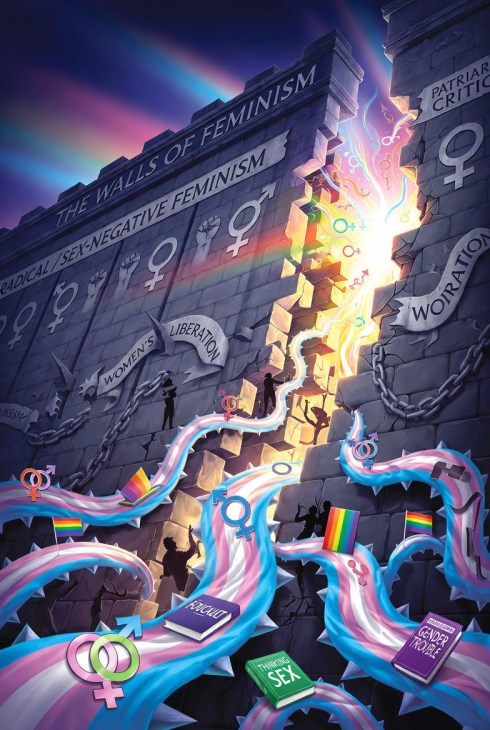
That is how organizations founded to defend women ended up defending males in women’s spaces while calling it liberation. They had trained themselves to treat coalition belonging as moral proof, so when the coalition turned against sex-based rights, too many lacked either the nerve or the language to resist.
This matters because gender ideology did not win by argument alone. It won through institutions. HR departments, schools, medical bodies, activist organizations, media outlets, professional regulators, and law all played their parts. Queer theory supplied much of the more radical conceptual machinery. Bureaucracy turned it into policy. Social media turned dissent into reputational danger.
But some feminist concepts weakened the walls before the push came.
That is the uncomfortable part.
The tragedy is that many women saw the danger early and were told to shut up by institutions claiming to speak for them. They were not confused, hysterical, or hateful for noticing that sex-based rights require sex-based categories. They were pointing at the load-bearing wall while the renovation crew was already swinging hammers.
The repair begins with honesty.
Women are female humans. Sex is real. Sex roles are not destiny. Biology is not oppression. Lived experience matters, but it does not outrank evidence. Coalitions are useful only while they remain answerable to reality.
This is not an argument against women’s rights. It is an argument against refusing to audit the theories that claimed to speak for women.
Feminism does not have to accept hostile caricatures of itself. But it does have to face the places where its own language, assumptions, and institutional loyalties were turned against its central subject.
Test the claim. Follow the mechanism. Face the consequences.
Too many land acknowledgements are not acknowledgements anymore. They are rituals of submission with nicer stationery.
Everyone knows the form. Before the meeting, concert, lecture, school assembly, or conference begins, someone reads a solemn paragraph about the land. The tone is reverent. The words are familiar. The effect is usually deadening. Nobody is supposed to argue with it. Nobody is supposed to ask what it means in practice. The ritual is complete once the room has been morally sorted.
That is the trick.
A land acknowledgement does not merely “acknowledge land.” It often imports a political frame. It suggests that some people belong here more deeply than others, that ordinary Canadians are guests in their own country, and that citizenship itself sits under a cloud of inherited guilt.
This is why Jamil Jivani’s version is useful:
“We acknowledge that we gather here today as free men and women on land governed by private property laws. We are enthusiastic to keep this as a proud tradition in our country, and we stand firmly as people who do not believe in two-tiered citizenship.”
That works because it does what the usual version refuses to do. It acknowledges the legal and political order under which people are actually gathered.
We are not meeting in a metaphysical guilt zone. We are meeting in Canada. That means Canadian law, constitutional government, treaty obligations, private property, Crown land, Aboriginal title, reserves, statutes, courts, and civic rights that apply to citizens as citizens.
The details matter. Canada’s land regime is not one simple thing, and anyone pretending otherwise is selling you a pamphlet, not an argument. But the public square still depends on a shared legal order. It cannot survive if every gathering begins by quietly ranking people according to ancestry.
That is why the phrase “land governed by private property laws” matters. It cuts through the incense.
Private property is not just about who owns a fence line or a parcel on a title map. It is one of the civilizational tools that lets strangers live beside each other without every dispute becoming a tribal contest. It turns land into a governed reality rather than a permanent symbolic battlefield. It lets people build homes, churches, schools, businesses, farms, and community halls without having to justify their existence every time someone invokes ancestry.
The usual acknowledgement often leaves people with a vague sense that Canada is illegitimate, but without saying clearly what should follow.
Are property titles invalid? Are municipal governments illegitimate? Are homeowners merely tenants of history? Are citizens equal, or are some citizens permanently morally prior because of bloodline?
These questions are usually dodged because answering them would reveal the radicalism hiding inside the ritual.
Jivani’s version answers plainly: no two-tiered citizenship.

That is the heart of it.
A serious country can honour Indigenous history. It can recognize treaties. It can correct specific injustices where evidence and law require correction. It can admit that governments have done cruel, stupid, and destructive things. None of that requires teaching Canadians that equal citizenship is somehow morally suspect.
But that is where many modern land acknowledgements drift. They sort the room into moral categories before the event even starts. Some people are original. Some are settlers. Some have ancestral legitimacy. Others inherit suspicion. The language remains soft, but the structure underneath it is hard.
That is not reconciliation. That is caste thinking with a grant application attached.
And no, refusing that frame does not mean pretending history began yesterday. This lazy accusation needs to be retired. Canadians can know the history without accepting a ritual designed to weaken their confidence in the country they inhabit. Memory does not require self-erasure. Justice does not require permanent civic grovelling. Respect does not require pretending that liberal citizenship is some colonial inconvenience we should all feel embarrassed about.
If people want reconciliation, then do the real work. Clarify treaty obligations. Improve reserve governance. Support economic development. Fix broken service delivery. Protect individual rights. Litigate actual claims. Negotiate actual settlements.
But stop pretending that reciting inherited guilt before a PowerPoint presentation is moral courage.
The better acknowledgement is provocative because it reverses the moral pressure. Instead of forcing citizens to rehearse guilt before they proceed, it affirms the conditions that let free people gather in the first place: law, property, citizenship, and equality before the state.
That is exactly why it will irritate the professional class that treats land acknowledgements as sacred theatre. It refuses the expected posture. It does not bow. It does not mumble through a half-confession. It says, openly, that Canada is a real country, that its legal order matters, and that citizenship must not be divided into ancestral ranks.
A land acknowledgement should acknowledge reality.
That is worth saying out loud.
Oh, for heaven’s sake.
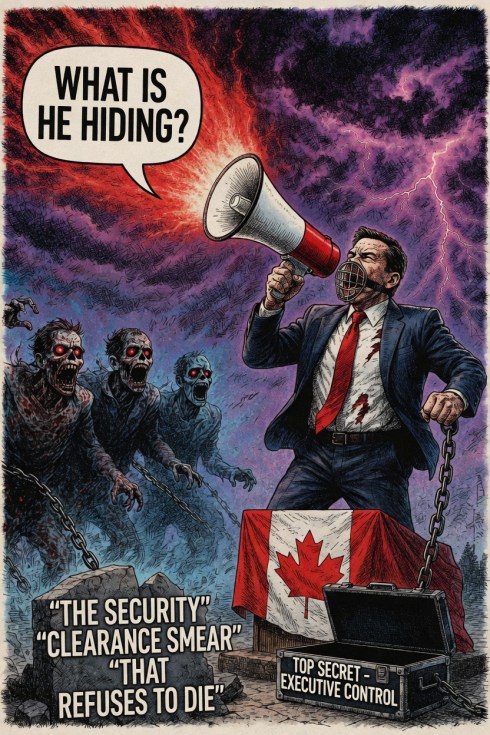
The Pierre Poilievre “security clearance” line has become one of those zombie claims in Canadian politics: killed repeatedly, buried repeatedly, and somehow still shambling around the media ecosystem looking for brains.
The lazy version goes like this: Poilievre does not have security clearance.
The line sounds grave because it is designed to sound grave. The average reader is supposed to hear it and supply the missing accusation: What is he hiding? Why can’t he pass the test? Is he compromised? The framing does not need to prove those suspicions. It only needs to keep them hovering.
But the real issue is not whether Poilievre is some random man off the street who cannot be trusted near a file folder. He served as a federal cabinet minister under Stephen Harper, including as minister of democratic reform and employment and social development. Cabinet ministers routinely handle sensitive government information. The current fight is over whether, as Leader of the Opposition, he should accept a particular classified briefing process under conditions that may limit what he can say afterward.
That is where the trick happens: critics collapse separate categories into one insinuating claim. Past cabinet access, present clearance status, and refusal of a specific classified-briefing regime are treated as though they are the same thing.
The accurate answer is not “his clearance never expires.” That claim is too broad and too easy to attack. Government of Canada security guidance says Secret clearance is valid for 10 years and Top Secret for 5 years. The stronger point is that the public is being offered a flattened version of a more complicated dispute.
The government, opposing parties, and many media voices say Poilievre “refuses to get security clearance.” Often, what they mean is that he has refused the additional clearance or classified briefing access needed to review certain foreign-interference material, including unredacted intelligence. Poilievre’s stated reason is that accepting those terms would restrict his ability to comment publicly.
You can view that choice as wise or reckless. But refusal under those terms is not the same as being unable to obtain clearance. It is not evidence that he failed a background check. It does not prove intelligence officials found him unfit. It means he has refused to enter a briefing regime with legal and political consequences.
Those consequences are not rhetorical decoration. The National Security and Intelligence Committee of Parliamentarians Act requires members to obtain and maintain the necessary Government of Canada security clearance, take an oath, and follow confidentiality rules. It also prohibits members and former members from knowingly disclosing protected information obtained through their work. The Supreme Court of Canada has upheld limits on parliamentary privilege in this context. In plain English: once you accept certain classified information under those rules, you may know more, but you may also be able to say less.
That architecture matters for an opposition leader. A government backbencher can absorb confidential information and stay quiet. A minister can be bound by cabinet confidence. But the Leader of the Opposition has a different role: to scrutinize the executive, press for disclosure, expose contradictions, and speak publicly when the government would rather manage the file behind closed doors.
There is still a serious criticism here. A potential prime minister should not be casually indifferent to classified intelligence. Foreign interference is not a branding exercise. It is real, ongoing, and aimed at Canadian institutions. Critics argue that Poilievre’s refusal leaves him unnecessarily blind on files he may one day have to manage from the Prime Minister’s Office.
That case should be made plainly: Poilievre should accept the clearance because national security requires informed leadership, even if that limits what he can say publicly afterward.
Fair enough. Argue that.
But do not imply he failed a clearance process. Do not suggest he is too compromised to receive sensitive information. Do not turn a strategic refusal into a character indictment.
Poilievre’s position may be risky. It may even be wrong in some circumstances. But the risk he identifies is also real. If the government possesses information embarrassing to itself, damaging to another party, or relevant to public accountability, a briefed opposition leader may become strategically constrained. In ordinary life, “knowing more” is usually an advantage. In opposition politics, knowing something you cannot use can become a leash.
This is why the “just get the clearance” demand is not neutral. It asks the Leader of the Opposition to step inside a confidentiality framework shaped by the executive he is supposed to scrutinize.
None of this automatically makes Poilievre right. There may be briefings he should accept. There may be moments when national security requires trust between government and opposition. But pretending the only possible explanation for refusal is guilt, cowardice, or hidden compromise is political theatre masquerading as procedural concern.
The machinery is more complicated than the slogan. Opposition leaders can receive classified briefings through different routes, with different levels of access and different obligations attached. Some briefings may require formal clearance. Some may involve confidentiality agreements. Some may leave a political leader better informed but publicly constrained.
So argue the real question.
Should the Leader of the Opposition accept classified briefings if doing so may limit his ability to criticize the government? Or should he remain outside that framework so he can keep pressing for public disclosure, especially when the issue is foreign interference in Canadian democracy?
Canadians can land on either side of that question. What they should not accept is the cheap version: Poilievre won’t get clearance — what is he hiding?
That is not analysis. It is insinuation with a lanyard.
The proper answer is to force precision.
Say what actually happened: Poilievre refused a particular classified briefing path because he believes it would constrain his ability to speak publicly and perform the adversarial role of opposition. His critics may call that irresponsible. His defenders may call it prudent. But anyone still selling the crude version is not informing the public.
They are laundering a smear through procedure, and Canadians should be tired of that trick by now.
References
- Government of Canada — Security clearance request process
Explains clearance levels and validity periods: Secret clearance is valid for 10 years; Top Secret clearance is valid for 5 years.
https://www.canada.ca/en/public-services-procurement/services/industrial-security/security-requirements-contracting/personnel-security-screening/processes/security-clearance-request.html - National Security and Intelligence Committee of Parliamentarians Act
Sets out clearance, oath, confidentiality, and disclosure obligations for NSICOP members.
https://laws-lois.justice.gc.ca/eng/acts/n-16.6/page-1.html - Supreme Court of Canada — Alford v. Canada (Attorney General), 2026 SCC 11
Confirms limits on parliamentary privilege for NSICOP-related secrecy obligations.
https://www.scc-csc.ca/judgments-jugements/cb/2026/41336/ - Reuters — Trudeau says some opposition MPs could be involved in foreign interference
Includes the context around Poilievre declining clearance to access intelligence from the foreign-interference probe.
https://www.reuters.com/world/americas/trudeau-says-some-opposition-canada-mps-could-be-involved-foreign-interference-2024-10-16/ - Foreign Interference Commission — PCO memo on classified briefings for opposition leaders
Discusses possible classified briefing routes for opposition leaders, including Secret-level briefings, Privy Councillor options, confidentiality agreements, and Top Secret requirements.
https://foreigninterferencecommission.ca/fileadmin/foreign_interference_commission/Documents/Exhibits_and_Presentations/Exhibits/CAN023012.pdf
Alberta Premier Danielle Smith used her address at the Canada Strong and Free Network conference to frame her government’s recent legislative agenda as a direct challenge to what she called the “era of wokeism.”
The speech was not about one bill. It was a political inventory: professional regulation, classroom neutrality, parental rights, gender medicine for minors, female sport, and sexually explicit material in libraries. The through-line was institutional restraint. Schools, regulators, medical systems, and libraries should not become vehicles for ideological enforcement.
Smith pointed first to what supporters have called the “Jordan Peterson Law,” Alberta’s legislation aimed at professional regulators. The basic idea is that professional bodies should regulate competence and misconduct, not punish members for off-duty political or personal views unless those views clearly bear on professional conduct. Whatever one thinks of Peterson himself, the principle is larger than one man: licensing bodies are not supposed to become political conformity boards.
Education took up much of the speech. Alberta’s Bill 25, introduced March 31, 2026, is formally titled An Act to Remove Politics and Ideology from Classrooms and Amend the Education Act. The province says the bill is meant to keep classrooms neutral, impartial, and respectful of diverse viewpoints. It would require school authorities to avoid taking official positions on political, social, or ideological matters outside their education mandate, and would direct teachers to remain objective and present balanced perspectives.
That is the political nerve centre of the speech. For years, progressive activists have argued that schools cannot be neutral and must instead be actively “inclusive,” “anti-oppressive,” or “affirming.” Smith’s answer is that this logic has turned too many classrooms into ideological delivery systems. Her government’s position is that schools should teach students how to think, not quietly steer them toward approved political conclusions.
Smith also returned to Alberta’s laws on gender-related interventions for minors. The province’s Protecting Alberta’s Children Statutes Amendment Act invokes the notwithstanding clause to shield several measures from being struck down by courts. These include prohibitions on gender reassignment surgery for children under 18, restrictions on puberty blockers and hormone treatments for gender reassignment for children under 16, parental notice and consent rules around gender-related name and pronoun changes in schools, opt-in consent for teaching on gender identity, sexual orientation, or human sexuality, and rules limiting women’s and girls’ amateur competitive sports to those born female.
Supporters will call this child protection, parental rights, and fairness in female sport. Critics will call it state interference in the lives of transgender youth. That fight will not be settled by changing labels. It turns on deeper questions: what children can consent to, what parents are entitled to know, how strong the medical evidence is, and whether schools may keep consequential identity-related information from families.
Smith also addressed sexually explicit material in libraries. Alberta has proposed public-library measures aimed at limiting minors’ access to materials containing explicit visual depictions of sexual acts, while saying adults would retain access and that materials would not be removed from libraries. The government describes this as age-appropriate access control, not a book ban. Critics see it as censorship, especially given previous fights over school-library materials and LGBTQ-themed books.
The speech’s political purpose was obvious. Smith was not merely listing policies. She was tying them into a governing thesis: Alberta’s public institutions have drifted from their proper roles, and her government intends to pull them back.

That is the real argument underneath the “wokeism” language. Are schools, professional regulators, medical bodies, and libraries limited institutions with defined purposes? Or are they now expected to act as engines of progressive moral instruction?
Smith’s answer is blunt: no.
The word “wokeism” is not especially precise. It is a bucket term, and bucket terms can get sloppy fast. But in this case, it is pointing at something real: the steady conversion of public institutions into ideological enforcement systems, usually under softer language about safety, inclusion, equity, care, or professional standards.
Alberta’s new posture is simple: public institutions should serve the public under defined rules, not quietly reshape the public under activist supervision. That is the line Smith is trying to draw. The coming fight will be over whether Alberta is allowed to draw it.











 bleatmop
 Mystro


 Dead Wild Roses
Your opinions…