
You are currently browsing the monthly archive for June 2026.
The Alberta Medical Association and the Canadian Pediatric Society want Canadians to believe the debate over pediatric gender medicine is settled. It is not.
When Premier Danielle Smith announced restrictions on transgender medical interventions for minors, major medical bodies responded with the language of emergency. The Canadian Pediatric Society warned that Alberta’s policy would undermine the rights of transgender children and youth. The Alberta Medical Association’s pediatrics section argued that the government was targeting an already vulnerable population. The public message was clear enough: responsible doctors affirm; politicians interfere; children suffer.
 But that framing hides the central problem. There is no stable international medical consensus on pediatric transition. In fact, several European jurisdictions have moved in the opposite direction from Canada’s professional bodies, not because they have stopped caring about distressed children, but because they have begun applying more ordinary standards of evidence to extraordinary interventions.
That distinction matters. Puberty blockers and cross-sex hormones are not counselling, kindness, or protection from bullying. They are medical interventions into the development of physiologically healthy children and adolescents, often at an age when identity, sexuality, mental health, peer influence, family conflict, and neurodevelopmental conditions are still in motion. A serious medical institution should be able to say that without sounding frightened of its own profession.
Instead, Canadian medical institutions often speak as if caution itself is the danger.
The most revealing example is the suicide argument. Parents and voters have been told, sometimes openly and sometimes by implication, that restricting pediatric transition will kill children. The activist version is familiar: would you rather have a dead daughter or a trans son? The political version is not much better. Former Calgary mayor Naheed Nenshi told Premier Smith that “votes aren’t worth a few dead kids.”
That is not clinical reasoning. It is emotional coercion applied to frightened parents.
The evidence does not support the crude version of the claim. A 2024 Finnish register study in BMJ Mental Health examined more than 2,000 adolescents referred to gender identity services and compared them with more than 16,000 matched controls. The authors found that suicide deaths were rare, and that once psychiatric treatment history was accounted for, gender-referred youth did not show higher all-cause or suicide mortality than controls. The study does not say these young people are not distressed. It says the simple story — affirm or they die — is not evidence-based medicine.
That should change the conversation. Many adolescents presenting to gender clinics also carry depression, anxiety, autism, trauma histories, eating disorders, family instability, social isolation, or other serious mental-health burdens. If those burdens are treated as secondary to gender identity, medicine risks narrowing the diagnostic lens at exactly the moment it should be widening it.
This is one of the main lessons of the Cass Review in the United Kingdom. Cass did not recommend abandoning children with gender distress. It called for a more holistic model of care, better assessment, stronger evidence, and far more caution around medical pathways. NHS England subsequently stopped the routine prescription of puberty blockers for gender dysphoria in minors, moving them into a research setting rather than ordinary clinical use.
That is not a small update. It is a major warning to every country that imported the affirmative model and then treated dissent as bigotry.
The “pause button” metaphor has also aged badly. Puberty is not a decorative inconvenience. It is a central developmental process involving bones, brain maturation, sexual function, fertility, and identity formation. Cass specifically warned against assuming that drugs used for precocious puberty will have the same outcomes when used for children and adolescents with gender dysphoria. The medical context is different. The child is different. The purpose of the intervention is different. Pretending otherwise is not compassion; it is bad reasoning in therapeutic language.
The pathway concern is equally serious. If blockers were merely neutral time-buying devices, we would expect many children to pause, mature, and then step away from medicalization. But the available evidence shows high rates of progression from puberty blockers to cross-sex hormones. That does not prove every case is mishandled, and it does not prove no patient benefits. It does mean the intervention may help create the very path it claims merely to delay.
Other countries have noticed. France’s National Academy of Medicine urged “great medical caution” in treating gender-related distress in children and adolescents, citing vulnerability and the possibility of serious complications. The UK has moved puberty blockers away from routine use. Scotland paused new prescriptions for minors after the Cass Review. These are not fringe developments. They are evidence institutions pulling back after years of clinical momentum.
Canada’s professional bodies should be wrestling publicly with that reversal. Instead, they often sound as though the old consensus still exists.
“Institutional capture does not mean every doctor is corrupt. It means the institution has absorbed a political frame so deeply that it struggles to distinguish care from affirmation, caution from cruelty, and disagreement from harm.”
This is where the word “capture” becomes fair, but only if we are precise. Institutional capture does not mean every doctor is corrupt. It does not mean every pediatrician agrees with activists. It does not mean every child with gender distress is confused, lying, or socially influenced. It means the institution has absorbed a political frame so deeply that it struggles to distinguish care from affirmation, caution from cruelty, and disagreement from harm.
That is dangerous in any field. It is worse in pediatrics.
Children with gender distress deserve serious care. They deserve protection from bullying, family cruelty, humiliation, and ideological exploitation from every direction. They deserve psychological assessment, treatment for co-occurring mental-health problems, family involvement where safe, and adults who can tolerate uncertainty. The modern clinic population is also not the same as the older, smaller cohort of mostly childhood-onset cases; many services have seen a sharp rise in adolescent presentations, often with complex psychiatric and developmental profiles. A small number may continue to experience severe, persistent dysphoria into adulthood and may eventually choose medical transition. But that possibility does not justify allowing pediatric care to default into an affirmation-first pathway.
The honest position is not “do nothing.” The honest position is slow down, assess carefully, treat comorbidities, use exploratory psychological care rather than ideological confirmation, stop using suicide as a rhetorical weapon, and stop pretending that uncertain evidence becomes settled science because a professional association says so.
Medicine earns public trust when it disciplines itself. It loses that trust when it borrows the moral posture of activism and then demands deference as science.
The AMA and CPS still have a choice. They can defend vulnerable children by telling the whole truth: that distress is real, that cruelty is wrong, that some cases are complex, and that the evidence for routine medical transition in minors is weaker than Canadians have been led to believe. Or they can continue treating democratic oversight and parental caution as the real threat, while countries that reviewed the evidence more seriously move toward restraint.
“Medicine earns public trust when it disciplines itself. It loses that trust when it borrows the moral posture of activism and then demands deference as science.”
The issue is not whether vulnerable youth should be helped. They should.
The issue is whether Canadian medical institutions can still tell the difference between helping children and protecting an ideology from scrutiny.
Right now, the answer is not reassuring.
Canada’s ruling class has become very good at sounding compassionate while making the country less livable.
That is not the same as saying compassion is the problem. It is not. A decent country should care about fairness, dignity, historical wrongs, clean air, decent schools, housing, wages, and whether ordinary people can build a stable life. The problem begins when the language of care becomes a substitute for competence.
The road does not get built, the house does not get approved and mysteriously the paycheque does not stretch.
But the statement was inclusive, the framework was equitable, and the branding was excellent.
This is the Canadian disease in its current form. We have become fluent in the language of public virtue while becoming strangely incompetent at the material tasks that make public virtue affordable. Productivity is weak. Housing is absurdly expensive. Infrastructure is strained. Governments borrow more to deliver less. Businesses hesitate to invest. Young people look at the cost of living and quietly revise their expectations downward.
None of this is caused by slogans alone. Canada’s problems are real and structural: regulatory drag, housing bottlenecks, capital trapped in real estate, public-sector risk aversion, interprovincial barriers, immigration levels that outran housing and infrastructure capacity, and a political class allergic to trade-offs. A land acknowledgement did not create all that. A diversity statement did not single-handedly break productivity.
But symbolic politics gave our institutions a prettier way to avoid the problem.
 Once a government, university, corporation, or bureaucracy learns to measure moral posture more eagerly than delivery, failure becomes easier to disguise. The meeting had the right language. The report had the right vocabulary. The procurement process had the right values. The strategy document had the right tone. Meanwhile, the project slipped, the costs climbed, the housing never arrived, and the public was asked to admire the intentions.
Serious societies argue about trade-offs. They ask what a policy costs, who pays, what it produces, and whether the promised benefits are worth the burden. Unserious societies turn every hard question into a morality play. If you ask whether immigration levels are matched to housing, schools, health care, and infrastructure, you are accused of cruelty. If you ask whether a project approval process has become impossible to navigate, you are accused of hating the environment. If you ask whether equity metrics are displacing competence, you are told the question itself is suspicious.
That trick works for a while. It flatters the people using it. It turns arithmetic into moral failure and makes practical objections look ugly. But reality is not impressed by compassionate branding.
A country cannot announce its way out of weak productivity. It cannot consult its way into affordable housing. It cannot regulate its way into abundance while making useful work slow, expensive, and politically hazardous. It cannot keep treating prosperity as an inheritance while sneering at the habits that created it.
Canada does not need to abandon moral language. It needs to demote moral theatre. Justice matters, but so does delivery. Compassion matters, but so does arithmetic. Environmental stewardship matters, but so does affordable energy. Inclusion matters, but so does the basic ability to build homes, roads, businesses, and lives.
The country does not need another sermon about who we are, but rather Canadians need evidence that we can still do useful things.
Prosperity is built, measured, maintained, and defended. A country that forgets this can still sound compassionate while becoming poorer, slower, more indebted, and harder to live in.
There are few modern spectacles more interesting than Richard Dawkins speaking warmly about Christianity.
Not converting. Not recanting The God Delusion. Not wandering into Evensong with a softened heart and a sudden interest in incense. But speaking warmly, nevertheless.
 Dawkins has called himself a “cultural Christian.” He remains an atheist, which is what makes the admission interesting. He is not saying Christianity is true. He is noticing that Christianity helped form a civilization in which he could become Richard Dawkins: skeptical, eloquent, publicly irreverent, protected enough to criticize sacred things, and still culturally at home among the ruins and residues of the faith he rejects.
For a long time, many secular Westerners treated Christianity as something they had outgrown. It was old, morally complicated, often hypocritical, and associated with repression, scolding, and bad Sunday mornings. Keep the music, perhaps. Keep the architecture. Keep Christmas, provided no one gets doctrinal about it. The rest could be packed away.
There were reasons for that impatience. Churches persecuted, censored, lied, protected abusers, cozied up to power, and sometimes confused institutional self-interest with the will of God. No honest appreciation of Christian civilization can skip that part. But there is a difference between remembering the failures of an inheritance and forgetting that we inherited anything worth having.
The West was not built from one source. It is a quarrelsome inheritance: Greek reason, Roman law, Jewish moral seriousness, Christian theology, Germanic custom, common law, Reformation fracture, Enlightenment skepticism, scientific inquiry, and the long institutional habit of limiting power. Christianity did not invent every virtue from nothing, but it became one of the great furnaces in which those virtues were universalized, moralized, preached, contradicted, betrayed, and recovered.
Modern liberalism did not merely inherit Christian assumptions and put them in nicer clothes. It built institutions Christianity often resisted: robust free speech, religious disestablishment, broader suffrage, empirical science protected from clerical authority, and legal equality that went well beyond what most Christian societies were willing to grant. Some of the freedoms Dawkins enjoys were made possible by Christian moral inheritance. Others required sharp breaks from dominant Christian practice.
That tension is the point. The West is the product of argument, correction, rebellion, restraint, and institutional memory.
This is what modern secular people often miss. We imagine ourselves as freestanding moral adults. We believe in human dignity, equality before the law, freedom of conscience, care for the vulnerable, suspicion of tyranny, and the right to criticize authority. Fine. Keep all of that. But those commitments have a history. They were not produced by vibes, nor assembled last Tuesday by a committee with a land acknowledgement and a catering budget.
They came through centuries of conflict, doctrine, reform, law, blood, repentance, philosophy, institutional restraint, and exhaustion after too many people had killed each other over ultimate things.
To appreciate that inheritance is not to baptize every part of it. Christendom was not gentle. Christianity often had to be forced into better conduct by dissidents, reformers, scientists, heretics, abolitionists, and Christians reading their own scriptures more honestly than their institutions did. The West’s moral inheritance was not a clean gift. It was an argument, often conducted under pressure.
“The West is the product of argument, correction, rebellion, restraint, and institutional memory.”
But the argument happened inside a civilization shaped deeply by Christianity.
The freedom to doubt, mock religion, publish irreverent books, leave a faith, criticize clerics, and live without being ruled by priests was not inevitable. Nor was the expectation that women may walk unveiled, educated, employed, politically equal, and legally protected. These are achievements produced by particular histories, institutions, and moral restraints.
That is where Dawkins’ comparison with Islam enters the discussion, though it needs care.
The issue is not Muslim neighbours. Millions of Muslims live peacefully, work hard, raise families, keep faith privately, and want the ordinary goods everyone else wants: safety, dignity, friendship, decent schools, and a stable life. A serious argument begins by refusing collective suspicion.
The harder question is what happens when Islamic doctrine becomes politically confident and expects the wider society to accommodate its rules around blasphemy, apostasy, religious offence, sex roles, homosexuality, and public criticism. Outcomes differ by interpretation, education, migration patterns, and host-society confidence, but liberal societies still cannot survive by pretending every moral and legal order is equally compatible with liberal freedom.
Dawkins seems to understand that cultural Christianity has learned to live with disbelief in a way many religious systems have not. The Anglican church may annoy you. It may bore you. It may produce beige sermons, awkward committees, and hymns sung by twelve people spread across a nave built for three hundred. But it is unlikely to demand the state punish you for mocking it, which is not a small thing.
“But criticism without gratitude curdles into contempt, and contempt is a poor steward of anything worth preserving.”
The Sunday lesson, then, is not “become Christian or die,” nor “atheists secretly know God is real,” nor “all Muslims are enemies.” It is more modest and more useful: know where you are standing.
If you live in the West, you live inside an inheritance. You may criticize it. You should criticize it. The tradition itself contains the tools for doing so. But criticism without gratitude curdles into contempt, and contempt is a poor steward of anything worth preserving.
Secular liberalism has been living partly off inherited moral capital for a long time, even while adding real achievements of its own. Compassion, rights, conscience, equality, dissent, human dignity, forgiveness, reform, and care for the weak remained available, but the story of how they arrived became unfashionable.
A culture can run on inherited habits for a while. Maybe longer than its critics expect. But inheritance is not self-renewing, and gratitude alone is not repayment. If people are taught only to sneer at what formed them, they will not know what to keep, what to reform, what to defend, or what to pass on. If they merely admire the ruins, they become tourists in their own civilization.
Dawkins has not found God. He has noticed a debt.
The harder question is whether a civilization can repay that debt without pretending to believe what many of its citizens no longer believe.
“Human beings are very good at noticing the stupidity of outsiders and very bad at noticing when our own side has started laundering emotion through principle.”
It is easy to pick apart other people’s bad arguments. Too easy, sometimes. When the subject is gender ideology, the temptation is worse because so much of the public argument really does arrive as slogans, emotional coercion, category confusion, and moral theatre wearing institutional shoes.
But ease is a warning sign.
If an opponent’s weakest argument is the only one I can bear to examine, then I am not truth-seeking. I am harvesting reassurance. That may feel satisfying in the moment, especially when the home team applauds, but it is not the same thing as thinking.
The discipline I keep returning to is simple and unpleasant: prosecute your own argument in the harshest light you can tolerate. Ask what would weaken it. Ask which evidence you are avoiding. Ask whether your conclusion has become part of your identity, because once that happens, correction starts to feel like humiliation.
That is not easy. It cuts against our tribal wiring. Human beings are very good at noticing the stupidity of outsiders and very bad at noticing when our own side has started laundering emotion through principle. The people who agree with us can become dangerous in exactly this way. They reward the sharp line, the fast dunk, the satisfying contempt. They rarely reward the moment when you say, “This part of my own argument may need work.”
 I have had to revise some of my own instincts here. It is too easy to treat the whole phenomenon as ideology, cowardice, and social contagion. Those are real forces, but they do not explain every person caught inside the debate. Some people experience severe and persistent distress around sexed embodiment, and social recognition may reduce suffering in ways that are not trivial. That does not settle women’s spaces, children’s medicine, sports, prisons, or compelled speech. It does mean I have to resist the temptation to collapse every person into the worst activist slogan spoken on their behalf.
The trans debate remains a useful stress test because the public claims are so unstable. If strong evidence showed that cross-sex identification reflected a stable, measurable condition that reliably benefited from social or medical transition under careful safeguards, I would have to revise parts of my view. At present, I do not think that case has been made strongly enough, especially where children, safeguarding, and sex-based boundaries are concerned. Much of what is offered instead is moral pressure: affirmation presented as care, skepticism presented as harm, boundaries presented as hatred.
Still, that cannot become an excuse to write off every person on the other side. The strongest version of their argument is not that slogans are true because activists shout them. It is that some people experience suffering serious enough to deserve humane attention, even if the metaphysics built around that suffering are confused or overstated.
This is where charity matters. Not sentimental charity. Not the kind that asks you to pretend bad arguments are good. Real charity means refusing to make your opponent smaller than they are so you can defeat them more easily.
I do not want to become the mirror image of what I criticize: someone who begins with moral certainty, chooses the facts that flatter it, and treats disagreement as evidence of corruption. If reality matters, then it has to matter when it inconveniences me too.
That is the standard. Not perfection, because nobody gets that. But a willingness to remain revisable. To notice when contempt is doing the work of argument. To ask whether a cherished belief has survived scrutiny or merely avoided it.
A truth-first posture is only worth having if it still applies when the correction costs you something.
The double-slit experiment is one of those scientific ideas people love to borrow badly. It is strange, genuinely humbling, and easy to misuse. That makes it perfect material for people who want reality to be less stubborn than it is.
The basic version is simple enough. Fire particles through two slits without measuring which slit they pass through, and over time they produce an interference pattern, the kind of pattern we associate with waves. Try to measure which slit they go through, and that pattern changes. The system no longer behaves the same way.
That is the part people remember. Unfortunately, they often remember it badly.
The experiment does not show that human consciousness creates reality. It does not show that the universe waits around for a person to notice it before deciding what it is. “Observation” in this context does not mean vibes, attention, social agreement, or someone staring meaningfully at an electron. It means measurement. It means physical interaction with the system. The apparatus matters because the apparatus is part of the situation being tested.
That is weird enough. We do not need to add incense.
There are still serious debates in the foundations of quantum mechanics about how best to interpret what is happening. That is worth admitting. But those debates do not rescue the popular abuse of the experiment. Consciousness is not required, politics does not select the result, and social approval does not decide whether the interference pattern appears.
The real lesson is more disciplined and more interesting. Reality is not always available to common sense. How we investigate can affect what we are able to detect. At quantum scales, measurement is not a passive act, like glancing at a chair from across the room. It changes the conditions under which the result appears.
That should make people humble about truth-finding. It should not make them casual about reality.
This is where social constructivist thinking often slips in through the side door. It does not usually announce itself by saying, “Nothing is real.” That would be too crude, and too easy to reject. Instead, it emphasizes language, framing, power, interpretation, categories, and social meaning until the reader quietly stops treating reality as a constraint and starts treating it as a negotiation.
Reality is real, but not always simple. Because it is not simple, we need better methods, not ideological shortcuts.
Some things really are socially constructed. Money depends on shared agreement. Borders depend on law, force, recognition, and maps. Job titles, academic credentials, citizenship categories, and institutional rituals all rely on human systems to maintain them. That is not a trivial point. Human beings create layers of social meaning that shape how we live, distribute status, enforce rules, and decide what counts inside institutions.
But the fact that some realities are socially maintained does not mean all realities are socially produced. The category “doctor” is socially regulated. The body on the operating table is not. A passport is a legal object. A kidney is not. A government can change language around inflation, housing, crime, or sex, but the material world does not become more cooperative because the terminology became more fashionable.
This is the tell to watch for. A valid insight about interpretation gets stretched until it weakens contact with reality. “Categories have social meaning” becomes “categories are merely imposed.” “Observation matters” becomes “truth depends on standpoint.” “Language shapes perception” becomes “language can rearrange the world.” Each step sounds sophisticated enough in isolation. Put them together, and ordinary reality gets escorted out of the room by people who insist they are only asking questions.
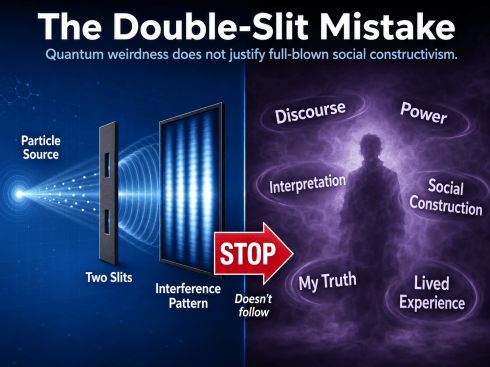
The double-slit experiment does not support that move. If anything, it rebukes it. The experiment is repeatable. The results are disciplined. The mathematics is unforgiving. You do not get a different interference pattern because your politics require one. You do not get to vote on the apparatus. The whole point of the experiment is that reality answers back, though not always in the form our intuitions expected.
That distinction matters far beyond physics. Bad theories of reality do not stay in seminar rooms. They eventually show up in schools, medicine, law, media, and public policy, often wearing the language of compassion or sophistication. If institutions lose the ability to distinguish between social meaning and material constraint, they do not become more humane. They become easier to fool.
Quantum weirdness should not become a permission slip for intellectual fog. It should remind us that careful methods are necessary precisely because reality can be subtle. The world is not always obvious, but it is also not waiting for our preferred theory to grant it permission to exist.
The better response to mystery is not social construction all the way down. It is patience, precision, and less eagerness to turn every difficulty in knowing into an excuse for pretending the thing known has disappeared.
Good intentions are not enough. That should be obvious, but much of our public life now behaves as if noble language can rescue bad thinking.
Before people declare what is compassionate, just, inclusive, hateful, dangerous, or necessary, they need some reliable way of knowing whether their factual claims are true. That order matters. If the tools used to find truth are broken, captured, or designed to protect a preferred belief from contradiction, then the moral conclusions built on top of those tools will inherit the damage.
This is not a left-wing or right-wing problem, though each side prefers noticing it in the other. The progressive version often begins with moral urgency. A policy is called compassionate, inclusive, or protective, and once that moral label is attached, factual objections start to look suspicious. Questions about consequences become “harm.” Questions about definitions become “erasure.” Questions about evidence become proof that the questioner is unsafe.
The conservative version has its own habits. A bad social trend gets folded too quickly into civilizational decline. One ugly example becomes proof of total collapse. A complicated institutional failure becomes evidence that the enemy planned the whole thing. The moral conclusion may contain some truth, but it arrives too early and then starts recruiting facts to serve it.
That is the trap. Once moral certainty arrives first, the mind stops investigating and starts defending.
You can see the pattern wherever institutions are rewarded for sounding virtuous before they are required to be accurate. A school board adopts fashionable language before asking whether the policy helps children. A medical system treats hesitation as cruelty before the long-term evidence is settled. A government describes economic pain in careful managerial terms while households are trying to make rent, groceries, debt, and wages fit inside the same month. The details differ, but the sequence is familiar: the moral frame arrives first, and the facts are invited in later as supporting cast.
A healthier public culture would ask plainer questions before the slogans begin. What is the claim? What evidence would show it is true? What evidence would weaken it? Who pays the cost if we are wrong? Are we counting those costs honestly, including the costs to people we do not like? Are we applying the same standard when the facts embarrass our own side?
Those questions are not glamorous. They do not fit neatly on a protest sign or a campaign graphic. They also do not offer the emotional satisfaction of instant righteousness. But they are the difference between thinking and performing.
This matters because moral language is powerful. It can move people to protect the vulnerable, correct injustice, and resist cruelty. But the same language can also be used to smuggle weak claims past scrutiny. Institutions have incentives to do this. Activists gain status from certainty. Bureaucracies protect themselves with approved vocabulary. Media outlets reward emotional clarity over careful qualification. Ordinary people learn, quickly enough, which questions are safe to ask in public and which ones are better saved for the parking lot.
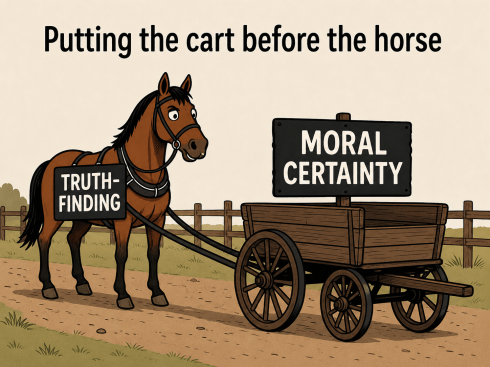
So they accept the conclusion first and hope the facts will catch up later.
They often do not.
Reality has a way of collecting unpaid debts. Bad premises eventually produce visible damage: failed policies, institutional distrust, medical scandals, economic denial, public cowardice, and citizens who no longer believe official language because they have watched it bend too many times.
The answer is not cynicism. Cynicism is often just laziness wearing a smarter jacket. The answer is better truth-finding: slower claims, clearer definitions, stronger evidence, real costs counted on both sides, and a willingness to notice when our preferred story stops matching the world.
That includes me. That includes you. That includes the people whose politics we find irritating, fashionable, smug, or deranged. Nobody gets a permanent exemption from reality because their intentions are good or their enemies are worse.
A decent society needs moral seriousness, but moral seriousness cannot mean protecting our favourite conclusions from examination. It has to mean caring enough about justice to ask whether our account of the world is actually true.











 bleatmop
 Mystro


 Dead Wild Roses
Your opinions…