
You are currently browsing The Arbourist’s articles.
Good intentions are not enough. That should be obvious, but much of our public life now behaves as if noble language can rescue bad thinking.
Before people declare what is compassionate, just, inclusive, hateful, dangerous, or necessary, they need some reliable way of knowing whether their factual claims are true. That order matters. If the tools used to find truth are broken, captured, or designed to protect a preferred belief from contradiction, then the moral conclusions built on top of those tools will inherit the damage.
This is not a left-wing or right-wing problem, though each side prefers noticing it in the other. The progressive version often begins with moral urgency. A policy is called compassionate, inclusive, or protective, and once that moral label is attached, factual objections start to look suspicious. Questions about consequences become “harm.” Questions about definitions become “erasure.” Questions about evidence become proof that the questioner is unsafe.
The conservative version has its own habits. A bad social trend gets folded too quickly into civilizational decline. One ugly example becomes proof of total collapse. A complicated institutional failure becomes evidence that the enemy planned the whole thing. The moral conclusion may contain some truth, but it arrives too early and then starts recruiting facts to serve it.
That is the trap. Once moral certainty arrives first, the mind stops investigating and starts defending.
You can see the pattern wherever institutions are rewarded for sounding virtuous before they are required to be accurate. A school board adopts fashionable language before asking whether the policy helps children. A medical system treats hesitation as cruelty before the long-term evidence is settled. A government describes economic pain in careful managerial terms while households are trying to make rent, groceries, debt, and wages fit inside the same month. The details differ, but the sequence is familiar: the moral frame arrives first, and the facts are invited in later as supporting cast.
A healthier public culture would ask plainer questions before the slogans begin. What is the claim? What evidence would show it is true? What evidence would weaken it? Who pays the cost if we are wrong? Are we counting those costs honestly, including the costs to people we do not like? Are we applying the same standard when the facts embarrass our own side?
Those questions are not glamorous. They do not fit neatly on a protest sign or a campaign graphic. They also do not offer the emotional satisfaction of instant righteousness. But they are the difference between thinking and performing.
This matters because moral language is powerful. It can move people to protect the vulnerable, correct injustice, and resist cruelty. But the same language can also be used to smuggle weak claims past scrutiny. Institutions have incentives to do this. Activists gain status from certainty. Bureaucracies protect themselves with approved vocabulary. Media outlets reward emotional clarity over careful qualification. Ordinary people learn, quickly enough, which questions are safe to ask in public and which ones are better saved for the parking lot.
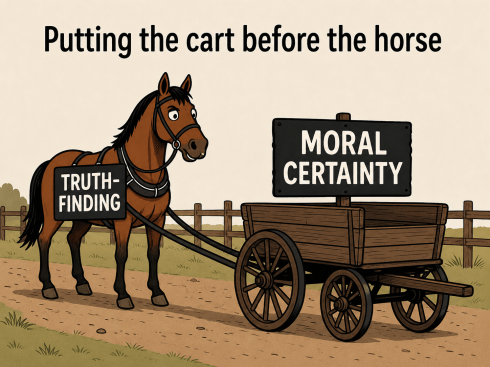
So they accept the conclusion first and hope the facts will catch up later.
They often do not.
Reality has a way of collecting unpaid debts. Bad premises eventually produce visible damage: failed policies, institutional distrust, medical scandals, economic denial, public cowardice, and citizens who no longer believe official language because they have watched it bend too many times.
The answer is not cynicism. Cynicism is often just laziness wearing a smarter jacket. The answer is better truth-finding: slower claims, clearer definitions, stronger evidence, real costs counted on both sides, and a willingness to notice when our preferred story stops matching the world.
That includes me. That includes you. That includes the people whose politics we find irritating, fashionable, smug, or deranged. Nobody gets a permanent exemption from reality because their intentions are good or their enemies are worse.
A decent society needs moral seriousness, but moral seriousness cannot mean protecting our favourite conclusions from examination. It has to mean caring enough about justice to ask whether our account of the world is actually true.
I do not especially care whether someone voted Liberal, Conservative, NDP, or something stranger from the pamphlet table. A democratic country still needs citizens who can look at reality without first asking whether the facts are useful to their team.
Canada is not in a healthy place. The economy has posted two straight quarters of contraction on an annualized basis, which is why the phrase “technical recession” has entered the conversation, even if analysts can argue over how much weight to give that label. Statistics Canada reported unemployment at 6.9% in April 2026, with youth unemployment at 14.3%. Food insecurity is harder to soften: PROOF reported that in 2024, 25.5% of people in the ten provinces lived in food-insecure households, about 10 million people, including 2.5 million children. These are not fringe complaints or partisan vibes. They are indicators of stress in the lives of ordinary people.
The point is not that every bad number belongs neatly to one party. Serious people should avoid that reflex. Some problems are inherited. Some are global. Some are structural. Some are provincial. Some are made worse by federal policy, and some are made worse by years of institutional delay, denial, or misplaced priorities. Canada’s productivity weakness, housing shortage, debt burden, immigration pressures, and affordability crisis did not arrive in one tidy partisan package. That is precisely why citizens need better habits of attention, not better excuses.
This is where media hygiene matters.

A lot of political coverage trains people to process public life through narrative before evidence. The right leader appears calm, credentialed, and respectable, so economic stress becomes “headwinds.” Stagnation becomes “uncertainty.” Failure becomes “transition.” Aggregate growth gets reported without enough attention to per-person decline. A press conference sounds adult and measured, while the household math keeps getting worse.
This problem is not confined to one side. Liberal-friendly media can soften failure when the right institutional language is being used. Conservative-friendly media can turn every bad number into proof that the apocalypse has already been scheduled. Social media rewards panic, resentment, and team loyalty. Legacy media rewards access, tone, and respectable framing. The result is a public conversation where facts often arrive already dressed for the argument someone wanted to make.
Voters participate in this too. Partisans learn to defend their side before checking the claim. Comfortable people mistake their own insulation for national health. Professionals who live inside institutional language can forget that ordinary Canadians live inside rent, groceries, wages, taxes, debt, and renewal notices, none of which become easier because the country’s managerial class found a more reassuring adjective.
A country needs some measure of optimism to function, so the answer is not theatrical despair. But optimism that cannot survive contact with the facts is closer to mood management than civic seriousness. Canadians should be able to say two things at once: yes, a leader may seem more competent than the alternative, and yes, the material indicators are still ugly. One does not cancel the other.
Political maturity begins when people stop treating bad news as betrayal. Reality does not care which party benefits from noticing it, which is precisely why noticing it remains one of the basic duties of citizenship.
Most social lies do not begin as lies. They begin as little acts of politeness.
You laugh at a joke that was not funny. You say “no problem” when there was, in fact, a problem. You sit through a meeting where everyone knows the plan makes no sense, but nobody wants to be the person who slows the room down. Ordinary life requires tact. Not every uncomfortable truth needs to be hurled across the table the moment it appears.
But there is a difference between tact and required unreality.
Tact says we should not be needlessly cruel. Required unreality says we must say the false thing, affirm the false thing, organize institutions around the false thing, and treat anyone who refuses as morally suspect.
That difference matters because societies rarely drift away from truth in one dramatic leap. They drift through small accommodations. A phrase changes here. A courtesy becomes expected there. A workplace norm hardens into policy. A school form gets rewritten. A professional guideline quietly changes the question everyone is allowed to ask.
Then, one day, ordinary people look around and realize they are being asked to deny things they can see with their own eyes.
The debate over sex and gender is one of the clearest examples.
The first move was linguistic. “Sex observed at birth” became “sex assigned at birth.” Many people shrugged. It sounded harmless, maybe even compassionate. Why fight over wording? But the change was not neutral. “Observed” describes the recognition of a biological fact. “Assigned” suggests an administrative decision, something imposed, possibly mistaken, perhaps unjust.
No parent waits for a committee to assign sex. They see the baby. They know. The doctor observes. The parents understand. The paperwork follows reality; it does not create it.
But once “assigned” becomes normal, the ground has shifted. The old reality has not disappeared, but the language around it has been loosened. A fact starts to sound like an opinion. An observation starts to sound like an imposition. What was once obvious becomes something polite people are encouraged not to say too firmly.
Pronouns came next for many ordinary people. “What is the harm?” they were told. “It is just politeness.”
And in private life, adults can choose whatever courtesies they want. People use nicknames. People avoid sore spots. People soften language to keep peace with neighbours, coworkers, students, friends, and family. That is normal human life.
The difficulty begins when courtesy becomes compulsory and everyone is expected to speak as though sex has disappeared from the room.
A teacher pauses before saying “she.” A coworker catches himself mid-sentence. A parent sits through a school meeting and says nothing because every adult in the room knows what is being asked, and nobody wants to be first to break the spell. So people go along. They use words they do not quite believe. They tell themselves it is only a small thing.
“Those arguments matter. But before any of them can be had honestly, people must be allowed to say what they know is true.”
Small things train larger habits. Once people become accustomed to saying what they do not believe, the person who says, “wait, this is not accurate,” becomes the problem. Not the falsehood. Not the policy built on it. The person who interrupts the shared performance.
That is how a real slippery slope works. It is not that one concession magically causes the next. It is that each concession changes the moral conditions under which the next demand is judged.
If sex is “assigned,” and pronouns are only kindness, and refusing preferred language is cruelty, then female-only spaces start to look morally suspicious. The sign on the changing room may stay the same, but the rule underneath it changes. The word “women” remains on the door. What it means has been quietly edited.
That edit does not stay abstract. It reaches the sports team someone’s daughter trains with. It reaches shelters, prisons, changing rooms, rape-crisis services, and lesbian boundaries. All can be reframed as sites of exclusion. The question quietly changes from “Do women and girls have sex-based rights?” to “Why are you being unkind to this vulnerable person?”
None of this denies that some people experience genuine distress about their bodies. They do. The question is whether compassion requires everyone else to rewrite reality around that distress.
By then, the argument has already moved. Women are no longer asking to preserve boundaries rooted in sex. They are being asked to justify why those boundaries should exist at all.
That is not an abstract problem. It changes institutions. It changes policies. It changes what children are taught. It changes what professionals are allowed to say. It changes whether parents, teachers, doctors, athletes, and ordinary citizens are permitted to name reality without being accused of hatred.
The kind lie does not remain kind once people are punished for refusing it.
We can debate the details of medicine, sports, schools, safeguarding, and law. Those arguments matter. But before any of them can be had honestly, people must be allowed to say what they know is true.
Reality has a way of waiting. Bodies still exist. Sex still matters in medicine, sport, privacy, reproduction, vulnerability, and patterns of violence. Institutions can change their language, but language does not abolish the facts underneath it. Step away from truth for long enough and eventually reality supplies the correction.
Reality always bats last.
The point is not that every hard truth should be spoken harshly. Decency matters. So does compassion. But compassion detached from truth becomes something else. It becomes a demand that some people absorb real costs so everyone else can feel morally clean.
That is the part ordinary people need to notice. Every time they play along with a claim they know is not true, they are not merely being polite. They may be helping build the next rule, the next policy, the next institutional punishment for the person who finally says no.
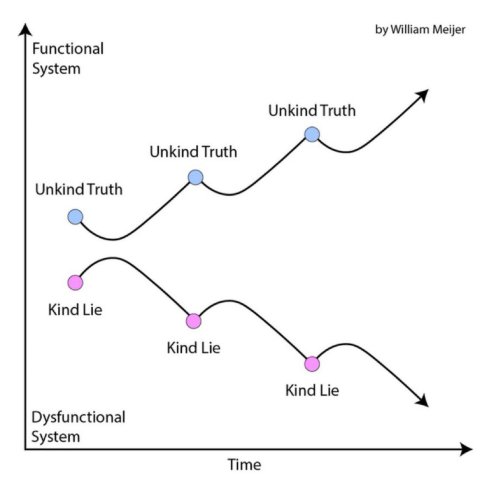
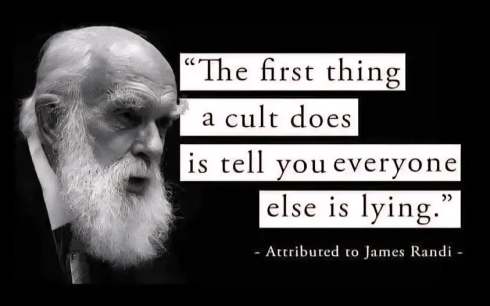
Check it with your favourite religion/ideology. The quote has a wide range of applicability.
A recent post from a Women’s Liberation Front activist should be read less as a complaint than as a warning about how institutions train dissenters to accept contempt as normal.
She describes years of opposing gender-identity legislation in California: travelling to Sacramento, meeting legislative offices, testifying at hearings, and trying to explain to ordinary people what the policies actually mean. Female locker rooms become mixed-sex spaces by administrative decree. Girls’ sports and girls’ boundaries become conditional. Distressed young women are placed on medical pathways that can permanently alter healthy bodies.
The remarkable part is not merely that lawmakers disagree with her. Disagreement is expected in politics. What stands out is the air of pre-judgment around the process. She writes that legislators’ offices treat these women with “barely contained disdain.” Public hearings fill with activists who regard any defence of female boundaries as proof of bigotry. The women objecting are not received as citizens raising serious concerns about privacy, safeguarding, fairness, or medical ethics. They are treated as a nuisance class: managed, endured, and socially disqualified before the argument begins.
A functioning democracy does not require lawmakers to agree with every citizen. It does require them to hear citizens as citizens. When women raise concerns about intimate spaces, parental knowledge, fair competition, or irreversible interventions on minors, the answer cannot simply be a sneer and a label. “Bigot” is not an argument. “Hate” is not a policy analysis. “Inclusion” does not magically settle every conflict between competing rights.
Institutional capture often works this way. It does not begin by winning every argument in public. It begins by deciding which arguments are permitted to count. After that, the ordinary political process becomes strangely theatrical. Hearings still happen. Citizens still line up to speak. Legislators still nod along with the solemn expressions of people performing democratic patience. But the conclusion has already been filed away. These women are not constituents with claims on representation. They are obstacles to be routed around.
“A functioning democracy does not require lawmakers to agree with every citizen. It does require them to hear citizens as citizens.”
California is an especially sharp example because its political culture is so one-sided on this issue. The institutions are not neutral referees; they have chosen a side, and women who object are expected to absorb that fact politely. Over time, this wears people down. The WoLF activist’s most revealing line is not the one about crazy legislation. It is the moment of recognition: going to Washington, D.C. reminded her how badly she had become accustomed to being treated in California.
That is what contempt does over time. It lowers your expectations. It trains you to think basic respect is a luxury. It teaches you that being ignored is normal, that being caricatured is normal, that being called hateful for stating sex-based concerns is the price of admission.
This is especially perverse when the dissenters are women defending women’s boundaries. Feminism once insisted that female privacy, bodily integrity, and protection from male entitlement mattered. Now women who make those arguments are often treated as embarrassing relics, reactionaries, or moral contaminants. The old feminist vocabulary survives, but the sex class it was built to defend has been quietly replaced by a more fashionable abstraction.
The inversion should be obvious by now. Women are told they must be compassionate while their own concerns are dismissed. Girls are told inclusion matters while fairness and privacy are negotiated away on their behalf. Parents are told to trust institutions that increasingly treat hesitation as a threat. Citizens are told democracy is sacred while lawmakers learn to ignore the public on issues where the public is far less progressive than the activist class.
“The hearings still happen. Citizens still line up to speak. But the conclusion has already been filed away.”
This is why the fight matters even when a particular bill is lost. Public opposition creates a record. It denies consensus. It tells other women they are not alone. It forces legislators to own what they are doing rather than hiding behind bureaucratic language and moral fog.
Eventually, legislators need to pay a political price for treating women this way. Not because disagreement is forbidden. Not because every feminist objection should automatically prevail. But because a political class that can dismiss women’s sex-based concerns with contempt has learned something dangerous about power: the right moral vocabulary can make ordinary citizens disappear.
Women cannot win a fight they are shamed out of entering. They cannot defend boundaries they are not allowed to name. They cannot rely on institutions that have already decided their objections are evidence of guilt.
The point is not that every battle will be won in Sacramento. Some will be lost. Maybe many. But silence is how capture becomes permanent. Visibility is how it starts to crack.

Institutional capture rarely arrives breathing fire. More often, it brings a binder, a microphone, and a schedule.
The text is the Song of Simeon from Luke 2:29–32:
Lord, now lettest thou thy servant depart in peace, according to thy word;
for mine eyes have seen thy salvation,
which thou hast prepared before the face of all people;
to be a light to lighten the Gentiles,
and to be the glory of thy people Israel.
Arvo Pärt’s Nunc dimittis did not grab me right away. At first, I found it almost too still — spare, slow, and hovering at the edge of boredom. But that seems to be part of how the piece works. It does not seize the listener by force. It waits. It asks for patience.
By the end, the music had done something I was not expecting. The quietness accumulated. The long lines, the luminous harmonies, and the text’s sense of release began to feel less like restraint and more like surrender. Simeon’s words — “Lord, now lettest thou thy servant depart in peace” — are not dramatic in the ordinary sense. They are the sound of someone who has seen enough, received enough, and can finally let go.
I caught shades of Bear McCreary’s Battlestar Galactica writing here, especially “Passacaglia”: music that seems static until the repetition starts to feel like fate gathering in the walls.
I began the piece slightly bored. I ended it in tears. That may be the best description of Pärt’s power here: the music seems almost empty until you realize it has been making room for something.
Why AI May See Patterns We Can’t, and Why That Still Won’t Make It God
Prime numbers look disarmingly simple until you spend more than five minutes with them.
A prime is a whole number that can be divided only by itself and one. That is all. Two is prime. Three is prime. Five, seven, eleven, and thirteen are prime. Twelve is not, because it can be divided by two, three, four, and six. Fifteen is not, because three and five get inside it. A prime number has no smaller whole-number factors hiding underneath it.
That plain definition has produced one of the deepest unsolved mysteries in mathematics.
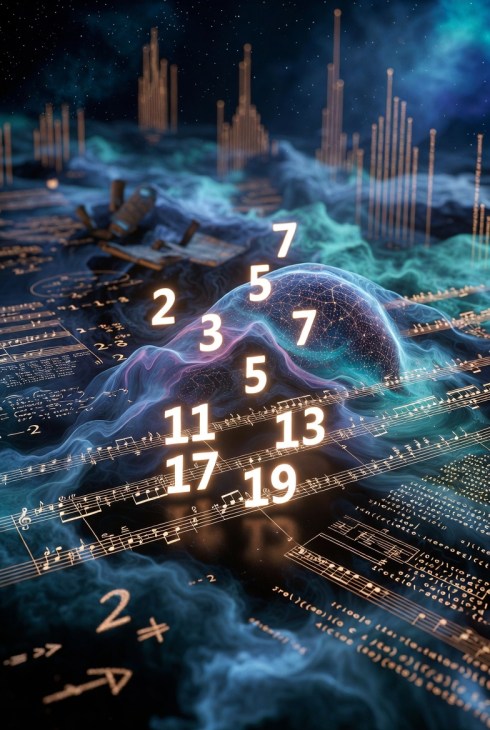
The primes appear one after another through the number line, but not in a clean repeating pattern. Sometimes they arrive close together, like 11 and 13, or 17 and 19. Sometimes they vanish for long stretches. They become less frequent as numbers get larger, but they never stop. They are orderly enough that mathematicians can predict their broad distribution, but irregular enough that no one has found a simple formula that tells us exactly where the next prime will appear.
That is the mystery this essay is interested in: prime numbers are not random, but they behave enough like randomness to make us wonder whether some deeper pattern exists beneath the pattern we can see.
And that raises a modern question. If human minds have spent centuries circling this mystery without fully cracking it, could artificial intelligence help us see the primes differently? Not because AI is magic. Not because machines are gods. But because a machine may be able to search mathematical spaces and test representations that human beings would never naturally think to use.
The primes are a perfect test case for this question because they sit at the intersection of mathematics, metaphysics, and machine intelligence. They force us to ask whether mathematical truths are invented or discovered, whether reality has an order independent of human minds, and whether a non-human tool might someday reveal a structure that we can verify, but could not have found unaided.
That possibility is thrilling. It is also dangerous. Pattern recognition is not proof. A machine can find beautiful garbage as easily as beautiful truth. So if AI ever helps break open one of the great prime-number mysteries, the result will still have to pass through the oldest gate in mathematics: proof.
Prime numbers have been humbling people for a very long time. Euclid proved more than two thousand years ago that there must be infinitely many of them. That proof is still beautiful because it is so simple. Suppose you had a complete list of all the primes. Multiply them together, add one, and the new number either is prime or has a prime factor not on your original list. Either way, the original list was incomplete.
There is something bracing about that. A short argument from the ancient world still fences in every number that has ever existed and every number that ever will. No laboratory required. No priesthood. No funding application. Just reason doing what reason does when it is allowed to breathe.
But knowing there are infinitely many primes does not tell us where they are. That is where the real trouble begins.
As numbers get larger, primes become rarer. Among the small numbers, they show up constantly. Farther out, they thin. Mathematicians eventually learned how to describe their average density. Very roughly, near a large number x, primes appear with a frequency related to the natural logarithm of x. That sounds dry, but the achievement is enormous. The primes are not just scattered grit across the number line. They obey a broad statistical law.
Broad law is not the same thing as exact knowledge.
Imagine looking at a coastline from high above. You can describe its general shape, its direction, even its expected roughness. But that does not mean you know every inlet, rock, and hidden cove. Prime numbers are like that. We understand much of the coastline from a distance. Up close, the detail still bites.
This is where the Riemann Hypothesis enters, and where many normal readers understandably begin looking for an exit. The words sound like something guarded by chalk dust and bad coffee. But the basic idea can be stated plainly enough.
In the nineteenth century, Bernhard Riemann found that the distribution of prime numbers is connected to a strange mathematical object called the zeta function. Instead of staring directly at the primes, he studied this function and its zeros — the places where the function equals zero. The astonishing thing is that these zeros appear to encode information about how the primes are distributed. The Clay Mathematics Institute describes the Riemann Hypothesis as the claim that all the “interesting” zeros of the zeta function lie on a certain vertical line, and it remains one of the Millennium Prize Problems.
That is not a decorative technicality. If true, the Riemann Hypothesis would tell us profound things about how closely the primes follow their expected distribution. It would not hand us a tidy little formula for the next prime, but it would tighten our understanding of the error, the wobble, the deviation between the average map and the jagged terrain.
This is why the zeta function matters. Riemann’s move was not to look harder at the obvious object. It was to look somewhere else entirely, at a mathematical shadow cast by the primes. The shadow turned out to reveal structure the direct view concealed.
That lesson matters for the age of AI because Riemann’s breakthrough was, in part, a change of representation. The primes did not become less mysterious because someone stared at the list with greater intensity. They became newly intelligible when placed inside a different mathematical frame. The right representation can turn a blur into a pattern, or at least show where the blur begins to obey pressure.
Human beings are very good at some kinds of pattern recognition. We notice faces in darkness, rhythm in sound, betrayal in a glance, weather in the air, and social danger in a badly timed pause. These are not trivial skills. They helped keep our ancestors alive. But we did not evolve to perceive billion-dimensional mathematical structure. We did not evolve to see the geometry of zeta zeros, the hidden relationships between distant mathematical objects, or the proof paths buried in enormous formal systems.
We are clever animals with chalk.
So the thought naturally arises: what if part of the problem is not that the primes are too deep, but that our ways of seeing are too narrow?
This is where artificial intelligence becomes interesting, provided we do not immediately ruin the topic by worshipping the machine. AI does not need to be conscious, divine, or even wise to be useful. Telescopes are not wise. Microscopes are not wise. They change the scale and kind of perception available to human beings. AI may do something similar for abstraction.
That is already beginning to happen in modest but serious ways. A 2021 Nature paper described the use of machine learning to discover potential patterns and relationships between mathematical objects, then use those observations to guide human intuition and propose conjectures. DeepMind’s AlphaProof later showed that AI-guided formal reasoning had become more than a parlour trick; in 2024, AlphaProof and AlphaGeometry achieved a silver-medal-level score on International Mathematical Olympiad problems, with the official DeepMind report noting 28 out of 42 possible points.
This does not mean AI is about to solve the Riemann Hypothesis over lunch. The point is subtler. Machines may become instruments that help mathematicians perceive relationships they would not have noticed unaided. They may search proof spaces too large for ordinary patience. They may generate strange conjectures, ugly lemmas, and unnatural comparisons. They may find new shadows.
For prime numbers, that possibility is hard not to find exciting. A human mathematician might begin with the familiar sequence: 2, 3, 5, 7, 11, 13. A machine could treat the same object as a cloud of relations: gaps, residues, spectral features, graph connections, compression patterns, high-dimensional embeddings, zeta zeros, modular structures, and p-adic behaviour layered together. Most of that may produce nothing. But once in a while, a strange representation can turn a locked door into a hinge.
This is where the romance of machine discovery needs cold water thrown at it.
Prime numbers are treacherous because they generate hints of pattern everywhere. Give a sufficiently powerful pattern-finder enough data and it will find beautiful garbage by the ton. It will discover relationships that hold for the first million cases and fail at the million-and-first. It will produce equations that look like prophecy until someone checks the boundary conditions. Used badly, it becomes a numerology engine with better cooling.
That is why proof remains the ancient gate. No matter how alien the insight, no matter how impressive the computation, no matter how persuasive the model, mathematics does not finally answer to vibes, elegance, prediction, or machine confidence. The machine may suggest. It may search. It may illuminate. Something still has to execute judgment.
The best future system would need two opposed temperaments built into it. One half should be the dreamer: reckless, generative, strange, willing to compare distant objects and invent new representations. The other half should be the executioner: formal, hostile, exacting, hunting counterexamples, checking every inference, and demanding translation into proof. Without the dreamer, the system only reproduces known methods faster. Without the executioner, it becomes a high-IQ crank.
This is also where the metaphysics gets interesting, though not in the cheap way.
If an AI someday helps prove the Riemann Hypothesis, it will not show that the machine is divine. It will not prove that numbers are little spirits, that reality is a simulation, or that silicon has achieved enlightenment under laboratory lighting. It would show something humbler and more unsettling: human reason can be extended by tools, and mathematical reality may contain structures we can verify once found, but could not have found unaided.
That would wound our vanity. Good.
A machine-discovered proof would not make truth mechanical. It would not reduce mathematics to computation. It would not eliminate human judgment, because human beings would still need to understand, verify, interpret, and integrate the result into the broader body of mathematics. But it would tell us that some doors in the house of reason may require instruments stranger than chalk, paper, and solitary genius.
Prime numbers have always stood at the boundary between order and mystery. They are simple enough to define, hard enough to humble civilizations, and deep enough to draw philosophy out of people who thought they were merely doing arithmetic. AI does not erase that mystery. It may sharpen it.
The machine may help us hear more of the music but does not get to declare itself the composer (yet?).
Sources
Clay Mathematics Institute — Riemann Hypothesis
https://www.claymath.org/millennium/riemann-hypothesis/
Nature — Advancing mathematics by guiding human intuition with AI
https://www.nature.com/articles/s41586-021-04086-x
DeepMind — AI solves IMO problems at silver-medal level
https://deepmind.google/discover/blog/ai-solves-imo-problems-at-silver-medal-level/











 bleatmop
 Mystro
 The Arbourist


 Dead Wild Roses
Your opinions…