
You are currently browsing the tag archive for the ‘Ideology’ tag.
Most political reform begins from a defect that can be named and a remedy that can be argued over. A law is unjust. A policy fails. An institution overreaches. The aim is improvement, not redemption. The point is to correct a problem within the permanent constraints of social life.
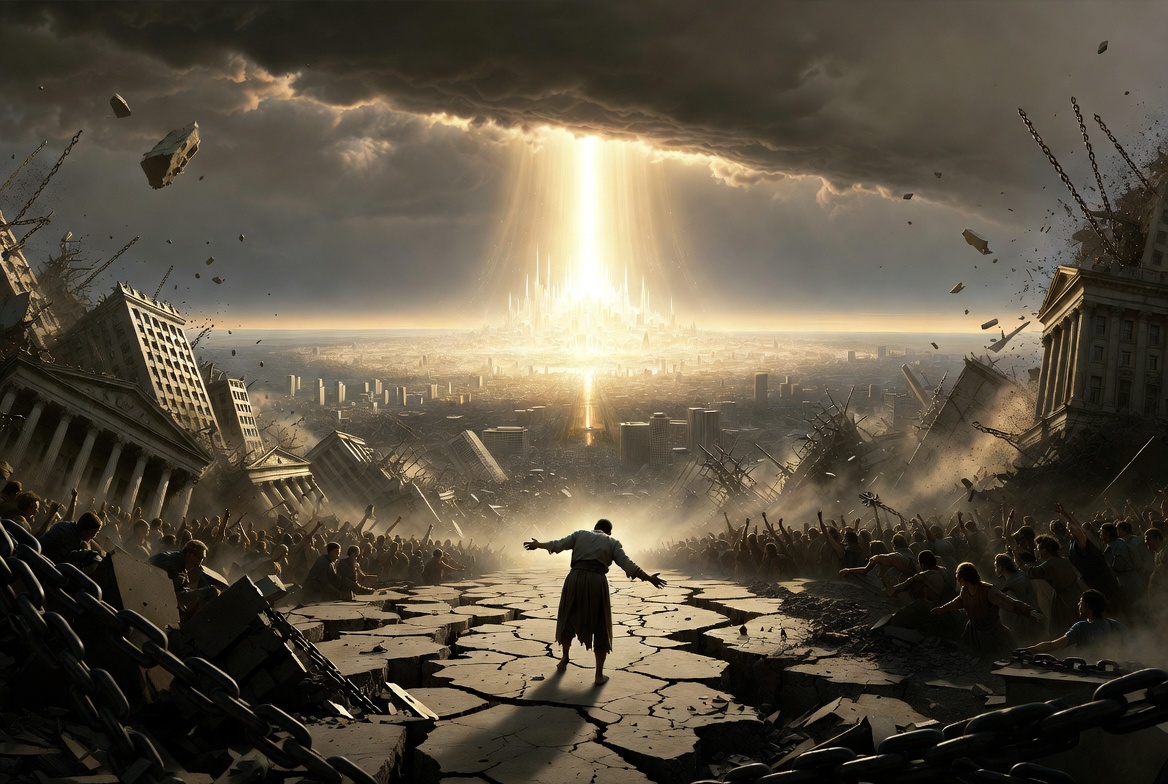
A different kind of politics begins elsewhere. It is driven less by a concrete vision of what a good society can actually sustain than by an intense certainty about what must be abolished: domination, exclusion, stigma, hierarchy, impurity. The ideal appears first not as a positive order with defined institutions, costs, limits, and tradeoffs, but as a purified horizon from which every visible moral stain has been removed.
That structure matters. A politics organized around what must disappear often possesses enormous critical energy but weak constructive discipline. It can identify contamination faster than it can describe settlement. It can mobilize outrage faster than it can specify completion. Because its standard is defined chiefly by negation, it struggles to say when the work is done. The result is a politics of permanent dissatisfaction: a style of moral and political life in which every remaining imperfection is read not as evidence of human limits, conflicting goods, or institutional friction, but as proof that the world is still guilty.
I will call this negative idealism. By that I mean a way of thinking in which the desired social order is known mainly by its absences rather than by its positive form. No oppression. No exclusion. No domination. No harm. No taint. Those aspirations can contain real moral insight. But as political endpoints they are unstable unless they are joined to harder questions. What institutions will carry this vision? What tradeoffs does it permit? What tensions are permanent? What counts as enough? When those questions go unanswered, negation begins to do more than criticize the present. It becomes a self-renewing engine of dissatisfaction.
The attraction is not mysterious. Negation is easier than construction. It is emotionally cleaner to denounce a stain than to design a settlement. Critique flatters the conscience. Construction burdens it. One allows people to inhabit moral clarity. The other forces them to reckon with scarcity, conflict, enforcement, and cost. It is easier to unite people around what they reject than around the terms on which they are prepared to live together.
“The structure is often recognizable: a purified horizon is announced, reality fails to comply, the gap is moralized, and the search for the guilty begins.”
That asymmetry gives this style of politics much of its force. It does not need to answer many hard questions in order to condemn domination, exclusion, or stigma. It can gather energy long before it can govern. It can speak in the language of moral emergency without yet saying what institutions would embody its ideal, what competing goods would have to be balanced, or what losses would remain even after reform. In that sense, it is potent precisely because it defers the moment when aspiration must submit to architecture.
Politics becomes serious at exactly that moment. It becomes serious when a moral vision is forced to move from diagnosis to design. What laws would reflect its principles? What institutional powers would be needed to enforce them? What rights would be protected when goods conflict? What exclusions would still remain, and on what grounds? What counts as enough? These are not secondary questions. They are the point at which aspiration is tested by the world it proposes to inhabit.
Here the negatively defined ideal often begins to wobble. The problem is not that it identifies nothing real. Many such projects do identify real injustices, real cruelties, and real failures of social order. The problem is that the ideal itself remains underdescribed. A society can reduce particular evils. It can mitigate harms. It can discipline abuses. But it cannot become a place with no stigma, no hierarchy, no domination, no friction, no exclusion, and no conflict unless words have ceased to mean what they usually mean. Human beings are finite. Goods compete. Institutions are blunt. Boundaries protect some things by restricting others. Social life is not clean.
Once that reality is faced, the burden of politics changes. The question is no longer how to abolish every trace of moral injury, but how to order a society under conditions where some tensions are permanent and some tradeoffs are unavoidable. That is the work negative idealism resists. It prefers purification to settlement. It treats compromise as contamination. It treats incompleteness not as a condition of human life, but as evidence that the moral task has been betrayed.
That is why dissatisfaction becomes self-renewing. An ideal that cannot be positively specified also cannot be clearly achieved. There is always another residue to expose, another hidden structure to name, another dissenter to classify as complicit, another demand that must now be treated as morally urgent because prior concessions have already established the principle. Partial victories do not calm the impulse. They often intensify it. Each gain becomes evidence that the horizon can be pressed farther still, and each remaining imperfection becomes proof that justice has been delayed by someone’s refusal, cowardice, or bad faith.
What this pattern often lacks is a serious category of tragedy. Not every persistent social imperfection survives because wicked people protect it. Some survive because resources are finite, institutions are crude, and goods that matter can come into conflict without any clean resolution. Freedom and equality can pull against each other. Inclusion and standards can pull against each other. Compassion and truth can pull against each other. Order has costs, but disorder has costs too. A politics that cannot admit such tensions will misread the world it is trying to govern.
The refusal to acknowledge limits distorts judgment. What should have been recognized as friction, tradeoff, or permanence is recoded as obstruction. What should have been understood as an unintended cost is treated as evidence of hidden malice. What should have been accepted as the unfinished character of social life is interpreted instead as proof that the work has been sabotaged. A movement that cannot say, “this good is real, but incomplete,” will be tempted to say, “this good has been denied because guilty people still stand in the way.”
This does not belong to one ideology alone. Variations of the pattern have appeared in revolutionary class politics, racial purification movements, and newer forms of moralized identity activism. The content differs. The vocabulary differs. The designated enemies differ. But the structure is often recognizable: a purified horizon is announced, reality fails to comply, the gap is moralized, and the search for the guilty begins.
That is the deeper political danger in negative idealism. It does not merely produce endless critique. It creates pressure to personalize failure. If the ideal is pure, and the ideal remains unrealized, then the fault must lie not in the ambition itself, nor in the constraints of reality, but in the people said to be resisting redemption. At that point dissatisfaction ceases to be diagnostic and becomes accusatory. The inability to perfect the world is no longer treated as a human condition. It is treated as evidence that enemies remain.
“A politics that knows the good chiefly as the removal of taint will have difficulty describing completion, accepting limits, or recognizing partial success.”
Ordinary politics depends on a harder and more chastened wisdom. It depends on the recognition that some injustices can be reduced without being abolished, that some conflicts must be managed rather than solved, and that settlement is often the proper goal where purification is impossible. A society that loses that wisdom becomes vulnerable to movements that know how to denounce every stain but do not know how to live with human limits. Such movements can speak with immense conviction. What they struggle to do is stop.
None of this means moral criticism is misplaced, or that reform should be timid, or that injustice is merely the name we give to unavoidable discomfort. It means something narrower and harder. A politics that knows the good chiefly as the removal of taint will have difficulty describing completion, accepting limits, or recognizing partial success. It will remain permanently dissatisfied because the horizon it serves is permanently receding. And once that condition sets in, the search for a better order can all too easily become a search for the guilty.
This is where the next question begins. If a movement cannot explain the gap between its ideal and reality through limits, tradeoffs, or tragedy, how will it explain that gap instead? Usually by finding someone to blame.
Glossary
Negative idealism: A way of thinking in which the desired social order is known mainly by what it seeks to abolish rather than by a clear positive account of what it can sustain.
Purified horizon: An imagined social condition from which moral stain has been removed, even though its institutions, limits, and tradeoffs remain vague.
Permanent dissatisfaction: The condition that arises when a movement cannot clearly define completion and so treats every remaining imperfection as proof that the work is unfinished.
Tragedy: The fact that some social tensions persist not because of sabotage or malice, but because goods conflict, resources are finite, and human beings are limited.
Settlement: A workable political order that manages conflict and tradeoffs without pretending to abolish them entirely.
Over the next week, I will be publishing a five-part essay series on a pattern that has become increasingly visible across contemporary politics.
The pattern is not confined to any one ideology. It appears in different forms, with different moral vocabularies, and at different levels of intensity. But the structure is often recognizable.
A movement begins with a grievance, often a real one. It defines the good chiefly by what must be abolished. The ideal remains vague, but the stain is vividly named. Reality resists. Limits persist. Tradeoffs do not disappear.
At that point, a choice presents itself. The movement can revise its ambitions in light of the world as it is, or it can moralize the gap between promise and outcome. When it chooses the second path, disappointment hardens into blame. Blame hardens into sorting. Sorting prepares the way for coercion.
That is the mechanism this series examines.
The aim is not to collapse different movements into one another, nor to deny that many of the grievances in question are real. The aim is to describe a recurring political logic that can emerge across very different doctrines once ideals are treated as immune to revision.
The essays proceed in sequence:
- Essay 1: The structure of negative idealism
- Essay 2: The turn to scapegoating
- Essay 3: Gender ideology and the breakdown of boundaries
- Essay 4: Family resemblances across radical movements
- Essay 5: Settlement against redemption
Each essay builds on the last. They are meant to be read together.
The argument is not that politics should abandon ideals. It is that ideals must be able to survive contact with limits, tradeoffs, and an unfinished world. When they cannot, the pressure to explain failure shifts outward, and the search for the guilty begins.
This series is an attempt at diagnosis. It is also, in its final movement, an argument for a different posture: one that prefers settlement to redemption, and construction to purification.

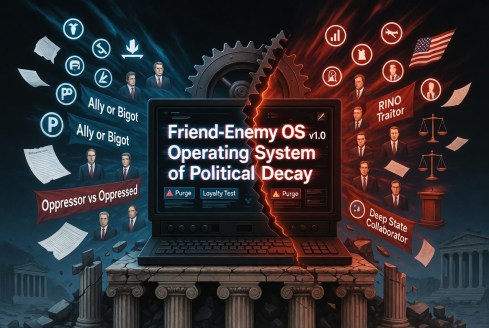
One of the most destructive temptations in politics is the urge to turn disagreement into moralized tribal war. Not argument. Not persuasion. Not the hard, frustrating work of governing a society full of competing interests and imperfect people. War. Friends and enemies. Allies and traitors. The pure and the contaminated. Once that frame takes hold, politics stops being about order, restraint, and judgment. It becomes a loyalty machine. Carl Schmitt gave this instinct its most famous formulation in The Concept of the Political, where he argued that the essence of politics lies in the distinction between public friend and public enemy. He was right to see that real political life can descend to existential conflict. He was wrong to treat that descent as the essence of politics rather than one of the permanent dangers civilized politics is supposed to contain. The friend-enemy distinction is not the foundation of healthy politics. It is the logic of political decay.
The danger is not only that the framework is harsh. Politics can be harsh. The danger is that it installs enmity at the center of public life and pushes everything else to the margins. Institutions, laws, debate, compromise, constitutional limits, due process, even ordinary factual disagreement all become secondary. What matters is identifying the enemy, consolidating the team, and punishing hesitation. That is why this logic travels so easily across ideologies. It can appear in revolutionary Marxism, in Maoist “enemies of the people,” in Islamist loyalty-and-disavowal frameworks, in activist binaries like ally versus bigot or oppressor versus oppressed, and in right-wing scripts about traitors, regime collaborators, and weak conservatives who supposedly enable the left. The vocabulary changes. The mechanism does not. A public enemy is named, and then a moral test is imposed: how fully will you align against him?
“The ratchet always turns one way: toward greater fanaticism, greater purification, greater moral ugliness. Truth is subordinated to solidarity. Principle is subordinated to faction.”
What makes this logic totalitarian is that it abolishes the space for dissent. Once the enemy has been declared, neutrality is no longer allowed. You either join the mobilization or you are suspected of serving the enemy’s cause. Hesitation becomes complicity. Refusal becomes betrayal. Moderation becomes guilt. That is how political movements become purge machines. You can either be anti-racist or you are helping racism. You can either be a trans ally or you are enabling bigotry. You can either fight the deep state, resist the regime, and oppose the left without reservation, or you are a RINO, a coward, a collaborator. This is the structure that matters. Not the tribe wearing it. Once politics is moralized into friend and enemy, the pressure falls hardest not only on official opponents, but on the insufficiently zealous within one’s own camp.
That is why factions organized around “no enemies to the left” or “no enemies to the right” almost always radicalize inward. The outer edge of the movement becomes untouchable because criticizing it risks helping the enemy. So the only safe targets are moderates, doubters, and fellow travelers who fail the loyalty test. The left protects its most extreme activists and attacks liberals who cannot keep up. The right protects its own hardliners and attacks conservatives who still think prudence, constitutional restraint, or factual discipline matter. In both cases, the center is hollowed out first. The ratchet always turns one way: toward greater fanaticism, greater purification, greater moral ugliness. Truth is subordinated to solidarity. Principle is subordinated to faction. Politics ceases to be the art of living together under conditions of disagreement and becomes a permanent sorting mechanism for friends, enemies, and suspects.
A civilized society cannot survive on those terms. That does not mean pretending enemies never exist. They do. Free societies are not obliged to indulge movements openly hostile to liberty, law, and peaceful coexistence. But the achievement of constitutional civilization is precisely that it refuses to make enmity the organizing principle of normal public life. It channels conflict through law, opposition, procedure, restraint, and rights. It leaves room for disagreement without turning every disagreement into proof of treason. That is the line Schmitt blurred and totalitarian movements erase completely. The mistake is not in noticing that politics can become existential. The mistake is in treating that possibility as the deepest truth of politics and then building public life around it. Once you do that, purges are no longer an accident. They are the destination. Friend-enemy politics is not realism. It is the operating system of political decay.
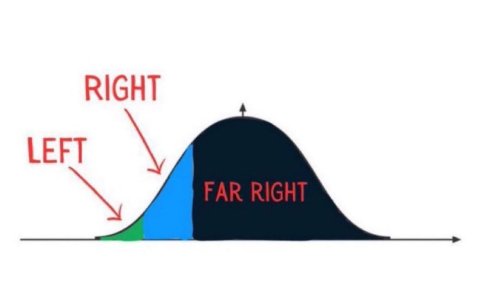
One of the most corrosive habits in current political discourse is the way plain factual claims get assigned a partisan label. Not arguments. Not policies. Facts. Or, more precisely, statements that point back to material reality, institutional limits, or ordinary human constraints. In theory, facts are supposed to discipline ideology. In practice, they are often treated as ideological aggression when they obstruct a preferred moral script.
That is what people are reaching for when they say facts are now treated as right-wing. The phrase is blunt, but it points to something real. In a growing number of disputes, especially around sex, gender, speech, and institutional policy, a person can say something materially true and be treated not as a participant in debate but as a moral suspect. The point is not answered on its merits. It is recoded as a signal of contamination. The speaker is no longer heard as describing reality. He is heard as choosing a tribe.
That shift matters because it changes the structure of argument. Once a factual claim is socially coded as “right-wing,” the burden quietly moves. The question is no longer whether the claim is true. The question becomes why you said it, what kind of person says such things, and who might feel endangered by hearing it. Motive replaces mechanism. Stigma replaces rebuttal. The claim is not refuted so much as quarantined.
You can see this clearly in disputes over sex and pronouns. For many people, saying that sex is real, binary in the ordinary human sense, and not altered by self-declaration is not an act of hostility. It is a claim about reality and a claim about language. “He” and “she” historically track male and female persons. Refusing to detach those words from sex is not, on its face, a partisan performance. It is an attempt to keep public language tethered to the material world rather than to inward identity claims.
“The disagreement is not mainly about politeness. It is about which reality gets public authority.”
That is exactly why the issue generates so much heat. The disagreement is not mainly about politeness. It is about which reality gets public authority. Does language track bodies, or does it track self-declared identity? Does a school treat sex as a stable feature of the world, or does it treat identity assertion as the governing fact? Those are not small etiquette disputes inflated by the internet. They are conflicts about ontology, law, and institutional power.
Canada now offers several live examples. Alberta’s Education Amendment Act requires parental notification when a student requests a gender identity-related preferred name or pronouns, and parental consent for students under 16 before staff may use them. The province says these changes are part of supporting families and setting clear school rules, with the remaining education amendments anticipated to take effect on September 1, 2025. Then, in late 2025, Alberta escalated further. Bill 9 invoked the notwithstanding clause to shield not only this school policy but other contested sex-and-gender measures from being struck down by the courts. That bundling matters. It shows this is no longer being treated as a narrow administrative disagreement, but as a foundational conflict over parental authority, child development, and the public meaning of sex.
Quebec presents the same fracture from the opposite direction, and it is ongoing now. Current reporting says a Montreal teacher is challenging the provincial policy that allows students 14 and older to change the name and pronouns used at school without parental consent. The teacher alleges she was required to use male pronouns at school while using female pronouns with the student’s parents. A preliminary hearing on anonymity and confidentiality was held on March 6, 2026, with the broader merits challenge still to come. Strip away the activist packaging and the conflict becomes plain: can institutional professionals be required to maintain two vocabularies of reality depending on the audience, and if they object, are they making an ethical argument or committing a moral offense?
The Barry Neufeld case in British Columbia shows the institutional end point of this logic. On February 18, 2026, the B.C. Human Rights Tribunal issued its decision and ordered substantial damages after finding that multiple publications were discriminatory, while some crossed the threshold into hate speech. That does not prove that every factual objection to gender ideology is punishable. It does show how readily dissent can be processed through systems that move from moral condemnation to formal classification. Once that line is crossed, everyone watching understands the lesson. The risk is no longer simply that you will be called wrong. The risk is that you will be treated as a public contaminant.
This is why the familiar “both sides are just choosing different facts” formula goes soft in exactly the wrong place. The conflict is not symmetrical. One side is generally making claims about bodies, language, legal authority, and institutional procedure. The other is often demanding that those things yield to identity-based recognition norms. Dignity is real and relevant. But dignity does not erase biological category, dissolve observable sex, or transmute factual disagreement into literal violence.
So when people say facts are treated as right-wing, the point is not that truth literally belongs to one side of the spectrum. The point is that in a culture saturated with moral performance, inconvenient facts are often recoded as partisan because it is easier to stigmatize them than to answer them. A factual claim that disrupts the script is no longer processed as description. It is processed as dissent. And dissent, under current conditions, is increasingly treated as a character defect.
Facts do not have a party. But when facts obstruct an ideological narrative, that narrative will often brand them right-wing and move straight to motive-policing. That is not a sign that the facts have changed. It is a sign that too much of public discourse has become allergic to reality when reality refuses to flatter the creed.
References
Government of Alberta. “Supporting Alberta students and families.”
https://www.alberta.ca/supporting-alberta-students-and-families
Government of Alberta. “Protecting youth, supporting parents, and safeguarding female sport.”
https://www.alberta.ca/protecting-youth-supporting-parents-and-safeguarding-female-sport
Global News. “Montreal teacher challenges policy for trans students to hide identity from parents.” March 6, 2026.
https://globalnews.ca/news/11719392/montreal-teacher-trans-students-challenge/
British Columbia Human Rights Tribunal. Chilliwack Teachers’ Association v. Neufeld (No. 10), 2026 BCHRT 49. February 18, 2026.
https://www.bctf.ca/docs/default-source/for-news-and-stories/49_chilliwack_teachers-_association_v_neufeld_no_10_2026_bchrt_49.pdf?sfvrsn=2d847803_1
Collin May has published a long, ambitious essay in the C2C journal (Hearts of Darkness: How the Left Uses Hate to Fuel its 21st Century Universal Imperium) on cancel culture, “hate” rhetoric, and the modern left’s moral posture. It is broader than I would write, more philosophical than most readers will tolerate, and occasionally overbuilt. But it names a pattern that matters, and one I return to often here: once “hate” becomes a universal accusation, institutions stop persuading and start policing.
May’s most useful contribution is not just the complaint (“cancel culture exists”) but the mechanism: “hate” stops being a moral description and becomes a category that pre-sorts who may be argued with and who may simply be managed.
That is the issue.
Not whether hatred exists. It does. Not whether some speech is vicious. It is. The issue is what happens when “hate” becomes the default label for disagreement, skepticism, refusal, dissent, or plain moral and factual judgments that cut against elite narratives.
At that point, the term stops describing and starts doing administrative work.
You can watch this happen across the institutions that shape public life: media, HR departments, professional bodies, universities, bureaucracies, and the expanding quasi-legal space around speech regulation. The sequence is familiar. Someone raises a concern about policy, ideology, language rules, school programming, medical ethics, public safety, immigration, religion, or sex-based rights. Instead of answering the argument, the institution reframes the speaker. Not wrong—harmful. Not questioning—spreading hate. Not participating in democratic friction—a threat to social order.
That move changes the rules of engagement. A wrong claim can be debated. A “hateful” claim can be quarantined. Once a claim is reclassified as harm rather than argument, the institutional response changes with it: less rebuttal, more restriction.
This language matters because it is not only moral language. It is managerial language. It justifies deplatforming, censorship, professional discipline, reputational destruction, and exclusion from ordinary civic legitimacy. It creates a class of people whose arguments no longer need to be answered on the merits. It also trains bystanders to confuse moral panic with moral seriousness.
May explains this through a large historical and philosophical genealogy. Fair enough. I am less interested in the full genealogy than in the practical result in front of us. In plain terms: the rhetoric of “hate” is often used to centralize authority in institutions that no longer trust the public and no longer feel obliged to reason with them.
That is one reason trust keeps collapsing.
People can live with disagreement. They can even live with policies they dislike. What they do not tolerate for long is being handled—being told their questions are illegitimate before they are heard. Once citizens conclude that institutions are using moral language as a shield against scrutiny, every future statement gets discounted. Even true statements are heard as spin.
And then the damage compounds. If “hate” is defined so broadly that it includes dissent, genuinely hateful speech becomes harder to identify and confront. The category gets inflated, politicized, and cheapened. Meanwhile, ordinary democratic disagreement becomes harder to conduct without professional or social risk.
That is not a confident free society. It is a managerial one.
Canada is not exempt. We have our own versions of this habit: speech debates reframed as safety debates, policy criticism recoded as identity harm, and public disputes (including over schools, sex-based rights, and even routine civic rituals like land acknowledgements) routed through tribunals, regulators, HR offices, and media scripts instead of open argument. The details vary by case. The mechanism does not. This tactic is not unique to one political tribe, but it is now especially entrenched in progressive-managerial institutions, which is precisely why it has so much reach.
The answer is not to deny hatred exists, or to become casual about cruelty. The answer is to recover civic discipline.
Name actual incitement when it occurs. Enforce existing laws where there are real threats, harassment, or violence. But stop using “hate” as a catch-all for disfavoured views. Stop treating condemnation as a substitute for evidence. Stop teaching institutions that the way to win an argument is to disqualify the speaker.
May quotes Pope Francis on cancel culture as something that “leaves no room.” Whether or not one follows his full historical argument, that phrase captures the operational problem.
A liberal society cannot function if citizens are only permitted to disagree inside moral boundaries drawn in advance by bureaucrats, activists, and legacy media.
The test is simple: can a claim be examined without first being moralized into silence?
If the answer is no, that is not moral confidence. It is institutional insecurity backed by power.
That is the pattern worth naming. And that is why essays like May’s, even when they overshoot, remain worth reading.

References
Collin May, “Hearts of Darkness: How the Left Uses Hate to Fuel its 21st Century Universal Imperium,” C2C Journal (February 16, 2026), https://c2cjournal.ca/2026/02/hearts-of-darkness-how-the-left-uses-hate-to-fuel-its-21st-century-universal-imperium/. (C2C Journal)
This post is inspired by the writing of James Lindsay on X.
The Mechanics of Woke Sociognosticism: A Persuasive Analysis
Contemporary “woke” ideology—focused on systemic injustice, identity-based power dynamics, and cultural transformation—has morphed into a quasi-religious framework that claims exclusive access to sociological truth. Its adherents, wielding an implacable certainty, cast dissent as ignorance or complicity, undermining the pluralism essential to liberal societies. This essay argues that woke ideology operates as sociognosticism: a fusion of critical social theory with gnostic epistemology, where salvation lies in “awakening” to hidden structures of oppression. While its moral aim to address inequities is undeniable, its totalizing worldview risks authoritarianism, stifling dialogue and fracturing society.
I. Defining Sociognosticism
Sociognosticism marries sociological critique with a gnostic belief in hidden, redemptive knowledge. Historically, gnosticism posits that gnosis—secret knowledge—unlocks salvation by revealing a dualistic reality of light versus darkness (Voegelin, 1952). Political theorist Eric Voegelin applied this to ideologies like Marxism, which claim to expose a veiled truth behind social structures. In woke sociognosticism, society is a prison crafted by hegemonic groups (e.g., white, male, capitalist), who maintain power through a “false consciousness” internalized by the masses (Gramsci, 1971). Activists position themselves as enlightened guides, dismantling this illusion. Yet, their framework is often presented not as one perspective but as the sole legitimate lens, dismissing alternative views as inherently flawed.
II. The Elect and the Awakened: Epistemic Elitism
Woke ideology fosters an “elect” class—those “awakened” to systemic oppression—who view their insight as both morally and intellectually unassailable (Lindsay, 2025). This mirrors Herbert Marcuse’s argument in Repressive Tolerance, where dissenting views are deemed intolerable if they perpetuate systemic harm (Marcuse, 1965). Disagreement is recast as evidence of false consciousness, as seen in online campaigns on platforms like X, where critics of woke orthodoxy face accusations of racism or transphobia (e.g., high-profile cancellations of public figures for questioning prevailing narratives, X, 2024–2025). Such epistemic elitism conditions dialogue on ideological conformity, punishing dissent with social ostracism or demands for public “self-education,” effectively silencing pluralistic debate.
III. Struggle, Awakening, and the Maoist Echo
Woke sociognosticism employs rituals of struggle and awakening, echoing Maoist techniques of “self-criticism” and “struggle sessions” (Mao, 1967). Originating during the Chinese Cultural Revolution, these were public rituals of ideological repentance in which individuals were forced to confess alleged wrongthink to reinforce social conformity. Contemporary analogues include institutional diversity training programs that require participants to acknowledge privilege or complicity in systemic bias. For example, several corporate and university DEI (Diversity, Equity, and Inclusion) initiatives between 2023 and 2025 have included exercises in which employees or students must complete “privilege checklists” or write statements of commitment to anti-racism. Refusal to comply is often interpreted as regression or resistance to enlightenment.
The concept of “allyship” reinforces this structure, demanding continuous affirmation of anti-oppression principles, with failure interpreted as betrayal. This creates a narrative of inevitability: crises—social, economic, or personal—are seen as catalysts for “waking up” to the truth. While rooted in a desire to address inequities, these tactics prioritize conformity over dialectic, substituting performative repentance for genuine inquiry.
IV. A Closed Epistemology
The woke worldview is self-sealing, absorbing contradictions into its narrative. Karl Popper’s critique of unfalsifiable theories applies here: counter-evidence is reinterpreted as proof of the system’s pervasive influence (Popper, 1963). For instance, when a woman denies experiencing gender-based oppression, she may be accused of internalized misogyny; when a Black individual critiques critical race theory, they are often labeled as “anti-Black” or as supporting white supremacy. Notably, prominent Black academics who voice heterodox views—such as critiques of DEI bureaucracy—have been targeted with denunciations on platforms like X (2025), reinforcing the idea that dissent is heresy. This totalizing simplicity reduces complex realities to a binary of oppressors versus oppressed, rendering the ideology immune to challenge and hostile to nuance, even when confronting legitimate inequities.
V. The Political Danger
While woke ideology seeks justice—a noble aim—its sociognostic structure threatens pluralism. Hannah Arendt warned that ideologies reducing reality to a single explanatory framework erode judgment and shared political life (Arendt, 1951). Woke influence in institutions like academia and media, where speech codes and DEI policies increasingly frame dissent as harm, raises concerns about encroaching authoritarianism. For example, university speech guidelines updated in 2024 at several U.S. campuses have redefined “harmful speech” to include disagreement with concepts such as gender self-identification or systemic racism, chilling open discourse.
If silence, speech, or disagreement can be deemed oppressive, liberal norms—due process, open debate, individual conscience—are subordinated to a dogmatic moral code. Acknowledging the validity of addressing systemic inequities does not negate the danger: a worldview that pathologizes dissent risks fracturing the very society it aims to redeem.
Conclusion
Woke sociognosticism, while driven by a moral impulse to rectify injustice, operates as a closed belief system that stifles dissent and undermines pluralism. Its adherents’ certainty—rooted in a gnostic claim to hidden truth—casts disagreement as ignorance or sin, fostering division over dialogue. For a liberal society reliant on free inquiry and epistemic humility, this poses a profound challenge. Justice is essential, but it must not sacrifice the principles—open debate, mutual respect—that make justice possible.

References
Arendt, H. (1951). The Origins of Totalitarianism. New York: Harcourt, Brace.
Gramsci, A. (1971). Selections from the Prison Notebooks. New York: International Publishers.
Lindsay, J. (2025). X Post, July 5, 2025. Retrieved from https://x.com/ConceptualJames/status/1941564050707501548
Mao, Z. (1967). Quotations from Chairman Mao Tse-Tung. Peking: Foreign Languages Press.
Marcuse, H. (1965). Repressive Tolerance. In R. P. Wolff, B. Moore Jr., & H. Marcuse, A Critique of Pure Tolerance (pp. 81–123). Boston: Beacon Press.
Popper, K. (1963). Conjectures and Refutations: The Growth of Scientific Knowledge. London: Routledge.
Voegelin, E. (1952). The New Science of Politics: An Introduction. Chicago: University of Chicago Press











 bleatmop
 Mystro


 Dead Wild Roses
Your opinions…